IGCSE Maths Question of the Day and weekly starter questions
Our own IGCSE Maths practice questions as images you can open, save or share: the daily puzzles from the Question of the Day and the weekly lesson starters, by course and week. Each image names the course and topic, and the question text is written out below it.
Question of the Day
The Question of the Day is a three-part multiple-choice puzzle, a new one each day, with hints if you get stuck. These are all the puzzles in the rotation, as images.
Edexcel IGCSE Maths 4MA1
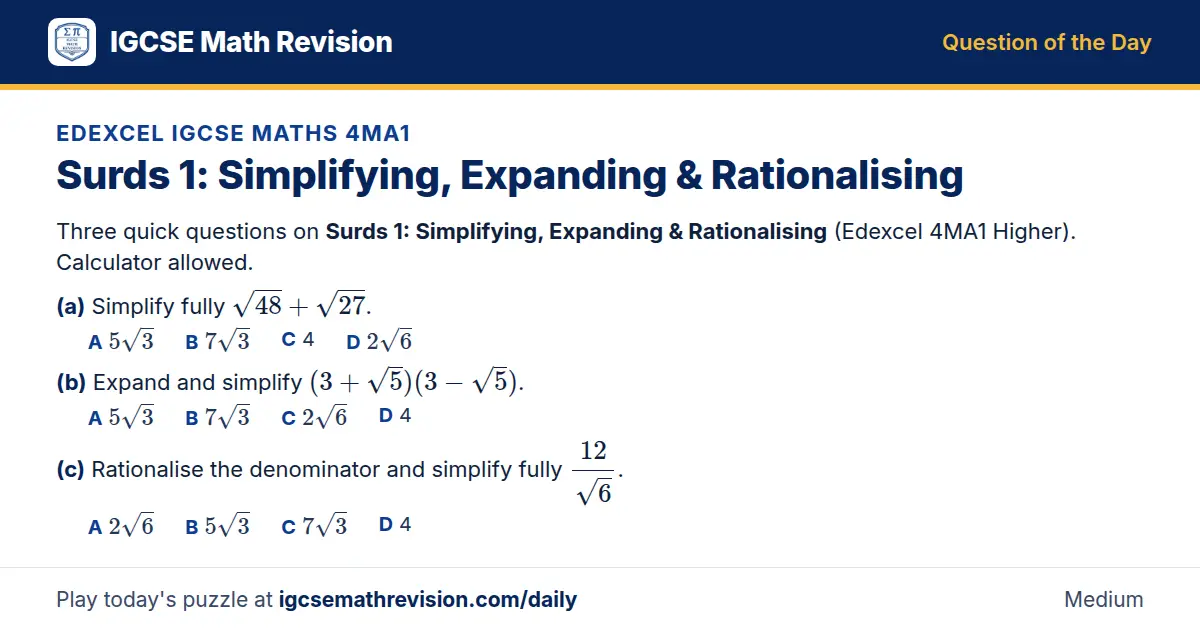
Surds 1: Simplifying, Expanding & Rationalising
Three quick questions on Surds 1: Simplifying, Expanding Rationalising (Edexcel 4MA1 Higher). Calculator allowed.
- Simplify fully √48 + √27. Options: A) 5√3; B) 7√3; C) 4; D) 2√6
- Expand and simplify (3+√5)(3-√5). Options: A) 5√3; B) 7√3; C) 2√6; D) 4
- Rationalise the denominator and simplify fully 12/(√6). Options: A) 2√6; B) 5√3; C) 7√3; D) 4
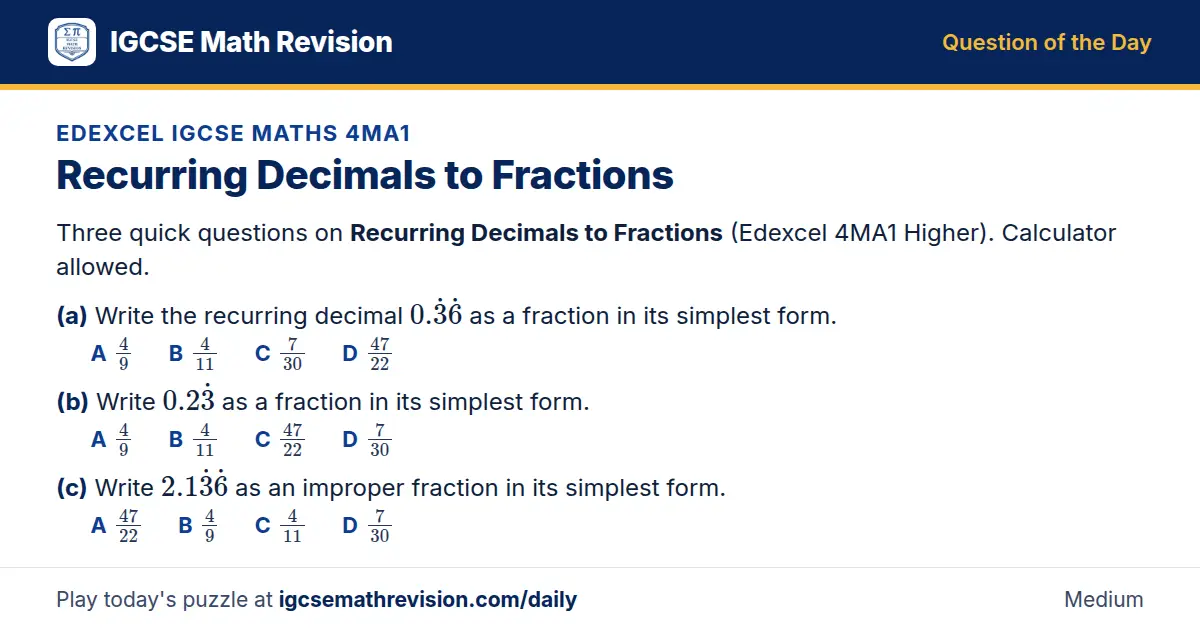
Recurring Decimals to Fractions
Three quick questions on Recurring Decimals to Fractions (Edexcel 4MA1 Higher). Calculator allowed.
- Write the recurring decimal 0.36 as a fraction in its simplest form. Options: A) 4/9; B) 4/11; C) 7/30; D) 47/22
- Write 0.23 as a fraction in its simplest form. Options: A) 4/9; B) 4/11; C) 47/22; D) 7/30
- Write 2.136 as an improper fraction in its simplest form. Options: A) 47/22; B) 4/9; C) 4/11; D) 7/30
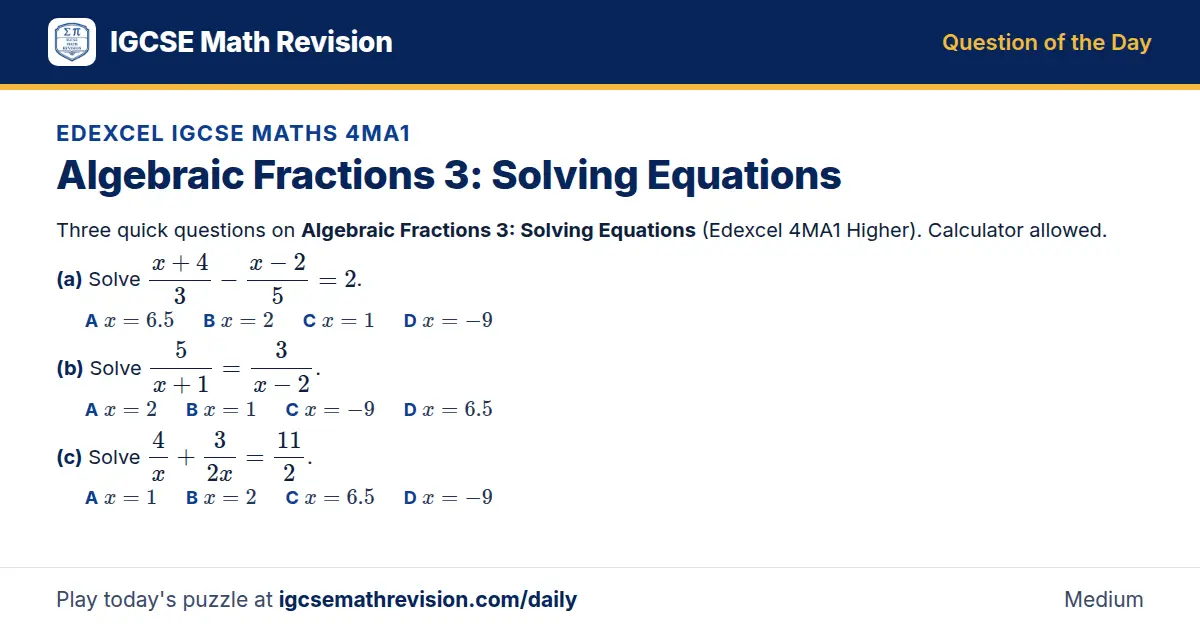
Algebraic Fractions 3: Solving Equations
Three quick questions on Algebraic Fractions 3: Solving Equations (Edexcel 4MA1 Higher). Calculator allowed.
- Solve (x+4)/3 - (x-2)/5 = 2. Options: A) x=6.5; B) x=2; C) x=1; D) x=-9
- Solve 5/(x+1) = 3/(x-2). Options: A) x=2; B) x=1; C) x=-9; D) x=6.5
- Solve 4/x + 3/2x = 11/2. Options: A) x=1; B) x=2; C) x=6.5; D) x=-9
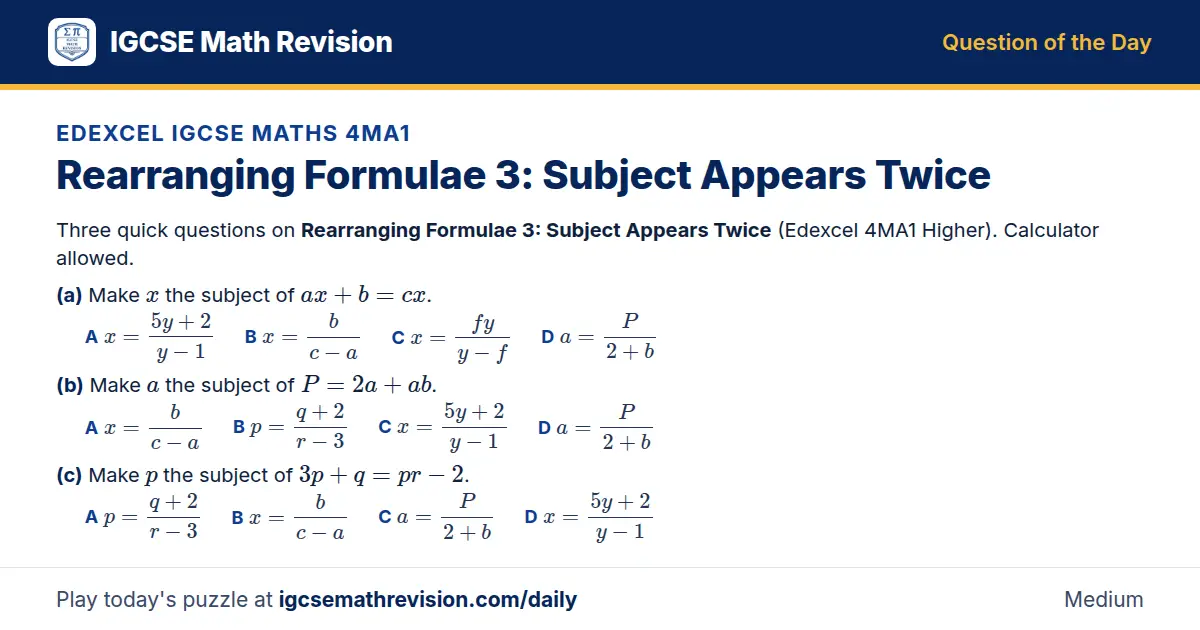
Rearranging Formulae 3: Subject Appears Twice
Three quick questions on Rearranging Formulae 3: Subject Appears Twice (Edexcel 4MA1 Higher). Calculator allowed.
- Make x the subject of ax + b = cx. Options: A) x=(5y+2)/(y-1); B) x=b/(c-a); C) x=fy/(y-f); D) a=P/(2+b)
- Make a the subject of P = 2a + ab. Options: A) x=b/(c-a); B) p=(q+2)/(r-3); C) x=(5y+2)/(y-1); D) a=P/(2+b)
- Make p the subject of 3p + q = pr - 2. Options: A) p=(q+2)/(r-3); B) x=b/(c-a); C) a=P/(2+b); D) x=(5y+2)/(y-1)
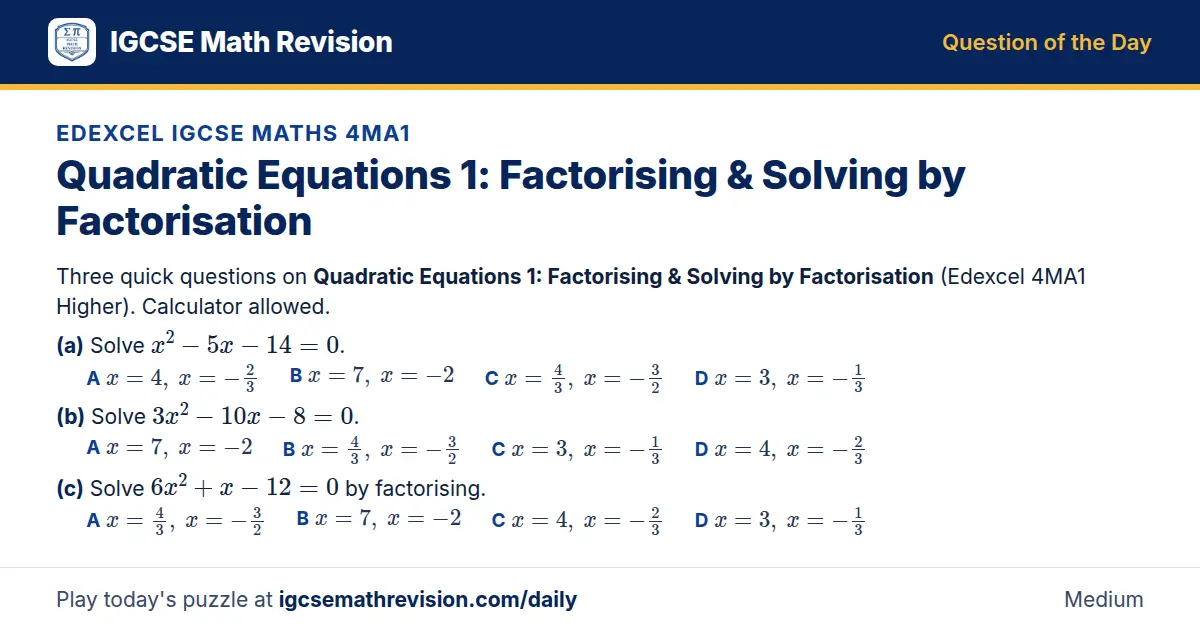
Quadratic Equations 1: Factorising & Solving by Factorisation
Three quick questions on Quadratic Equations 1: Factorising Solving by Factorisation (Edexcel 4MA1 Higher). Calculator allowed.
- Solve x² - 5x - 14 = 0. Options: A) x=4, x=-23; B) x=7, x=-2; C) x=43, x=-32; D) x=3, x=-13
- Solve 3x² - 10x - 8 = 0. Options: A) x=7, x=-2; B) x=43, x=-32; C) x=3, x=-13; D) x=4, x=-23
- Solve 6x² + x - 12 = 0 by factorising. Options: A) x=43, x=-32; B) x=7, x=-2; C) x=4, x=-23; D) x=3, x=-13
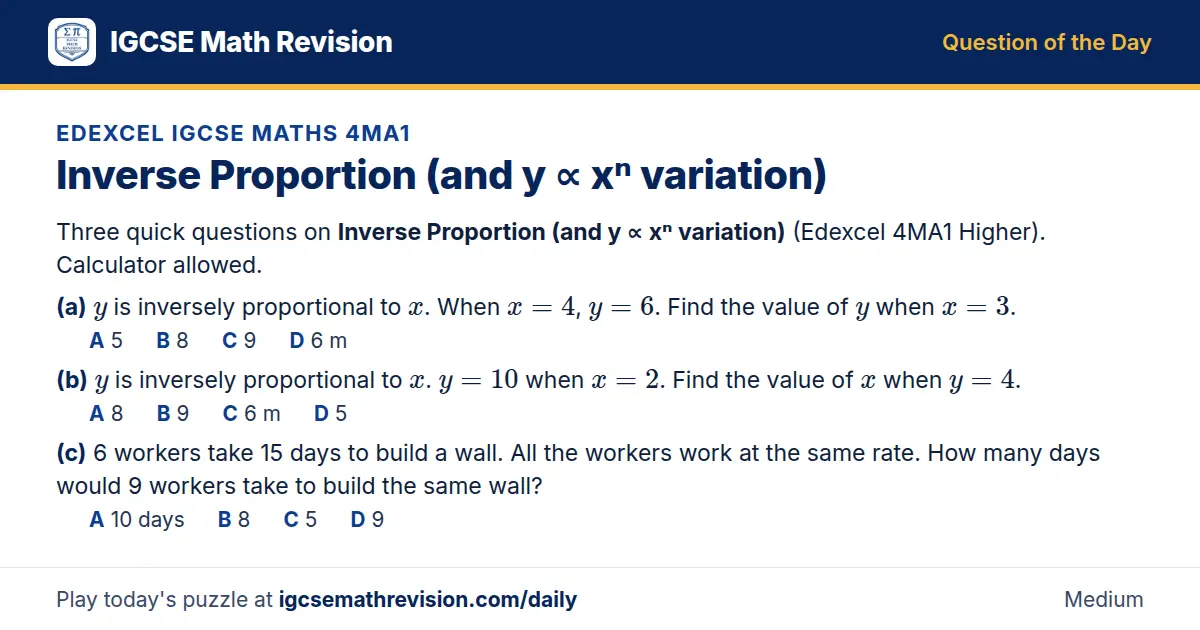
Inverse Proportion (and y ∝ xⁿ variation)
Three quick questions on Inverse Proportion (and y ∝ xⁿ variation) (Edexcel 4MA1 Higher). Calculator allowed.
- y is inversely proportional to x. When x = 4, y = 6. Find the value of y when x = 3. Options: A) 5; B) 8; C) 9; D) 6 m
- y is inversely proportional to x. y = 10 when x = 2. Find the value of x when y = 4. Options: A) 8; B) 9; C) 6 m; D) 5
- 6 workers take 15 days to build a wall. All the workers work at the same rate. How many days would 9 workers take to build the same wall? Options: A) 10 days; B) 8; C) 5; D) 9
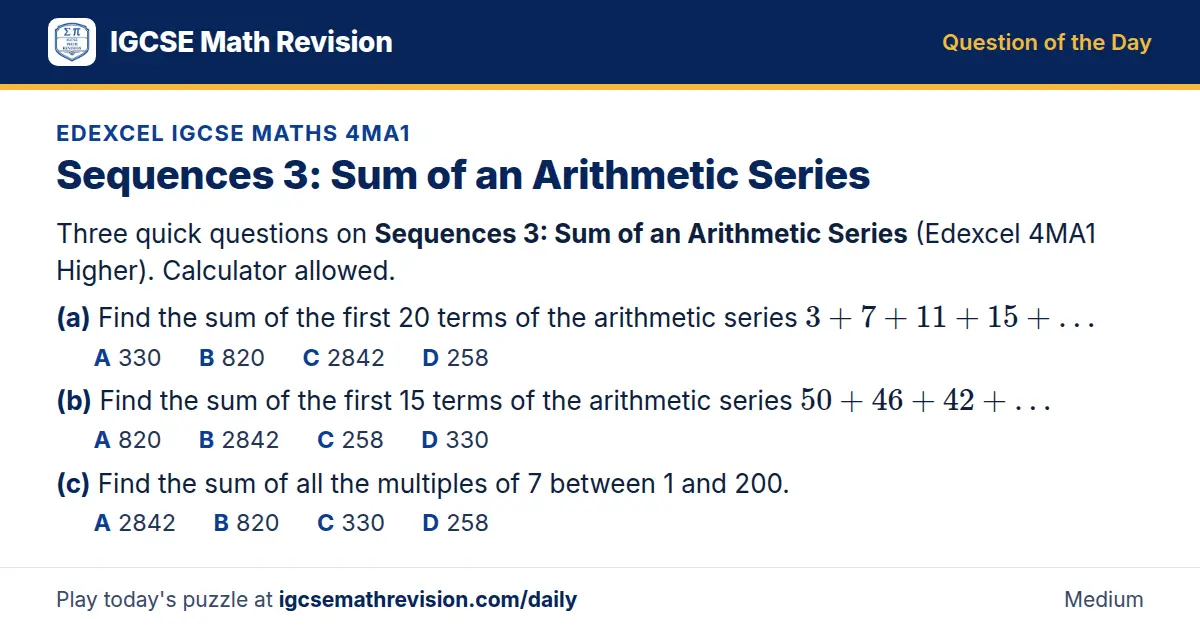
Sequences 3: Sum of an Arithmetic Series
Three quick questions on Sequences 3: Sum of an Arithmetic Series (Edexcel 4MA1 Higher). Calculator allowed.
- Find the sum of the first 20 terms of the arithmetic series 3 + 7 + 11 + 15 + … Options: A) 330; B) 820; C) 2842; D) 258
- Find the sum of the first 15 terms of the arithmetic series 50 + 46 + 42 + … Options: A) 820; B) 2842; C) 258; D) 330
- Find the sum of all the multiples of 7 between 1 and 200. Options: A) 2842; B) 820; C) 330; D) 258
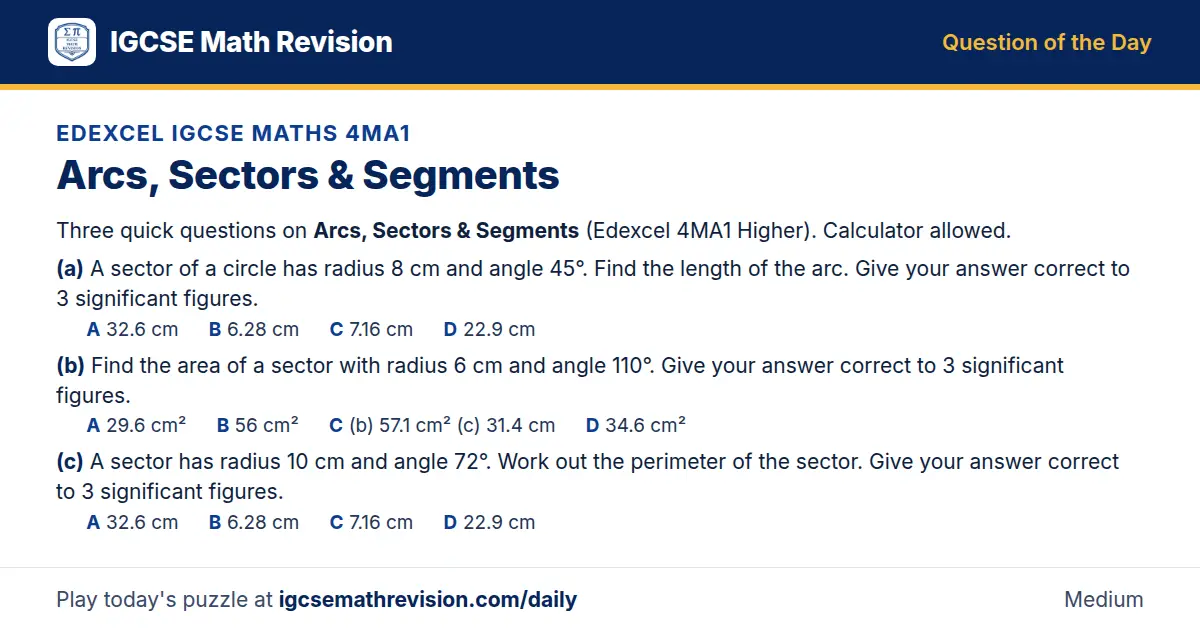
Arcs, Sectors & Segments
Three quick questions on Arcs, Sectors Segments (Edexcel 4MA1 Higher). Calculator allowed.
- A sector of a circle has radius 8 cm and angle 45°. Find the length of the arc. Give your answer correct to 3 significant figures. Options: A) 32.6 cm; B) 6.28 cm; C) 7.16 cm; D) 22.9 cm
- Find the area of a sector with radius 6 cm and angle 110°. Give your answer correct to 3 significant figures. Options: A) 29.6 cm²; B) 56 cm²; C) (b) 57.1 cm² (c) 31.4 cm; D) 34.6 cm²
- A sector has radius 10 cm and angle 72°. Work out the perimeter of the sector. Give your answer correct to 3 significant figures. Options: A) 32.6 cm; B) 6.28 cm; C) 7.16 cm; D) 22.9 cm
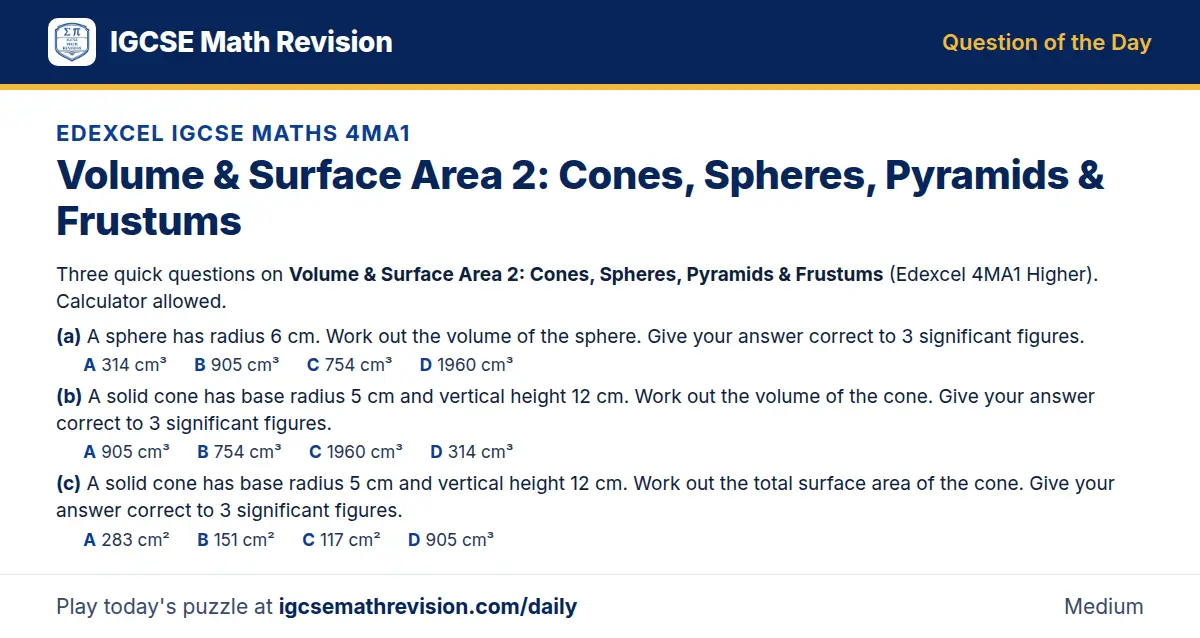
Volume & Surface Area 2: Cones, Spheres, Pyramids & Frustums
Three quick questions on Volume Surface Area 2: Cones, Spheres, Pyramids Frustums (Edexcel 4MA1 Higher). Calculator allowed.
- A sphere has radius 6 cm. Work out the volume of the sphere. Give your answer correct to 3 significant figures. Options: A) 314 cm³; B) 905 cm³; C) 754 cm³; D) 1960 cm³
- A solid cone has base radius 5 cm and vertical height 12 cm. Work out the volume of the cone. Give your answer correct to 3 significant figures. Options: A) 905 cm³; B) 754 cm³; C) 1960 cm³; D) 314 cm³
- A solid cone has base radius 5 cm and vertical height 12 cm. Work out the total surface area of the cone. Give your answer correct to 3 significant figures. Options: A) 283 cm²; B) 151 cm²; C) 117 cm²; D) 905 cm³
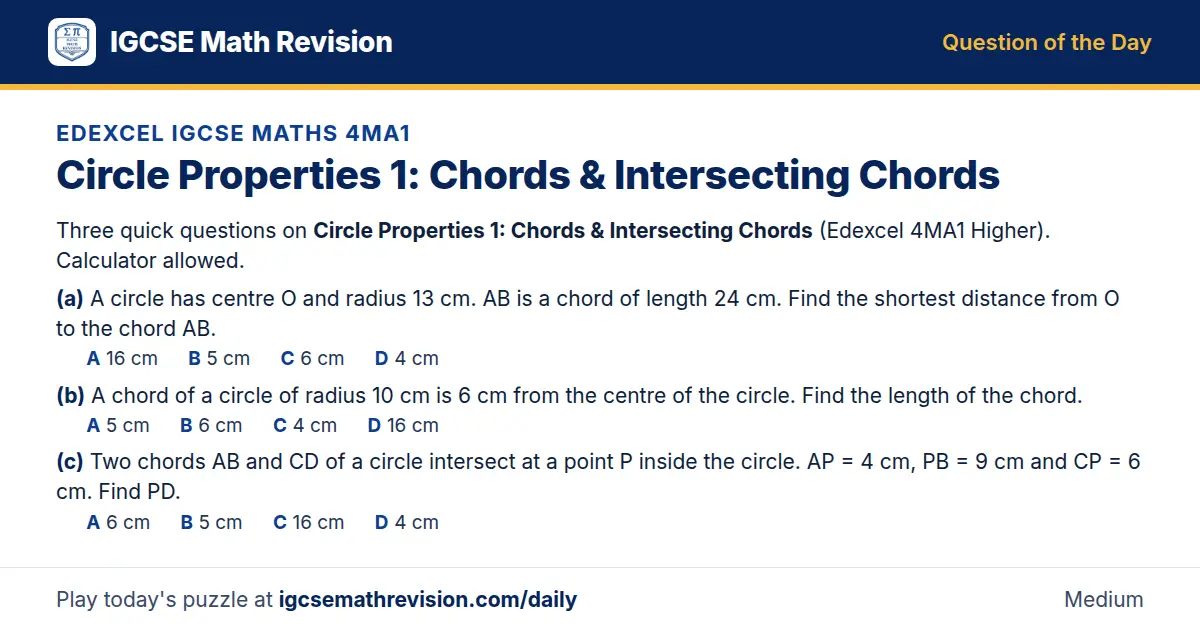
Circle Properties 1: Chords & Intersecting Chords
Three quick questions on Circle Properties 1: Chords Intersecting Chords (Edexcel 4MA1 Higher). Calculator allowed.
- A circle has centre O and radius 13 cm. AB is a chord of length 24 cm. Find the shortest distance from O to the chord AB. Options: A) 16 cm; B) 5 cm; C) 6 cm; D) 4 cm
- A chord of a circle of radius 10 cm is 6 cm from the centre of the circle. Find the length of the chord. Options: A) 5 cm; B) 6 cm; C) 4 cm; D) 16 cm
- Two chords AB and CD of a circle intersect at a point P inside the circle. AP = 4 cm, PB = 9 cm and CP = 6 cm. Find PD. Options: A) 6 cm; B) 5 cm; C) 16 cm; D) 4 cm
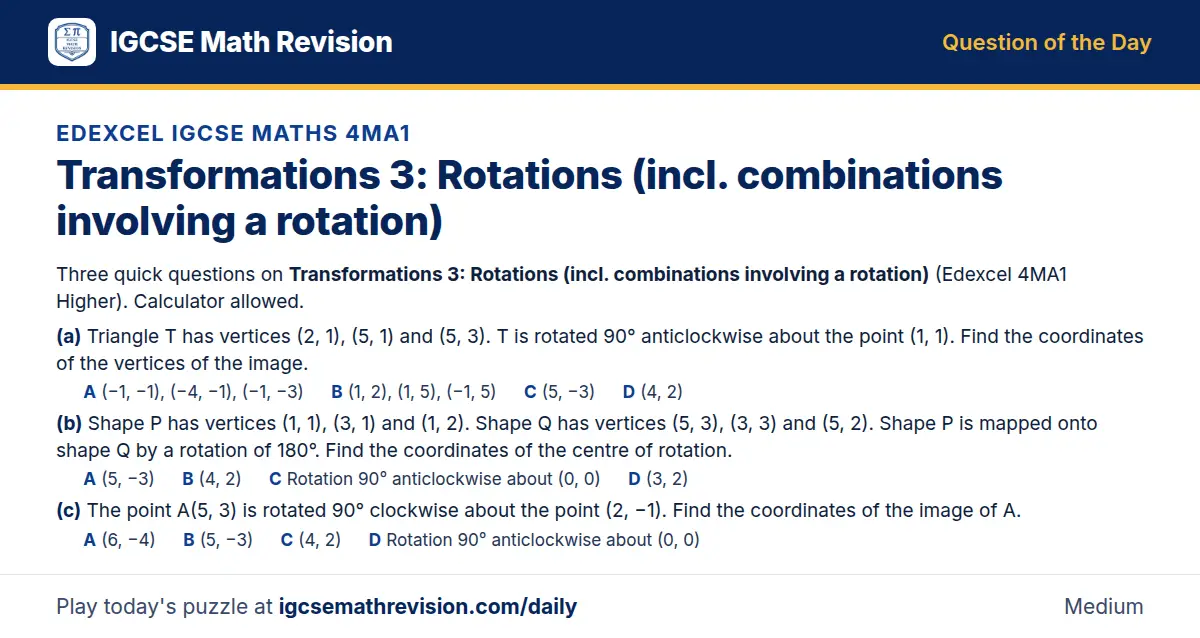
Transformations 3: Rotations (incl. combinations involving a rotation)
Three quick questions on Transformations 3: Rotations (incl. combinations involving a rotation) (Edexcel 4MA1 Higher). Calculator allowed.
- Triangle T has vertices (2, 1), (5, 1) and (5, 3). T is rotated 90° anticlockwise about the point (1, 1). Find the coordinates of the vertices of the image. Options: A) (−1, −1), (−4, −1), (−1, −3); B) (1, 2), (1, 5), (−1, 5); C) (5, −3); D) (4, 2)
- Shape P has vertices (1, 1), (3, 1) and (1, 2). Shape Q has vertices (5, 3), (3, 3) and (5, 2). Shape P is mapped onto shape Q by a rotation of 180°. Find the coordinates of the centre of rotation. Options: A) (5, −3); B) (4, 2); C) Rotation 90° anticlockwise about (0, 0); D) (3, 2)
- The point A(5, 3) is rotated 90° clockwise about the point (2, −1). Find the coordinates of the image of A. Options: A) (6, −4); B) (5, −3); C) (4, 2); D) Rotation 90° anticlockwise about (0, 0)
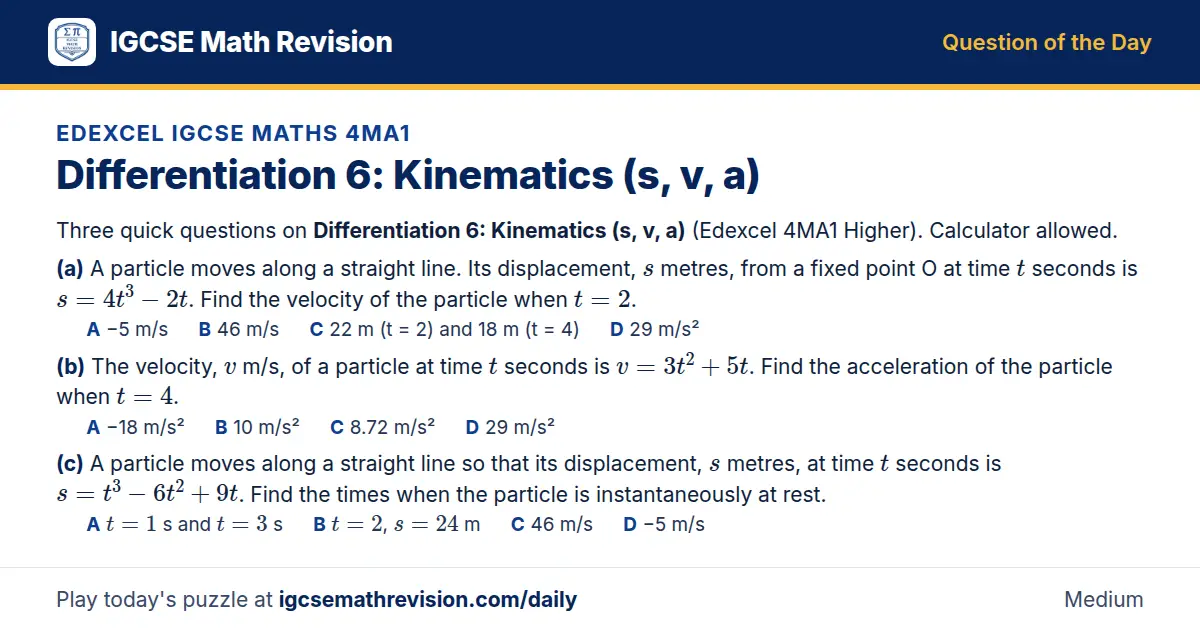
Differentiation 6: Kinematics (s, v, a)
Three quick questions on Differentiation 6: Kinematics (s, v, a) (Edexcel 4MA1 Higher). Calculator allowed.
- A particle moves along a straight line. Its displacement, s metres, from a fixed point O at time t seconds is s = 4t³ - 2t. Find the velocity of the particle when t = 2. Options: A) −5 m/s; B) 46 m/s; C) 22 m (t = 2) and 18 m (t = 4); D) 29 m/s²
- The velocity, v m/s, of a particle at time t seconds is v = 3t² + 5t. Find the acceleration of the particle when t = 4. Options: A) −18 m/s²; B) 10 m/s²; C) 8.72 m/s²; D) 29 m/s²
- A particle moves along a straight line so that its displacement, s metres, at time t seconds is s = t³ - 6t² + 9t. Find the times when the particle is instantaneously at rest. Options: A) t=1 s and t=3 s; B) t=2, s=24 m; C) 46 m/s; D) −5 m/s
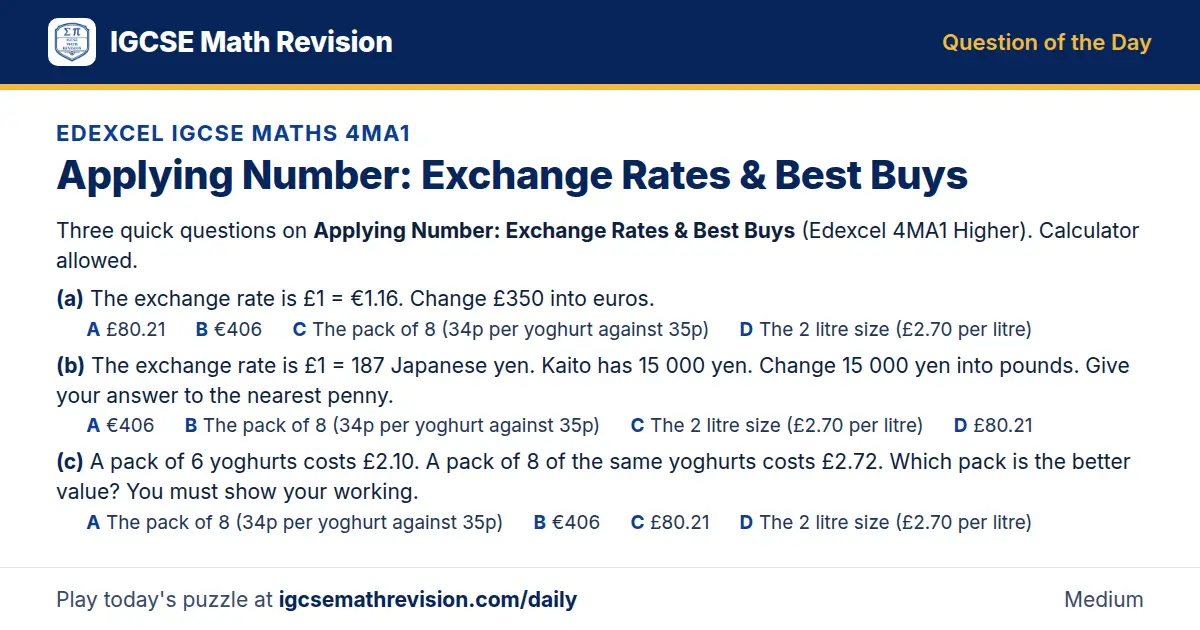
Applying Number: Exchange Rates & Best Buys
Three quick questions on Applying Number: Exchange Rates Best Buys (Edexcel 4MA1 Higher). Calculator allowed.
- The exchange rate is £1 = €1.16. Change £350 into euros. Options: A) £80.21; B) €406; C) The pack of 8 (34p per yoghurt against 35p); D) The 2 litre size (£2.70 per litre)
- The exchange rate is £1 = 187 Japanese yen. Kaito has 15 000 yen. Change 15 000 yen into pounds. Give your answer to the nearest penny. Options: A) €406; B) The pack of 8 (34p per yoghurt against 35p); C) The 2 litre size (£2.70 per litre); D) £80.21
- A pack of 6 yoghurts costs £2.10. A pack of 8 of the same yoghurts costs £2.72. Which pack is the better value? You must show your working. Options: A) The pack of 8 (34p per yoghurt against 35p); B) €406; C) £80.21; D) The 2 litre size (£2.70 per litre)
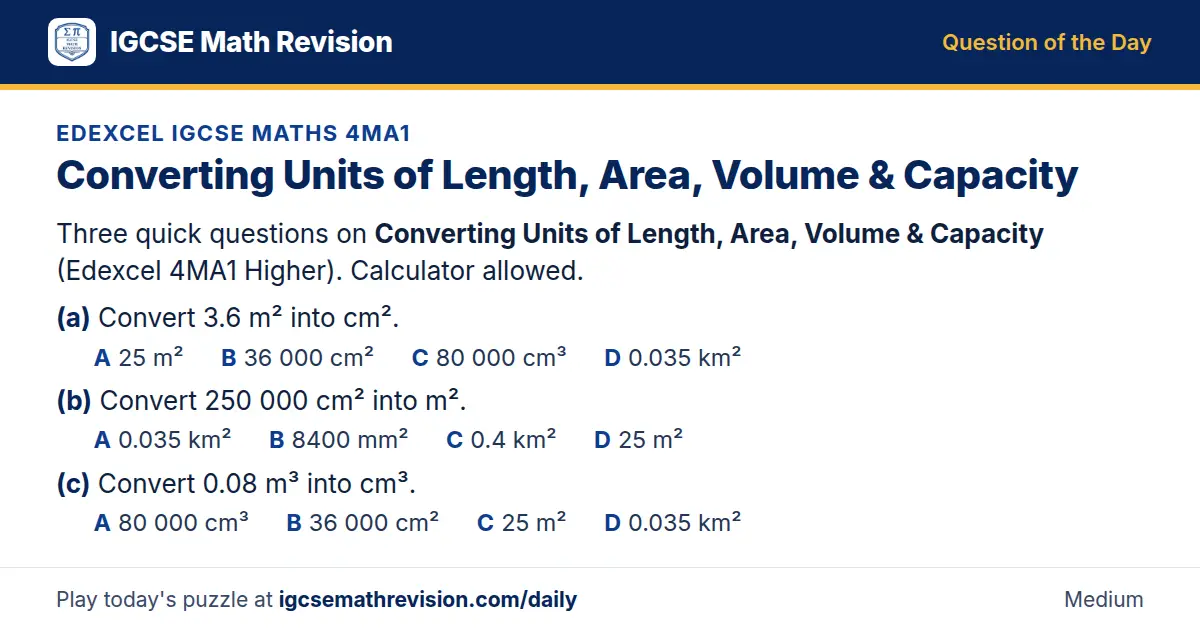
Converting Units of Length, Area, Volume & Capacity
Three quick questions on Converting Units of Length, Area, Volume Capacity (Edexcel 4MA1 Higher). Calculator allowed.
- Convert 3.6 m² into cm². Options: A) 25 m²; B) 36 000 cm²; C) 80 000 cm³; D) 0.035 km²
- Convert 250 000 cm² into m². Options: A) 0.035 km²; B) 8400 mm²; C) 0.4 km²; D) 25 m²
- Convert 0.08 m³ into cm³. Options: A) 80 000 cm³; B) 36 000 cm²; C) 25 m²; D) 0.035 km²
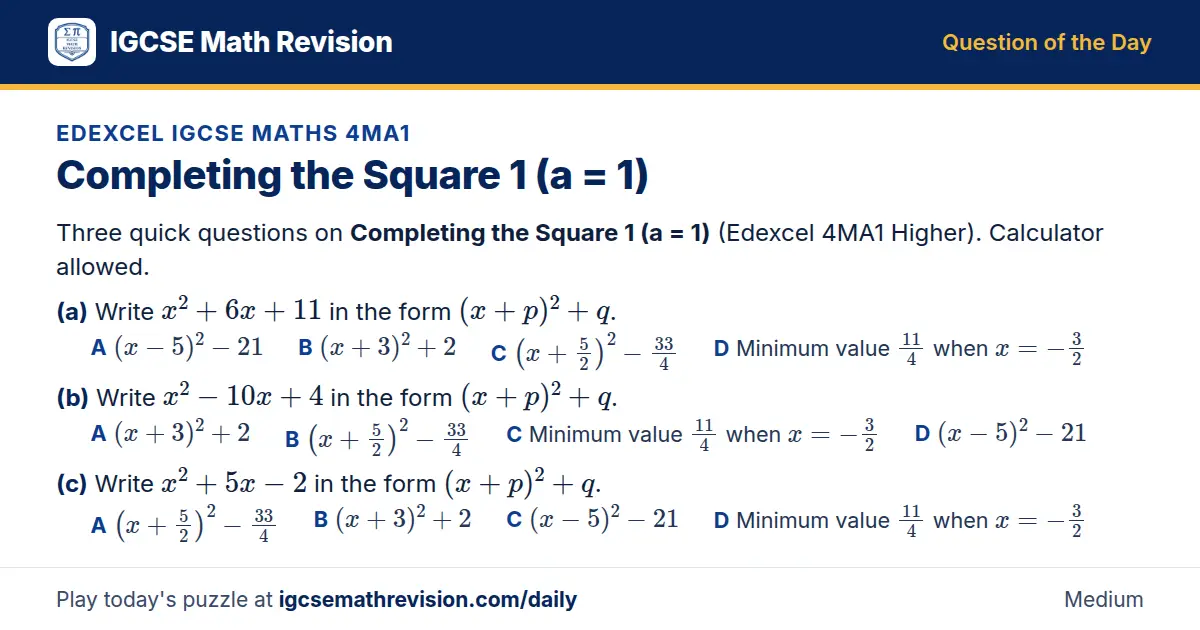
Completing the Square 1 (a = 1)
Three quick questions on Completing the Square 1 (a = 1) (Edexcel 4MA1 Higher). Calculator allowed.
- Write x²+6x+11 in the form (x+p)²+q. Options: A) (x-5)²-21; B) (x+3)²+2; C) (x+5/2)²-33/4; D) Minimum value 11/4 when x=-3/2
- Write x²-10x+4 in the form (x+p)²+q. Options: A) (x+3)²+2; B) (x+5/2)²-33/4; C) Minimum value 11/4 when x=-3/2; D) (x-5)²-21
- Write x²+5x-2 in the form (x+p)²+q. Options: A) (x+5/2)²-33/4; B) (x+3)²+2; C) (x-5)²-21; D) Minimum value 11/4 when x=-3/2
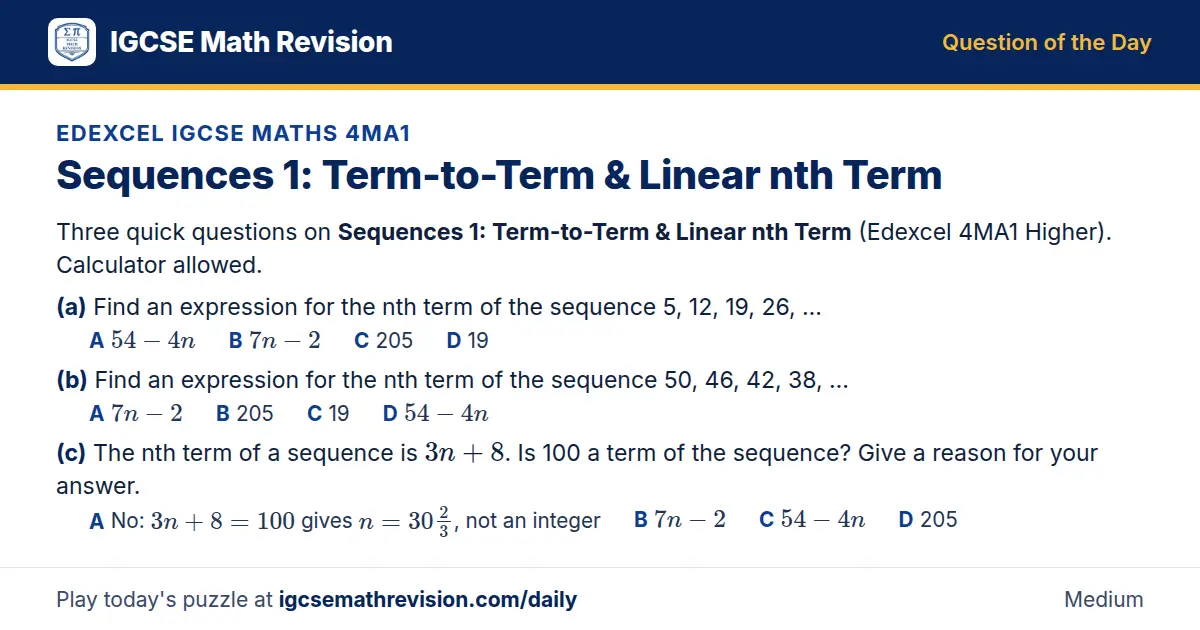
Sequences 1: Term-to-Term & Linear nth Term
Three quick questions on Sequences 1: Term-to-Term Linear nth Term (Edexcel 4MA1 Higher). Calculator allowed.
- Find an expression for the nth term of the sequence 5, 12, 19, 26, … Options: A) 54-4n; B) 7n-2; C) 205; D) 19
- Find an expression for the nth term of the sequence 50, 46, 42, 38, … Options: A) 7n-2; B) 205; C) 19; D) 54-4n
- The nth term of a sequence is 3n+8. Is 100 a term of the sequence? Give a reason for your answer. Options: A) No: 3n+8=100 gives n=302/3, not an integer; B) 7n-2; C) 54-4n; D) 205
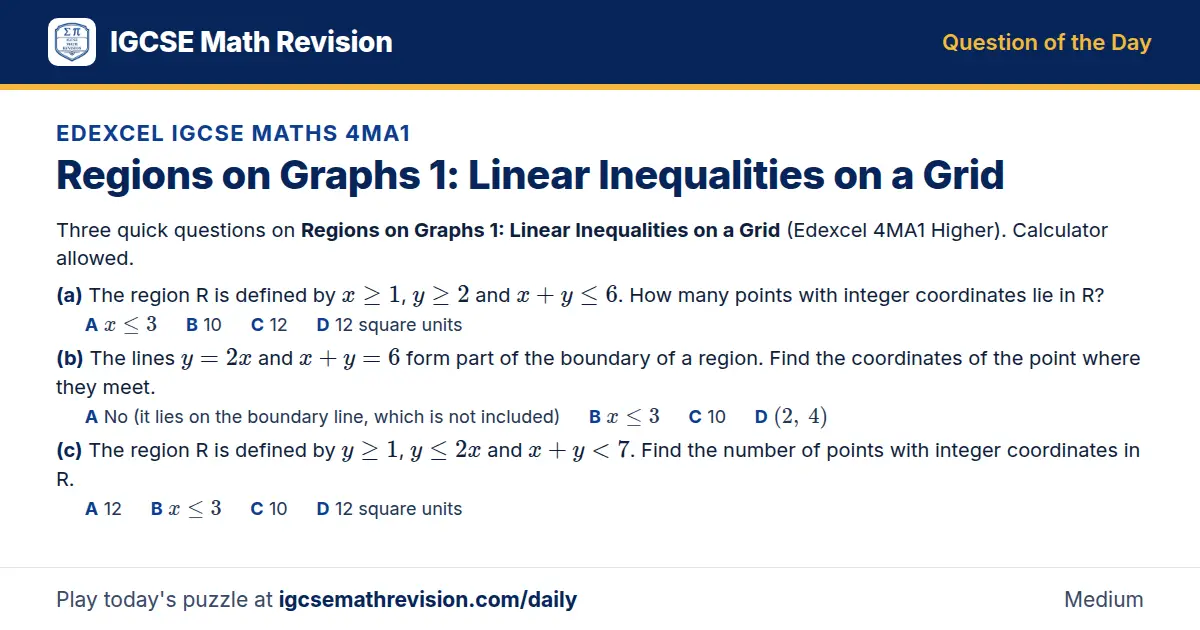
Regions on Graphs 1: Linear Inequalities on a Grid
Three quick questions on Regions on Graphs 1: Linear Inequalities on a Grid (Edexcel 4MA1 Higher). Calculator allowed.
- The region R is defined by x≥1, y≥2 and x+y≤6. How many points with integer coordinates lie in R? Options: A) x≤ 3; B) 10; C) 12; D) 12 square units
- The lines y=2x and x+y=6 form part of the boundary of a region. Find the coordinates of the point where they meet. Options: A) No (it lies on the boundary line, which is not included); B) x≤ 3; C) 10; D) (2, 4)
- The region R is defined by y≥1, y≤2x and x+y< 7. Find the number of points with integer coordinates in R. Options: A) 12; B) x≤ 3; C) 10; D) 12 square units
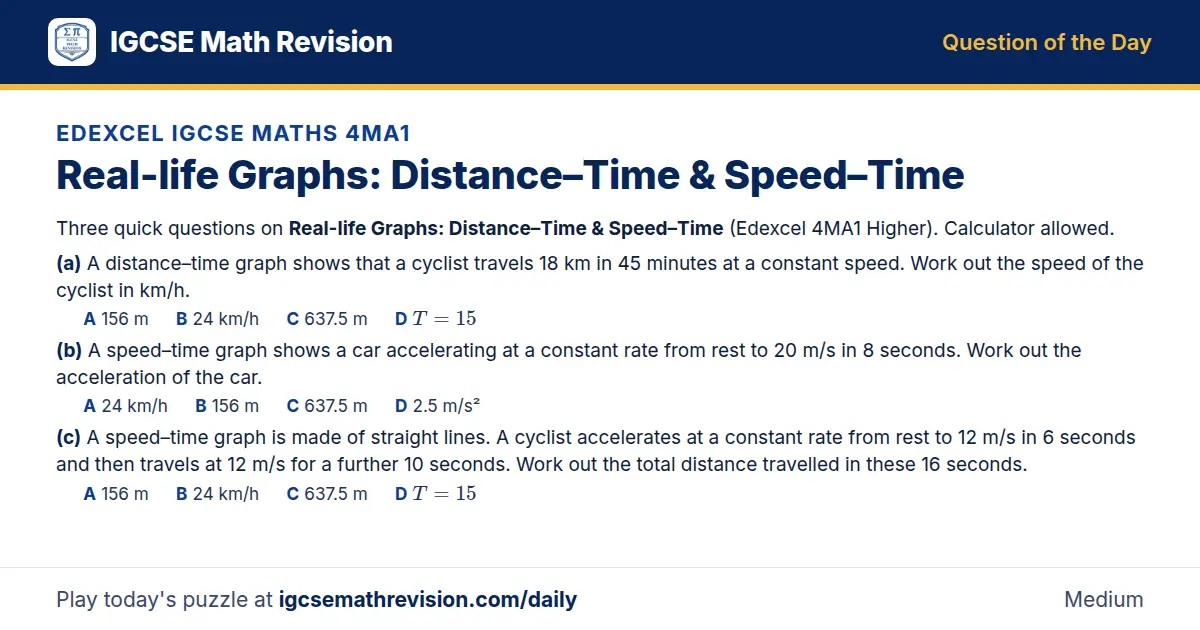
Real-life Graphs: Distance–Time & Speed–Time
Three quick questions on Real-life Graphs: Distance–Time Speed–Time (Edexcel 4MA1 Higher). Calculator allowed.
- A distance–time graph shows that a cyclist travels 18 km in 45 minutes at a constant speed. Work out the speed of the cyclist in km/h. Options: A) 156 m; B) 24 km/h; C) 637.5 m; D) T=15
- A speed–time graph shows a car accelerating at a constant rate from rest to 20 m/s in 8 seconds. Work out the acceleration of the car. Options: A) 24 km/h; B) 156 m; C) 637.5 m; D) 2.5 m/s²
- A speed–time graph is made of straight lines. A cyclist accelerates at a constant rate from rest to 12 m/s in 6 seconds and then travels at 12 m/s for a further 10 seconds. Work out the total distance travelled in these 16 seconds. Options: A) 156 m; B) 24 km/h; C) 637.5 m; D) T=15
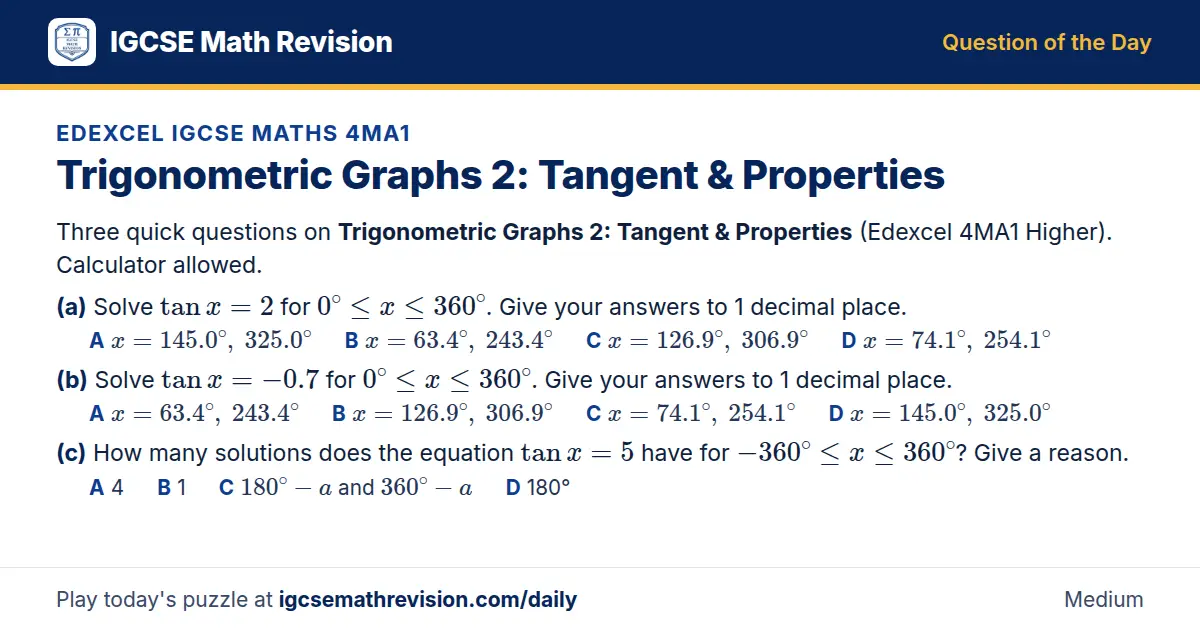
Trigonometric Graphs 2: Tangent & Properties
Three quick questions on Trigonometric Graphs 2: Tangent Properties (Edexcel 4MA1 Higher). Calculator allowed.
- Solve tan x=2 for 0^∘≤ x≤360^∘. Give your answers to 1 decimal place. Options: A) x=145.0^∘, 325.0^∘; B) x=63.4^∘, 243.4^∘; C) x=126.9^∘, 306.9^∘; D) x=74.1^∘, 254.1^∘
- Solve tan x=-0.7 for 0^∘≤ x≤360^∘. Give your answers to 1 decimal place. Options: A) x=63.4^∘, 243.4^∘; B) x=126.9^∘, 306.9^∘; C) x=74.1^∘, 254.1^∘; D) x=145.0^∘, 325.0^∘
- How many solutions does the equation tan x=5 have for -360^∘≤ x≤360^∘? Give a reason. Options: A) 4; B) 1; C) 180^∘-a and 360^∘-a; D) 180°
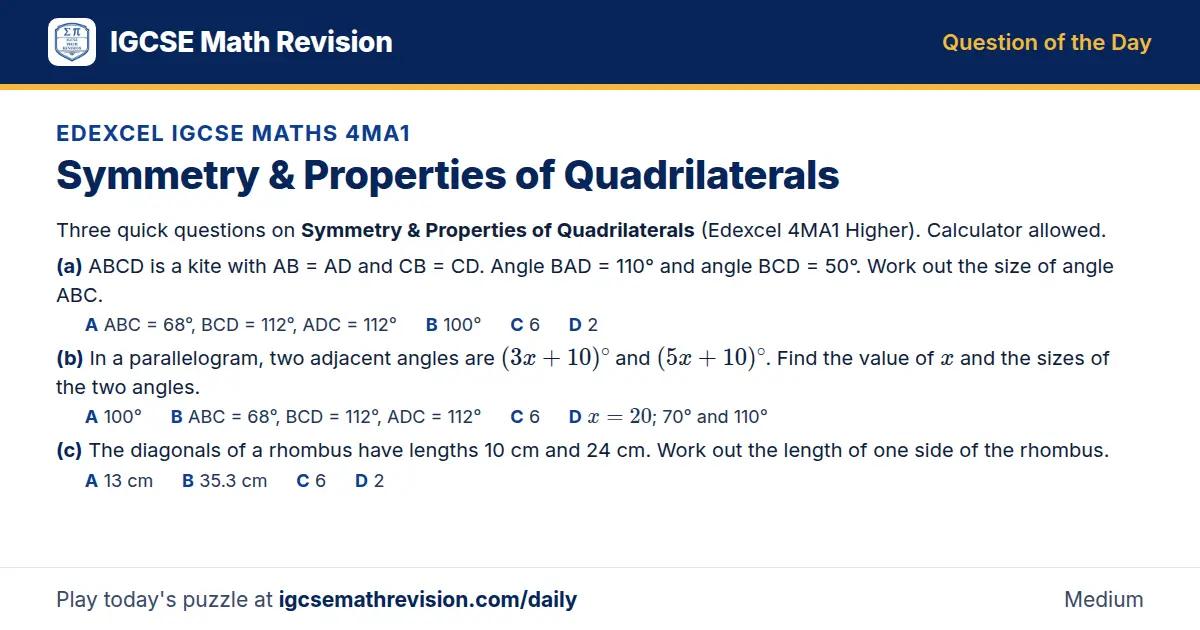
Symmetry & Properties of Quadrilaterals
Three quick questions on Symmetry Properties of Quadrilaterals (Edexcel 4MA1 Higher). Calculator allowed.
- ABCD is a kite with AB = AD and CB = CD. Angle BAD = 110° and angle BCD = 50°. Work out the size of angle ABC. Options: A) ABC = 68°, BCD = 112°, ADC = 112°; B) 100°; C) 6; D) 2
- In a parallelogram, two adjacent angles are (3x+10)^∘ and (5x+10)^∘. Find the value of x and the sizes of the two angles. Options: A) 100°; B) ABC = 68°, BCD = 112°, ADC = 112°; C) 6; D) x=20; 70° and 110°
- The diagonals of a rhombus have lengths 10 cm and 24 cm. Work out the length of one side of the rhombus. Options: A) 13 cm; B) 35.3 cm; C) 6; D) 2
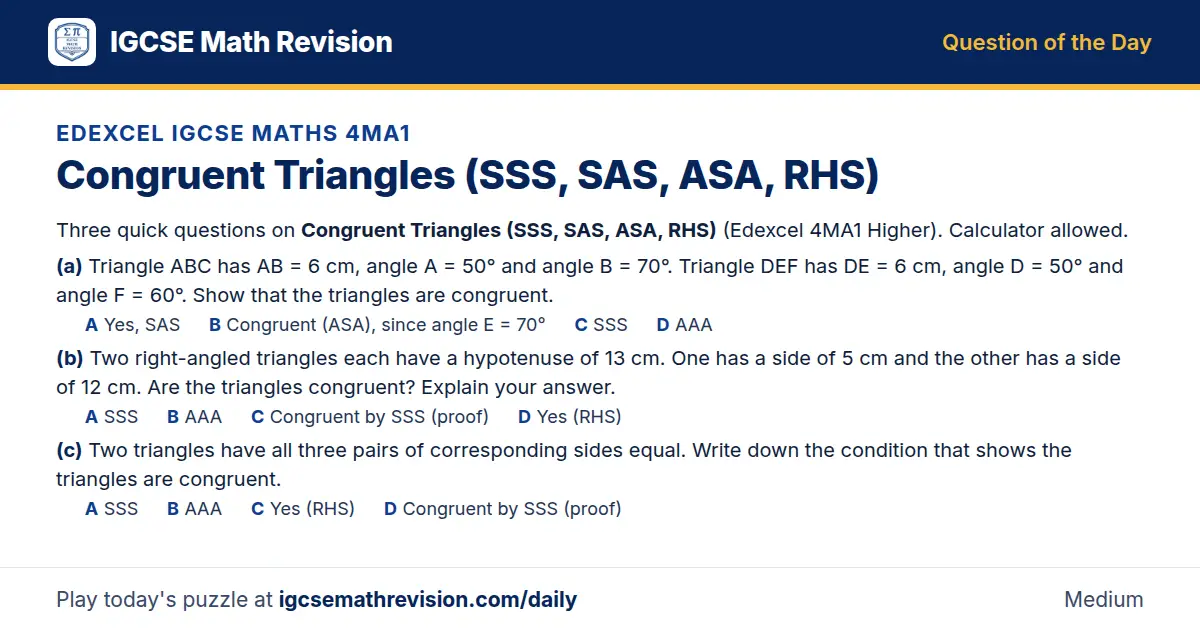
Congruent Triangles (SSS, SAS, ASA, RHS)
Three quick questions on Congruent Triangles (SSS, SAS, ASA, RHS) (Edexcel 4MA1 Higher). Calculator allowed.
- Triangle ABC has AB = 6 cm, angle A = 50° and angle B = 70°. Triangle DEF has DE = 6 cm, angle D = 50° and angle F = 60°. Show that the triangles are congruent. Options: A) Yes, SAS; B) Congruent (ASA), since angle E = 70°; C) SSS; D) AAA
- Two right-angled triangles each have a hypotenuse of 13 cm. One has a side of 5 cm and the other has a side of 12 cm. Are the triangles congruent? Explain your answer. Options: A) SSS; B) AAA; C) Congruent by SSS (proof); D) Yes (RHS)
- Two triangles have all three pairs of corresponding sides equal. Write down the condition that shows the triangles are congruent. Options: A) SSS; B) AAA; C) Yes (RHS); D) Congruent by SSS (proof)
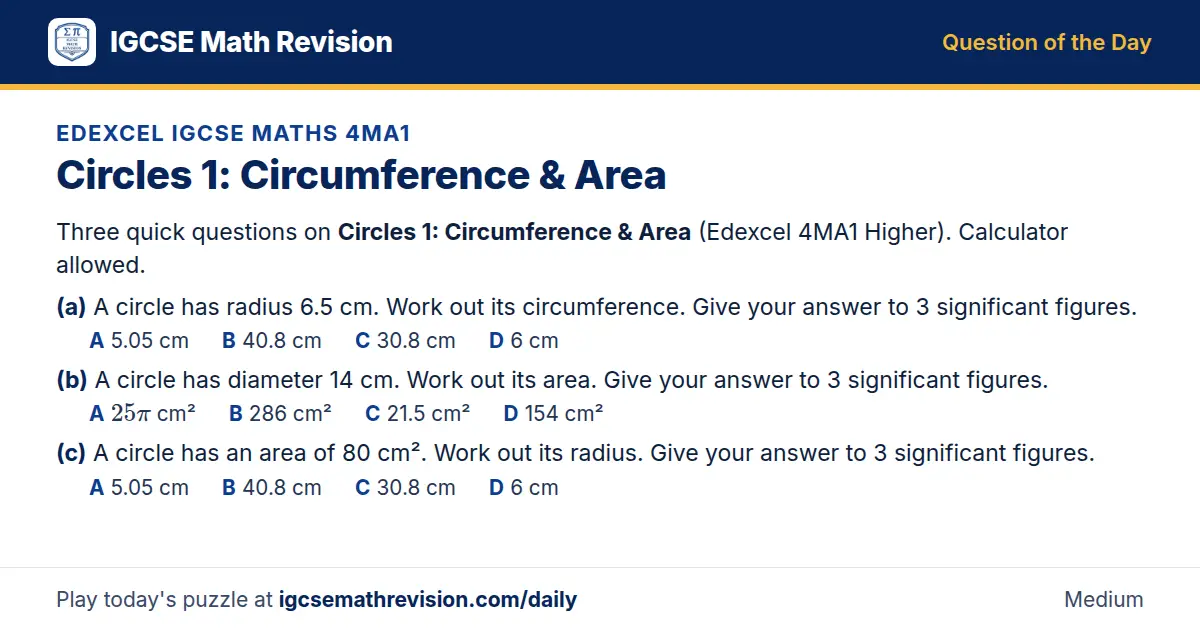
Circles 1: Circumference & Area
Three quick questions on Circles 1: Circumference Area (Edexcel 4MA1 Higher). Calculator allowed.
- A circle has radius 6.5 cm. Work out its circumference. Give your answer to 3 significant figures. Options: A) 5.05 cm; B) 40.8 cm; C) 30.8 cm; D) 6 cm
- A circle has diameter 14 cm. Work out its area. Give your answer to 3 significant figures. Options: A) 25π cm²; B) 286 cm²; C) 21.5 cm²; D) 154 cm²
- A circle has an area of 80 cm². Work out its radius. Give your answer to 3 significant figures. Options: A) 5.05 cm; B) 40.8 cm; C) 30.8 cm; D) 6 cm
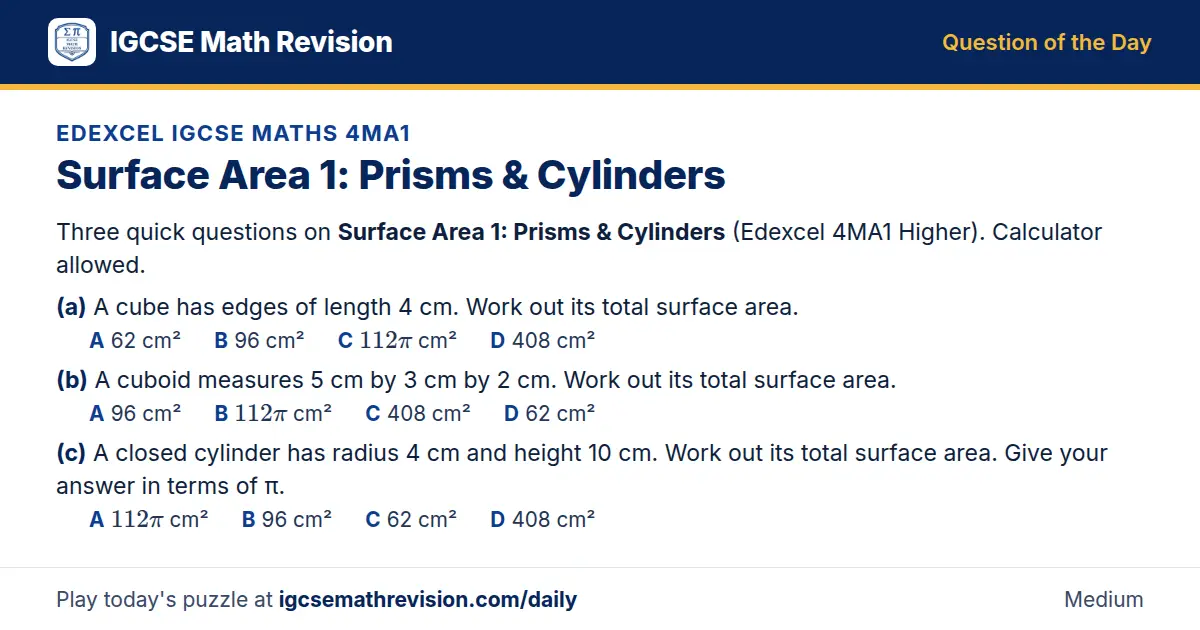
Surface Area 1: Prisms & Cylinders
Three quick questions on Surface Area 1: Prisms Cylinders (Edexcel 4MA1 Higher). Calculator allowed.
- A cube has edges of length 4 cm. Work out its total surface area. Options: A) 62 cm²; B) 96 cm²; C) 112π cm²; D) 408 cm²
- A cuboid measures 5 cm by 3 cm by 2 cm. Work out its total surface area. Options: A) 96 cm²; B) 112π cm²; C) 408 cm²; D) 62 cm²
- A closed cylinder has radius 4 cm and height 10 cm. Work out its total surface area. Give your answer in terms of π. Options: A) 112π cm²; B) 96 cm²; C) 62 cm²; D) 408 cm²
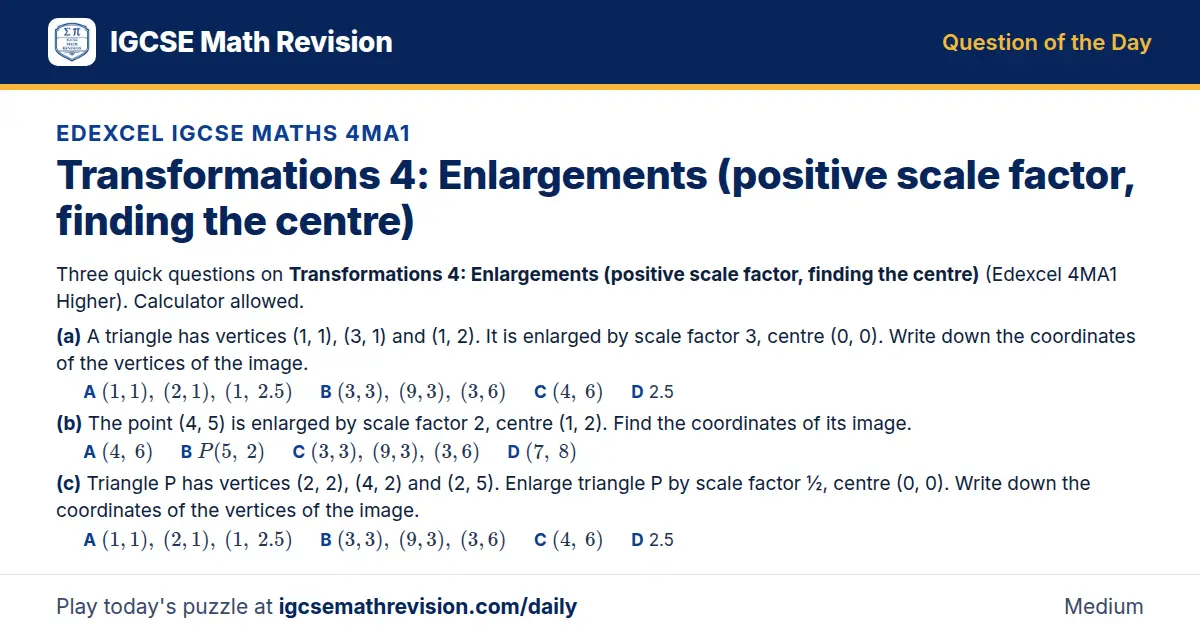
Transformations 4: Enlargements (positive scale factor, finding the centre)
Three quick questions on Transformations 4: Enlargements (positive scale factor, finding the centre) (Edexcel 4MA1 Higher). Calculator allowed.
- A triangle has vertices (1, 1), (3, 1) and (1, 2). It is enlarged by scale factor 3, centre (0, 0). Write down the coordinates of the vertices of the image. Options: A) (1,1), (2,1), (1, 2.5); B) (3,3), (9,3), (3,6); C) (4, 6); D) 2.5
- The point (4, 5) is enlarged by scale factor 2, centre (1, 2). Find the coordinates of its image. Options: A) (4, 6); B) P(5, 2); C) (3,3), (9,3), (3,6); D) (7, 8)
- Triangle P has vertices (2, 2), (4, 2) and (2, 5). Enlarge triangle P by scale factor ½, centre (0, 0). Write down the coordinates of the vertices of the image. Options: A) (1,1), (2,1), (1, 2.5); B) (3,3), (9,3), (3,6); C) (4, 6); D) 2.5
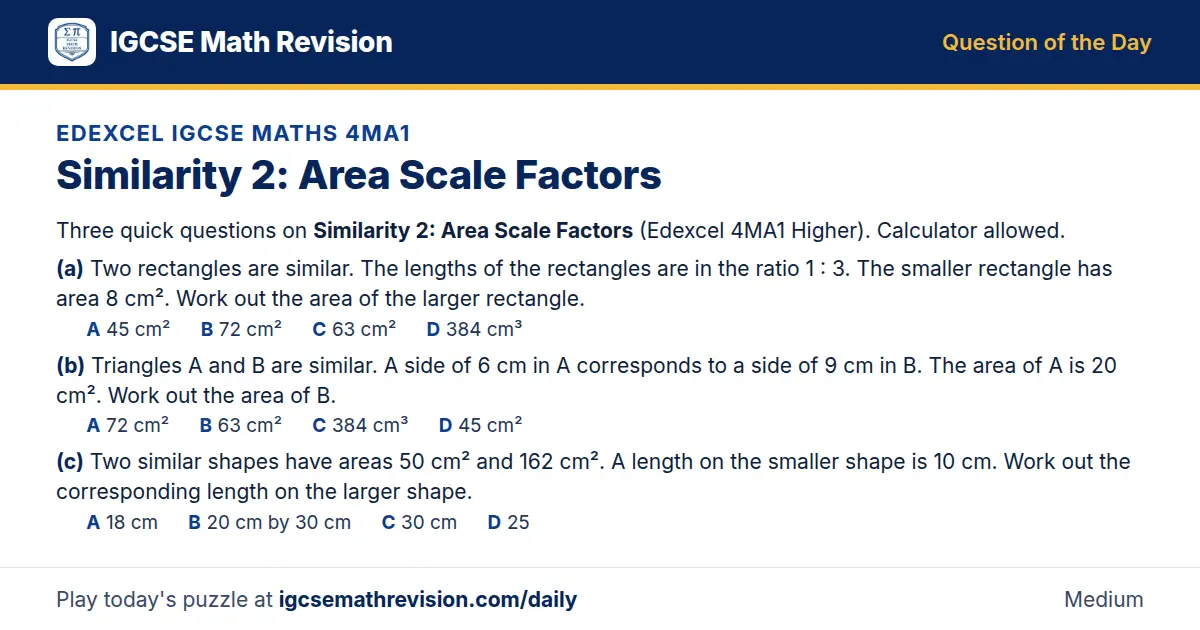
Similarity 2: Area Scale Factors
Three quick questions on Similarity 2: Area Scale Factors (Edexcel 4MA1 Higher). Calculator allowed.
- Two rectangles are similar. The lengths of the rectangles are in the ratio 1: 3. The smaller rectangle has area 8 cm². Work out the area of the larger rectangle. Options: A) 45 cm²; B) 72 cm²; C) 63 cm²; D) 384 cm³
- Triangles A and B are similar. A side of 6 cm in A corresponds to a side of 9 cm in B. The area of A is 20 cm². Work out the area of B. Options: A) 72 cm²; B) 63 cm²; C) 384 cm³; D) 45 cm²
- Two similar shapes have areas 50 cm² and 162 cm². A length on the smaller shape is 10 cm. Work out the corresponding length on the larger shape. Options: A) 18 cm; B) 20 cm by 30 cm; C) 30 cm; D) 25
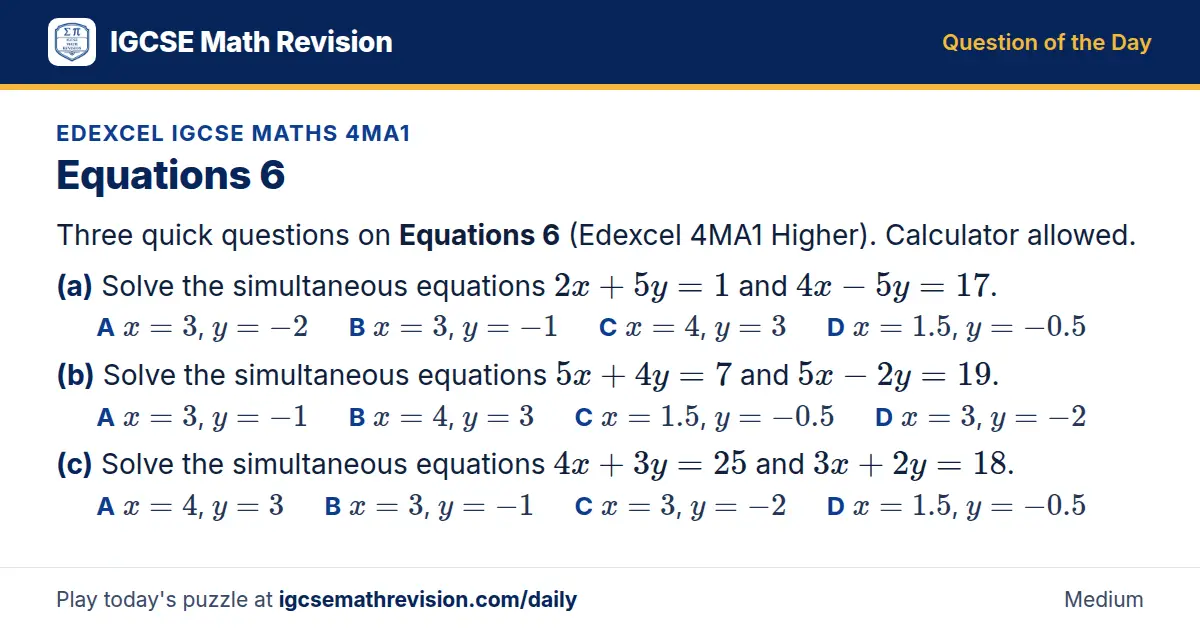
Equations 6
Three quick questions on Equations 6 (Edexcel 4MA1 Higher). Calculator allowed.
- Solve the simultaneous equations 2x + 5y = 1 and 4x - 5y = 17. Options: A) x = 3, y = -2; B) x = 3, y = -1; C) x = 4, y = 3; D) x = 1.5, y = -0.5
- Solve the simultaneous equations 5x + 4y = 7 and 5x - 2y = 19. Options: A) x = 3, y = -1; B) x = 4, y = 3; C) x = 1.5, y = -0.5; D) x = 3, y = -2
- Solve the simultaneous equations 4x + 3y = 25 and 3x + 2y = 18. Options: A) x = 4, y = 3; B) x = 3, y = -1; C) x = 3, y = -2; D) x = 1.5, y = -0.5
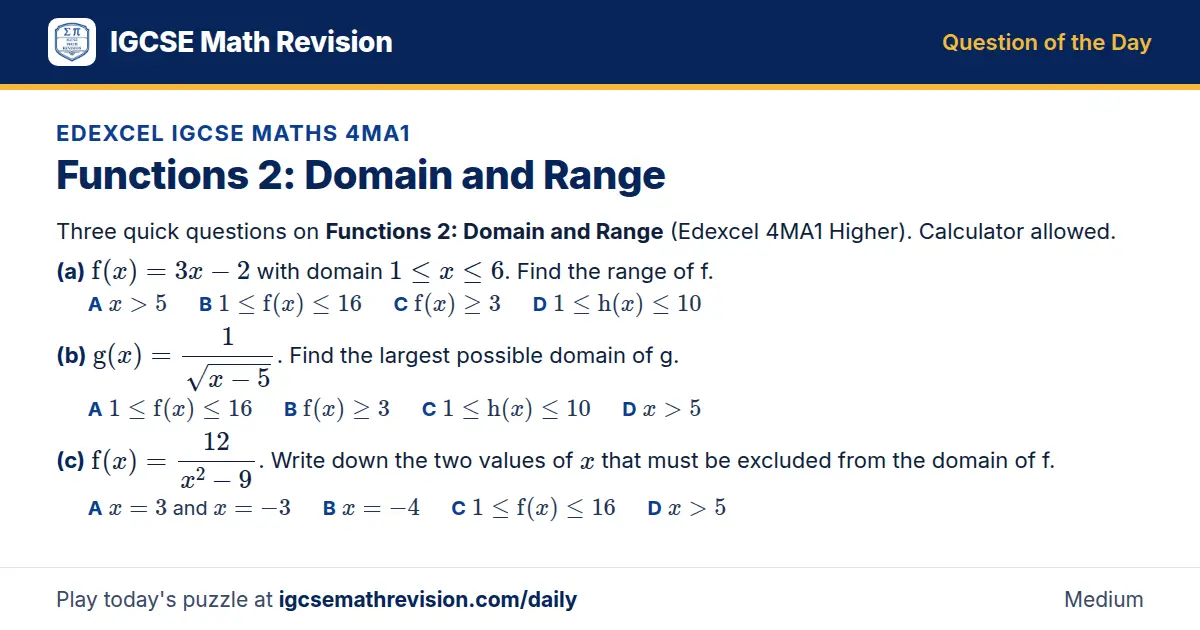
Functions 2: Domain and Range
Three quick questions on Functions 2: Domain and Range (Edexcel 4MA1 Higher). Calculator allowed.
- f(x) = 3x - 2 with domain 1 ≤ x ≤ 6. Find the range of f. Options: A) x > 5; B) 1 ≤ f(x) ≤ 16; C) f(x) ≥ 3; D) 1 ≤ h(x) ≤ 10
- g(x) = 1/(√(x - 5)). Find the largest possible domain of g. Options: A) 1 ≤ f(x) ≤ 16; B) f(x) ≥ 3; C) 1 ≤ h(x) ≤ 10; D) x > 5
- f(x) = 12/(x² - 9). Write down the two values of x that must be excluded from the domain of f. Options: A) x = 3 and x = -3; B) x = -4; C) 1 ≤ f(x) ≤ 16; D) x > 5
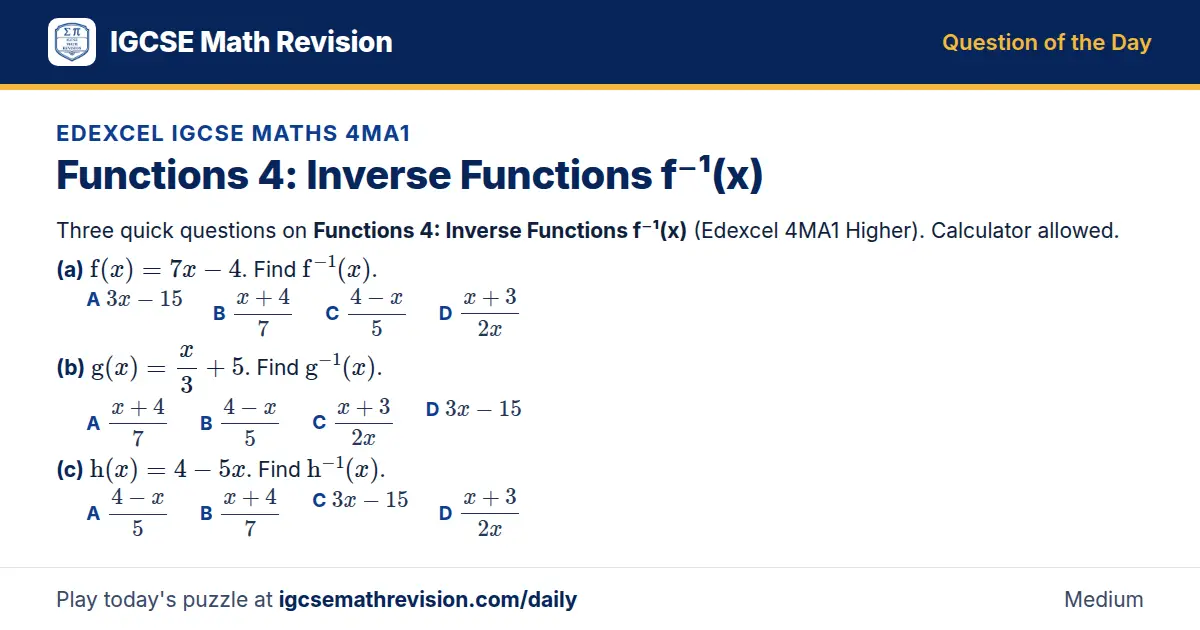
Functions 4: Inverse Functions f⁻¹(x)
Three quick questions on Functions 4: Inverse Functions f⁻¹(x) (Edexcel 4MA1 Higher). Calculator allowed.
- f(x) = 7x - 4. Find f⁻¹(x). Options: A) 3x - 15; B) (x + 4)/7; C) (4 - x)/5; D) (x + 3)/2x
- g(x) = x/3 + 5. Find g⁻¹(x). Options: A) (x + 4)/7; B) (4 - x)/5; C) (x + 3)/2x; D) 3x - 15
- h(x) = 4 - 5x. Find h⁻¹(x). Options: A) (4 - x)/5; B) (x + 4)/7; C) 3x - 15; D) (x + 3)/2x
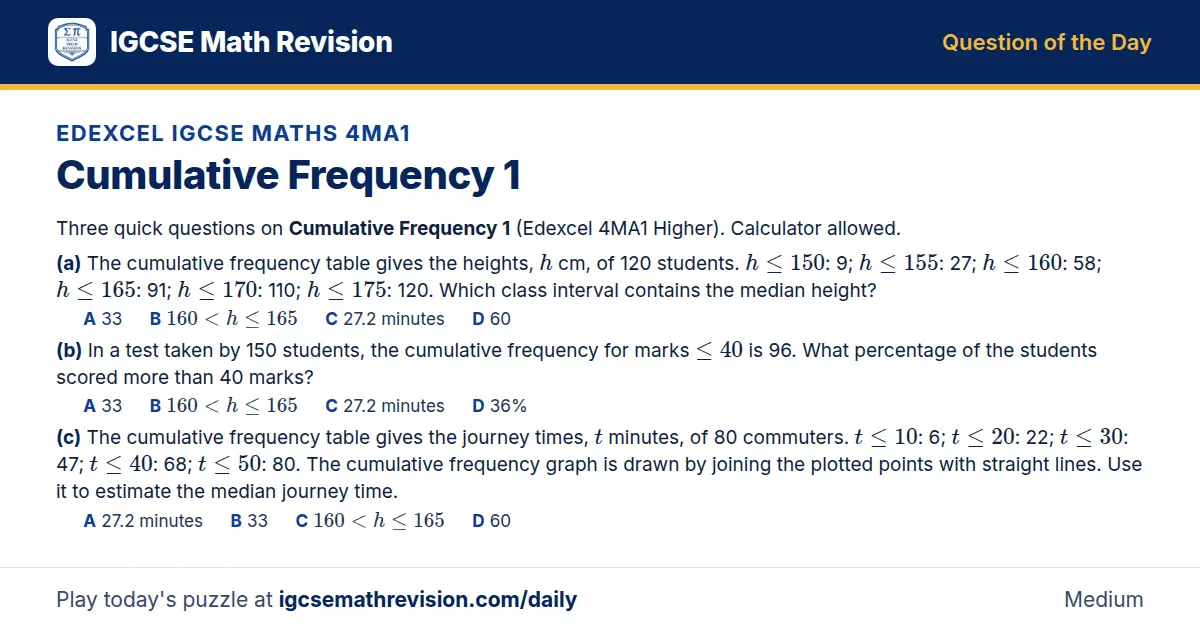
Cumulative Frequency 1
Three quick questions on Cumulative Frequency 1 (Edexcel 4MA1 Higher). Calculator allowed.
- The cumulative frequency table gives the heights, h cm, of 120 students. h ≤ 150: 9; h ≤ 155: 27; h ≤ 160: 58; h ≤ 165: 91; h ≤ 170: 110; h ≤ 175: 120. Which class interval contains the median height? Options: A) 33; B) 160 < h ≤ 165; C) 27.2 minutes; D) 60
- In a test taken by 150 students, the cumulative frequency for marks ≤ 40 is 96. What percentage of the students scored more than 40 marks? Options: A) 33; B) 160 < h ≤ 165; C) 27.2 minutes; D) 36%
- The cumulative frequency table gives the journey times, t minutes, of 80 commuters. t ≤ 10: 6; t ≤ 20: 22; t ≤ 30: 47; t ≤ 40: 68; t ≤ 50: 80. The cumulative frequency graph is drawn by joining the plotted points with straight lines. Use it to estimate the median journey time. Options: A) 27.2 minutes; B) 33; C) 160 < h ≤ 165; D) 60
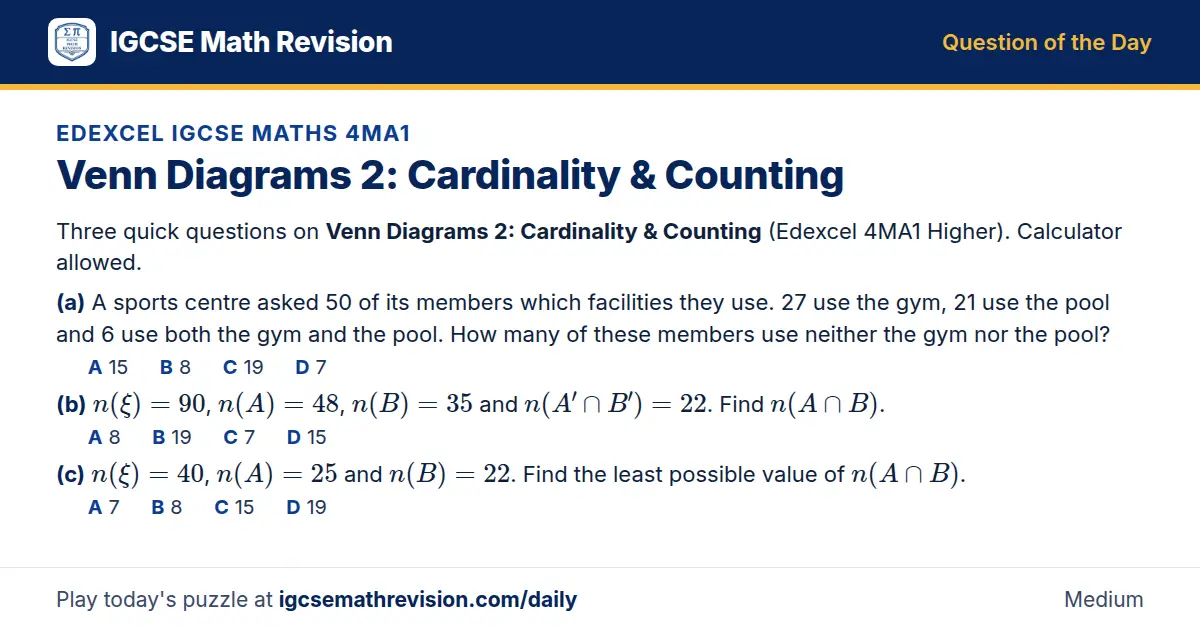
Venn Diagrams 2: Cardinality & Counting
Three quick questions on Venn Diagrams 2: Cardinality Counting (Edexcel 4MA1 Higher). Calculator allowed.
- A sports centre asked 50 of its members which facilities they use. 27 use the gym, 21 use the pool and 6 use both the gym and the pool. How many of these members use neither the gym nor the pool? Options: A) 15; B) 8; C) 19; D) 7
- n() = 90, n(A) = 48, n(B) = 35 and n(A' ∩ B') = 22. Find n(A ∩ B). Options: A) 8; B) 19; C) 7; D) 15
- n() = 40, n(A) = 25 and n(B) = 22. Find the least possible value of n(A ∩ B). Options: A) 7; B) 8; C) 15; D) 19
Weekly starter questions
Three or four short questions for each teaching week, to open a lesson or warm up for homework. Each page shows the questions as images with their text; answers and mark schemes are in the teacher tools.
Edexcel IGCSE Maths A (4MA1) Higher, Year 10
129 starter questions: Weeks 1–11 · Weeks 12–22 · Weeks 23–33.
Edexcel IGCSE Maths A (4MA1) Higher, Year 11
96 starter questions: Weeks 1–12 · Weeks 13–24.
Cambridge IGCSE Mathematics 0580, Core
204 starter questions: Weeks 1–13 · Weeks 14–26 · Weeks 27–39 · Weeks 40–51.
Cambridge IGCSE Mathematics 0580, Extended
220 starter questions: Weeks 1–11 · Weeks 12–22 · Weeks 23–33 · Weeks 34–44 · Weeks 45–55.