Cambridge IGCSE 0580 Core starter questions: weeks 14–26
52 short questions to open a lesson for Cambridge IGCSE Mathematics 0580, Core, weeks 14–26 of the teaching year, three or four a week. Each question is shown as an image with its text underneath; answers and mark schemes stay with teachers.
- ← Cambridge IGCSE 0580 Core, weeks 1–13
- Cambridge IGCSE 0580 Core, weeks 27–39 →
- All IGCSE Maths daily and weekly questions
Week 14
![Cambridge IGCSE 0580 Core starter question on 2.5 Equations: Make the letter in brackets the subject of each formula. (a) C = 2π r [r] (b) y = 3x + 5 [x]](/igcse-frontend/img/questions/igcse-maths-0580-core-2-5-equations-starter-question-cie0580c-w14-q1.webp)
Question 1: 2.5 Equations
Make the letter in brackets the subject of each formula. (a) C = 2π r [r] (b) y = 3x + 5 [x]
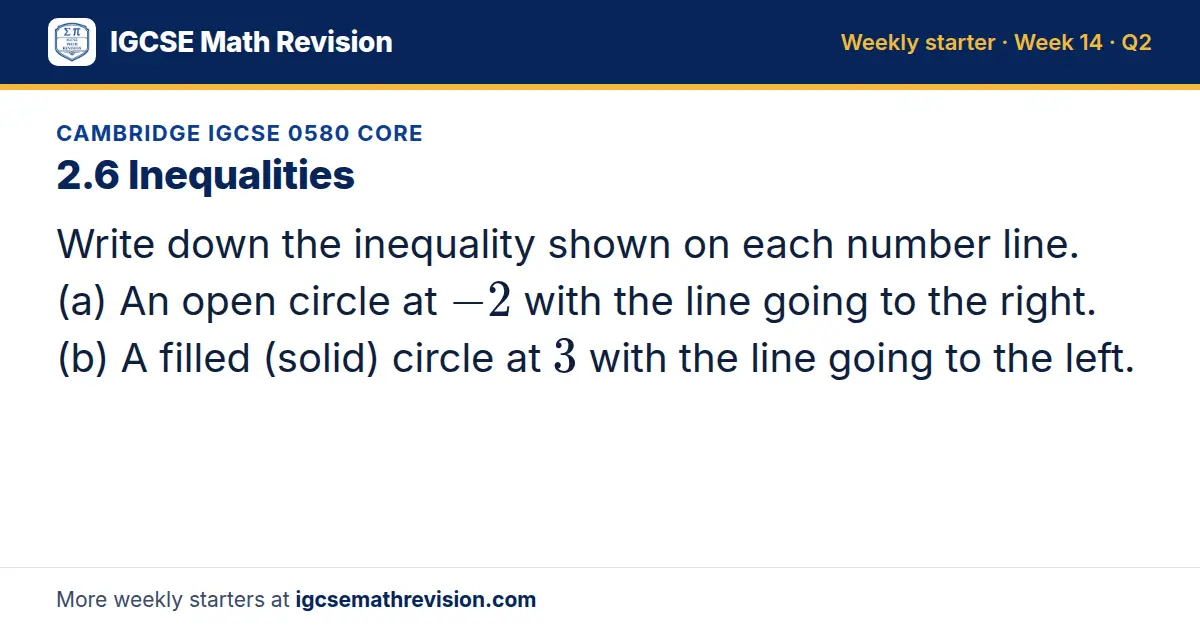
Question 2: 2.6 Inequalities
Write down the inequality shown on each number line. (a) An open circle at -2 with the line going to the right. (b) A filled (solid) circle at 3 with the line going to the left.
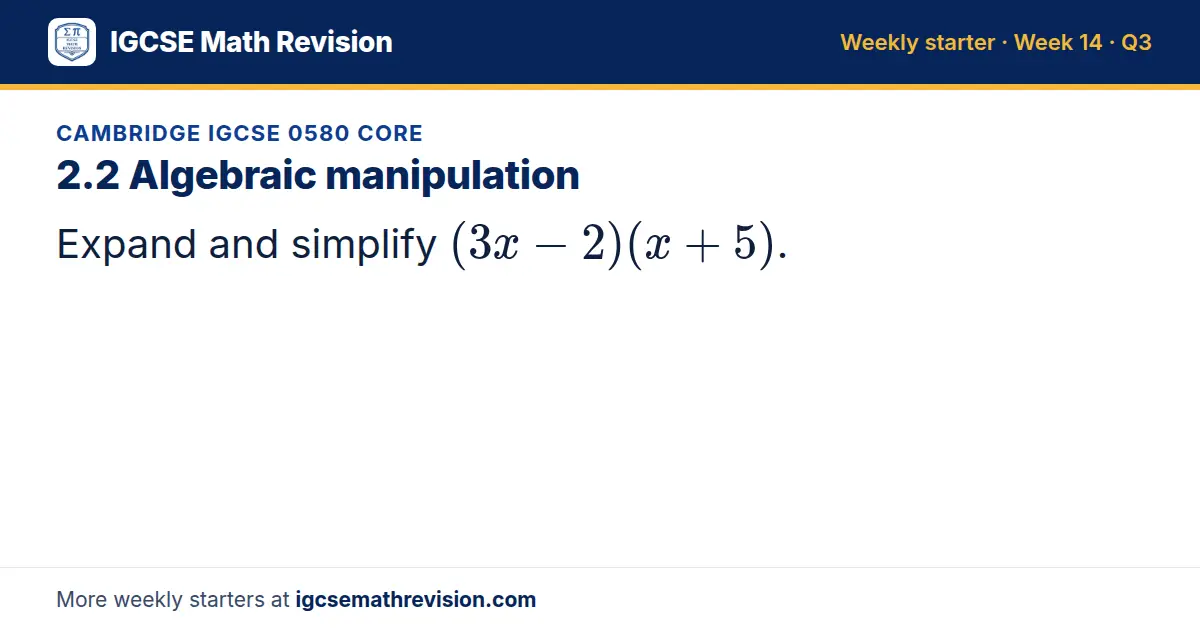
Question 3: 2.2 Algebraic manipulation
Expand and simplify (3x - 2)(x + 5).
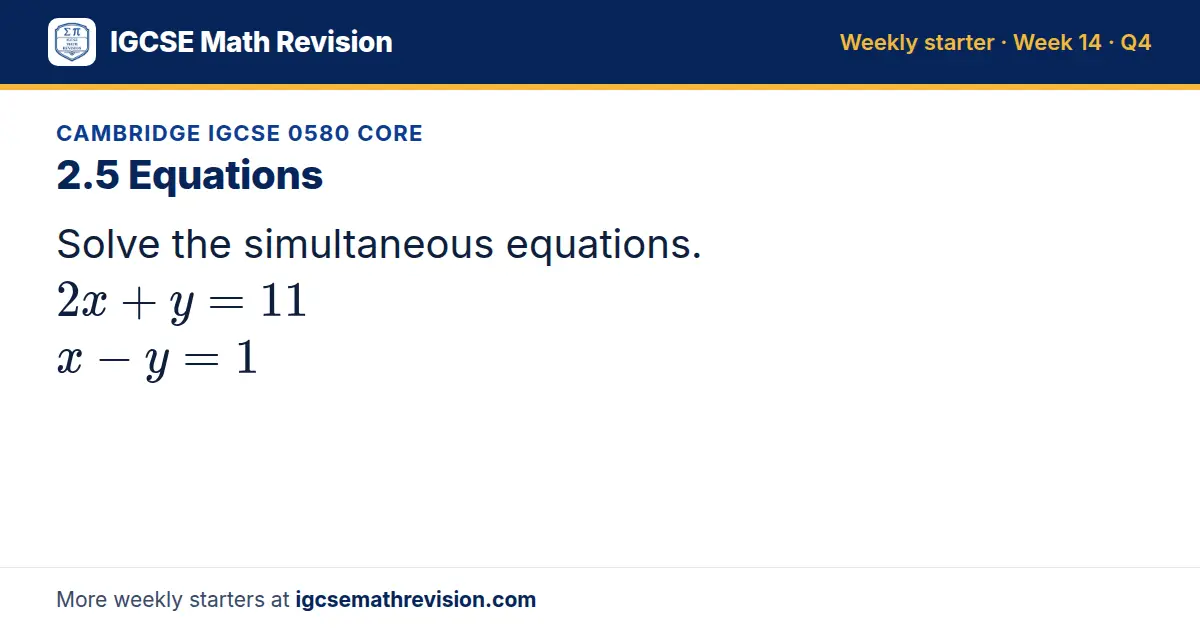
Question 4: 2.5 Equations
Solve the simultaneous equations. 2x + y = 11 x - y = 1
Week 15
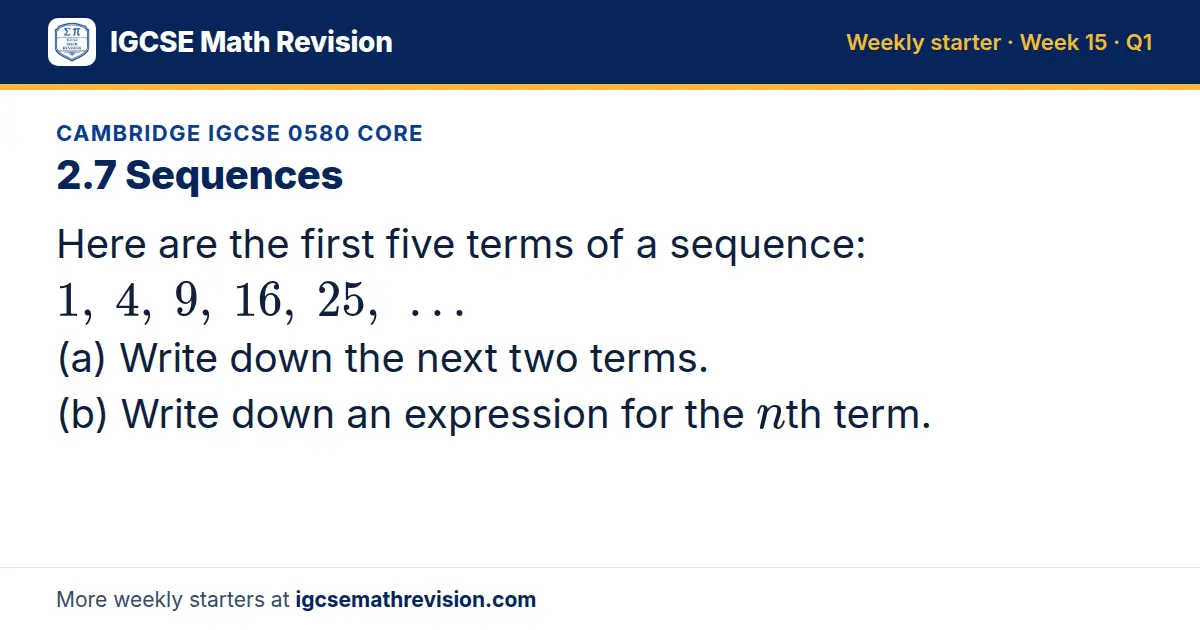
Question 1: 2.7 Sequences
Here are the first five terms of a sequence: 1, 4, 9, 16, 25, … (a) Write down the next two terms. (b) Write down an expression for the nth term.
Question 2: 2.9 Graphs in practical situations
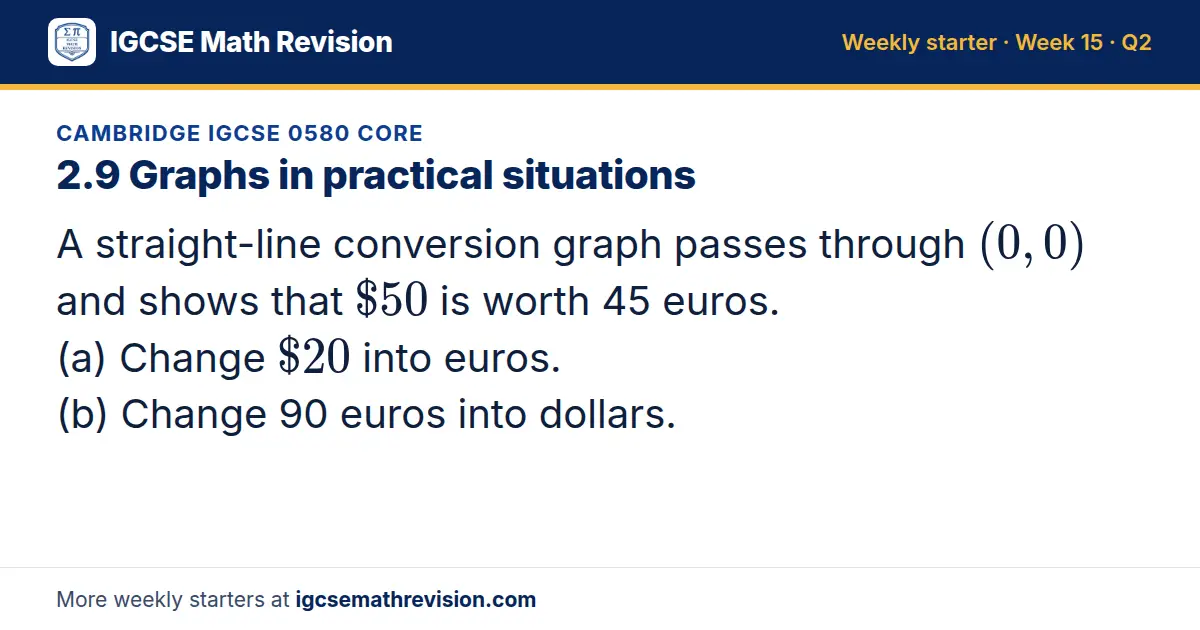
A straight-line conversion graph passes through (0, 0) and shows that $50 is worth 45 euros. (a) Change $20 into euros. (b) Change 90 euros into dollars.
Question 3: 2.5 Equations
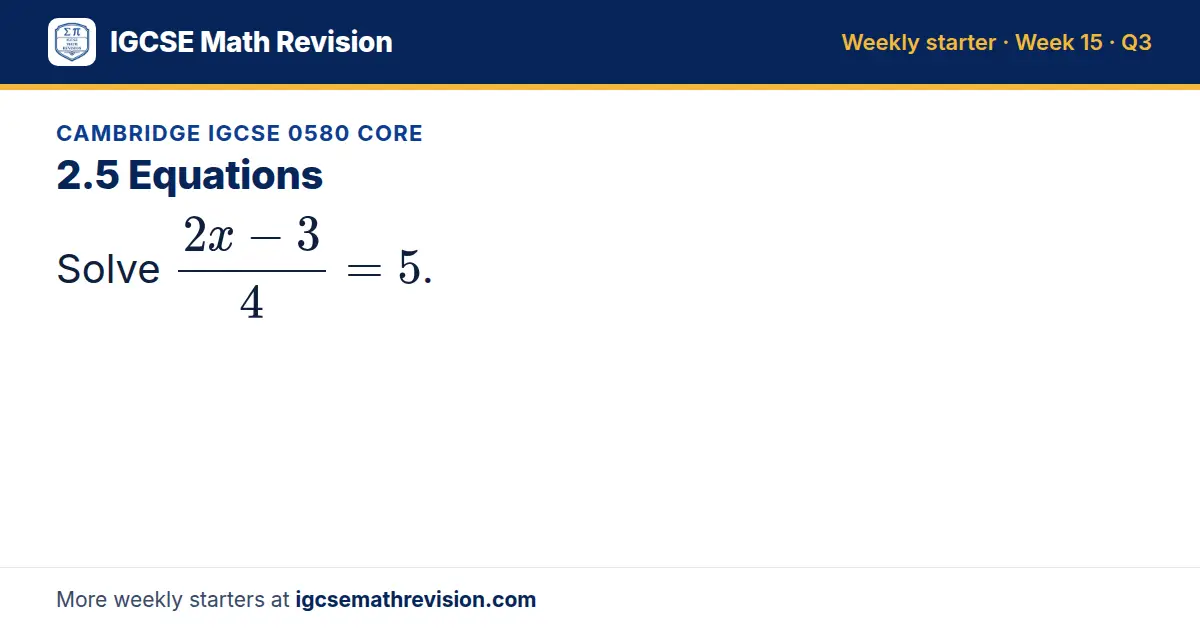
Solve (2x - 3)/4 = 5.
Question 4: 2.6 Inequalities
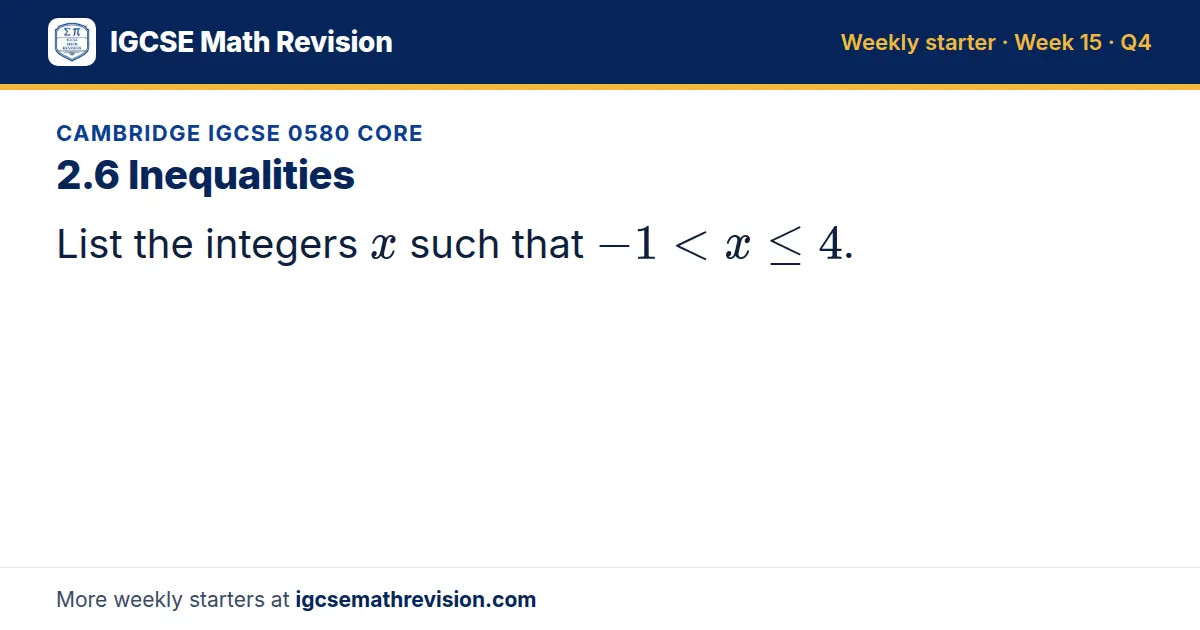
List the integers x such that -1 < x ≤ 4.
Week 16
Question 1: 2.9 Graphs in practical situations
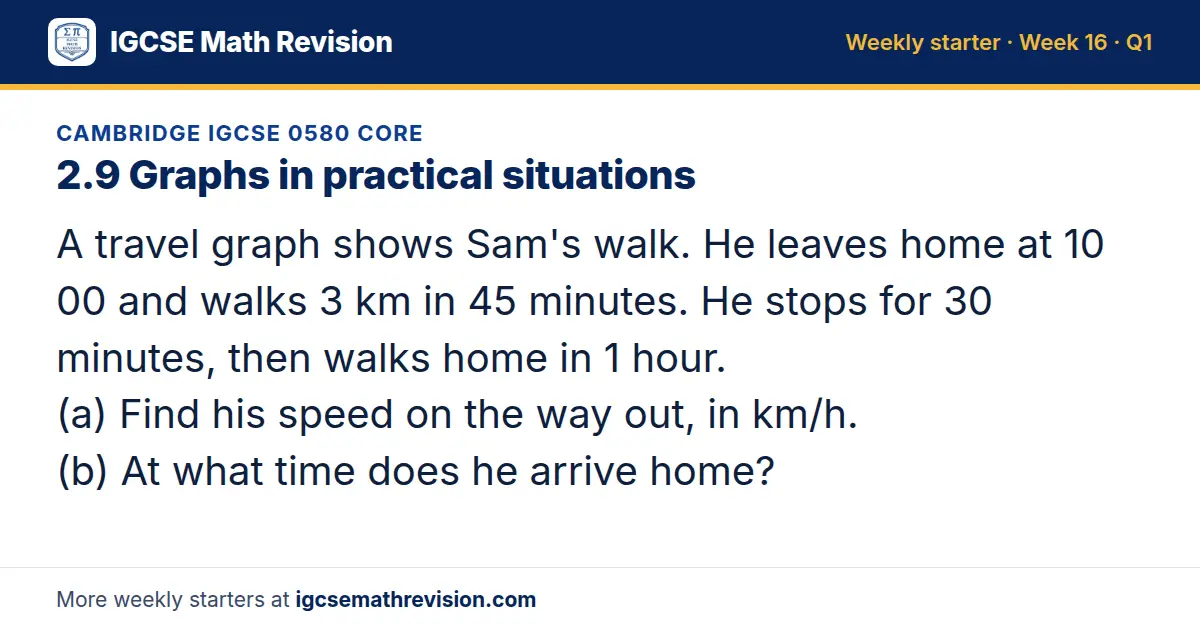
A travel graph shows Sam's walk. He leaves home at 10 00 and walks 3 km in 45 minutes. He stops for 30 minutes, then walks home in 1 hour. (a) Find his speed on the way out, in km/h. (b) At what time does he arrive home?
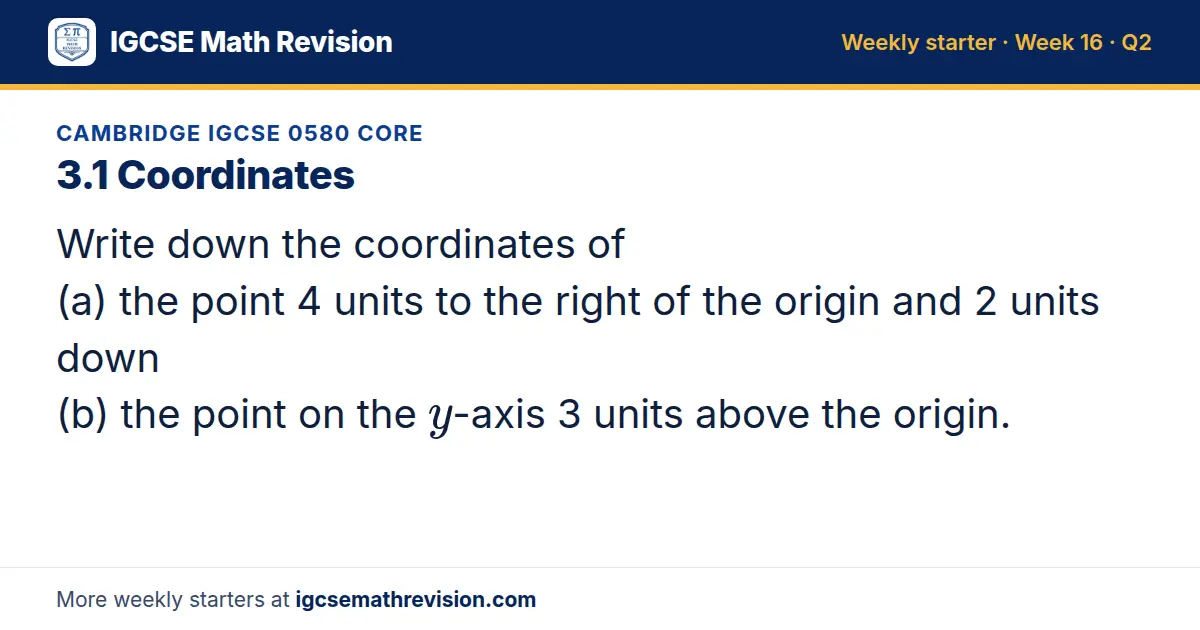
Question 2: 3.1 Coordinates
Write down the coordinates of (a) the point 4 units to the right of the origin and 2 units down (b) the point on the y-axis 3 units above the origin.
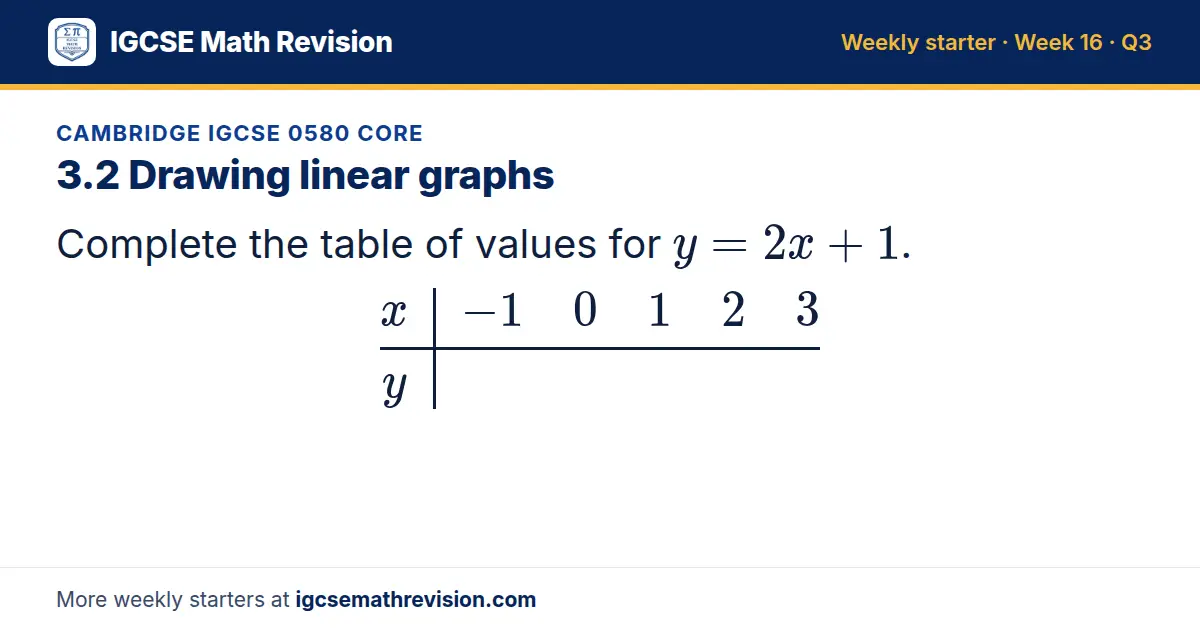
Question 3: 3.2 Drawing linear graphs
Complete the table of values for y = 2x + 1. x -1 0 1 2 3; y
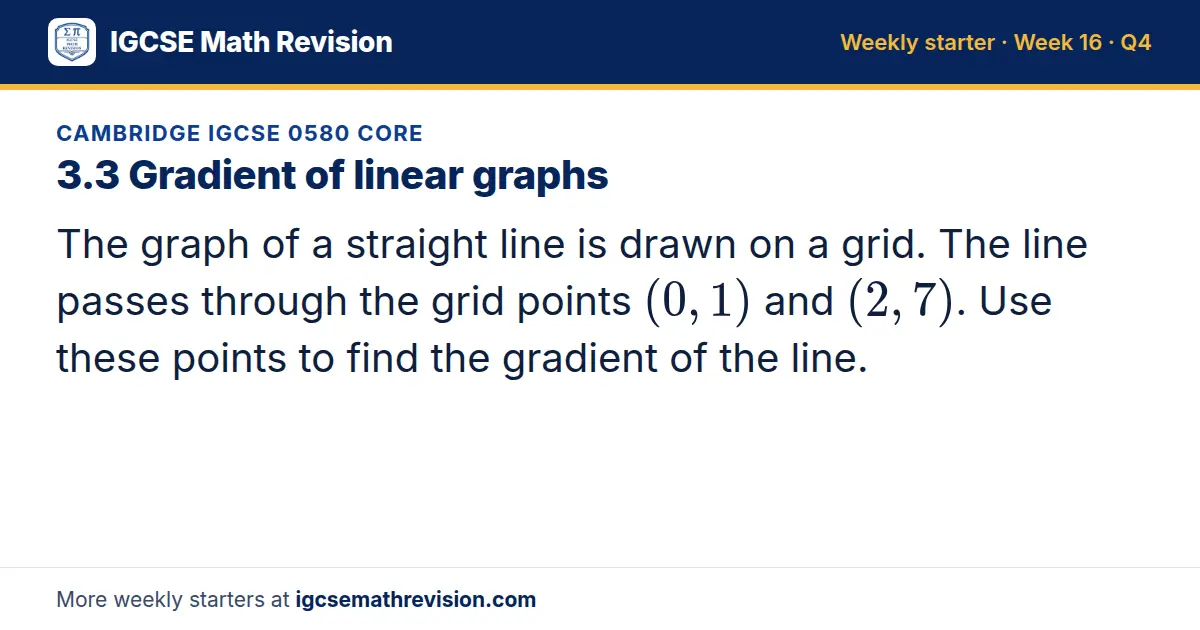
Question 4: 3.3 Gradient of linear graphs
The graph of a straight line is drawn on a grid. The line passes through the grid points (0, 1) and (2, 7). Use these points to find the gradient of the line.
Week 17
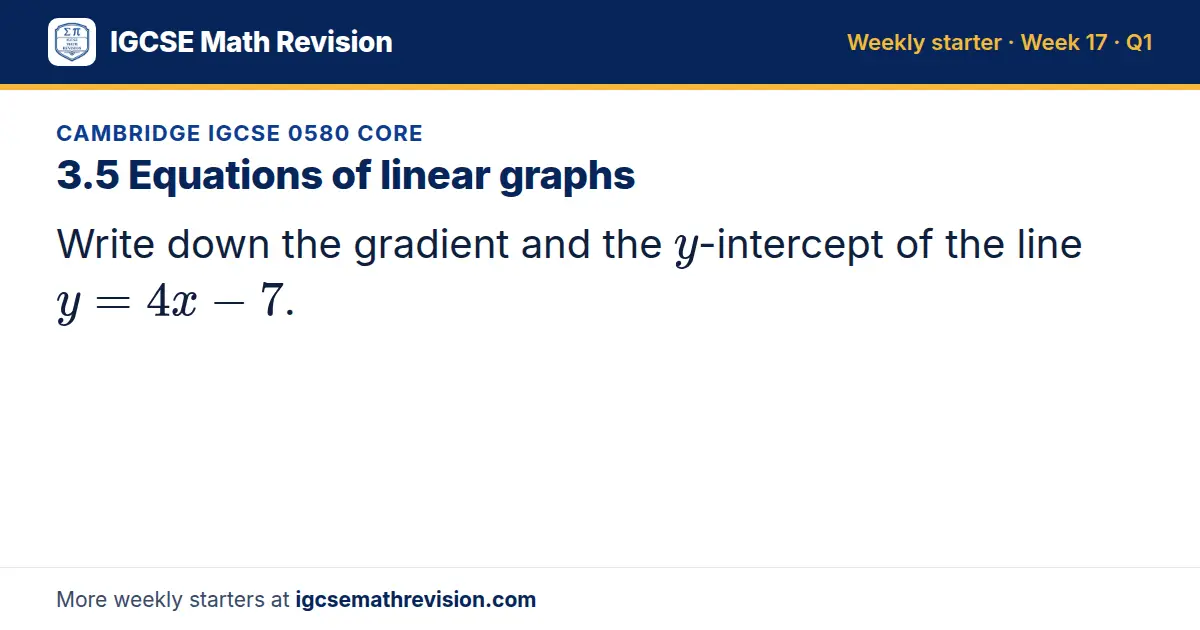
Question 1: 3.5 Equations of linear graphs
Write down the gradient and the y-intercept of the line y = 4x - 7.
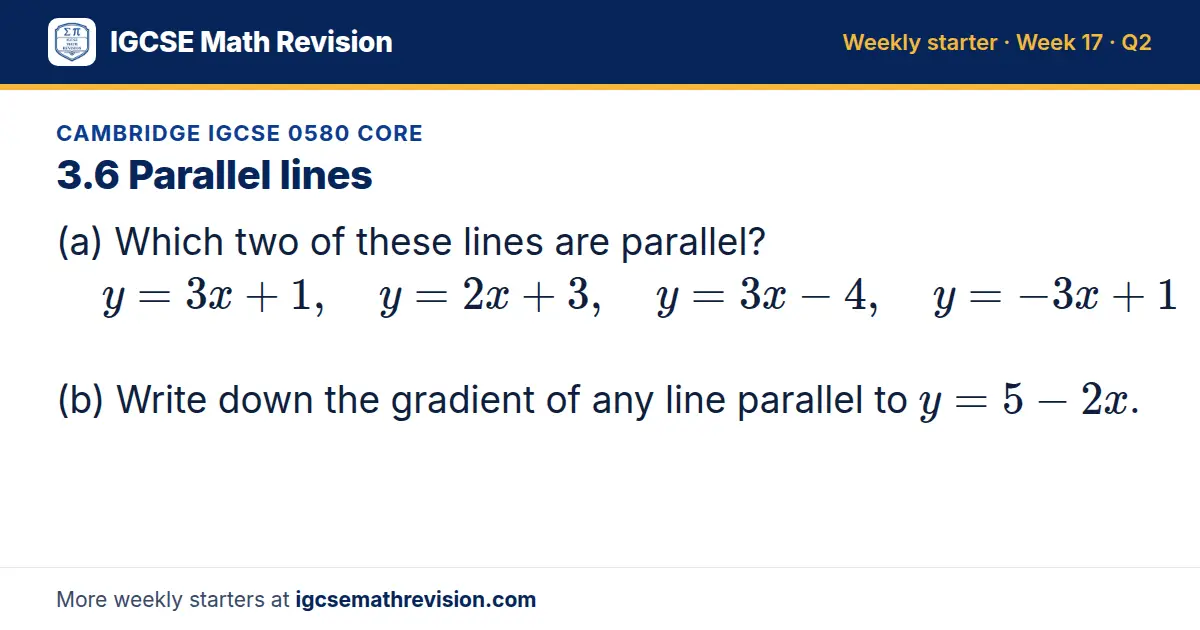
Question 2: 3.6 Parallel lines
(a) Which two of these lines are parallel? y = 3x + 1, y = 2x + 3, y = 3x - 4, y = -3x + 1 (b) Write down the gradient of any line parallel to y = 5 - 2x.
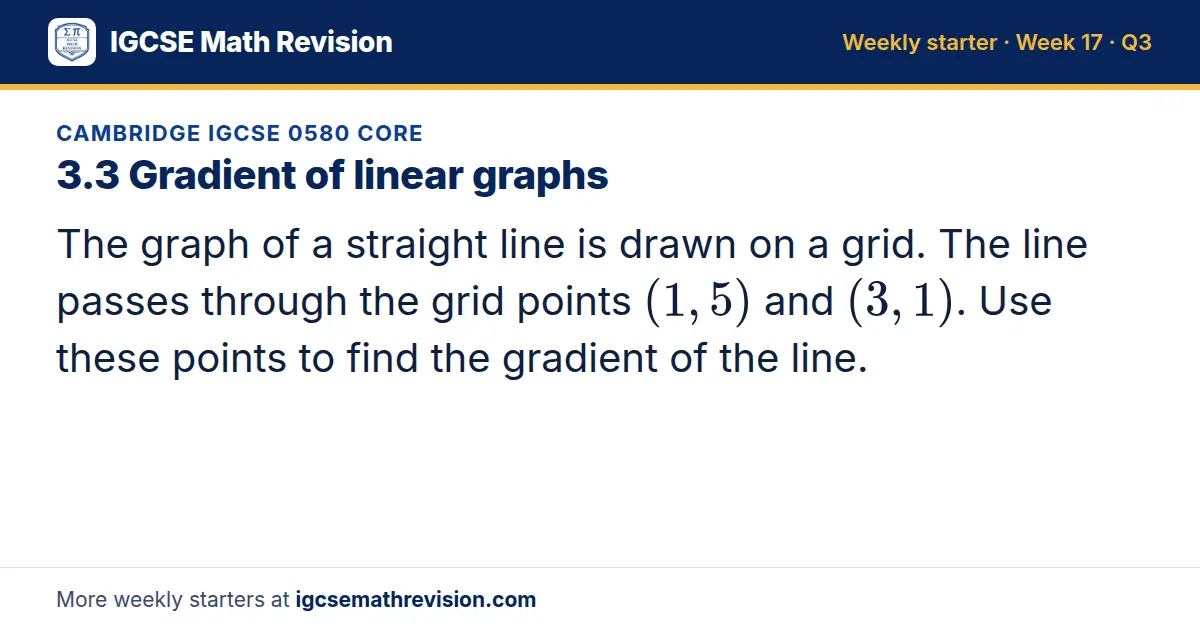
Question 3: 3.3 Gradient of linear graphs
The graph of a straight line is drawn on a grid. The line passes through the grid points (1, 5) and (3, 1). Use these points to find the gradient of the line.
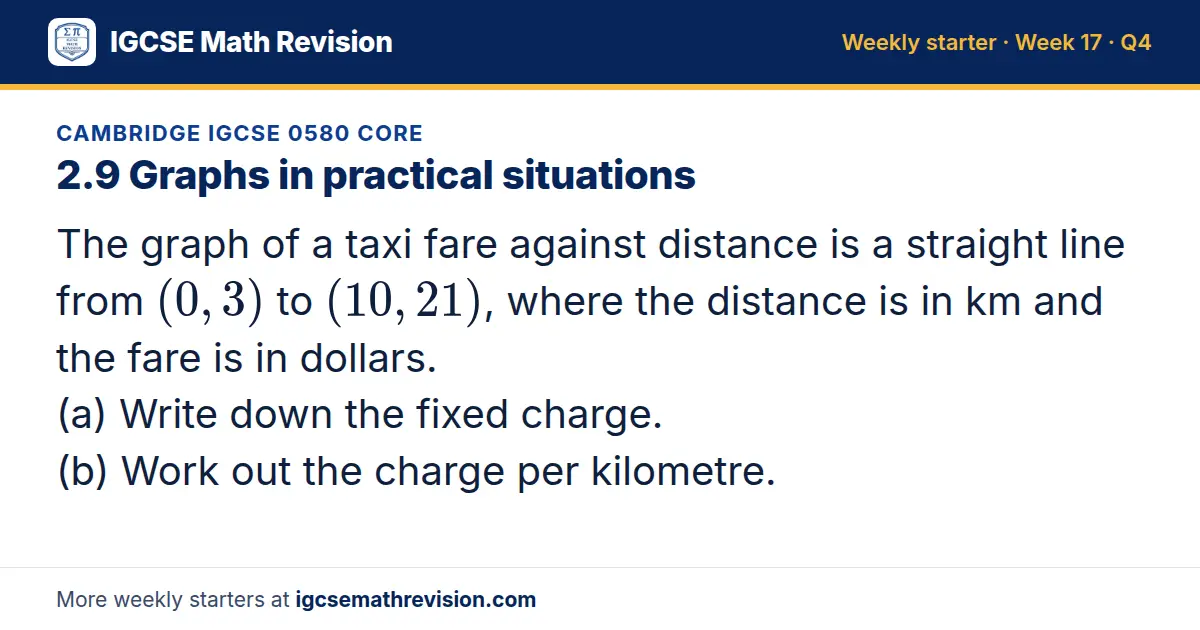
Question 4: 2.9 Graphs in practical situations
The graph of a taxi fare against distance is a straight line from (0, 3) to (10, 21), where the distance is in km and the fare is in dollars. (a) Write down the fixed charge. (b) Work out the charge per kilometre.
Week 18
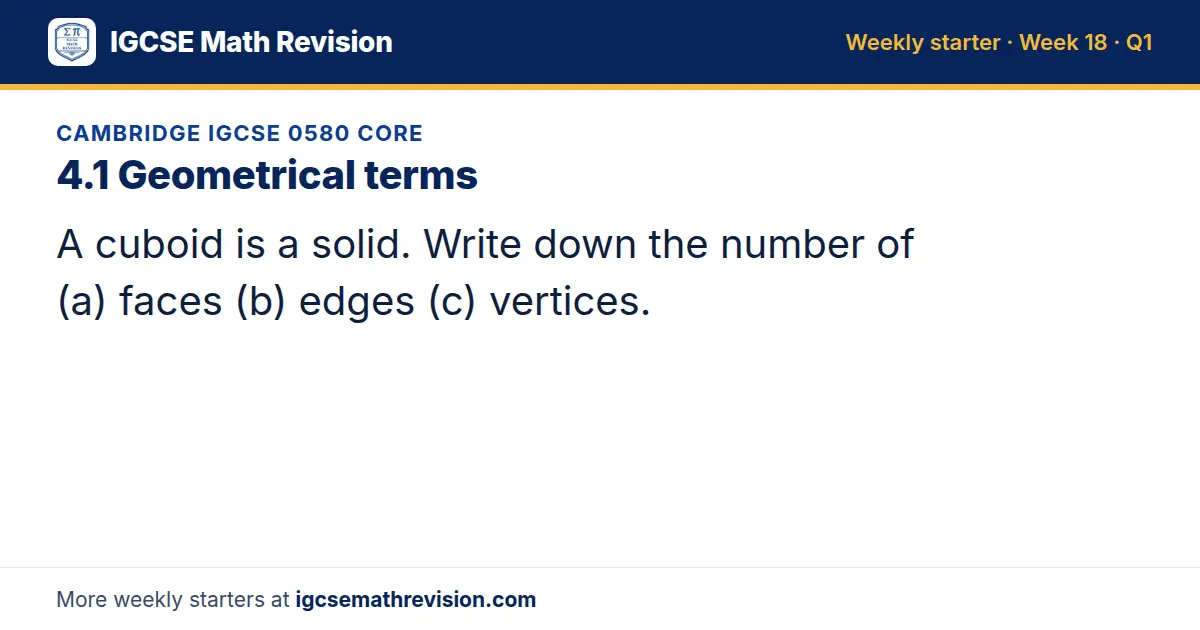
Question 1: 4.1 Geometrical terms
A cuboid is a solid. Write down the number of (a) faces (b) edges (c) vertices.
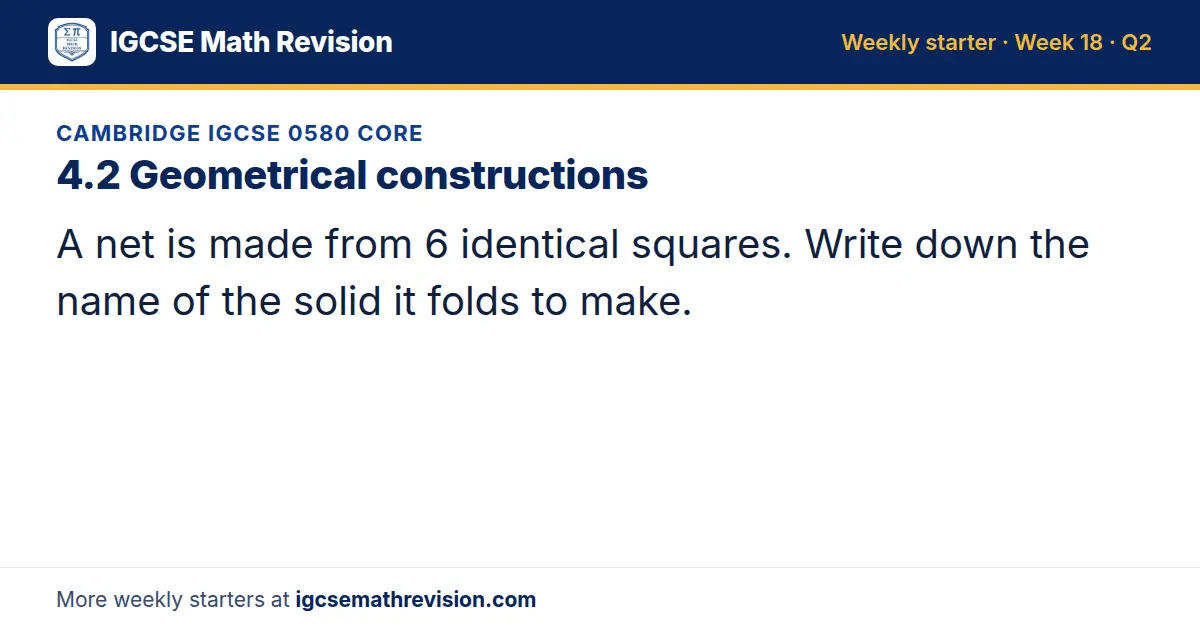
Question 2: 4.2 Geometrical constructions
A net is made from 6 identical squares. Write down the name of the solid it folds to make.
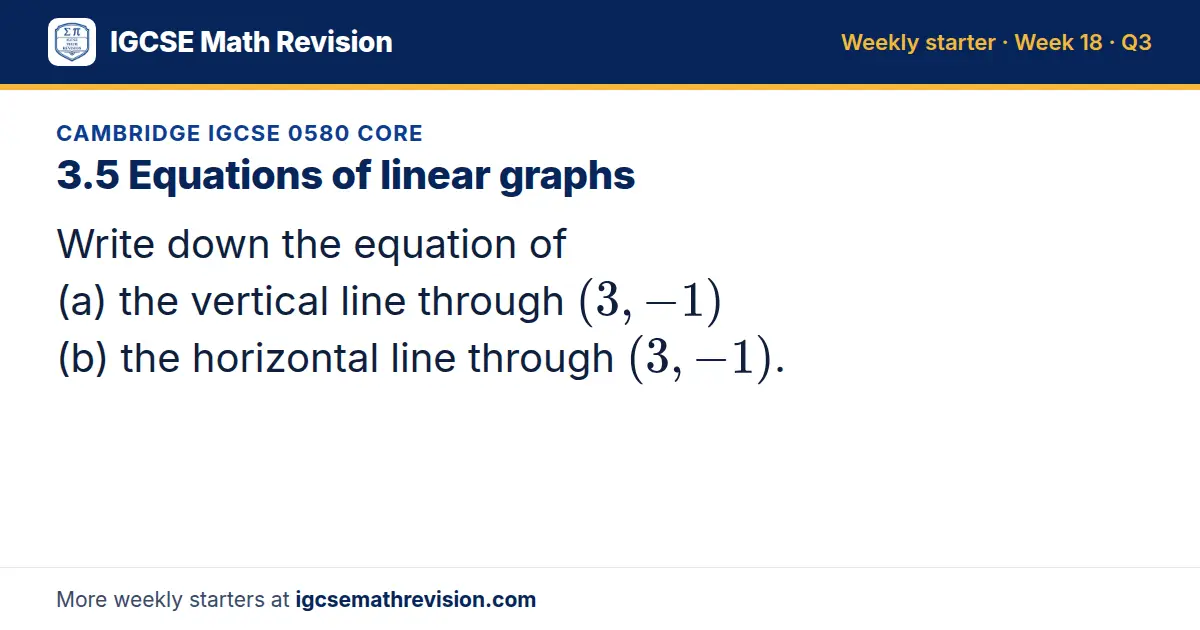
Question 3: 3.5 Equations of linear graphs
Write down the equation of (a) the vertical line through (3, -1) (b) the horizontal line through (3, -1).
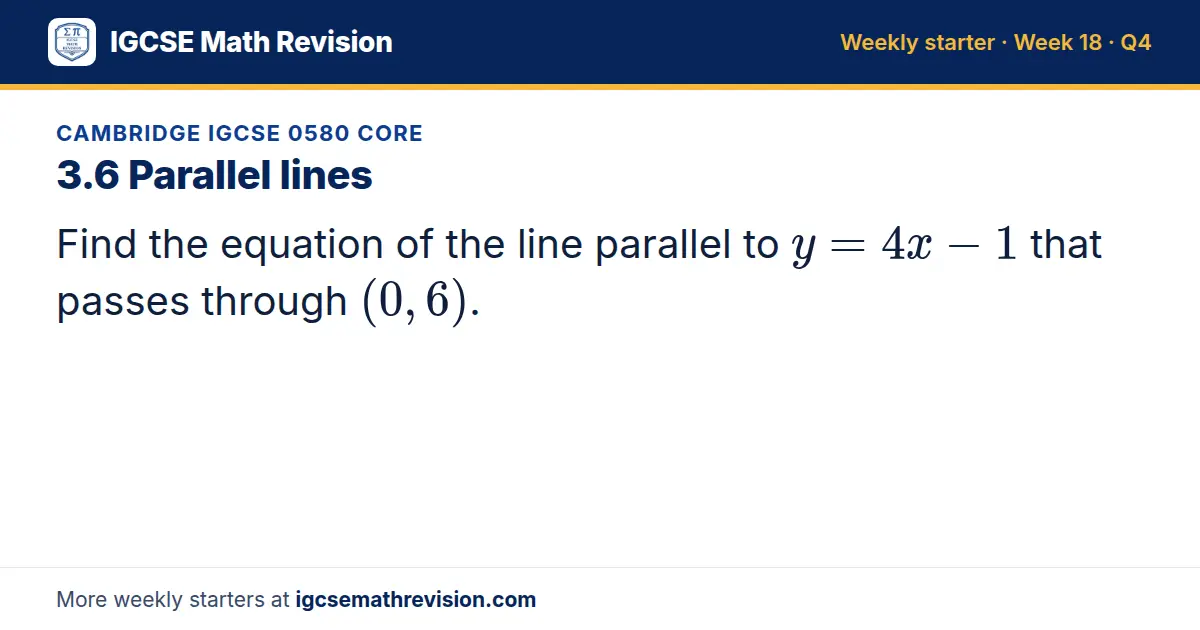
Question 4: 3.6 Parallel lines
Find the equation of the line parallel to y = 4x - 1 that passes through (0, 6).
Week 19
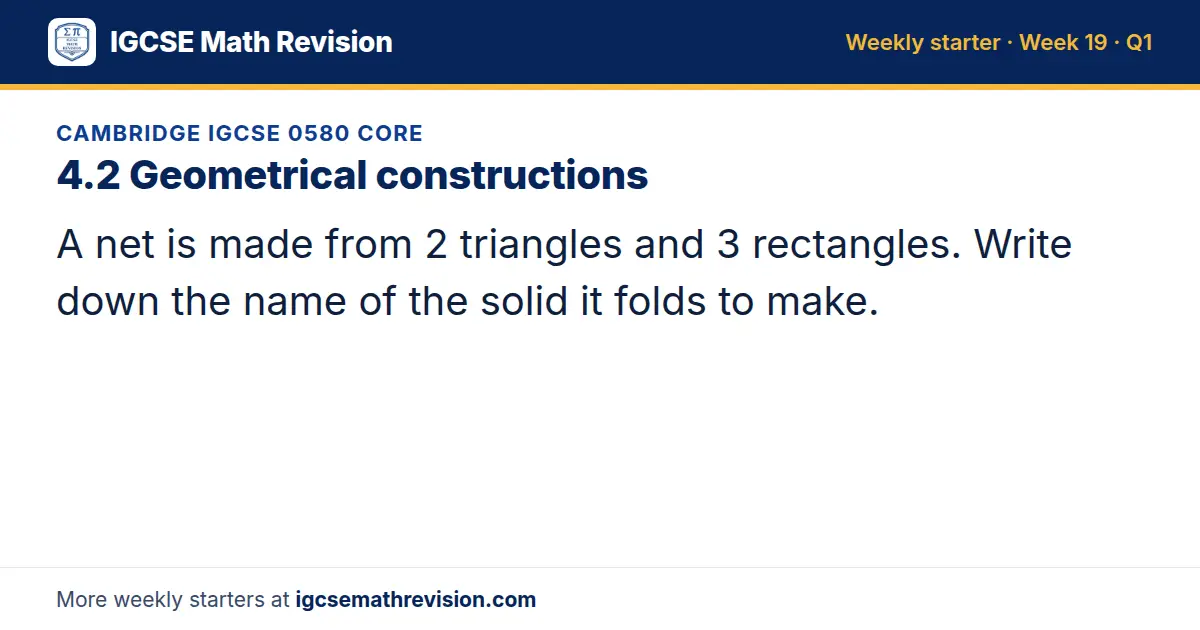
Question 1: 4.2 Geometrical constructions
A net is made from 2 triangles and 3 rectangles. Write down the name of the solid it folds to make.
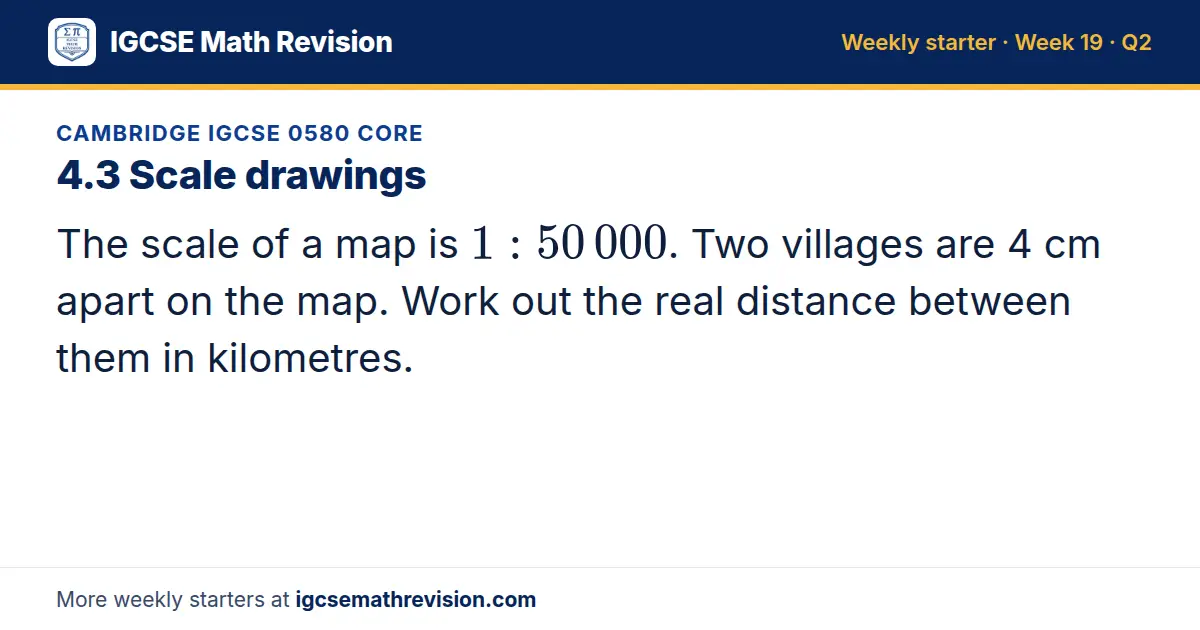
Question 2: 4.3 Scale drawings
The scale of a map is 1: 50 000. Two villages are 4 cm apart on the map. Work out the real distance between them in kilometres.
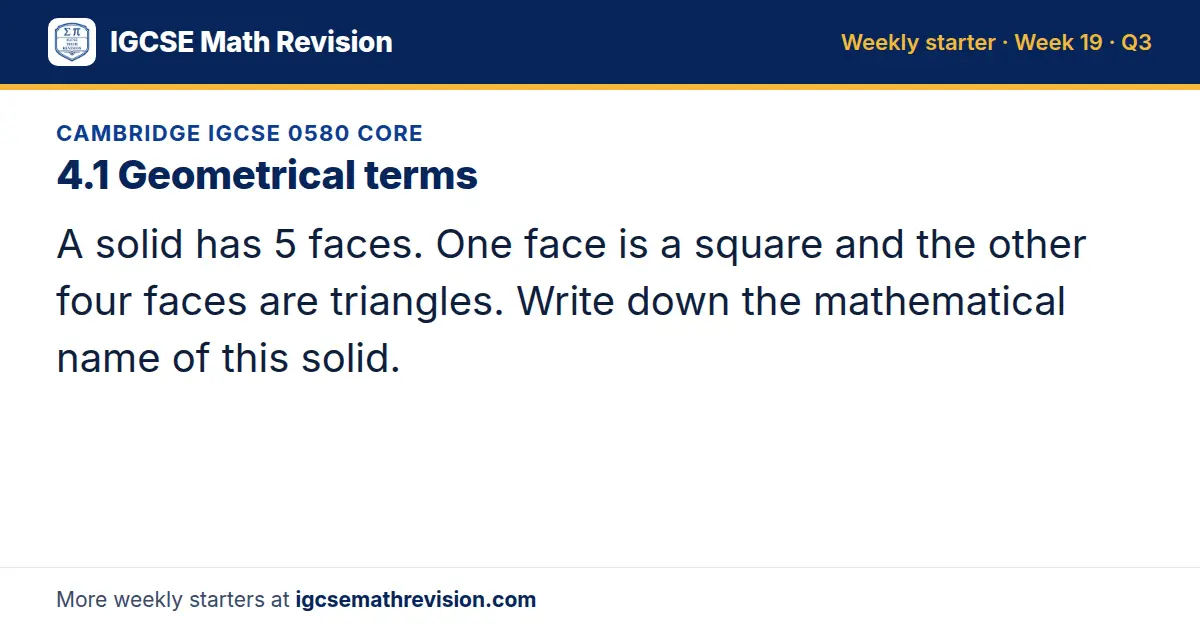
Question 3: 4.1 Geometrical terms
A solid has 5 faces. One face is a square and the other four faces are triangles. Write down the mathematical name of this solid.
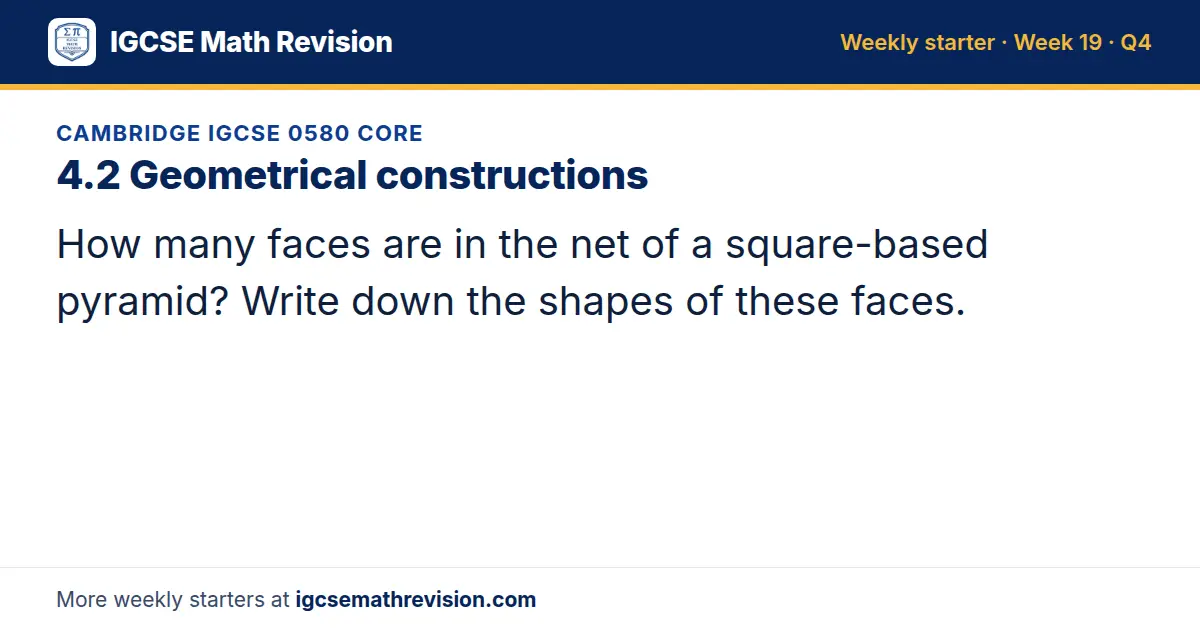
Question 4: 4.2 Geometrical constructions
How many faces are in the net of a square-based pyramid? Write down the shapes of these faces.
Week 20
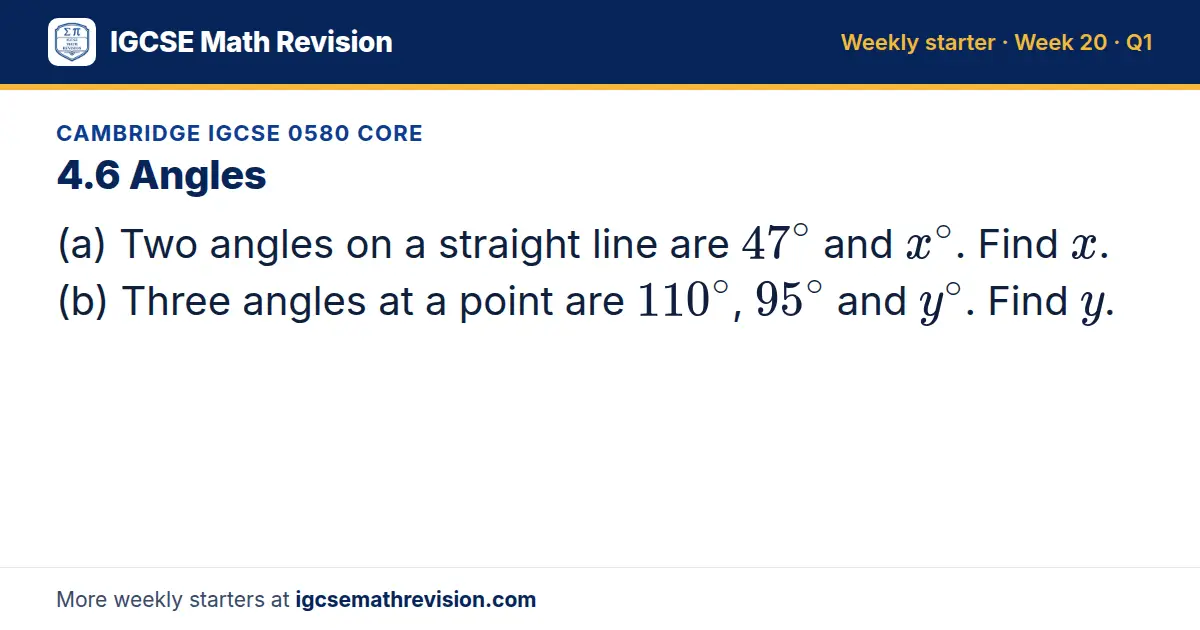
Question 1: 4.6 Angles
(a) Two angles on a straight line are 47^∘ and x^∘. Find x. (b) Three angles at a point are 110^∘, 95^∘ and y^∘. Find y.
Question 2: 4.2 Geometrical constructions
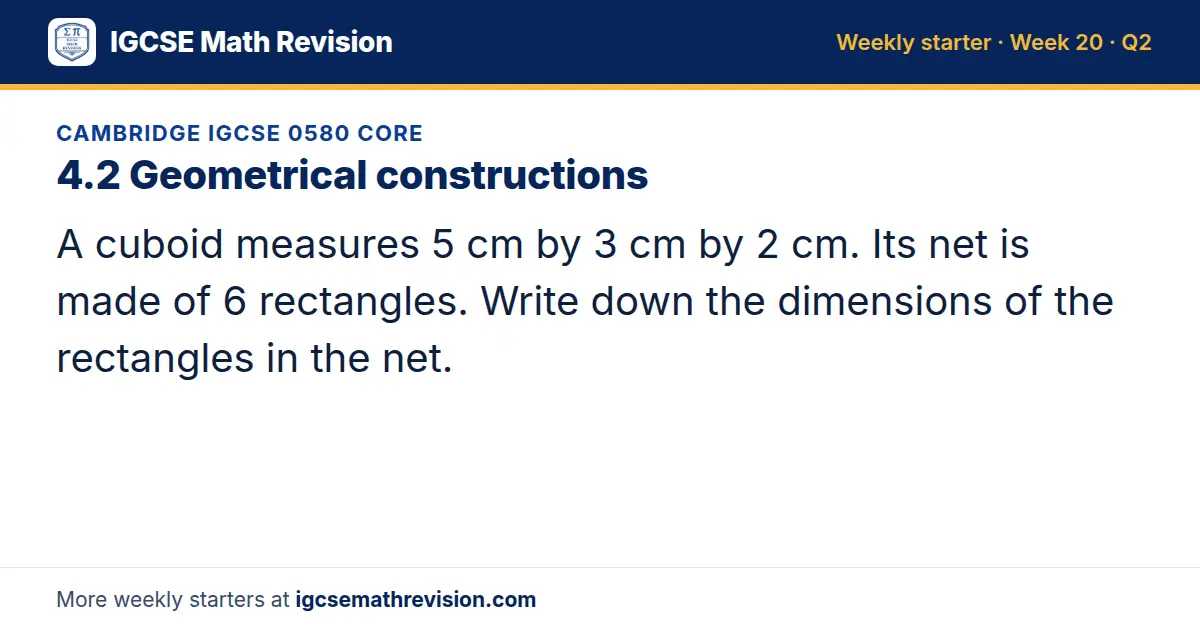
A cuboid measures 5 cm by 3 cm by 2 cm. Its net is made of 6 rectangles. Write down the dimensions of the rectangles in the net.
Question 3: 4.3 Scale drawings
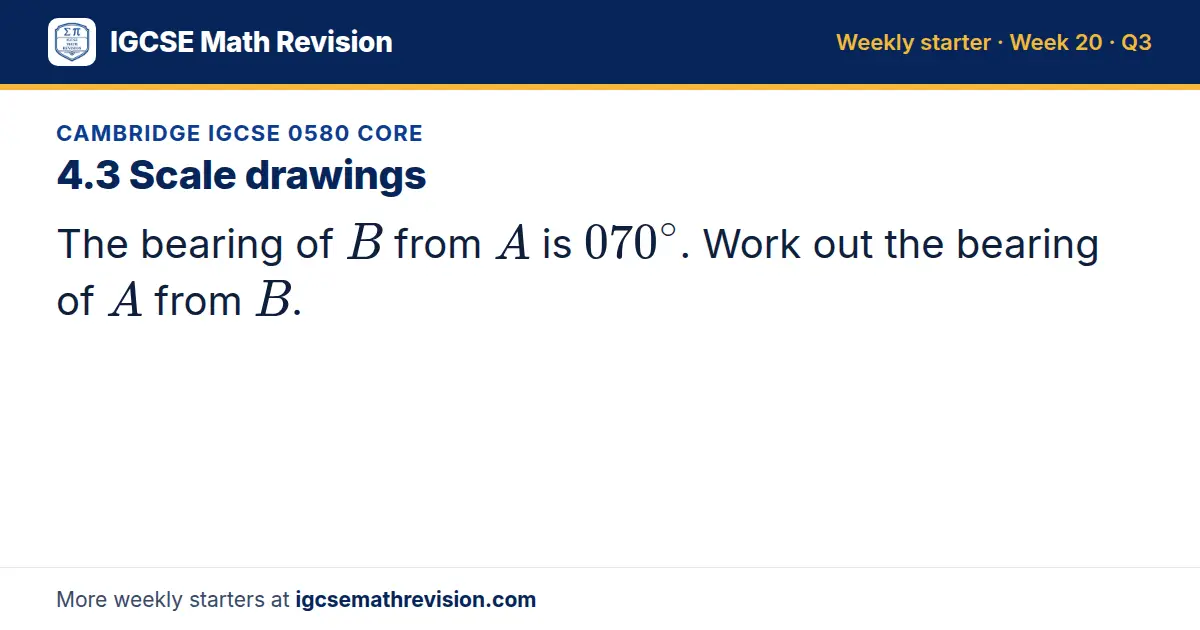
The bearing of B from A is 070^∘. Work out the bearing of A from B.
Question 4: 4.6 Angles
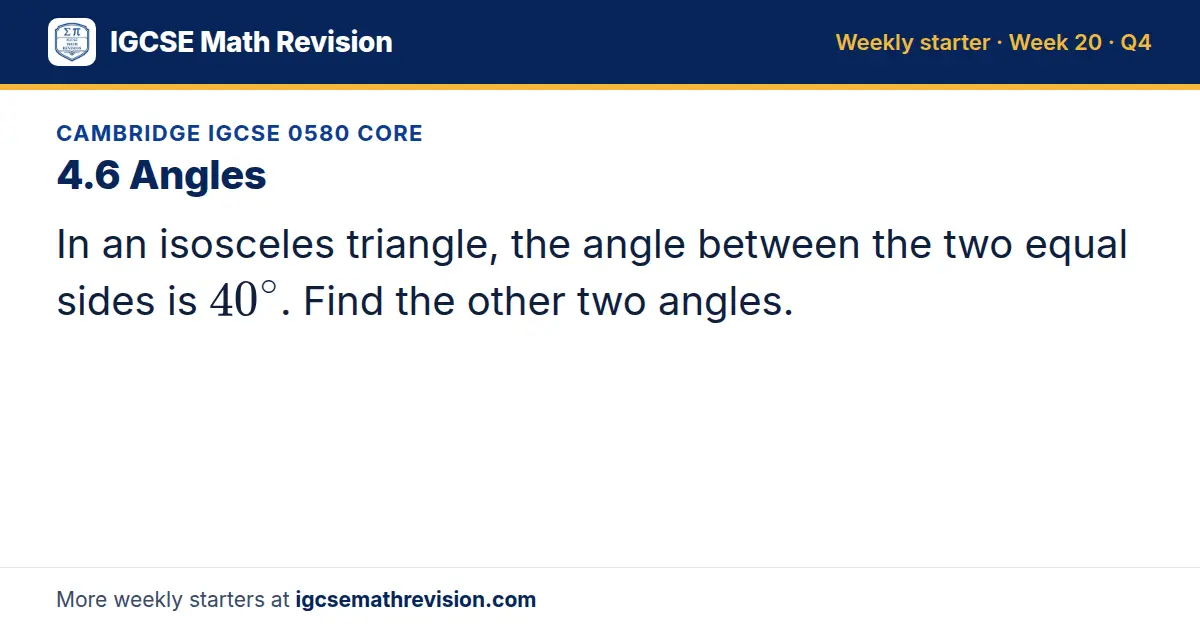
In an isosceles triangle, the angle between the two equal sides is 40^∘. Find the other two angles.
Week 21
Question 1: 4.5 Symmetry
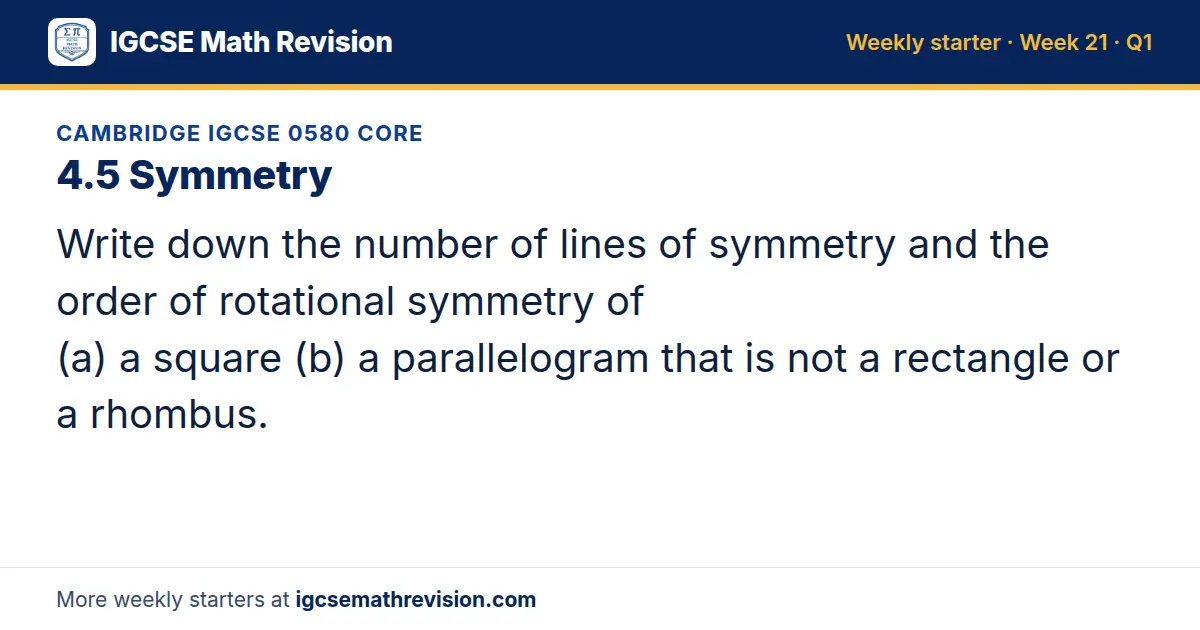
Write down the number of lines of symmetry and the order of rotational symmetry of (a) a square (b) a parallelogram that is not a rectangle or a rhombus.
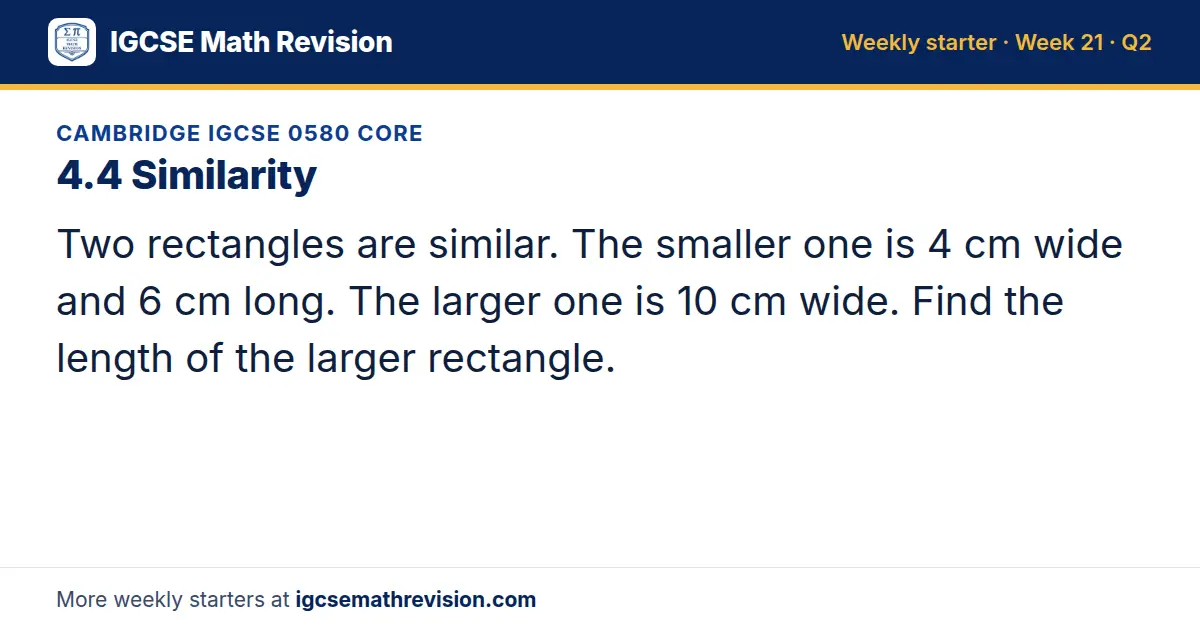
Question 2: 4.4 Similarity
Two rectangles are similar. The smaller one is 4 cm wide and 6 cm long. The larger one is 10 cm wide. Find the length of the larger rectangle.
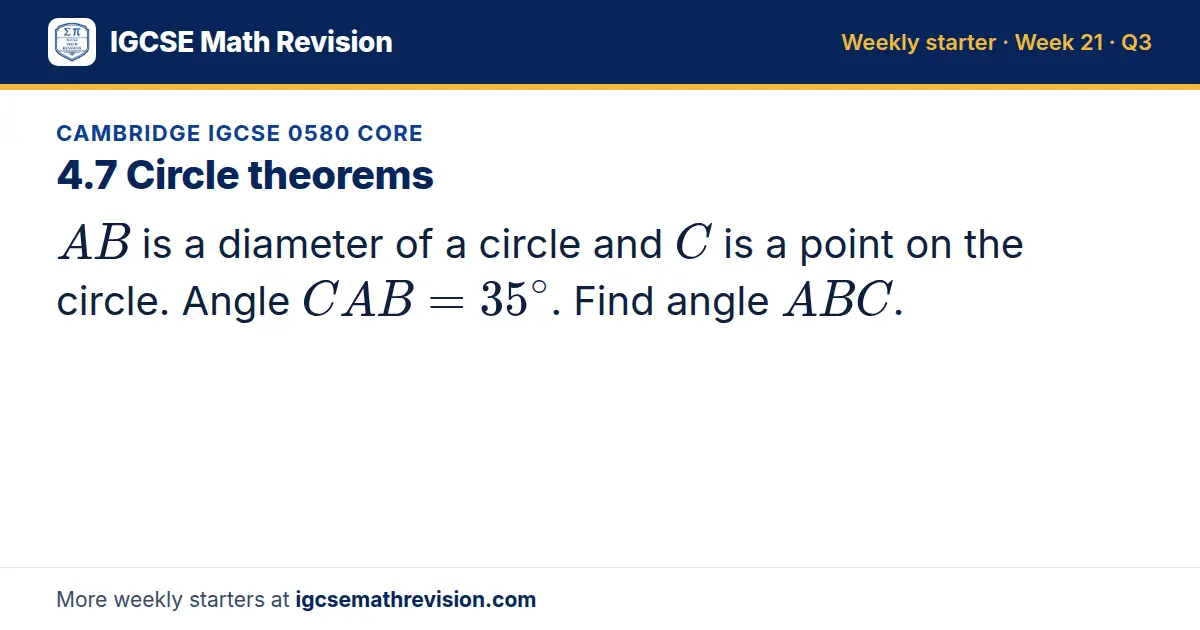
Question 3: 4.7 Circle theorems
AB is a diameter of a circle and C is a point on the circle. Angle CAB = 35^∘. Find angle ABC.
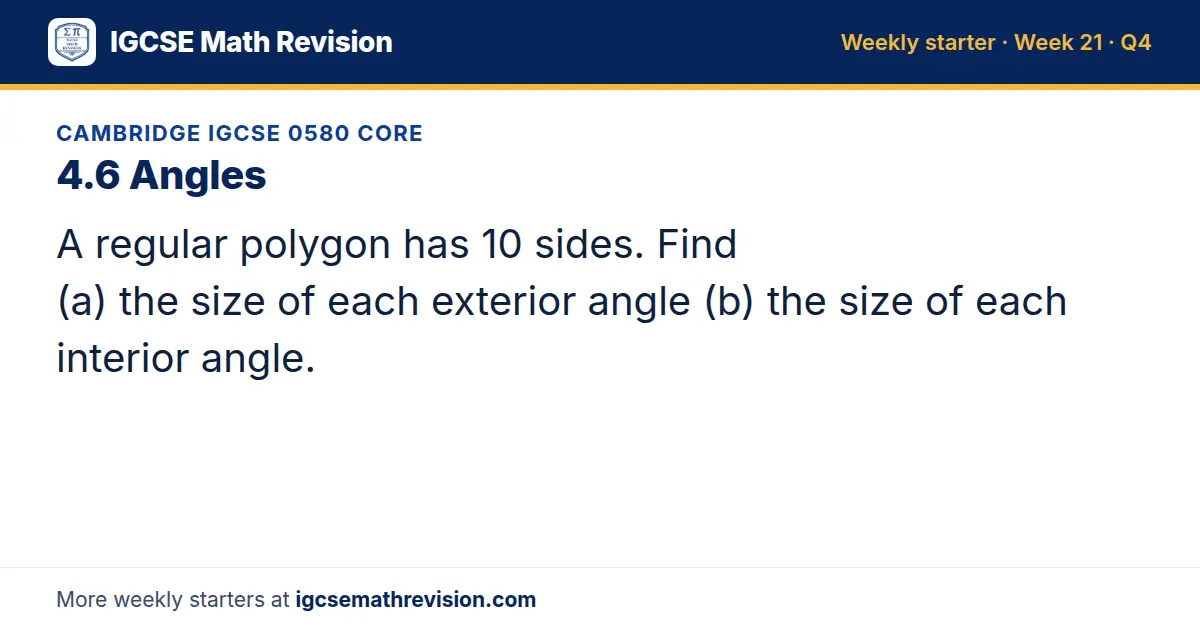
Question 4: 4.6 Angles
A regular polygon has 10 sides. Find (a) the size of each exterior angle (b) the size of each interior angle.
Week 22
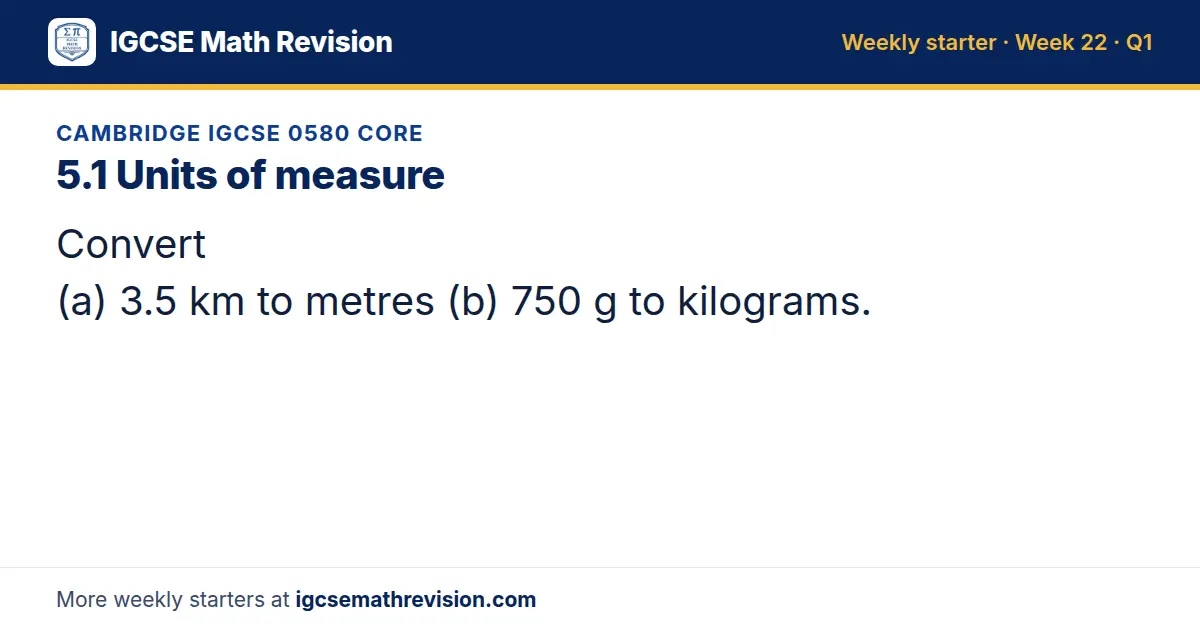
Question 1: 5.1 Units of measure
Convert (a) 3.5 km to metres (b) 750 g to kilograms.
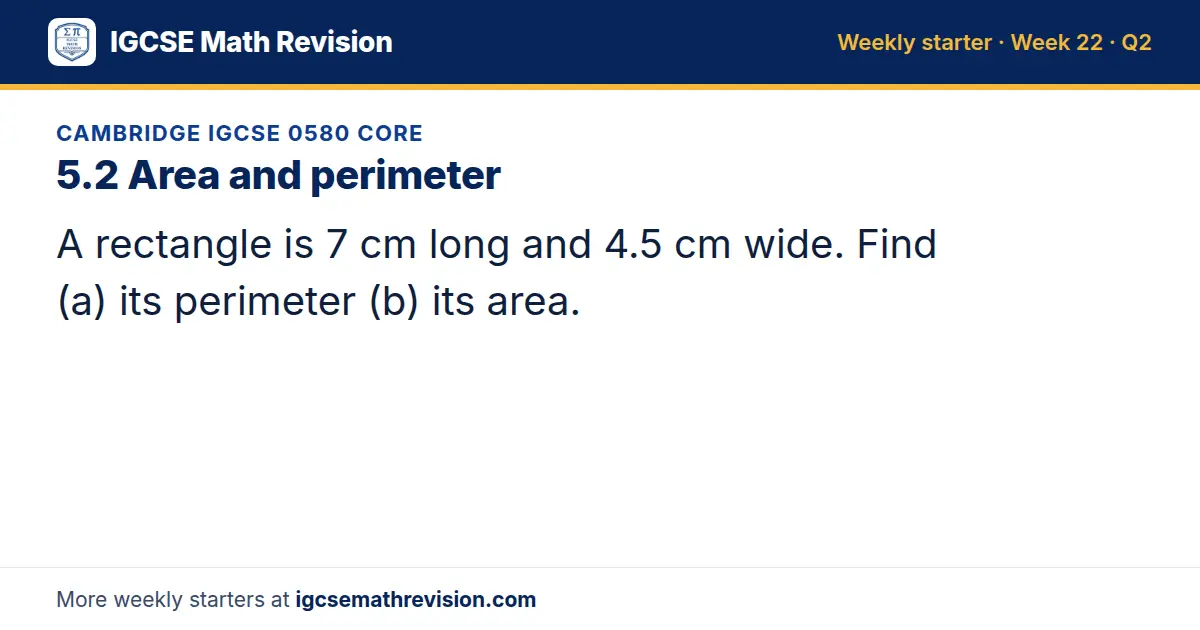
Question 2: 5.2 Area and perimeter
A rectangle is 7 cm long and 4.5 cm wide. Find (a) its perimeter (b) its area.
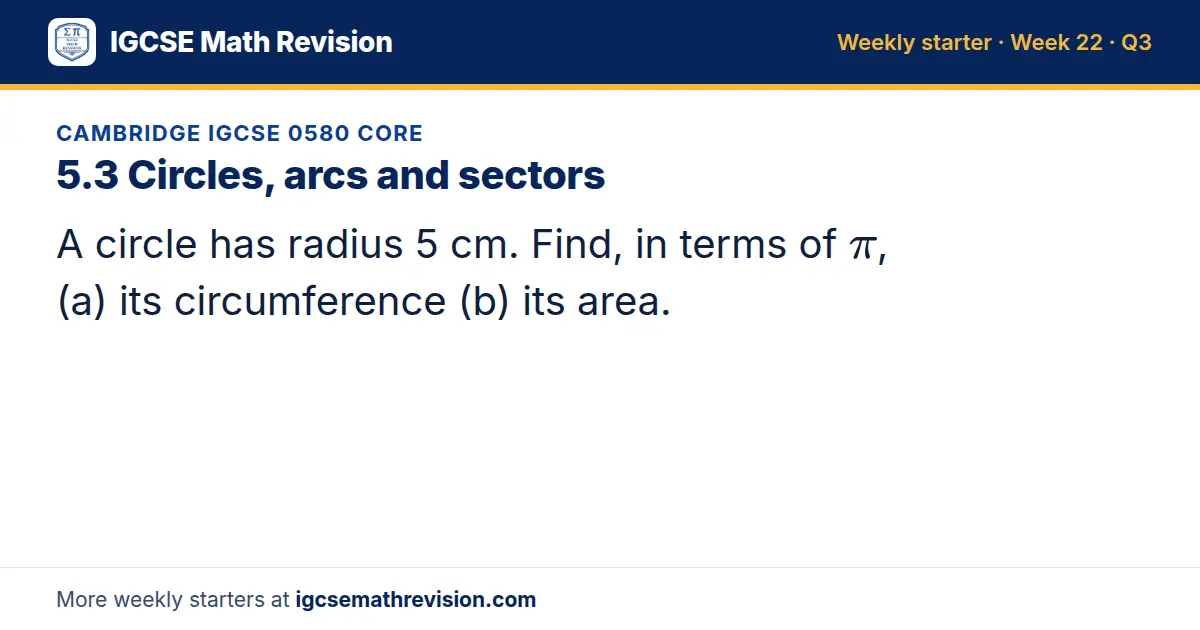
Question 3: 5.3 Circles, arcs and sectors
A circle has radius 5 cm. Find, in terms of π, (a) its circumference (b) its area.
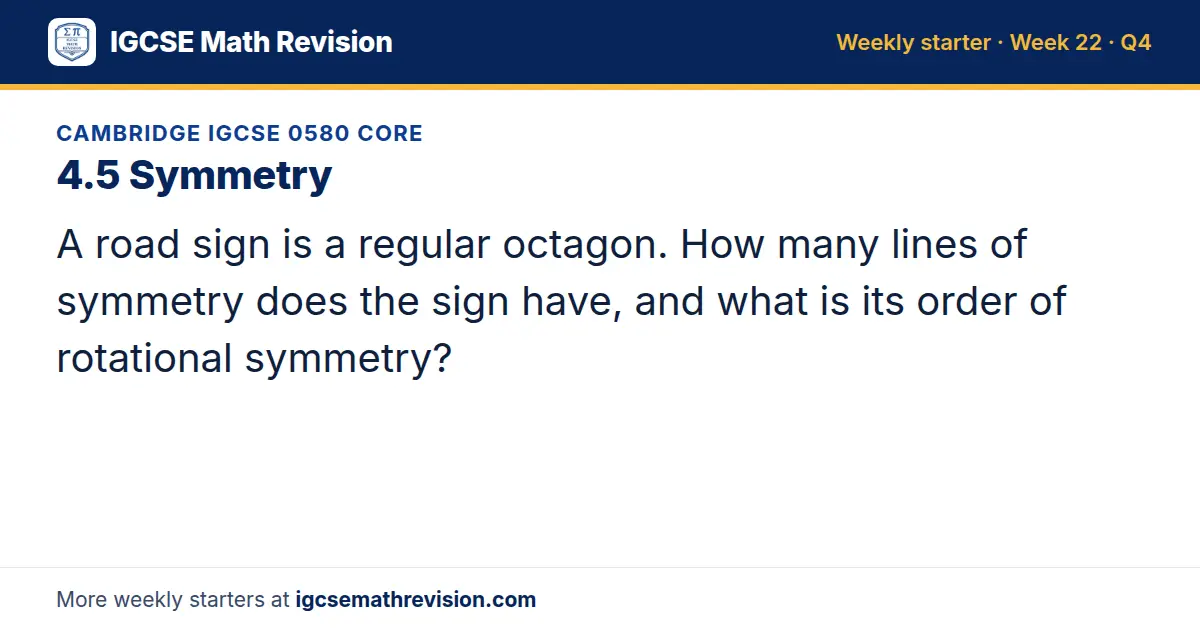
Question 4: 4.5 Symmetry
A road sign is a regular octagon. How many lines of symmetry does the sign have, and what is its order of rotational symmetry?
Week 23
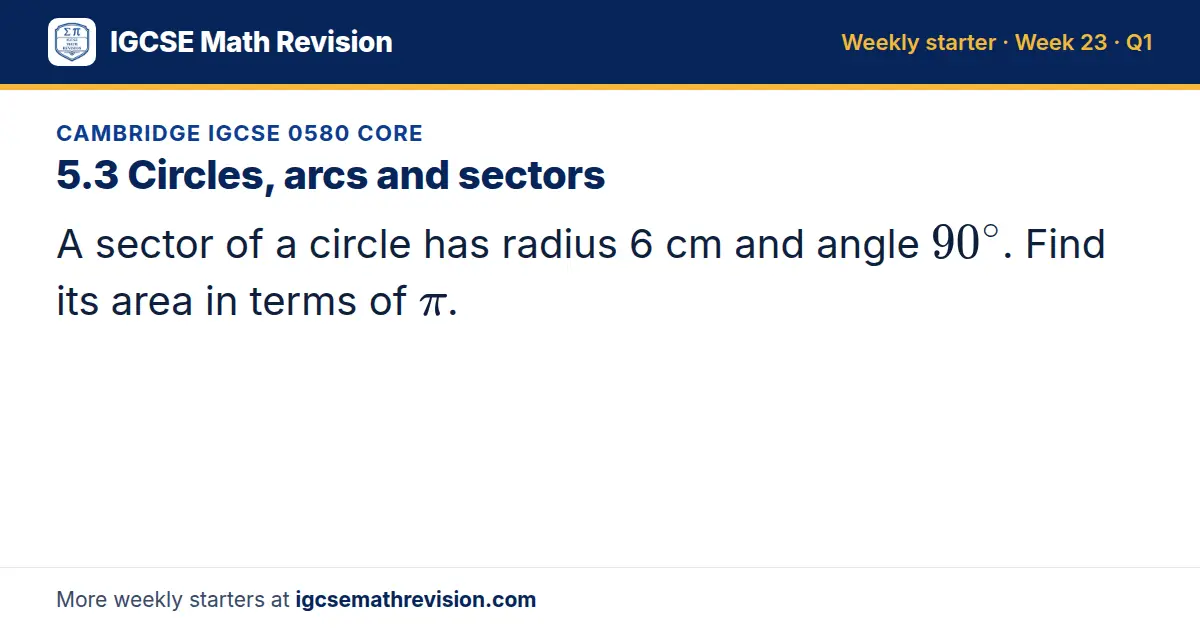
Question 1: 5.3 Circles, arcs and sectors
A sector of a circle has radius 6 cm and angle 90^∘. Find its area in terms of π.
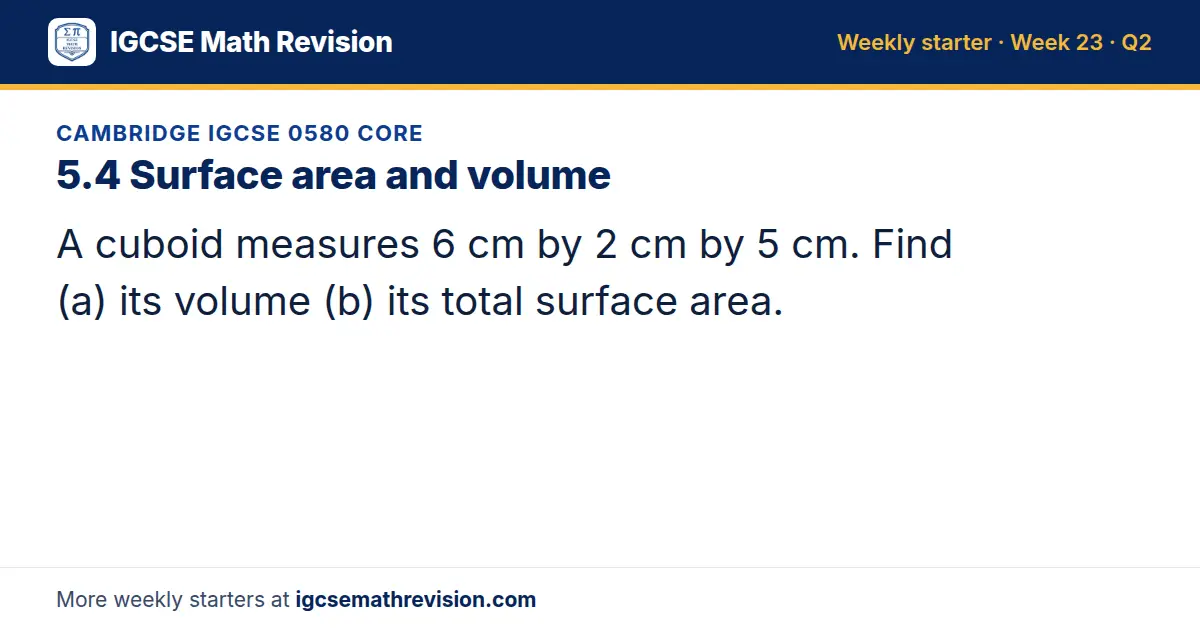
Question 2: 5.4 Surface area and volume
A cuboid measures 6 cm by 2 cm by 5 cm. Find (a) its volume (b) its total surface area.
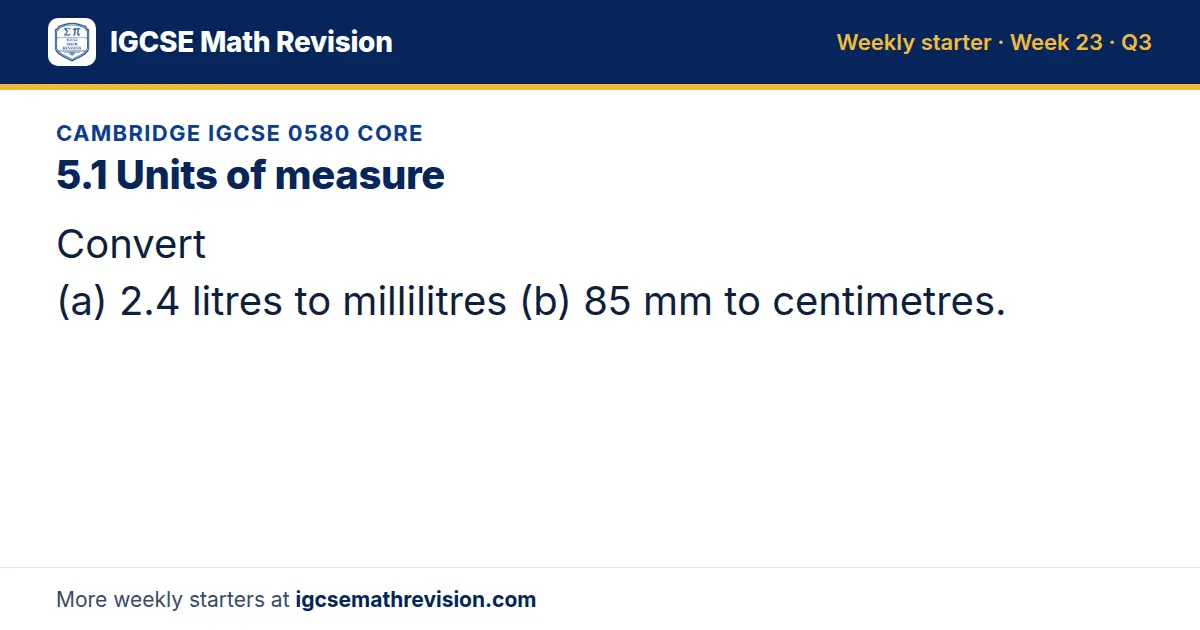
Question 3: 5.1 Units of measure
Convert (a) 2.4 litres to millilitres (b) 85 mm to centimetres.
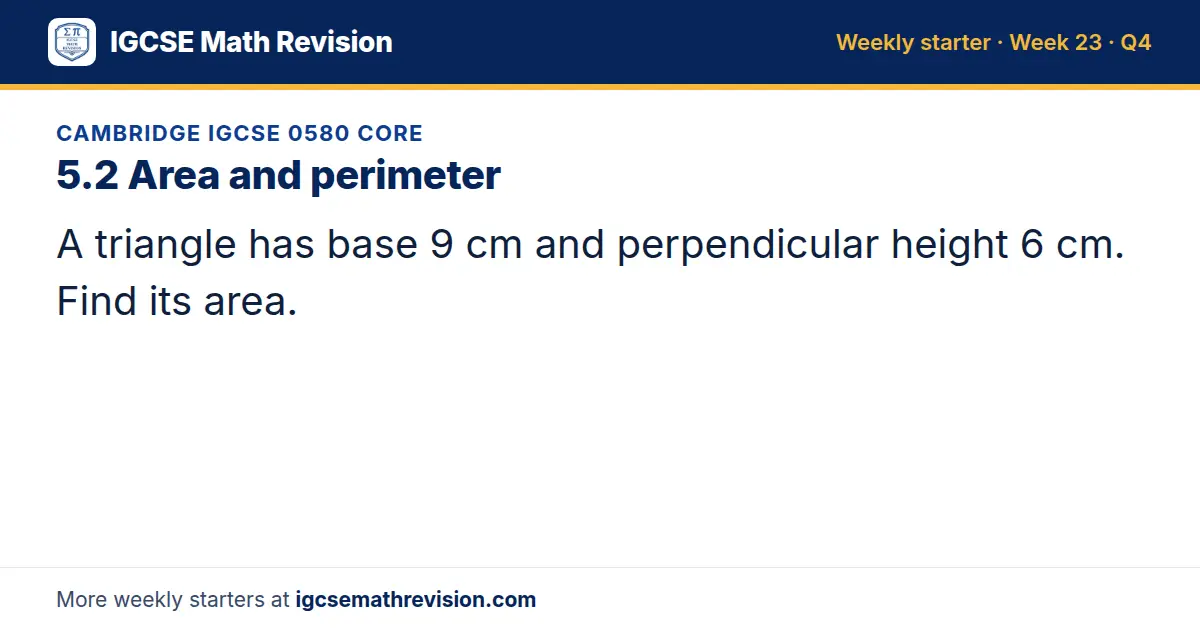
Question 4: 5.2 Area and perimeter
A triangle has base 9 cm and perpendicular height 6 cm. Find its area.
Week 24
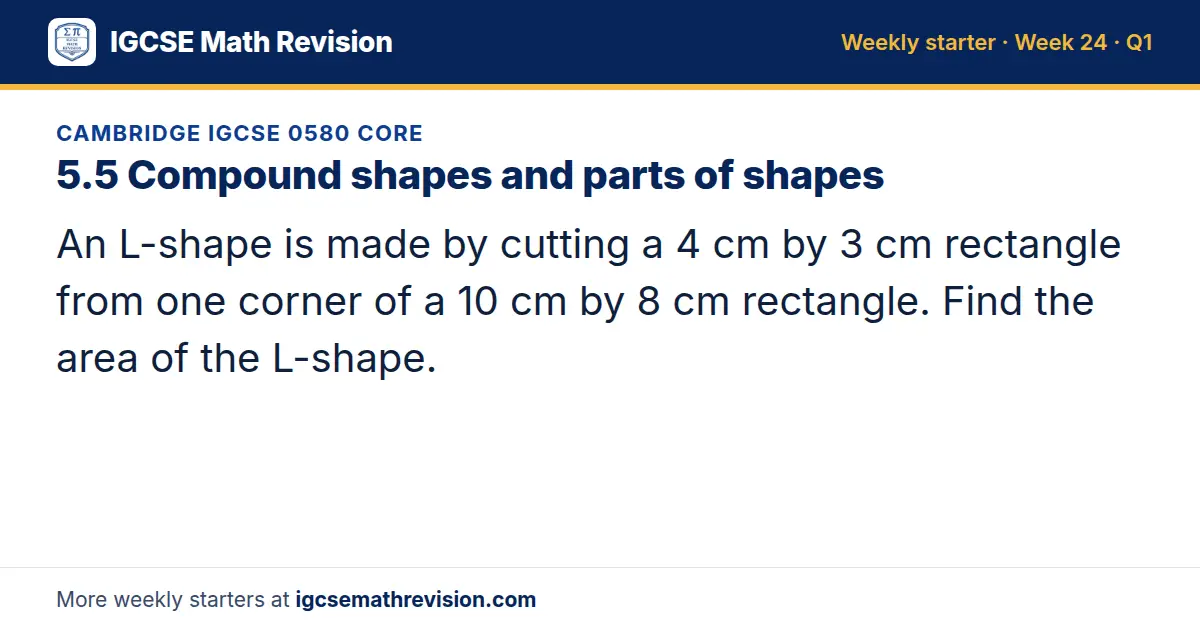
Question 1: 5.5 Compound shapes and parts of shapes
An L-shape is made by cutting a 4 cm by 3 cm rectangle from one corner of a 10 cm by 8 cm rectangle. Find the area of the L-shape.
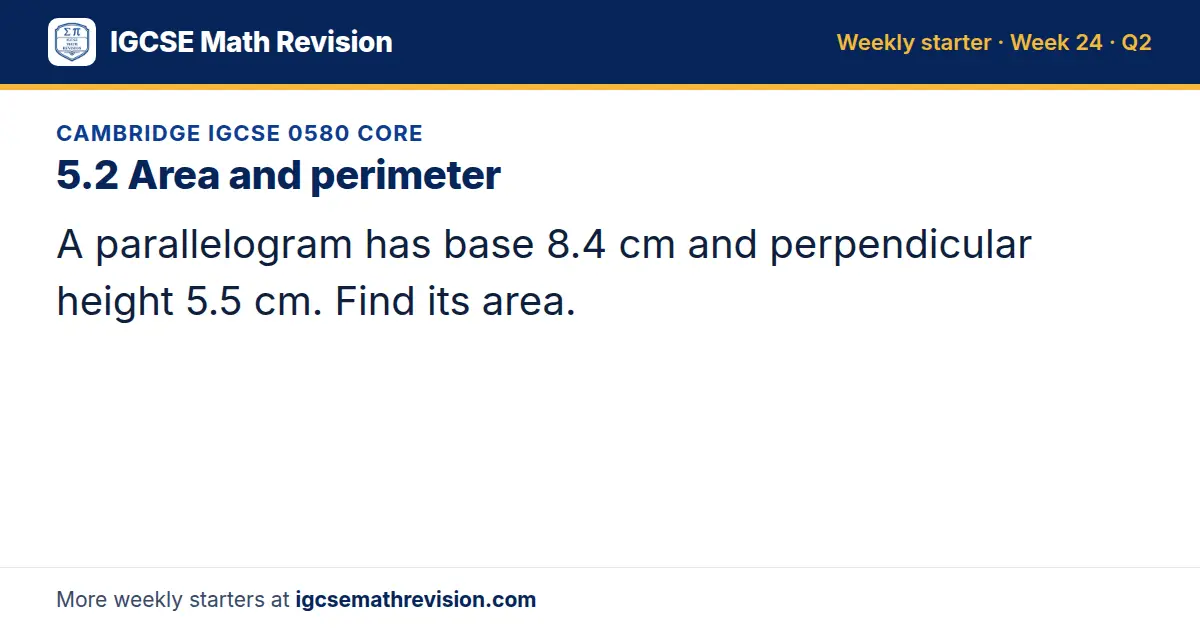
Question 2: 5.2 Area and perimeter
A parallelogram has base 8.4 cm and perpendicular height 5.5 cm. Find its area.
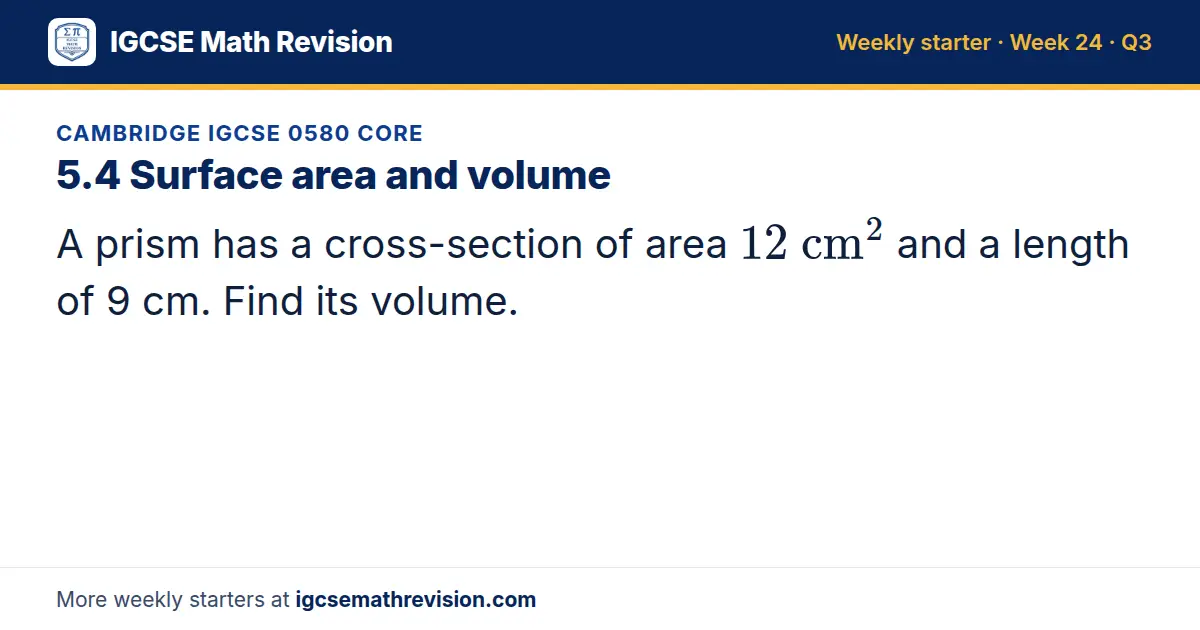
Question 3: 5.4 Surface area and volume
A prism has a cross-section of area 12 cm² and a length of 9 cm. Find its volume.
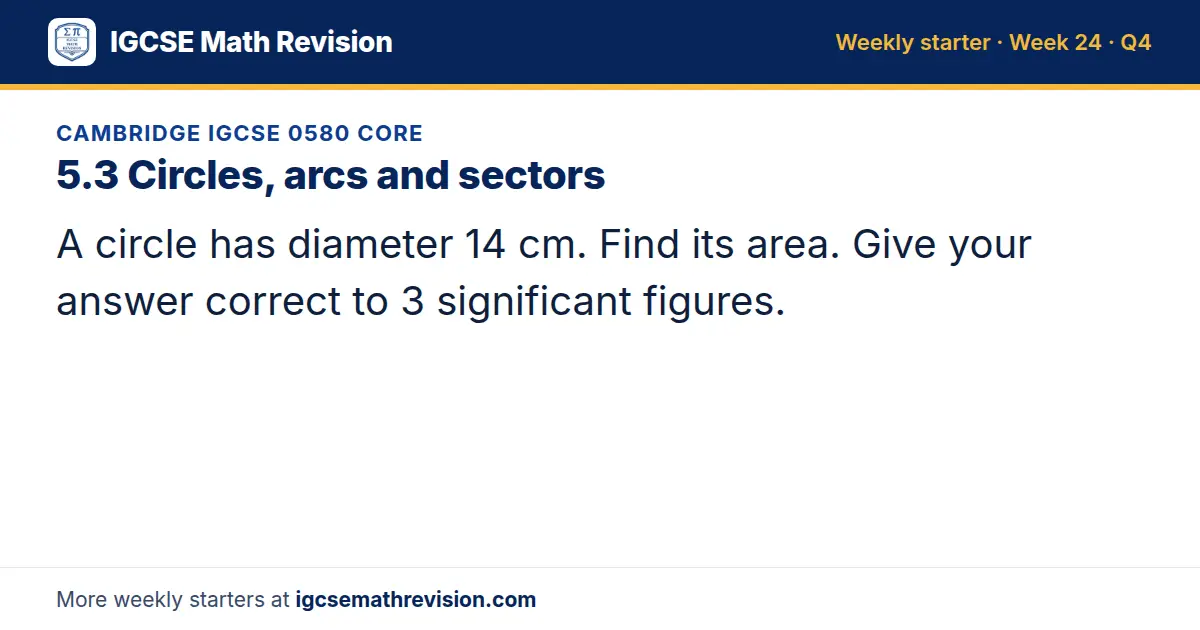
Question 4: 5.3 Circles, arcs and sectors
A circle has diameter 14 cm. Find its area. Give your answer correct to 3 significant figures.
Week 25
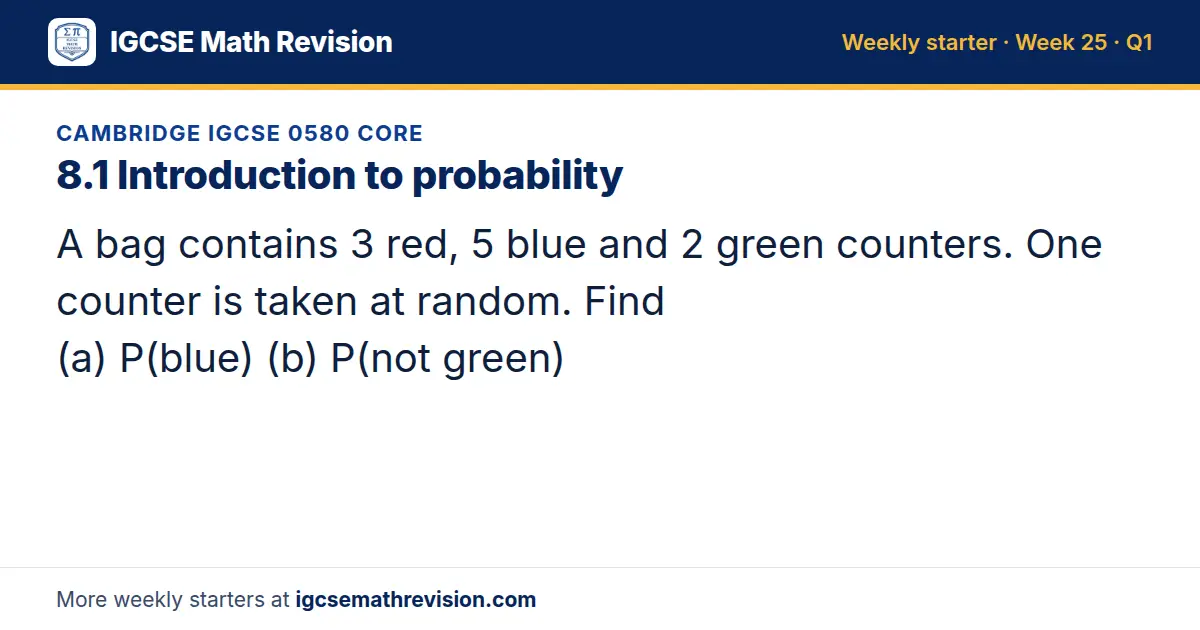
Question 1: 8.1 Introduction to probability
A bag contains 3 red, 5 blue and 2 green counters. One counter is taken at random. Find (a) P(blue) (b) P(not green)
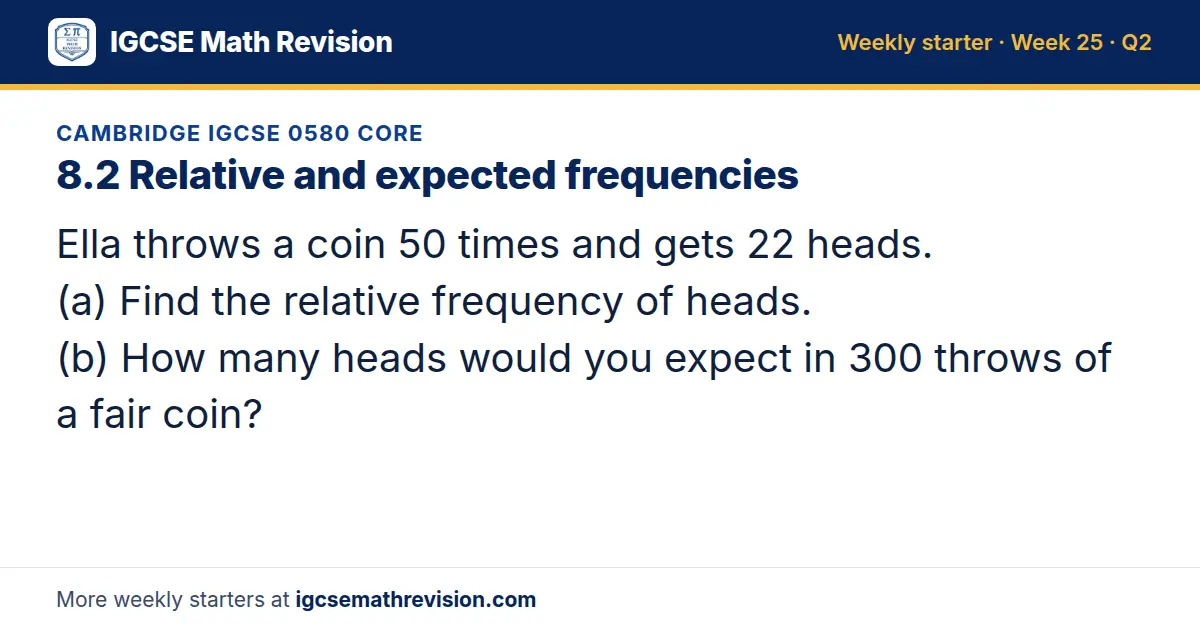
Question 2: 8.2 Relative and expected frequencies
Ella throws a coin 50 times and gets 22 heads. (a) Find the relative frequency of heads. (b) How many heads would you expect in 300 throws of a fair coin?
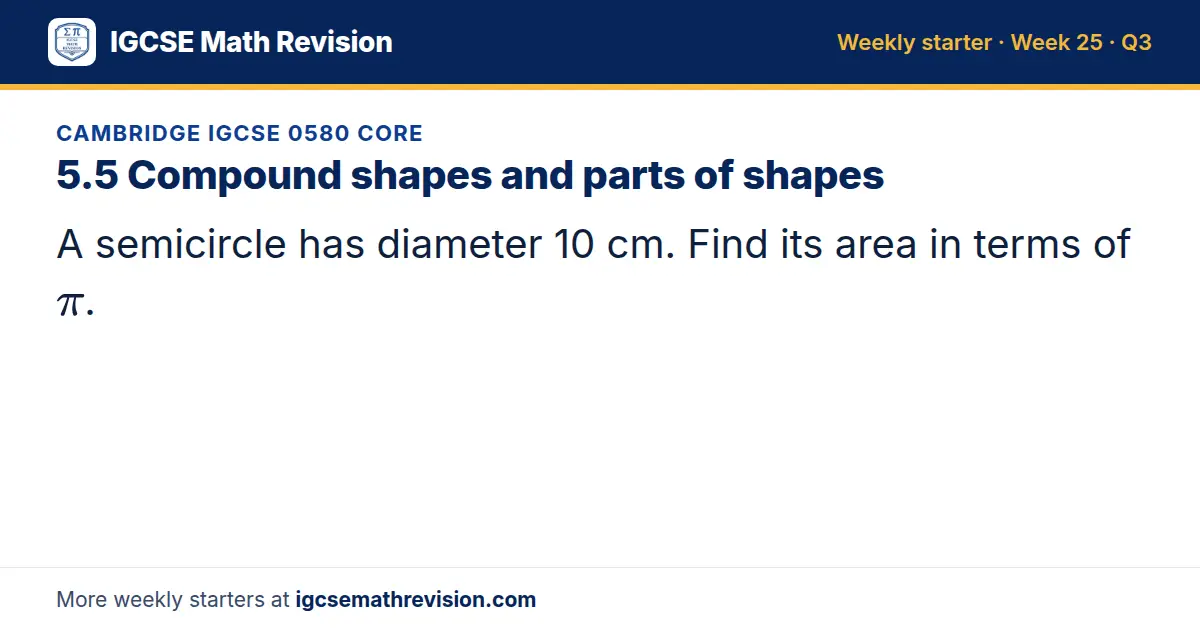
Question 3: 5.5 Compound shapes and parts of shapes
A semicircle has diameter 10 cm. Find its area in terms of π.
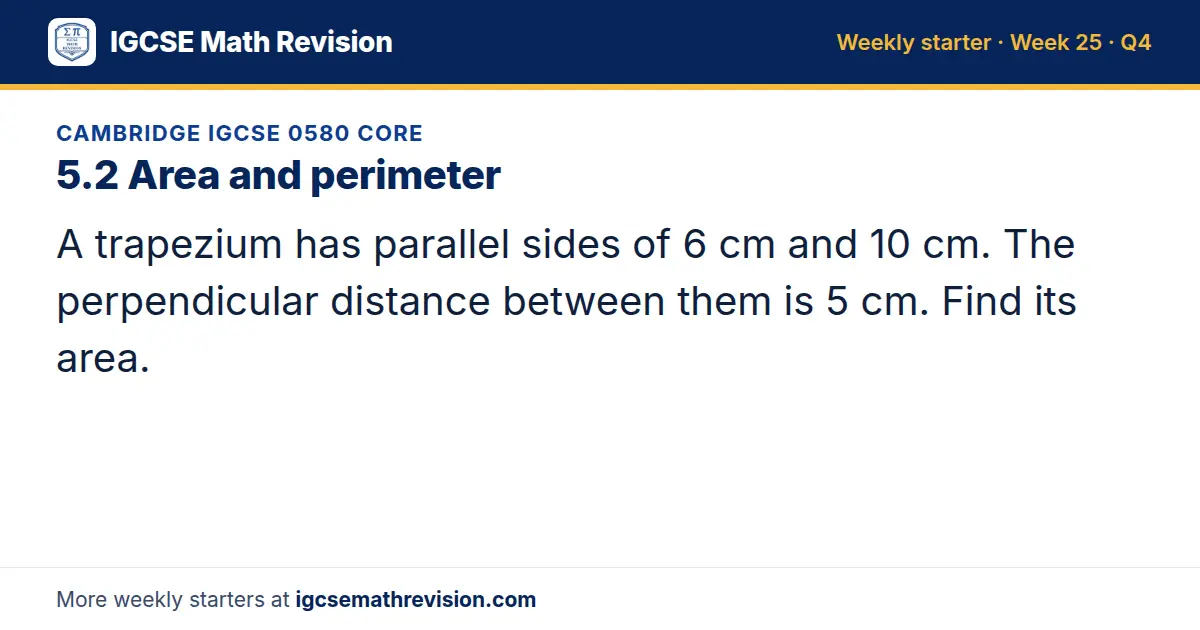
Question 4: 5.2 Area and perimeter
A trapezium has parallel sides of 6 cm and 10 cm. The perpendicular distance between them is 5 cm. Find its area.
Week 26
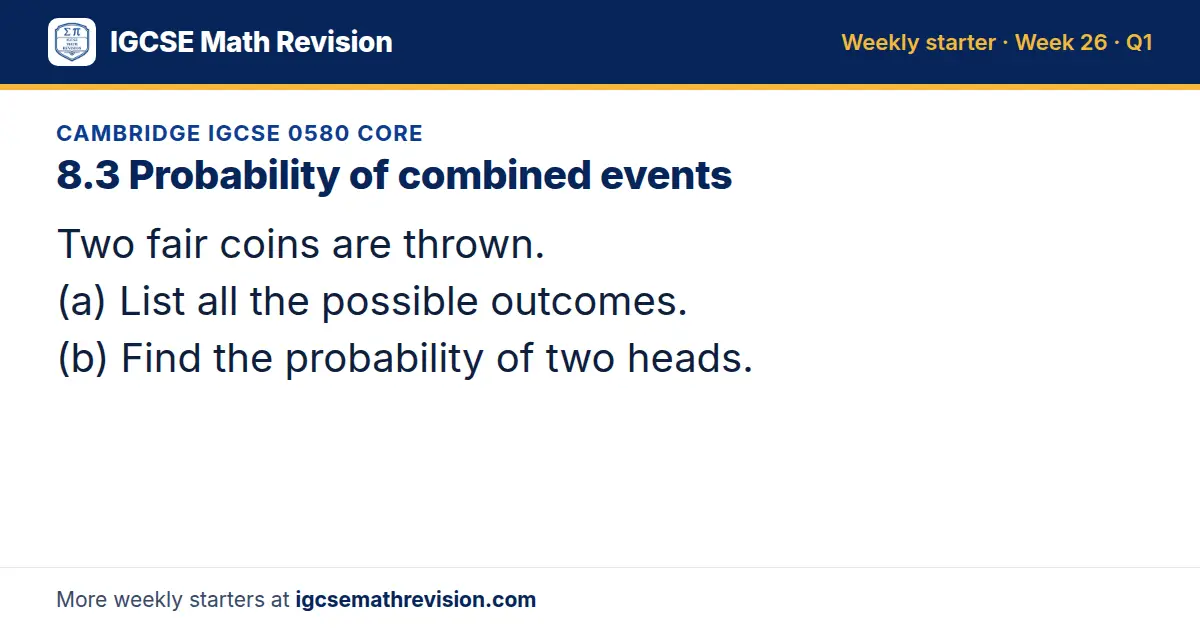
Question 1: 8.3 Probability of combined events
Two fair coins are thrown. (a) List all the possible outcomes. (b) Find the probability of two heads.
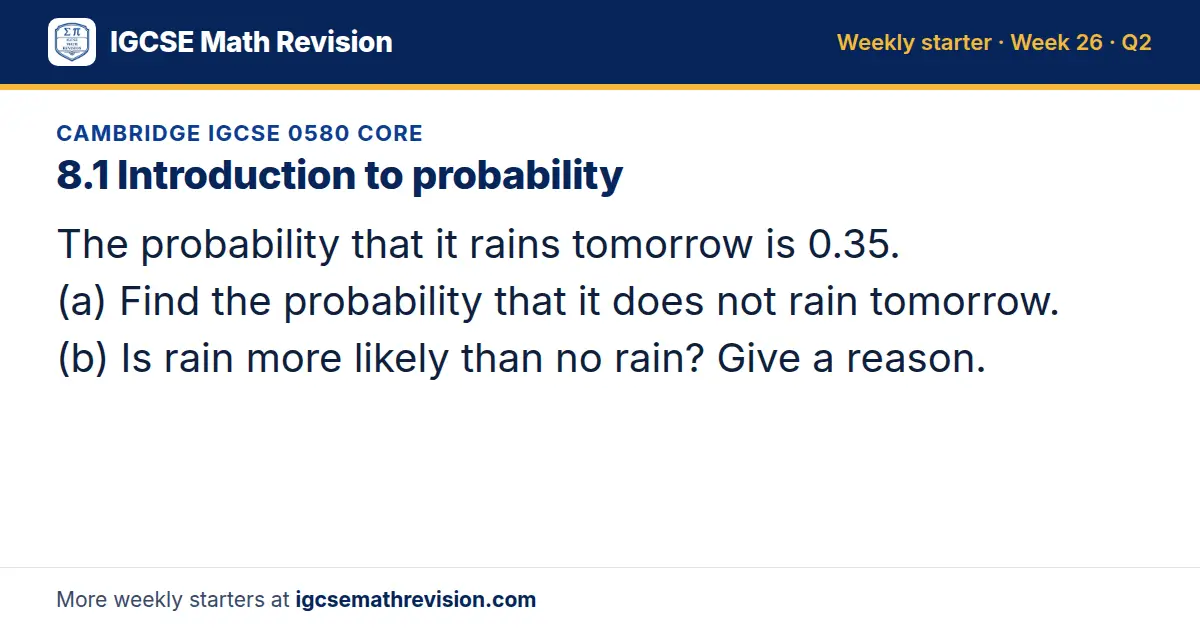
Question 2: 8.1 Introduction to probability
The probability that it rains tomorrow is 0.35. (a) Find the probability that it does not rain tomorrow. (b) Is rain more likely than no rain? Give a reason.
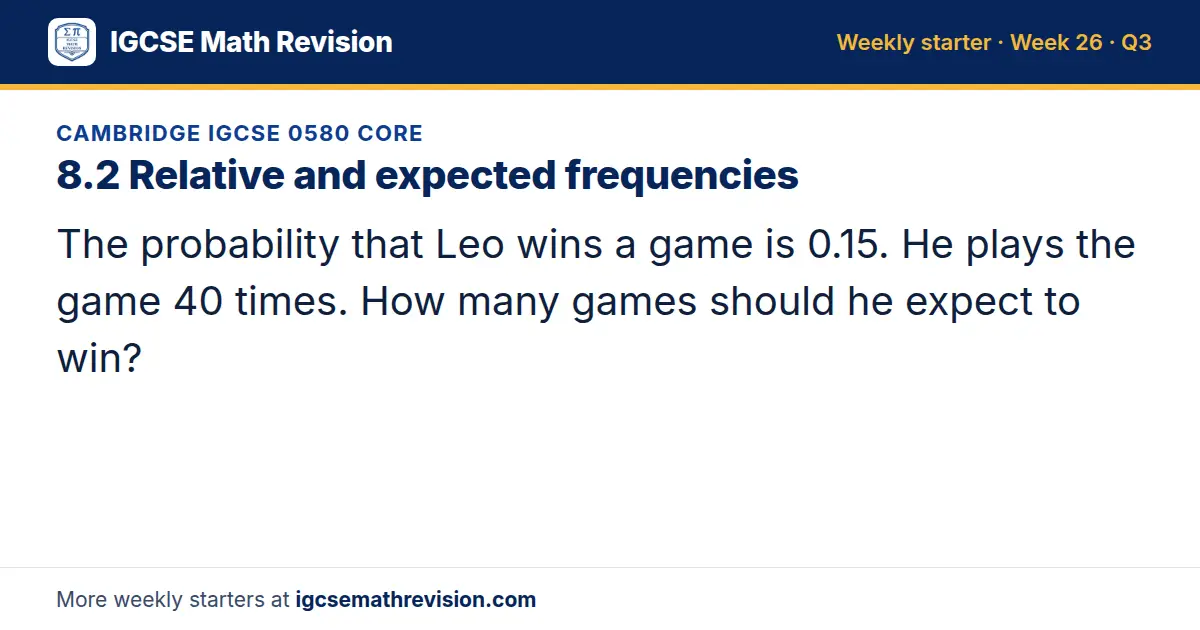
Question 3: 8.2 Relative and expected frequencies
The probability that Leo wins a game is 0.15. He plays the game 40 times. How many games should he expect to win?
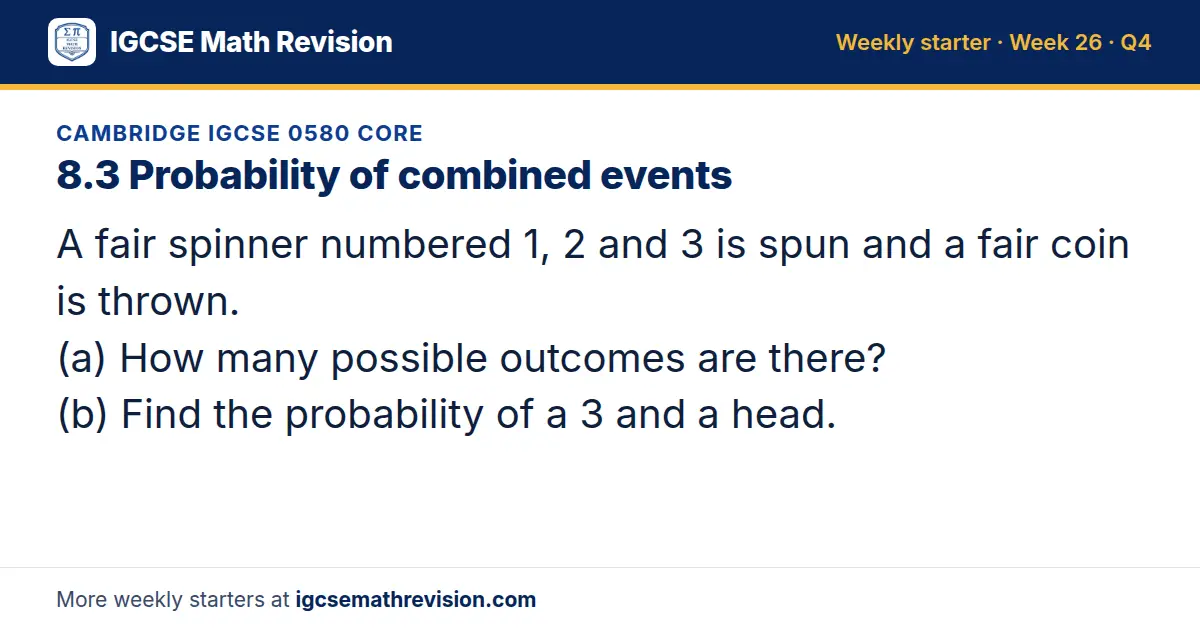
Question 4: 8.3 Probability of combined events
A fair spinner numbered 1, 2 and 3 is spun and a fair coin is thrown. (a) How many possible outcomes are there? (b) Find the probability of a 3 and a head.
More starter questions
Other weeks: Weeks 1–13 · Weeks 14–26 · Weeks 27–39 · Weeks 40–51. Answers and mark schemes are in the teacher tools.