Cambridge IGCSE 0580 Extended starter questions: weeks 1–11
44 short questions to open a lesson for Cambridge IGCSE Mathematics 0580, Extended, weeks 1–11 of the teaching year, three or four a week. Each question is shown as an image with its text underneath; the answers and mark schemes are free on the free weekly starters page, to show or project in class.
- Answers and mark schemes (free)
- Cambridge IGCSE 0580 Extended, weeks 12–22 →
- All IGCSE Maths daily and weekly questions
Week 1
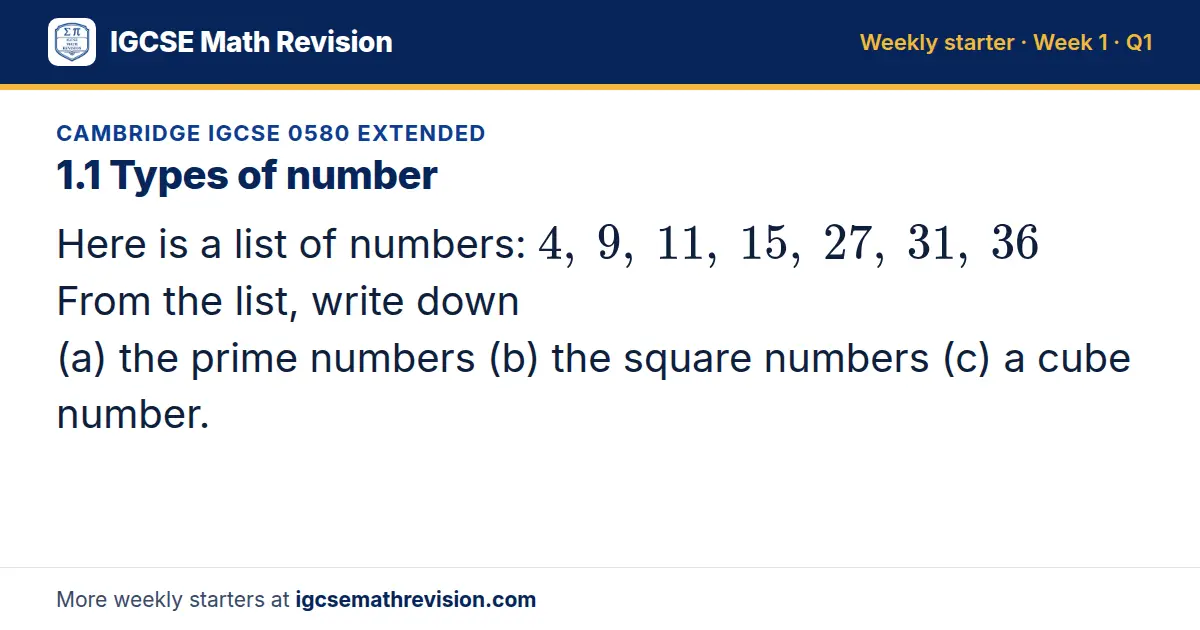
Question 1: 1.1 Types of number
Here is a list of numbers: 4, 9, 11, 15, 27, 31, 36 From the list, write down (a) the prime numbers (b) the square numbers (c) a cube number.
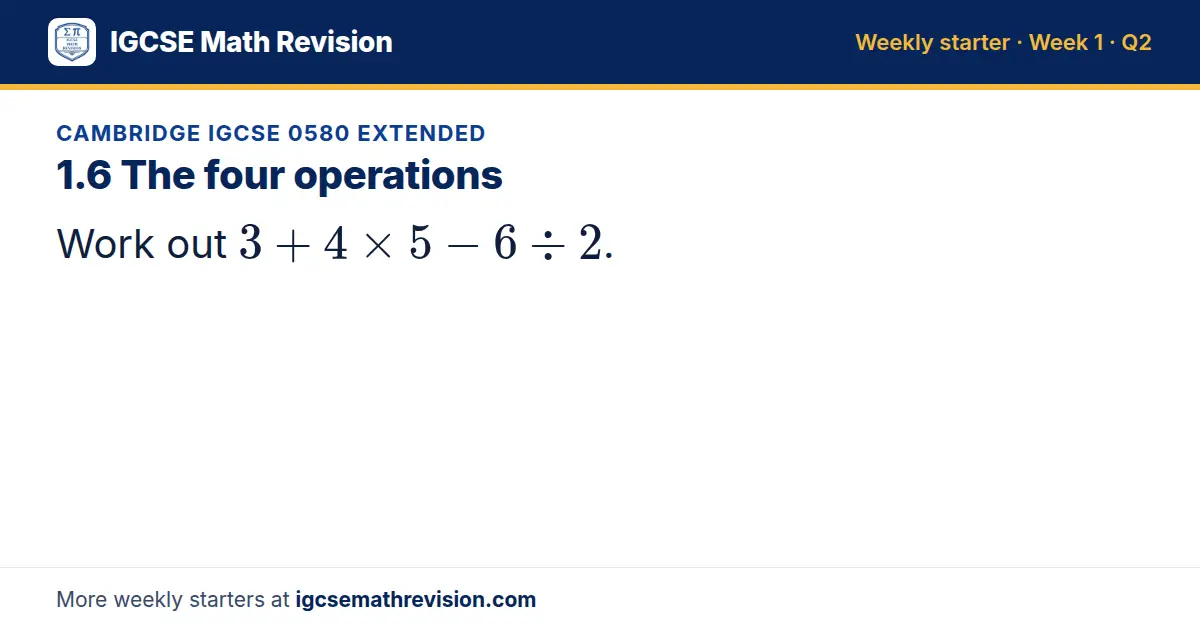
Question 2: 1.6 The four operations
Work out 18 - 6 ÷ 3 × 2.
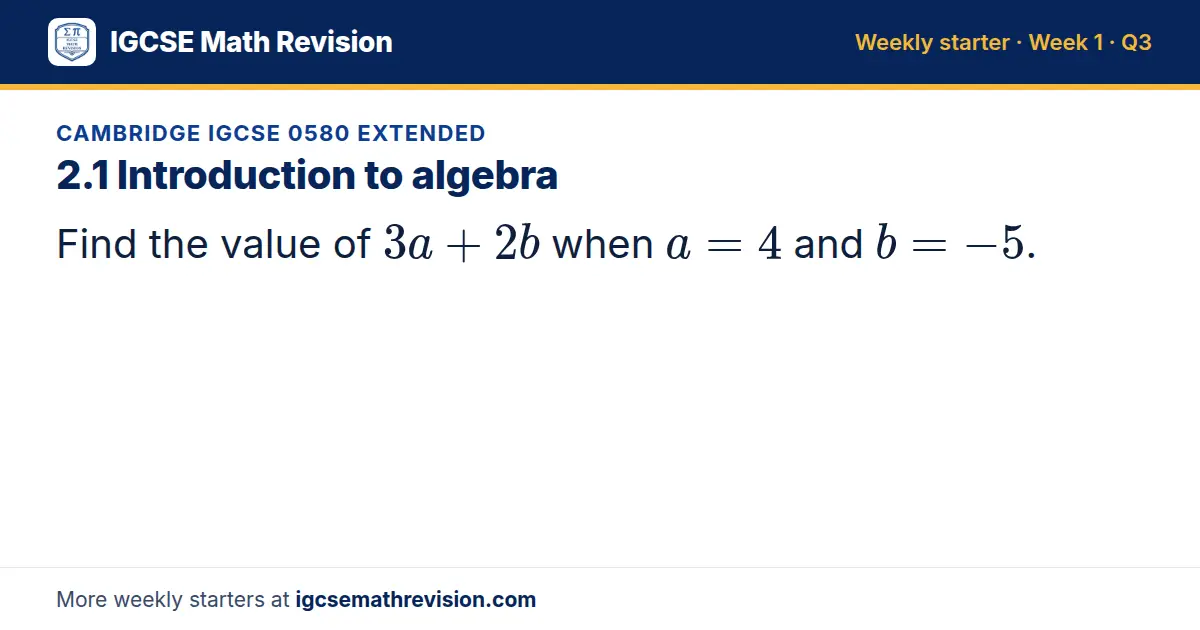
Question 3: 2.1 Introduction to algebra
Find the value of 3a + 2b when a = 4 and b = -5.
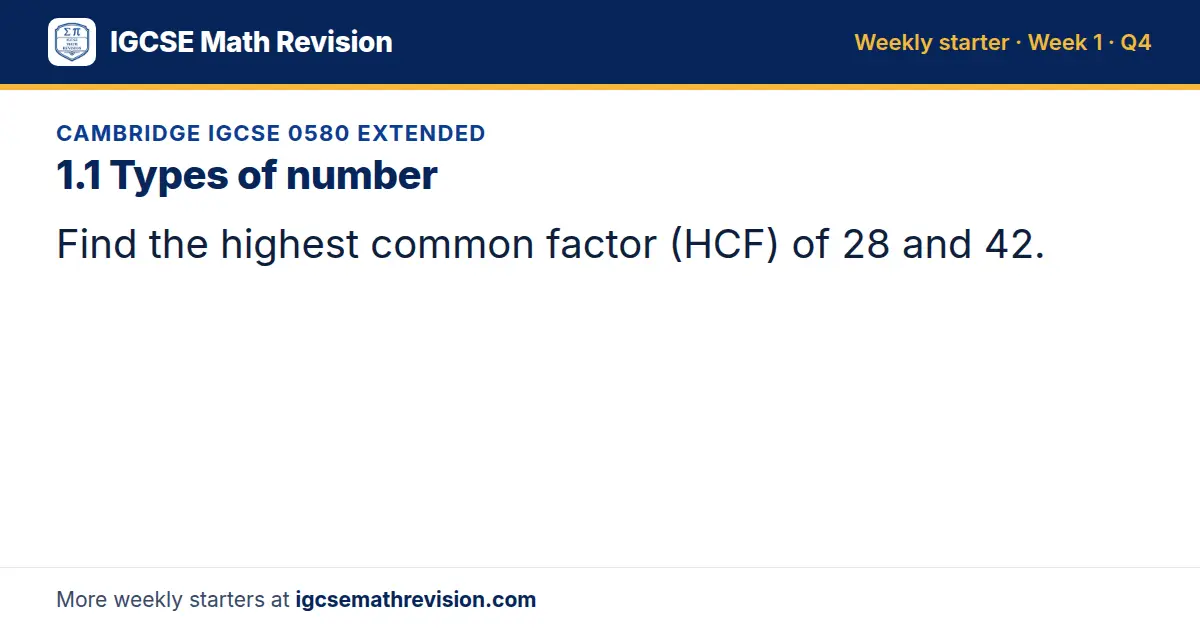
Question 4: 1.1 Types of number
Find the highest common factor (HCF) of 28 and 42.
Week 2
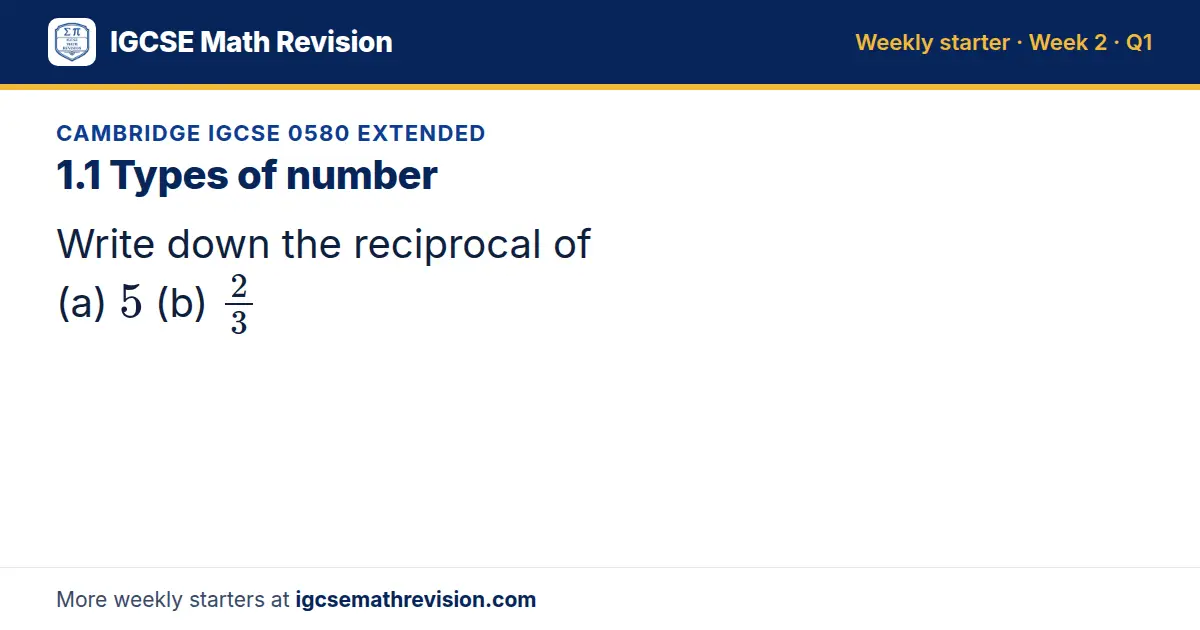
Question 1: 1.1 Types of number
Write down the reciprocal of (a) 5 (b) 2/3
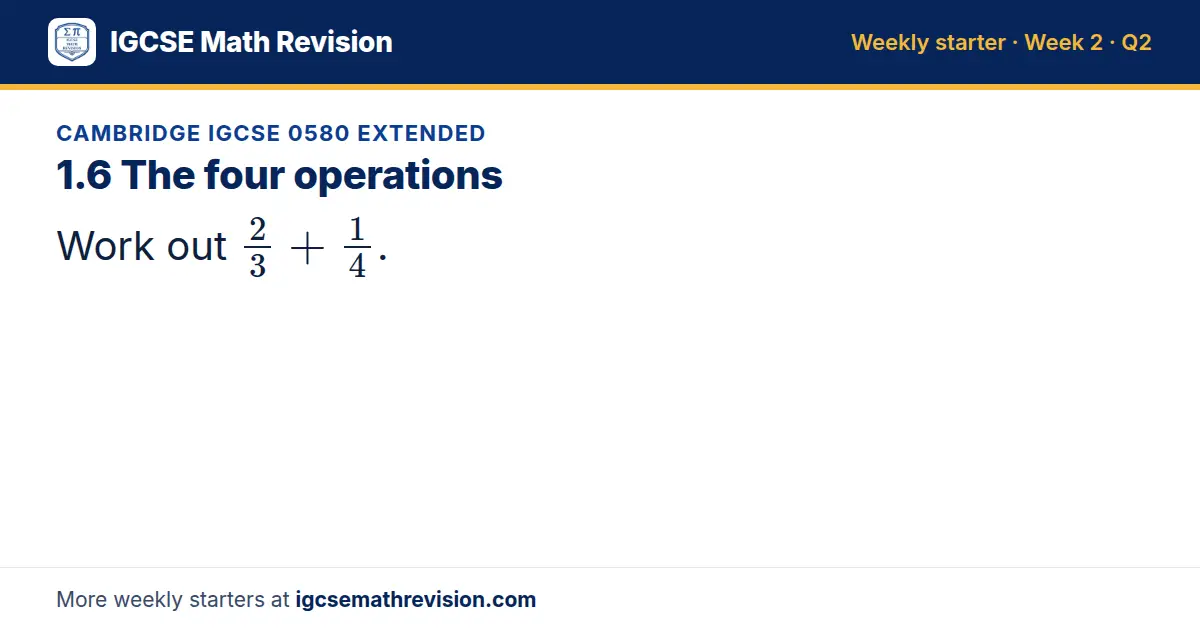
Question 2: 1.6 The four operations
A jug is 3/5 full of juice. Ben pours out an amount equal to 1/4 of the jug's capacity. What fraction of the jug is full now?
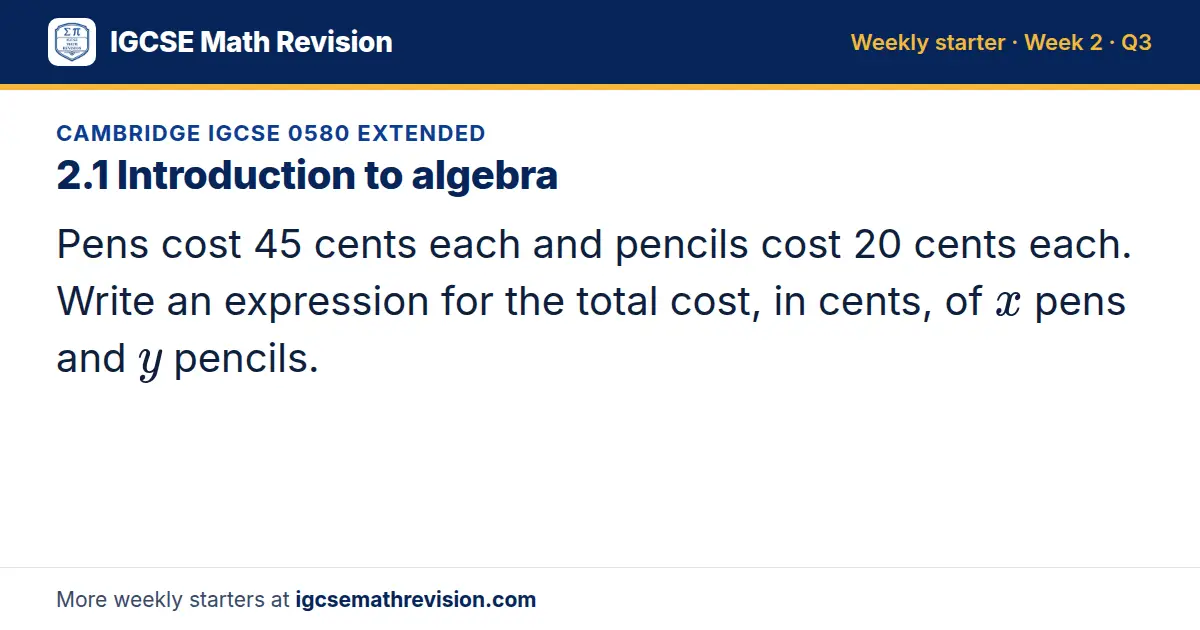
Question 3: 2.1 Introduction to algebra
Pens cost 45 pence each and pencils cost 20 pence each. Write an expression for the total cost, in pence, of x pens and y pencils.
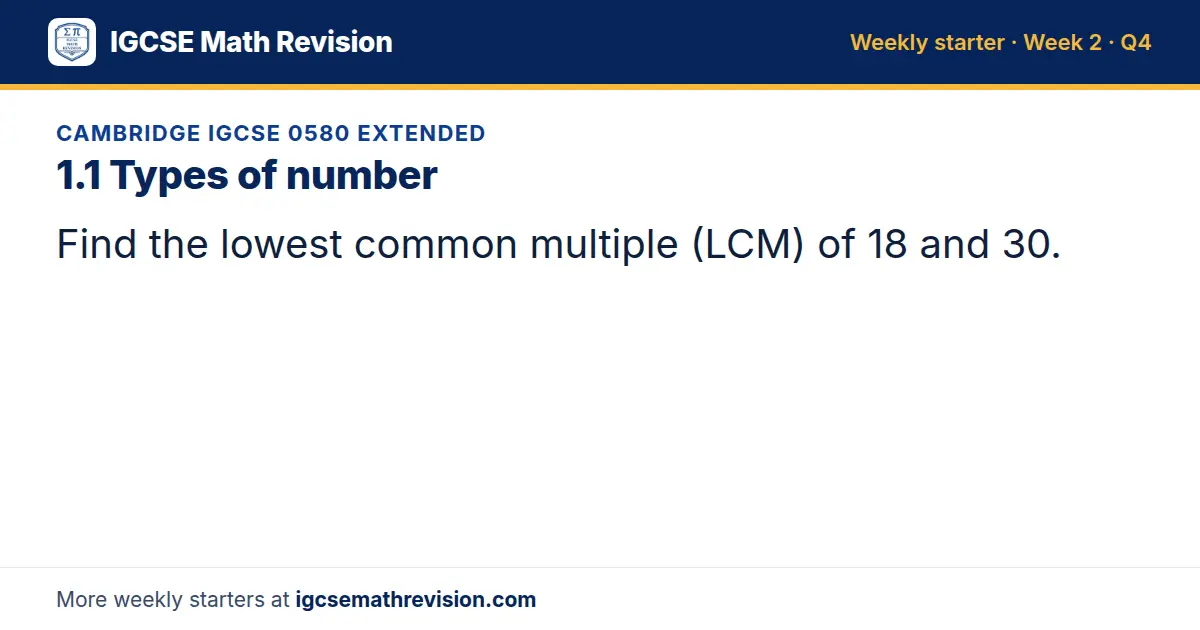
Question 4: 1.1 Types of number
Find the lowest common multiple (LCM) of 18 and 30.
Week 3
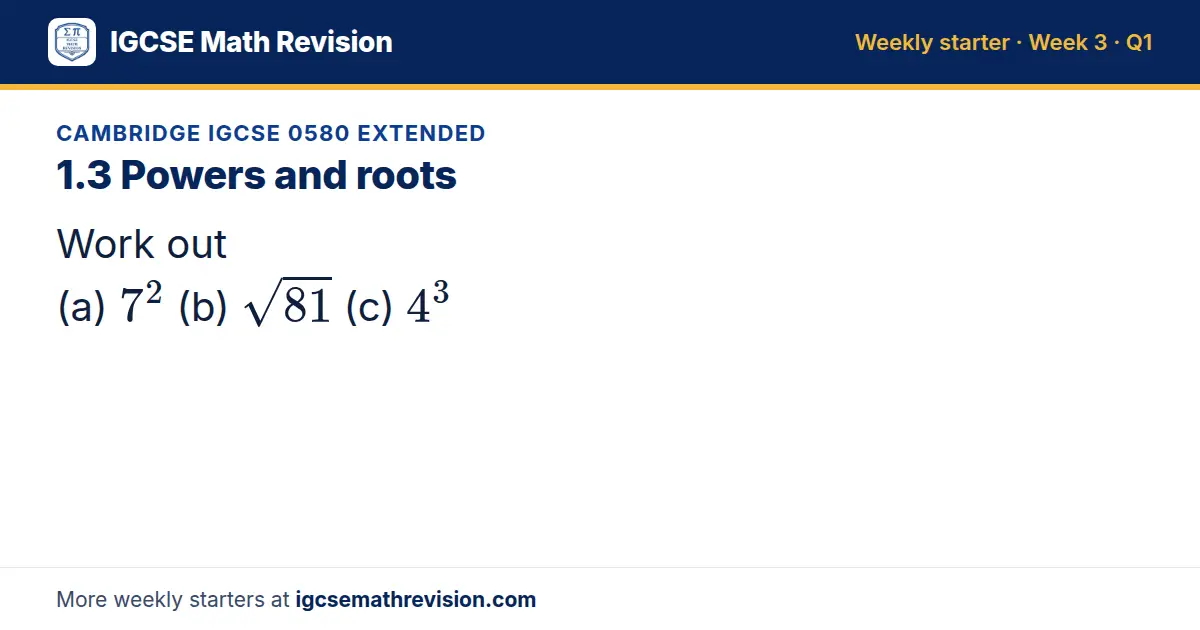
Question 1: 1.3 Powers and roots
Work out (a) 7² (b) √81 (c) 4³
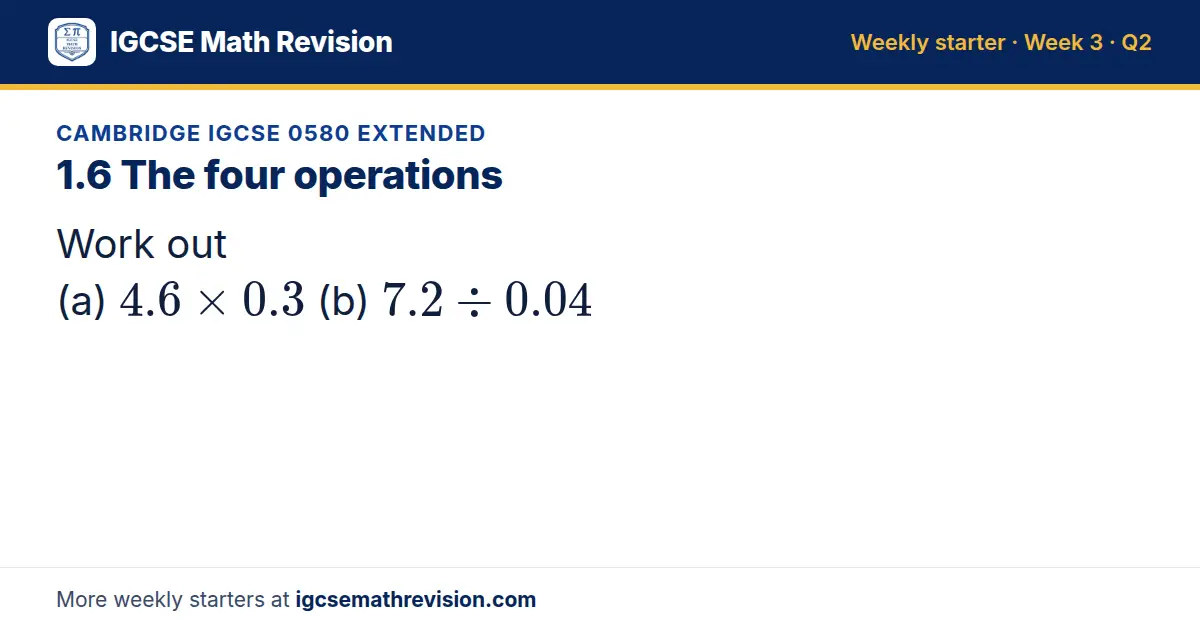
Question 2: 1.6 The four operations
Without using a calculator, work out (a) 0.36 × 2.5 (b) 0.84 ÷ 0.12
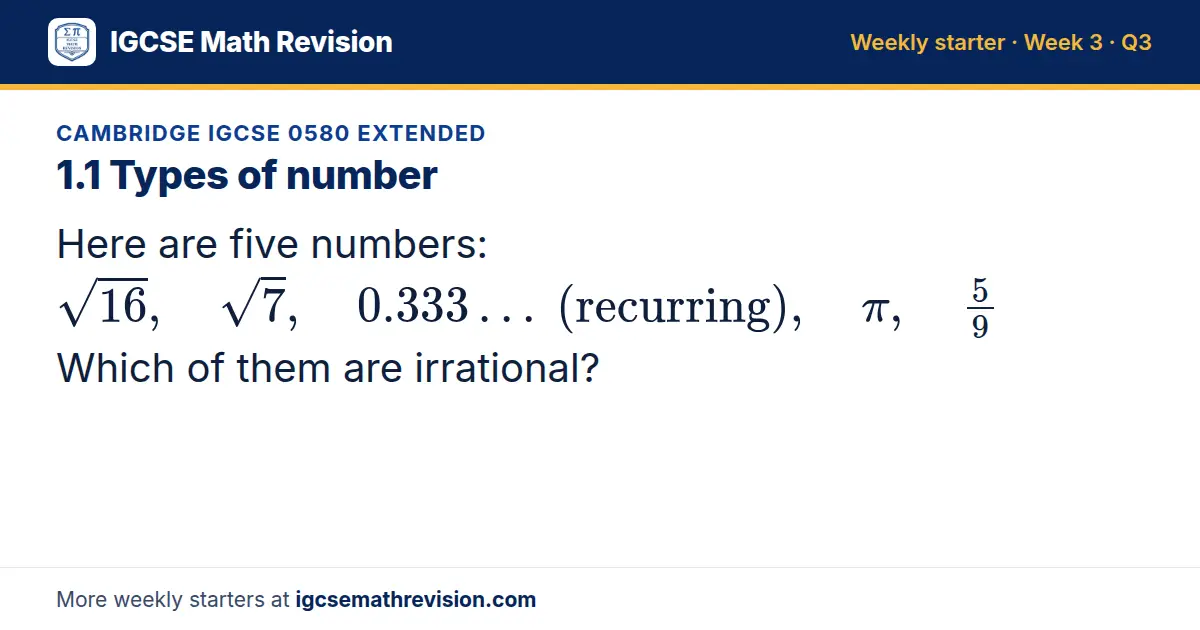
Question 3: 1.1 Types of number
Here are five numbers: √16, √7, 0.333… (recurring), π, 5/9 Which of them are irrational?
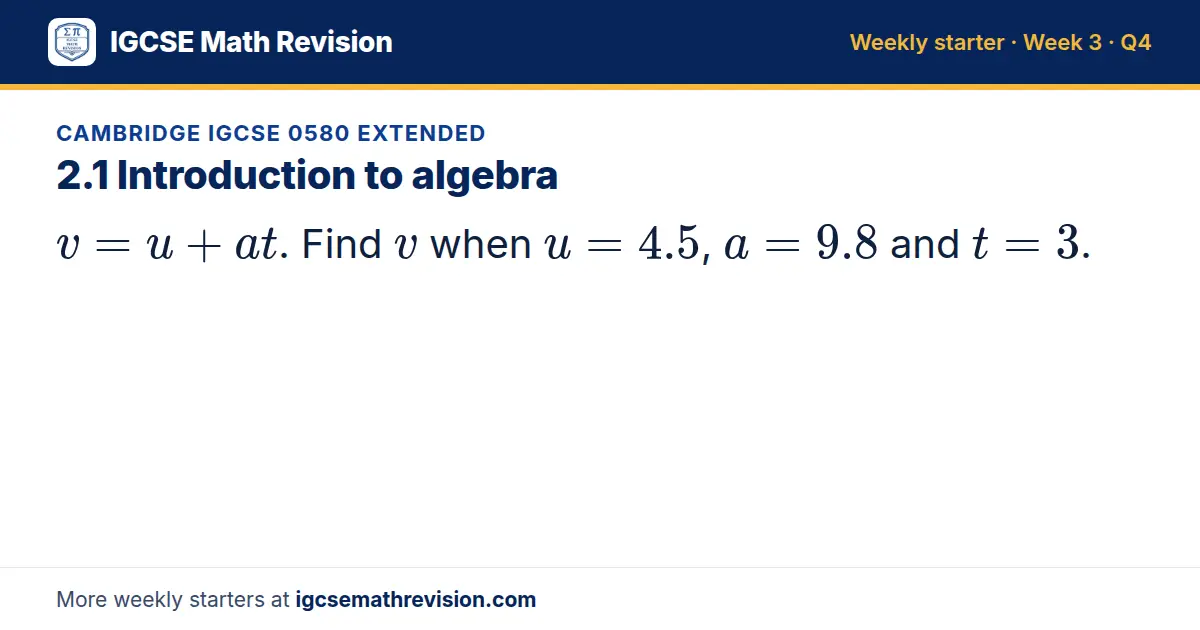
Question 4: 2.1 Introduction to algebra
v = u + at. Find v when u = 4.5, a = 9.8 and t = 3.
Week 4
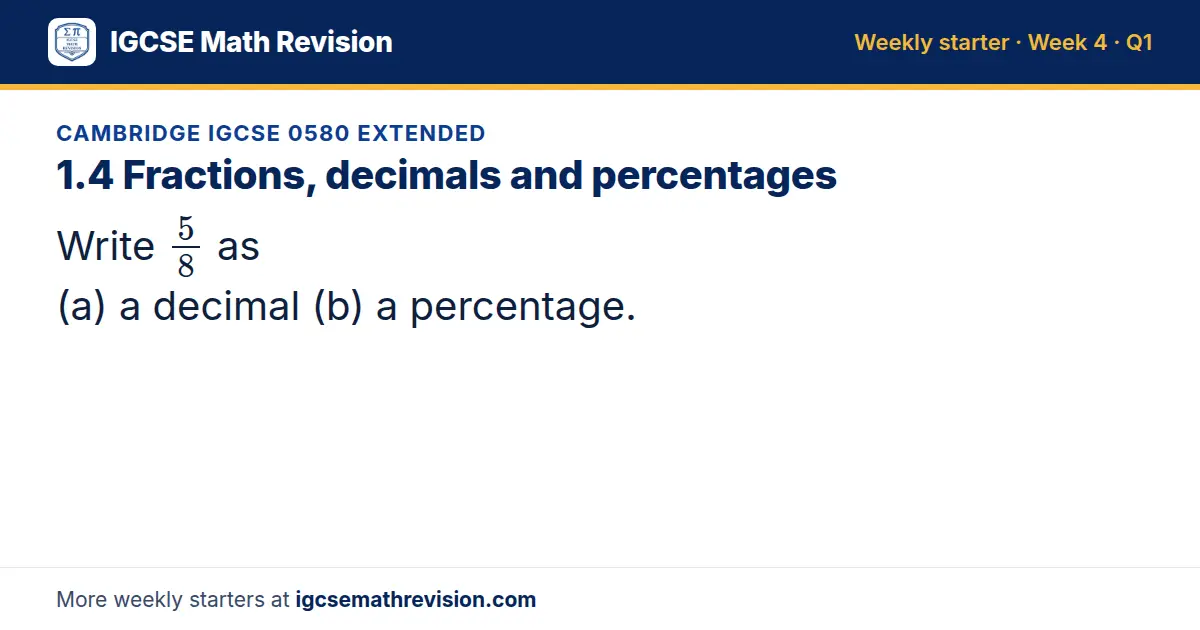
Question 1: 1.4 Fractions, decimals and percentages
Write 5/8 as (a) a decimal (b) a percentage.
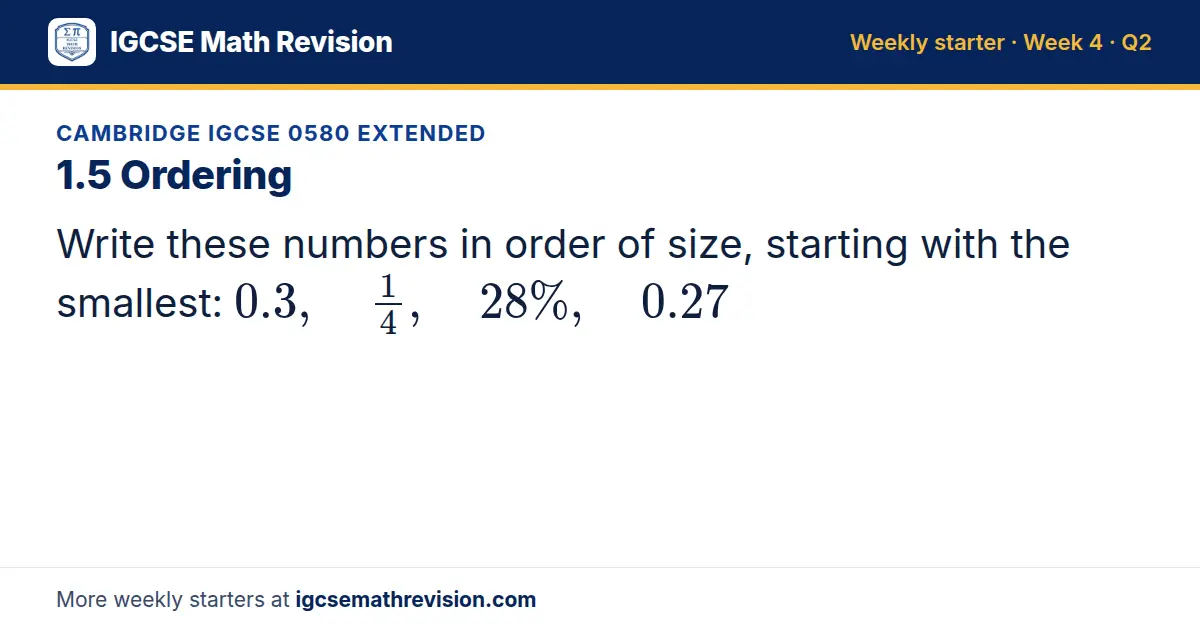
Question 2: 1.5 Ordering
In a quiz, Priya scored 0.6 of the marks, Sam scored 5/8 of the marks, Tom scored 61% and Uma scored 0.65 of the marks. List the four students in order of their scores, lowest first.
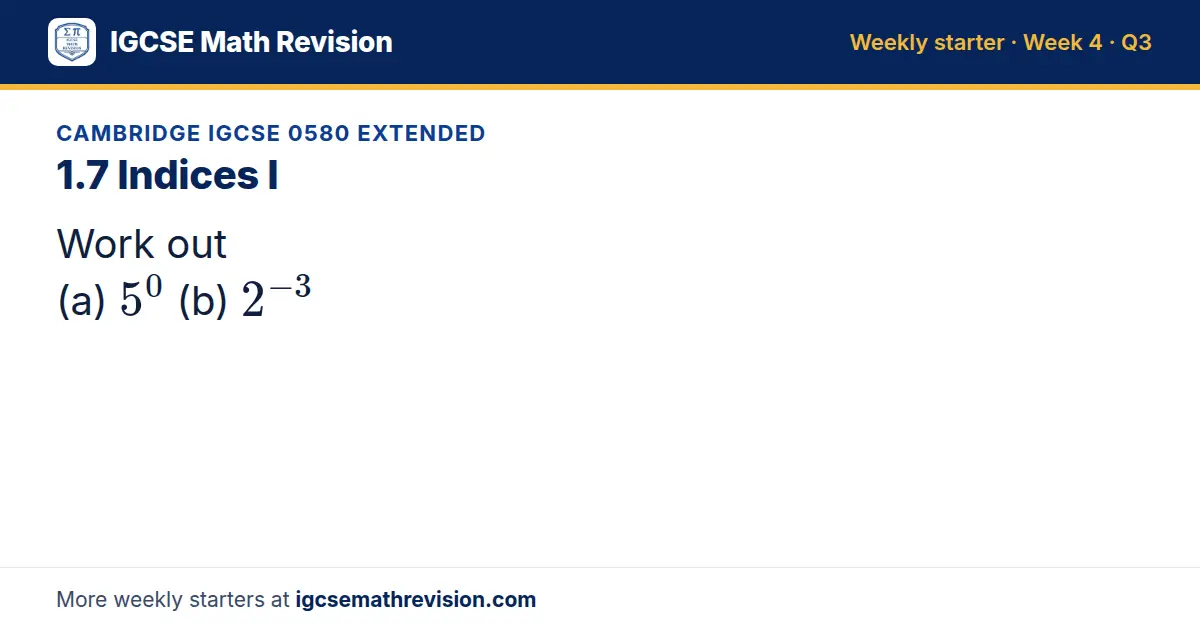
Question 3: 1.7 Indices I
Work out (a) 5⁰ (b) 2⁻³
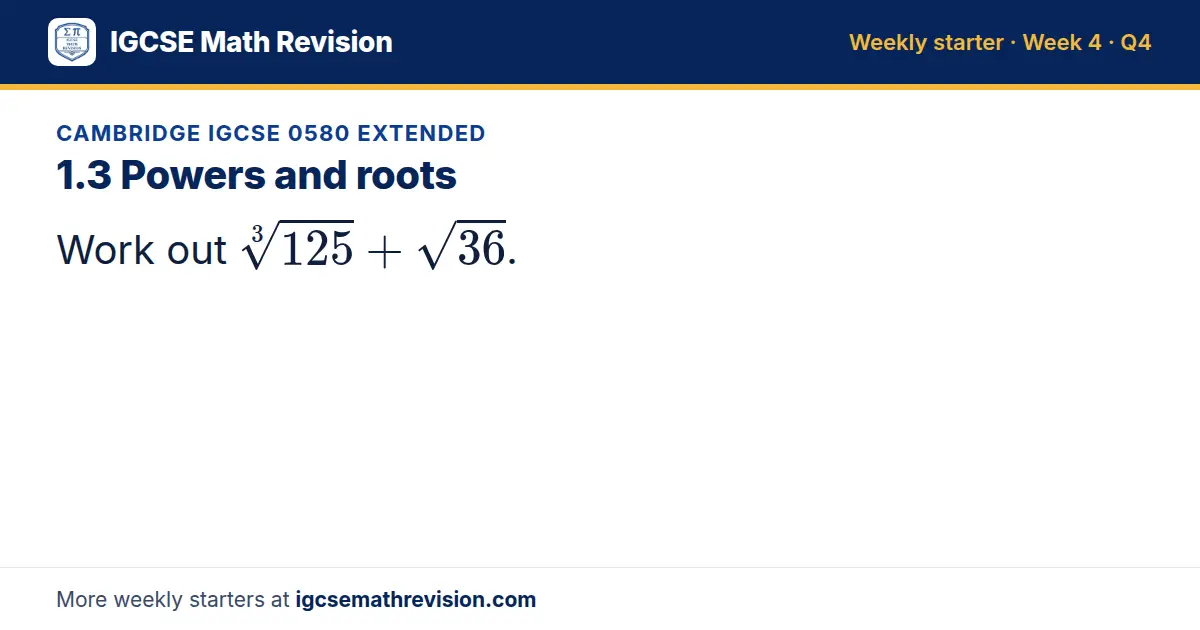
Question 4: 1.3 Powers and roots
Work out 3√(125) + √36.
Week 5
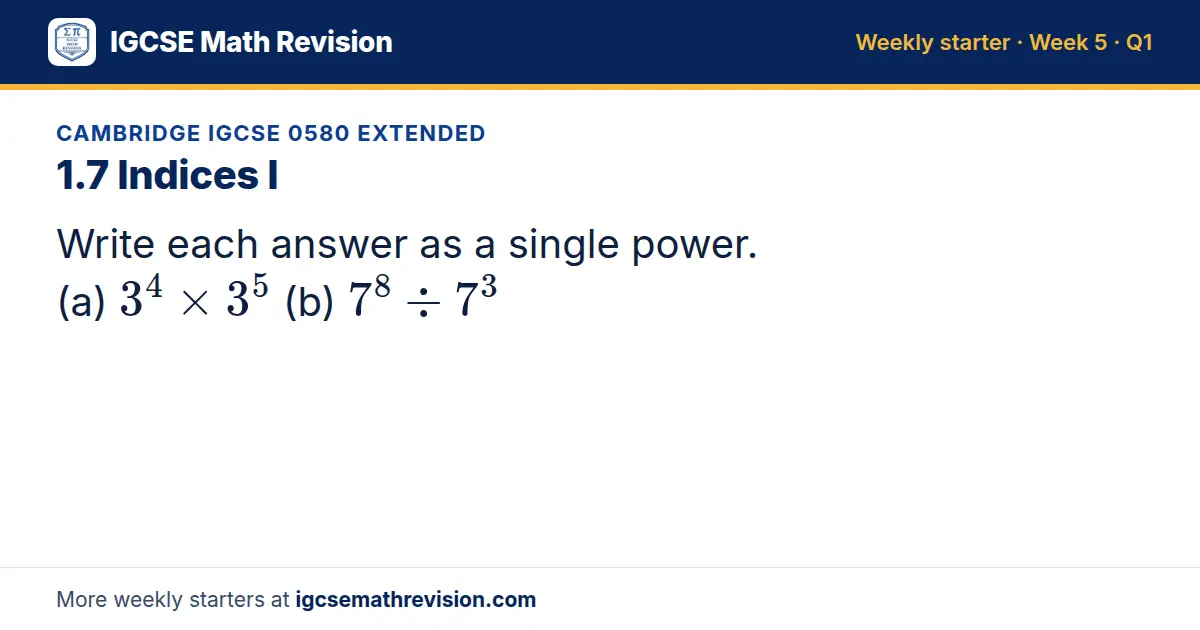
Question 1: 1.7 Indices I
Write each answer as a single power. (a) 3⁴ × 3⁵ (b) 7⁸ ÷ 7³
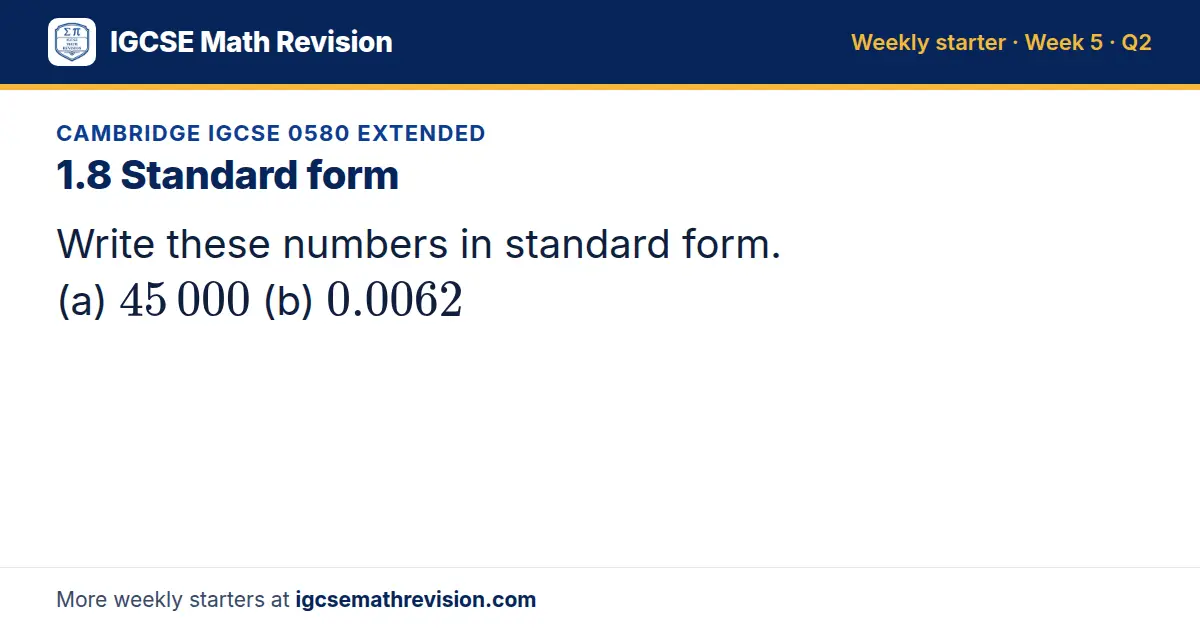
Question 2: 1.8 Standard form
Write these numbers in standard form. (a) 45 000 (b) 0.0062
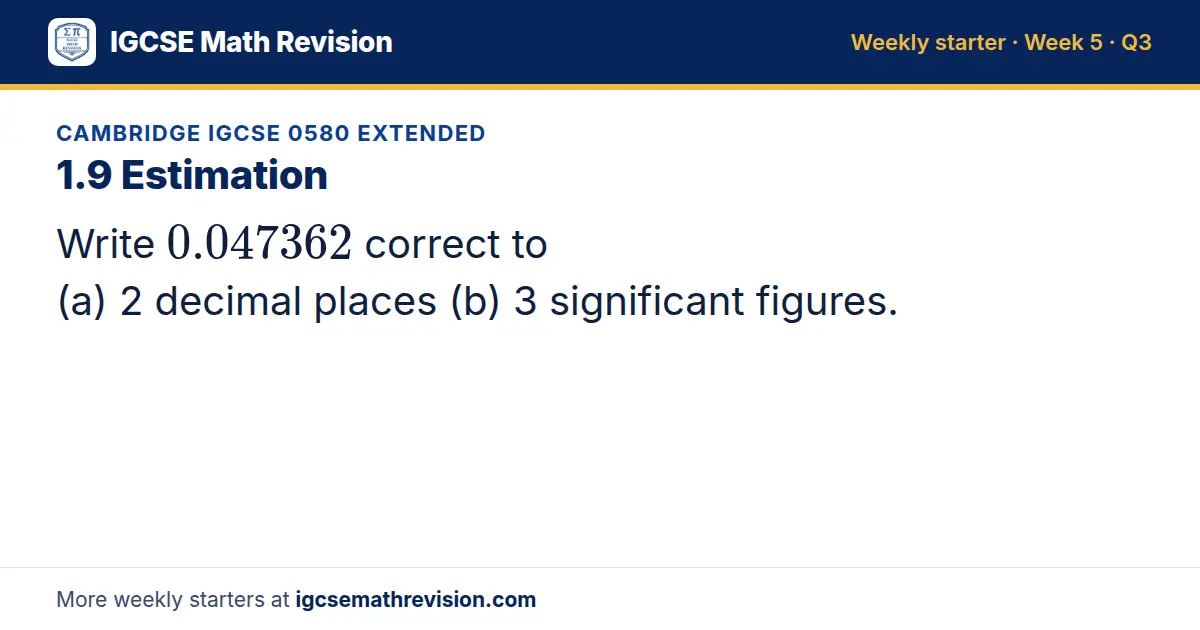
Question 3: 1.9 Estimation
Write 0.047362 correct to (a) 2 decimal places (b) 3 significant figures.
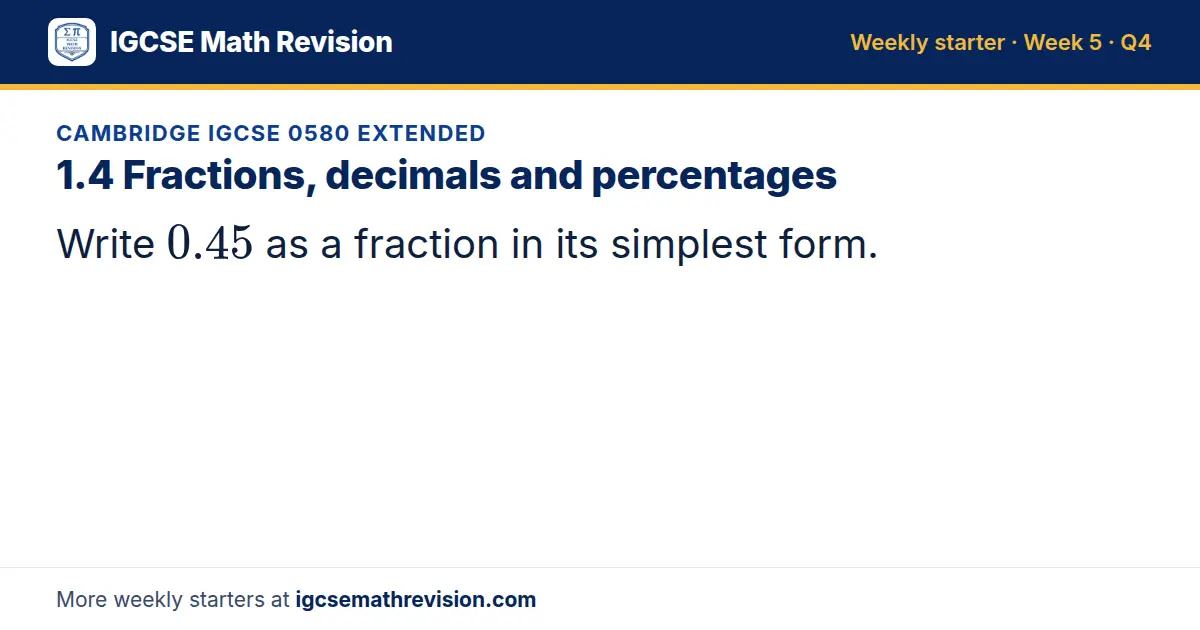
Question 4: 1.4 Fractions, decimals and percentages
Write 0.45 as a fraction in its simplest form.
Week 6
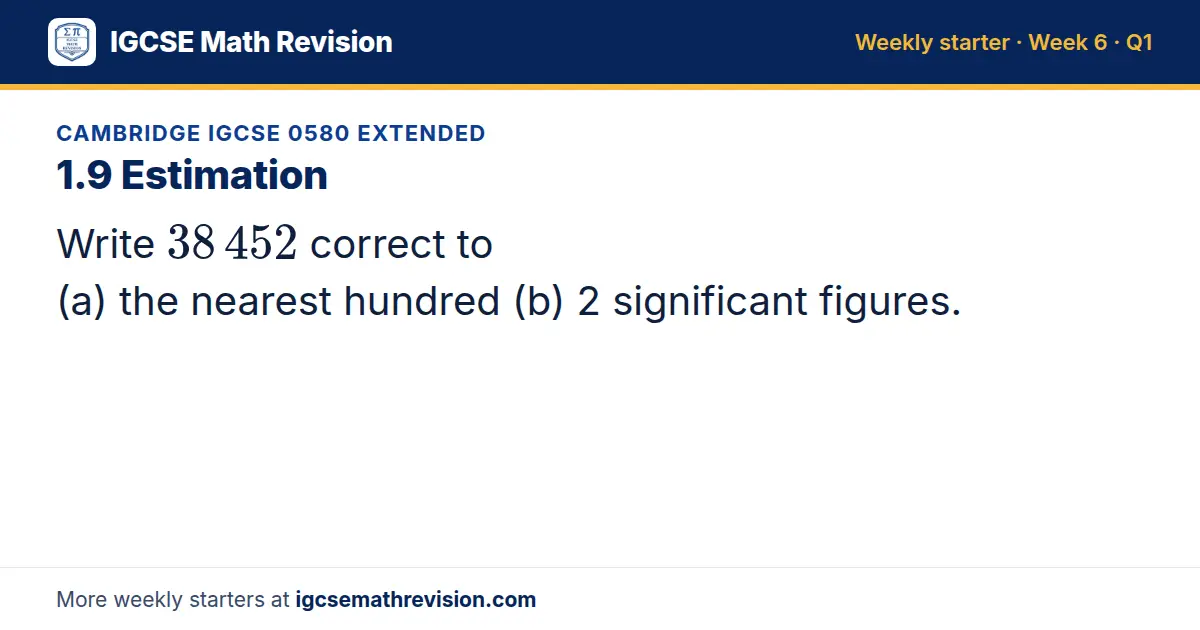
Question 1: 1.9 Estimation
Write 38 452 correct to (a) the nearest hundred (b) 2 significant figures.
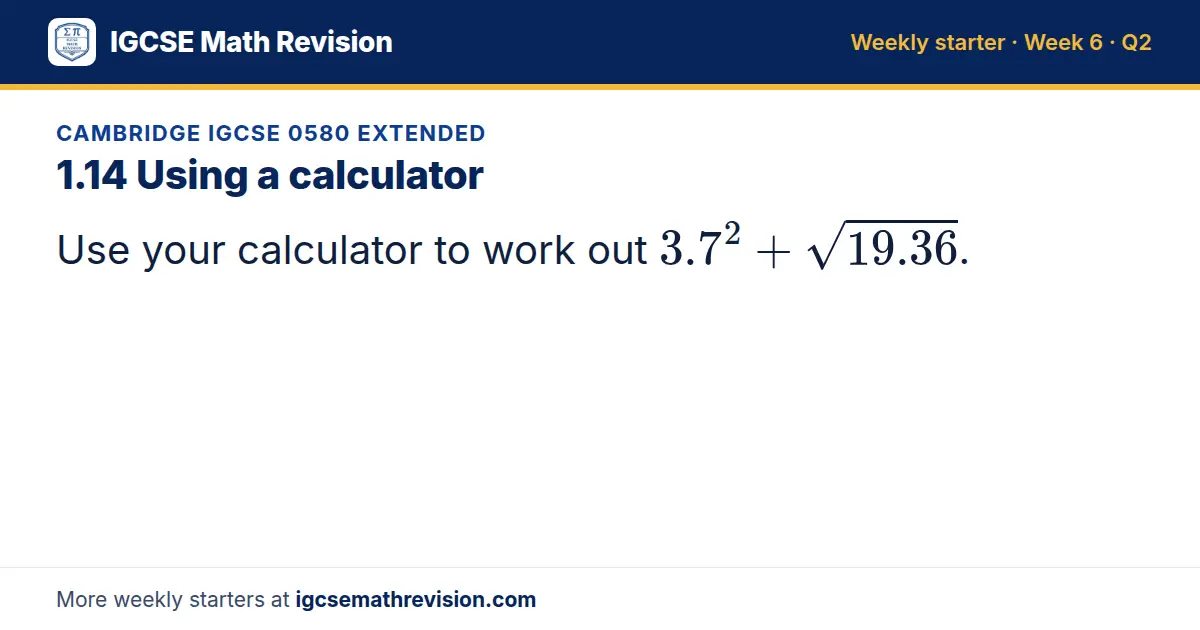
Question 2: 1.14 Using a calculator
Use your calculator to work out √(14.44) + 2.3^3. Write down all the figures on your calculator display.
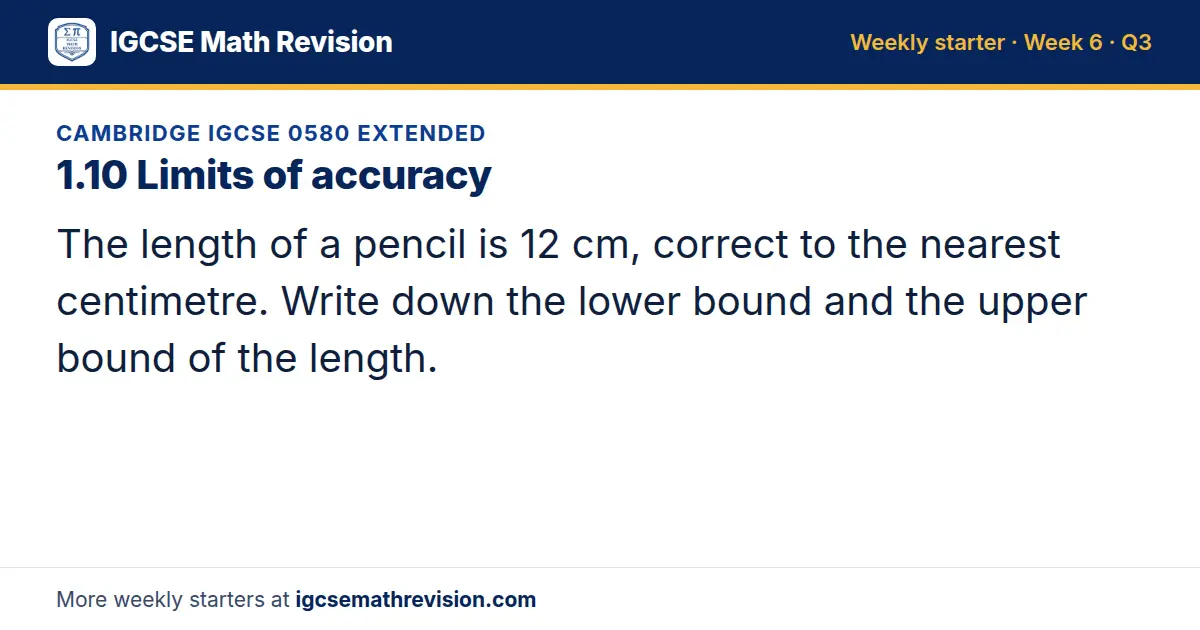
Question 3: 1.10 Limits of accuracy
The length of a pencil is 12 cm, correct to the nearest centimetre. Write down the lower bound and the upper bound of the length.
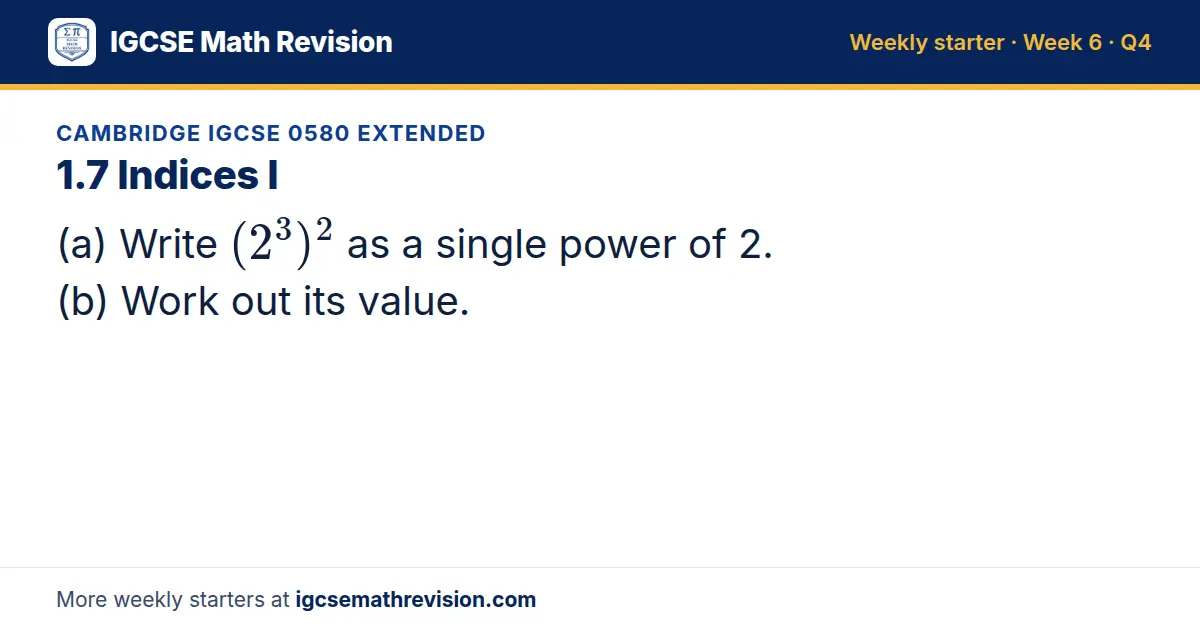
Question 4: 1.7 Indices I
(a) Write (2³)² as a single power of 2. (b) Work out its value.
Week 7
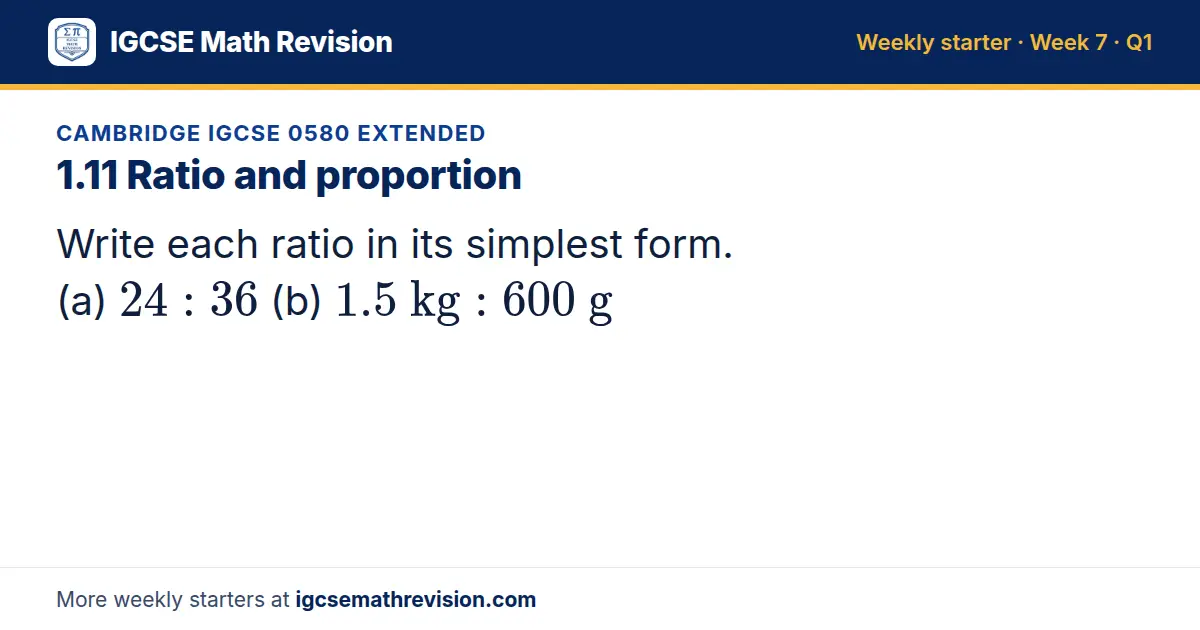
Question 1: 1.11 Ratio and proportion
Write each ratio in its simplest form. (a) 24: 36 (b) 1.5 kg: 600 g
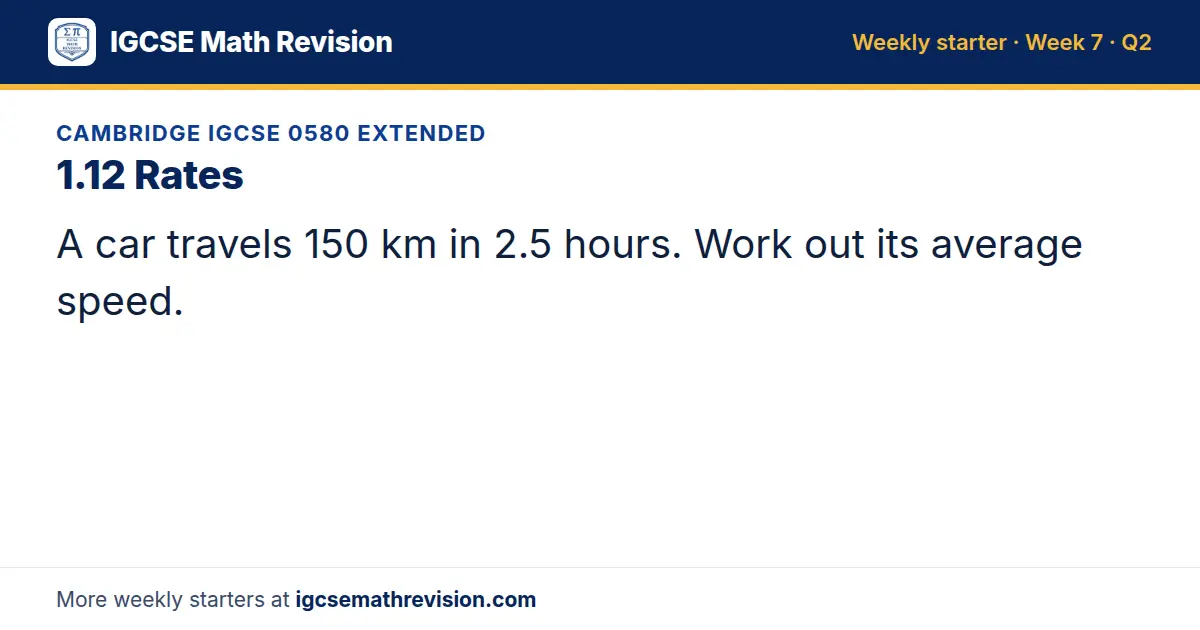
Question 2: 1.12 Rates
A car travels 150 km in 2.5 hours. Work out its average speed.
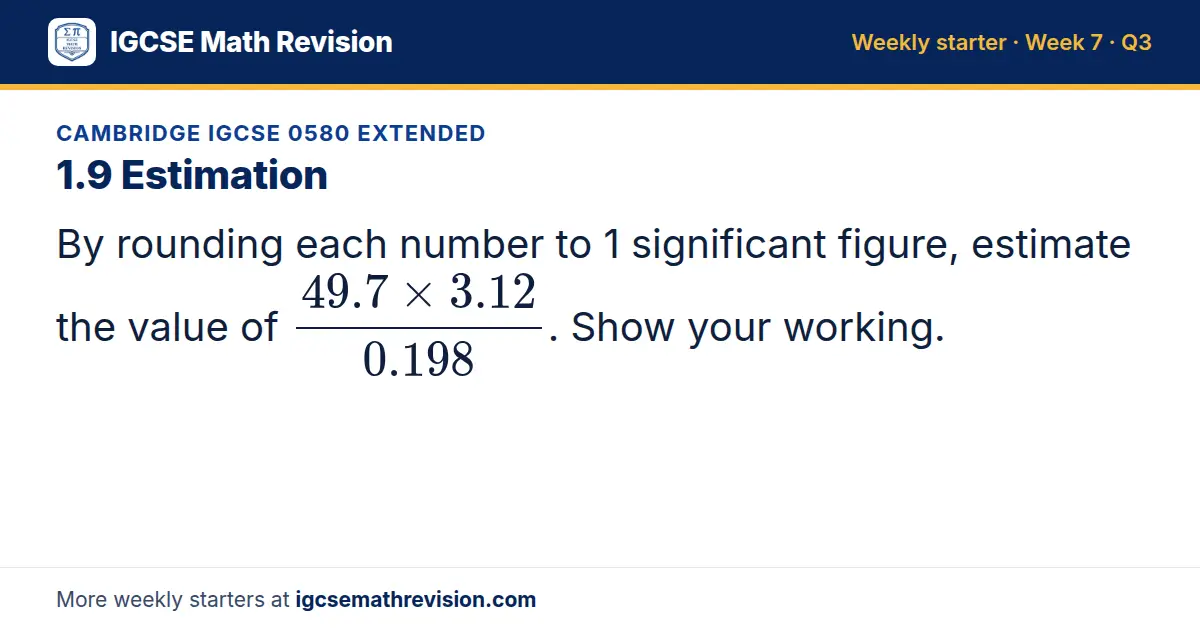
Question 3: 1.9 Estimation
By rounding each number to 1 significant figure, estimate the value of (49.7 × 3.12)/0.198. Show your working.
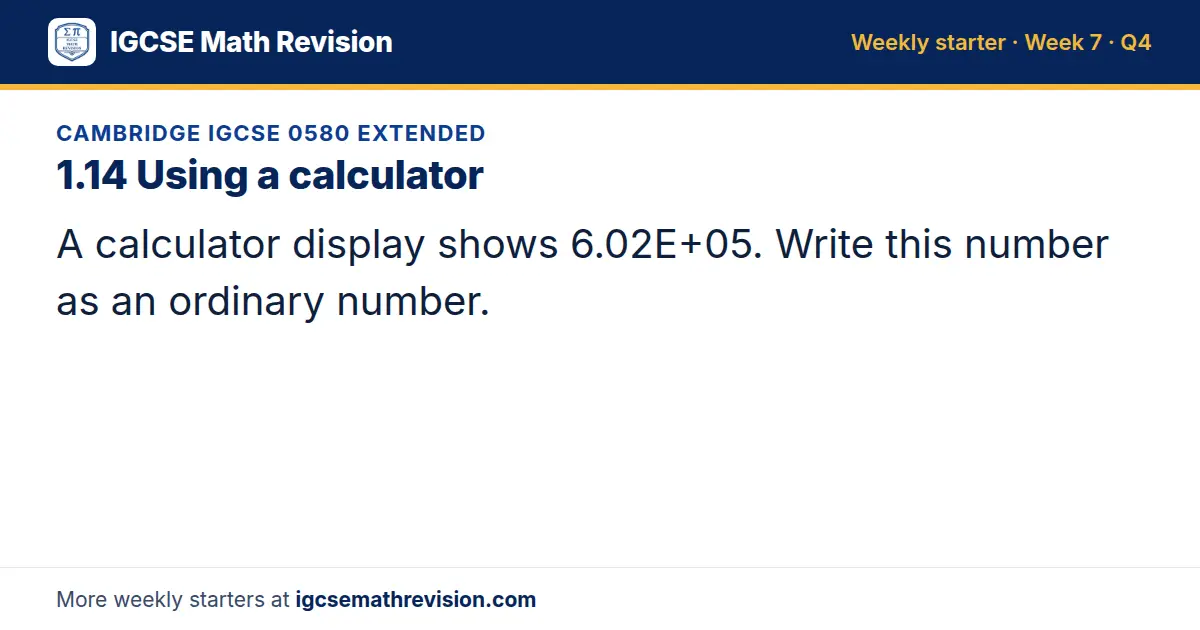
Question 4: 1.14 Using a calculator
Kim types (5.7 + 2.16)/(0.8²) into her calculator. (a) Write down every figure the display should show. (b) Write the value on the display correct to 3 significant figures.
Week 8
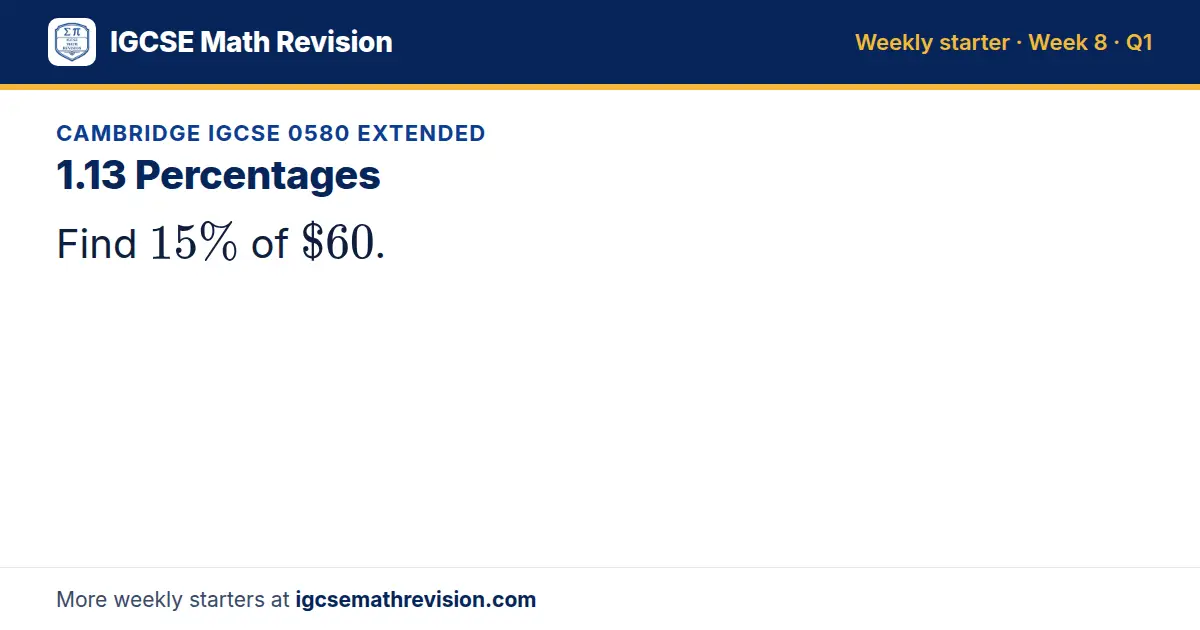
Question 1: 1.13 Percentages
Find 15% of £60.
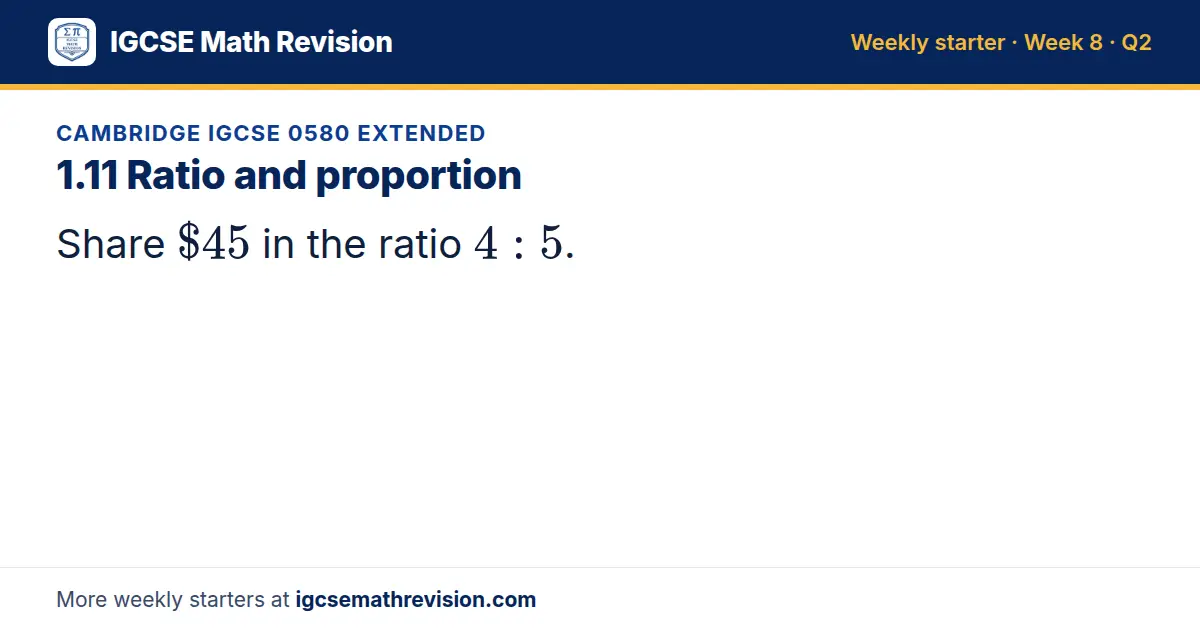
Question 2: 1.11 Ratio and proportion
Share £45 in the ratio 4: 5.
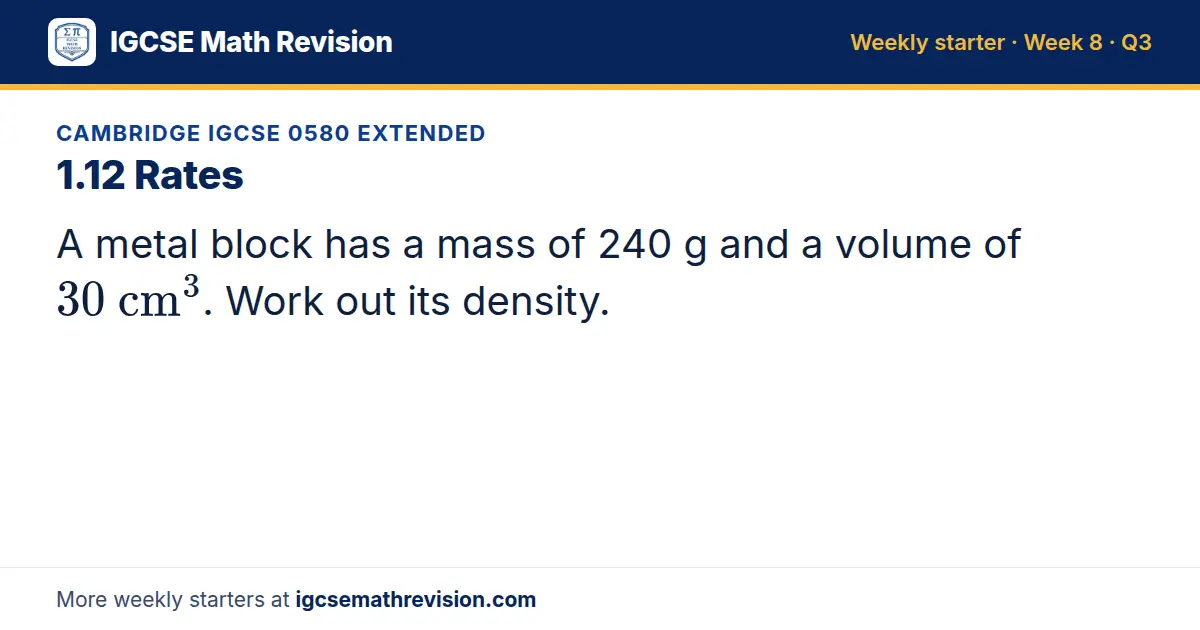
Question 3: 1.12 Rates
A metal block has a mass of 240 g and a volume of 30 cm^3. Work out its density.
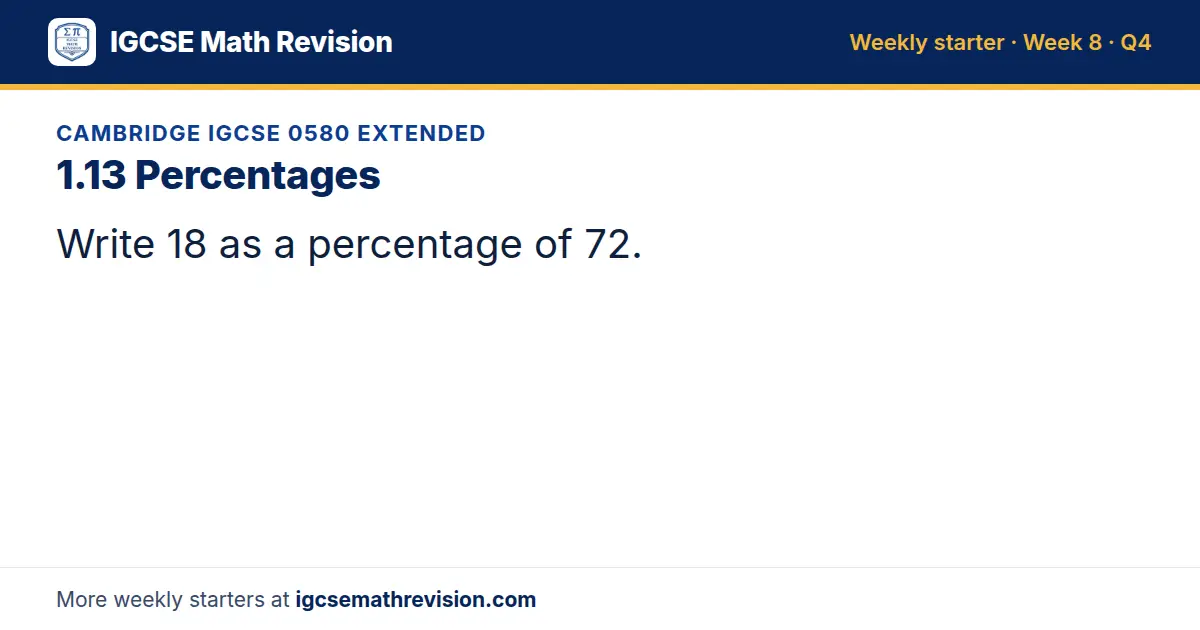
Question 4: 1.13 Percentages
Write 18 as a percentage of 72.
Week 9
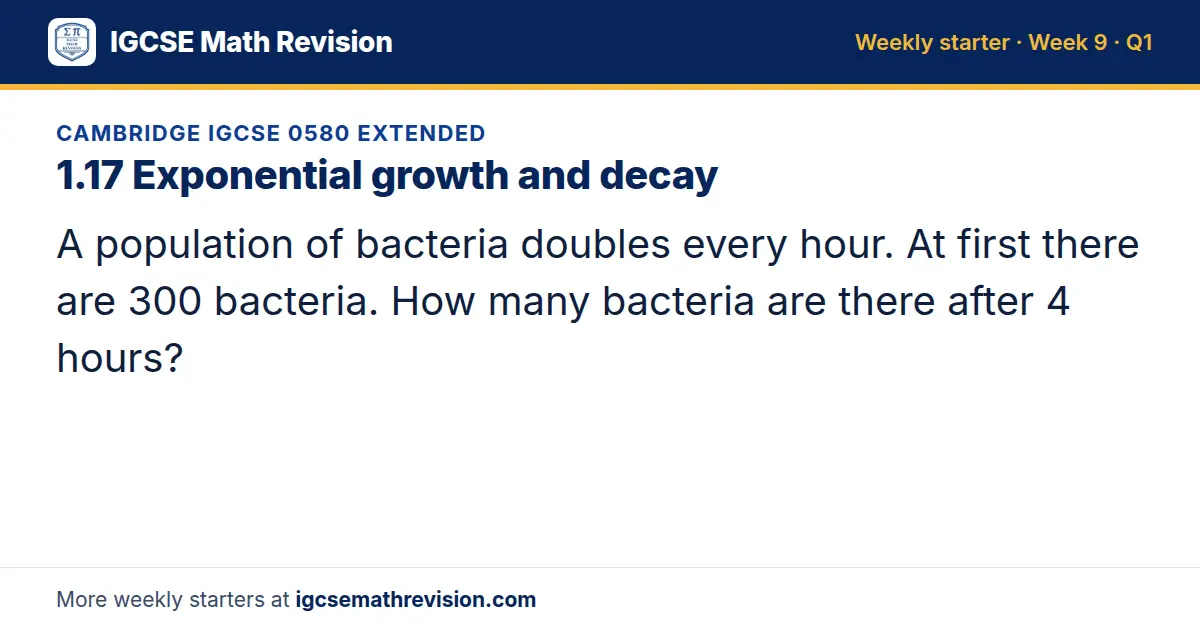
Question 1: 1.17 Exponential growth and decay
A car is worth £18 500. Its value decreases by 12% each year. Work out its value after 4 years. Give your answer correct to the nearest pound.
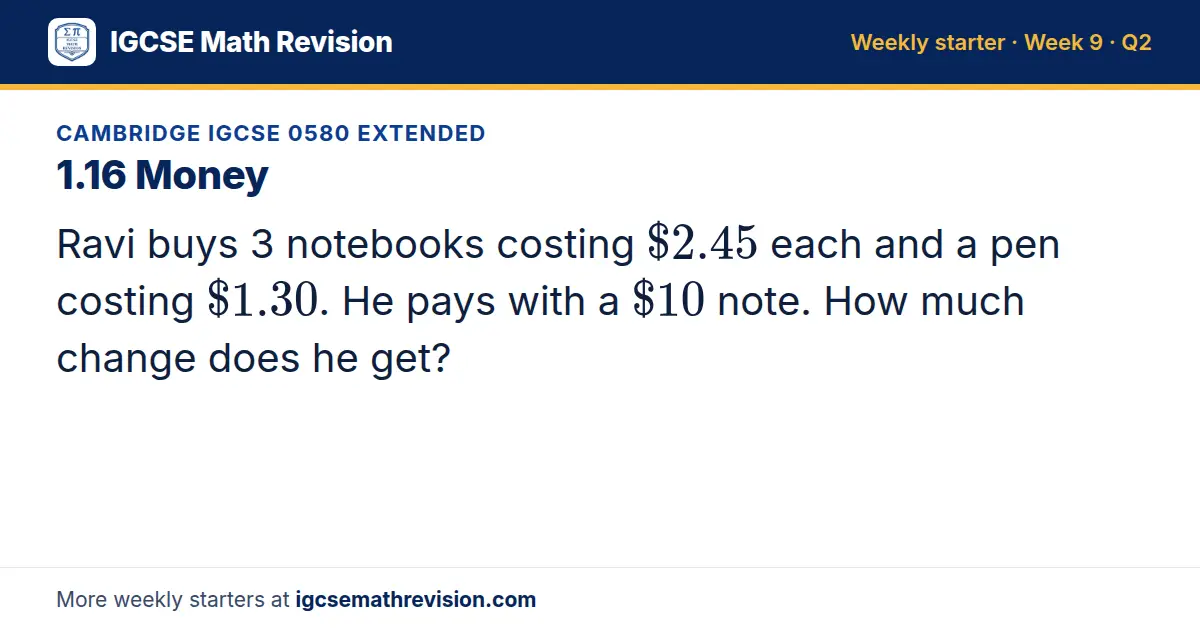
Question 2: 1.16 Money
Leo buys 5 bottles of water at £1.35 each and 2 sandwiches at £2.40 each. He pays with a £20 note. How much change does he get?
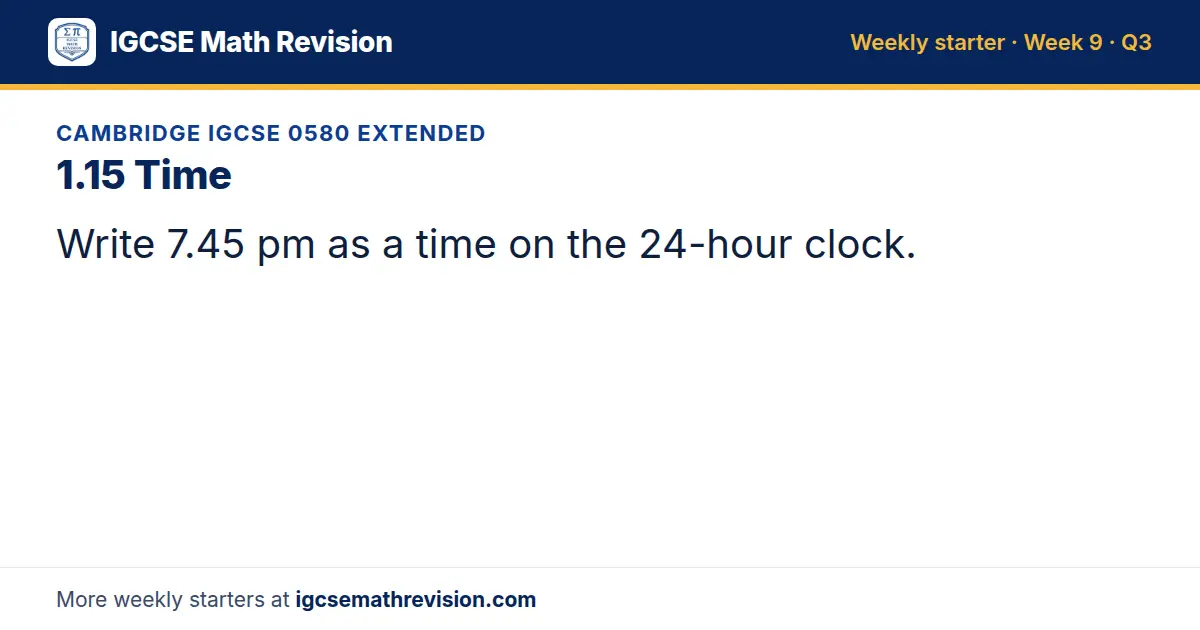
Question 3: 1.15 Time
A lesson starts at 13 50 and lasts 75 minutes. At what time does the lesson end? Give your answer on the 24-hour clock.
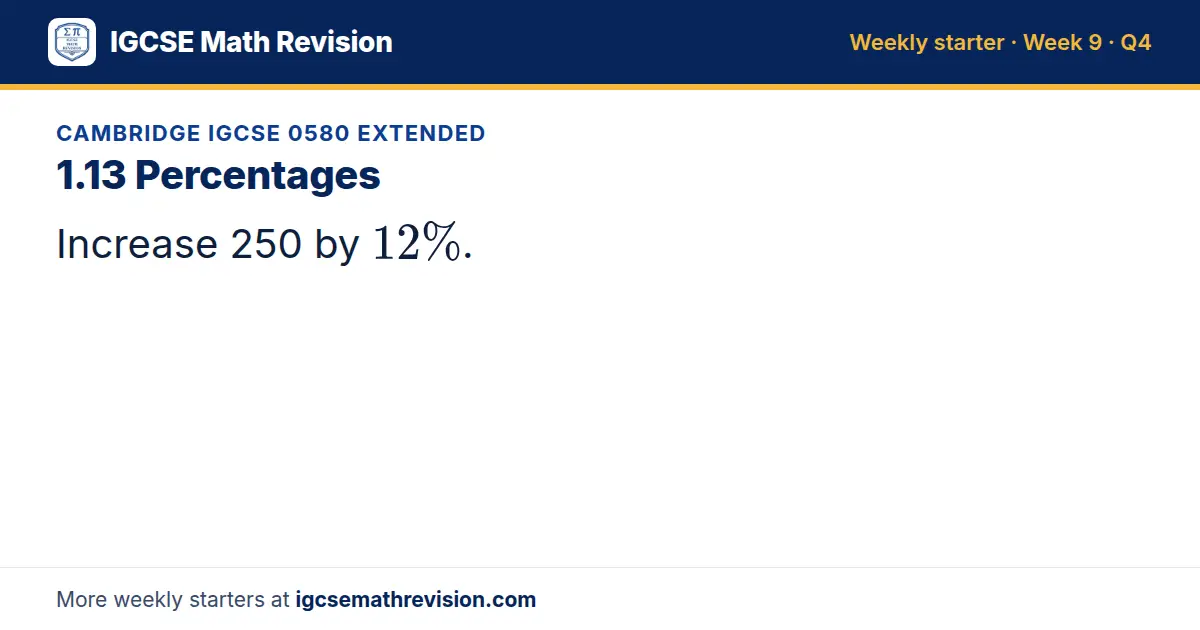
Question 4: 1.13 Percentages
Increase 250 by 12%.
Week 10
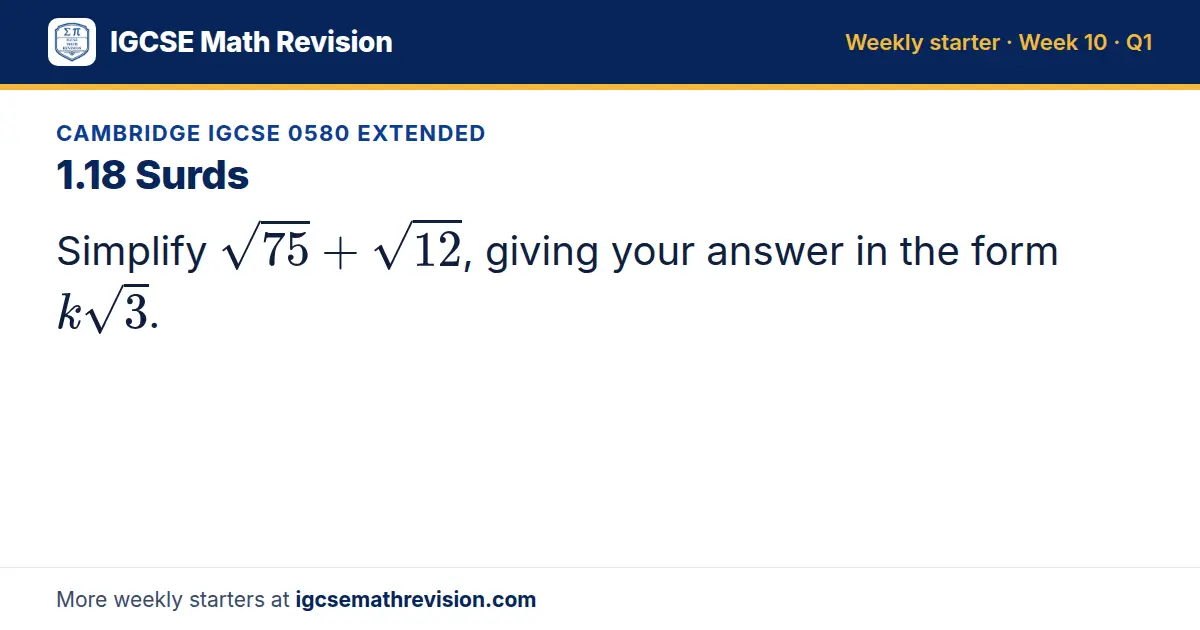
Question 1: 1.18 Surds
Simplify √75.
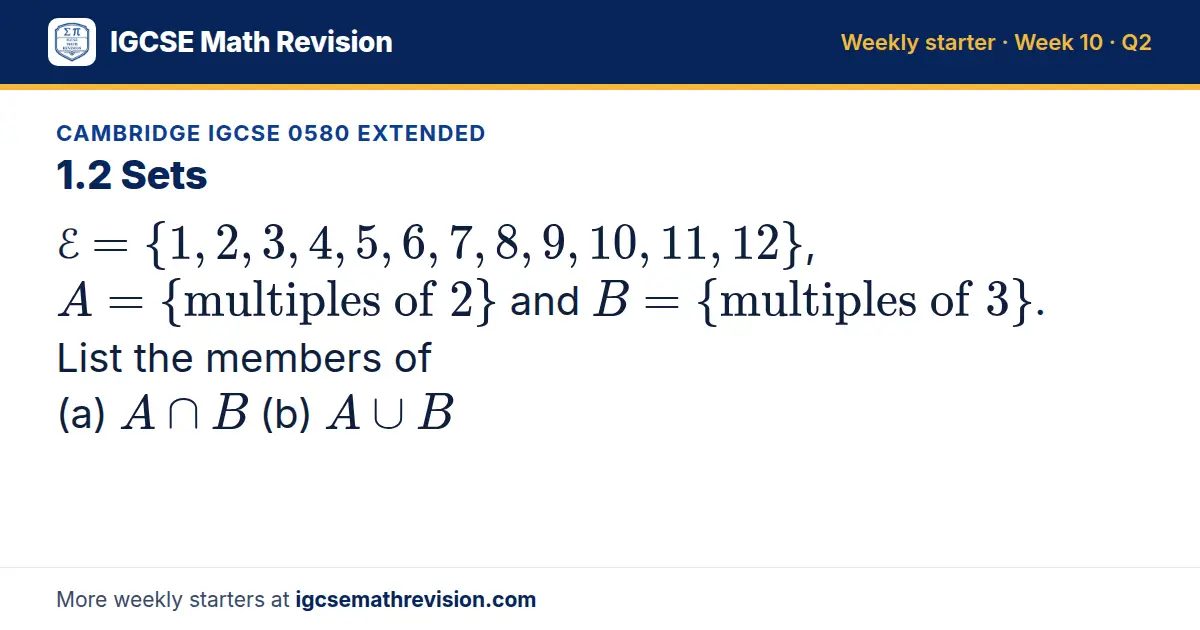
Question 2: 1.2 Sets
ℰ = 1, 2, 3, 4, 5, 6, 7, 8, 9, 10, 11, 12, A = multiples of 2 and B = multiples of 3. List the members of (a) A ∩ B (b) A ∪ B
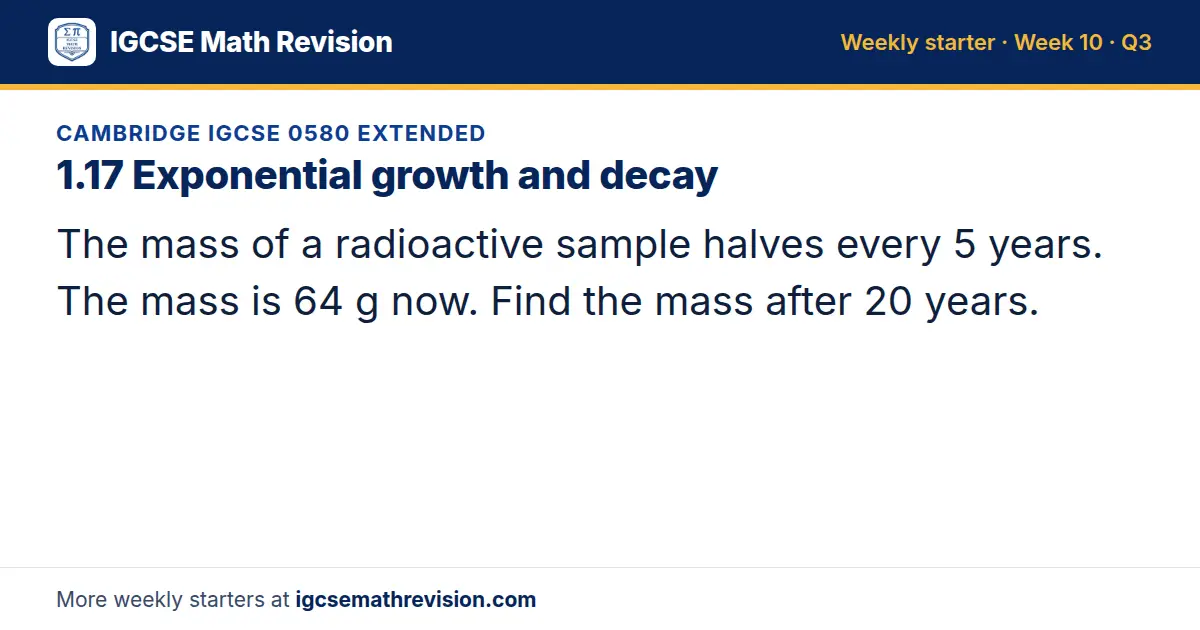
Question 3: 1.17 Exponential growth and decay
A population of bacteria doubles every hour. At first there are 300 bacteria. How many bacteria are there after 4 hours?
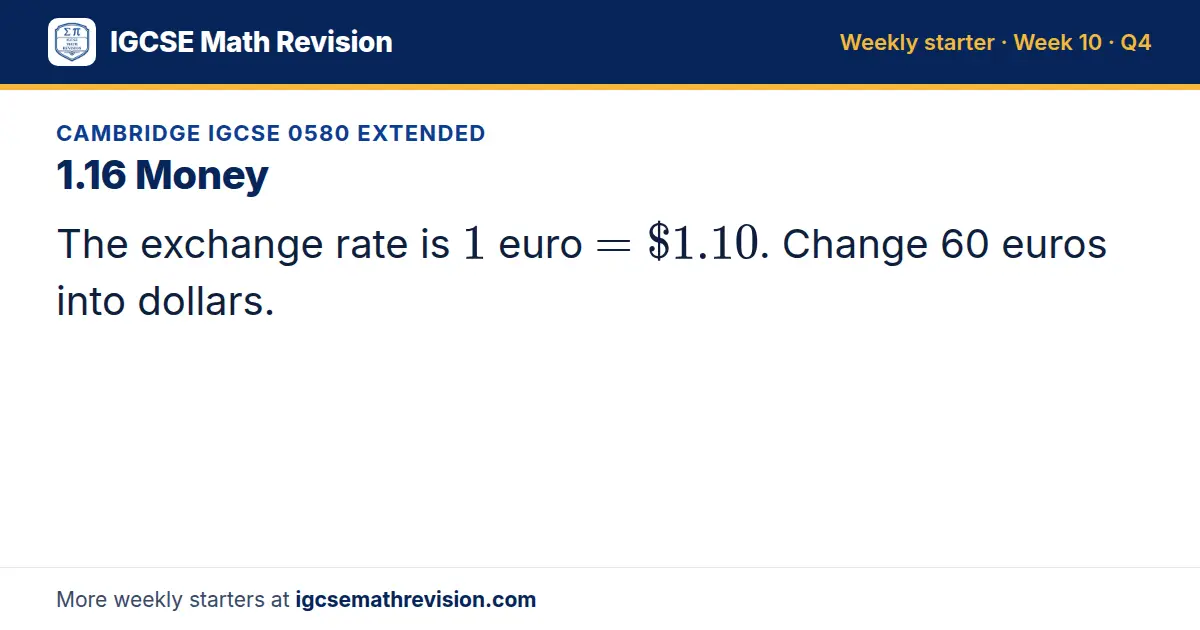
Question 4: 1.16 Money
The exchange rate is £1 = 0.92 euros. Change 375 euros into pounds. Give your answer correct to the nearest penny.
Week 11
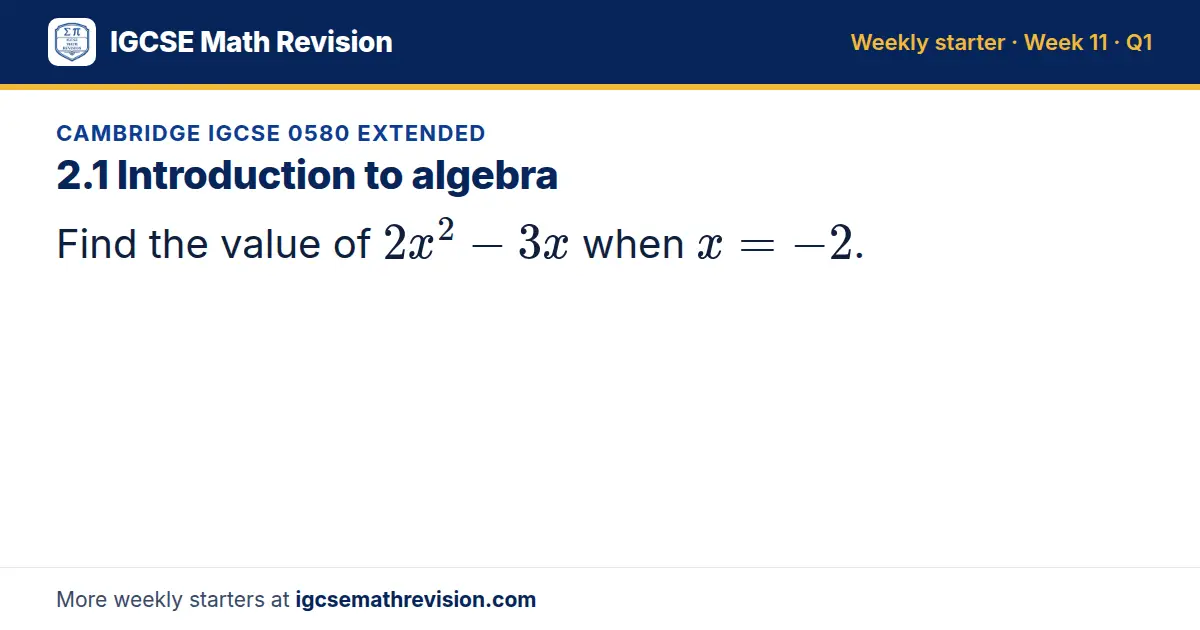
Question 1: 2.1 Introduction to algebra
Find the value of 2x² - 3x when x = -2.
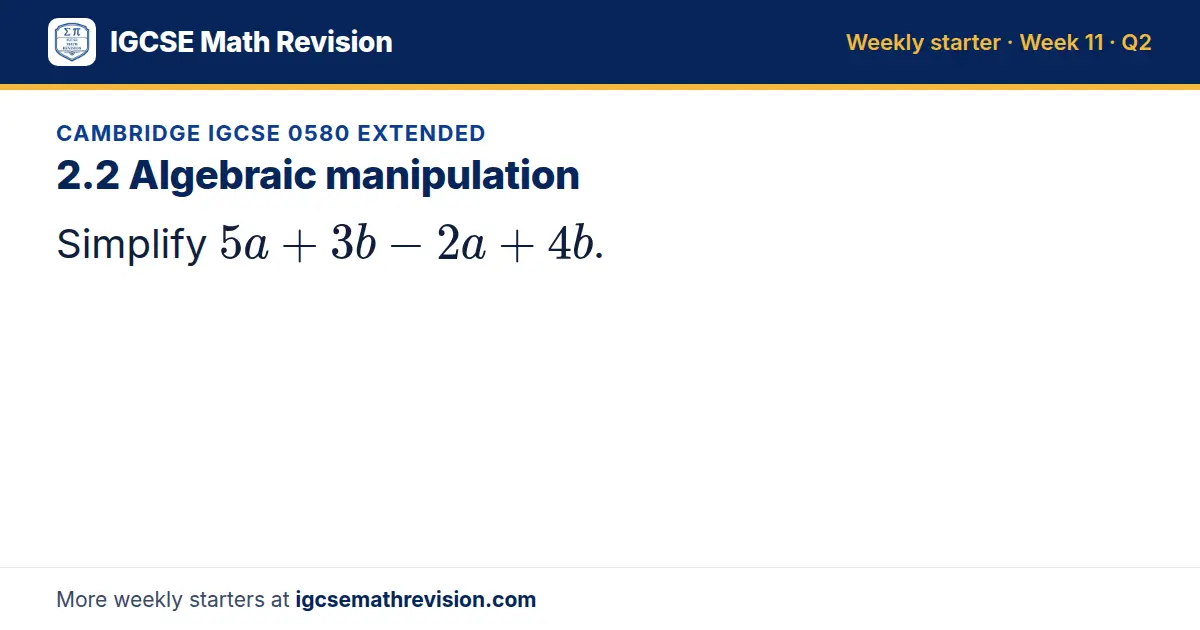
Question 2: 2.2 Algebraic manipulation
Simplify 5a + 3b - 2a + 4b.
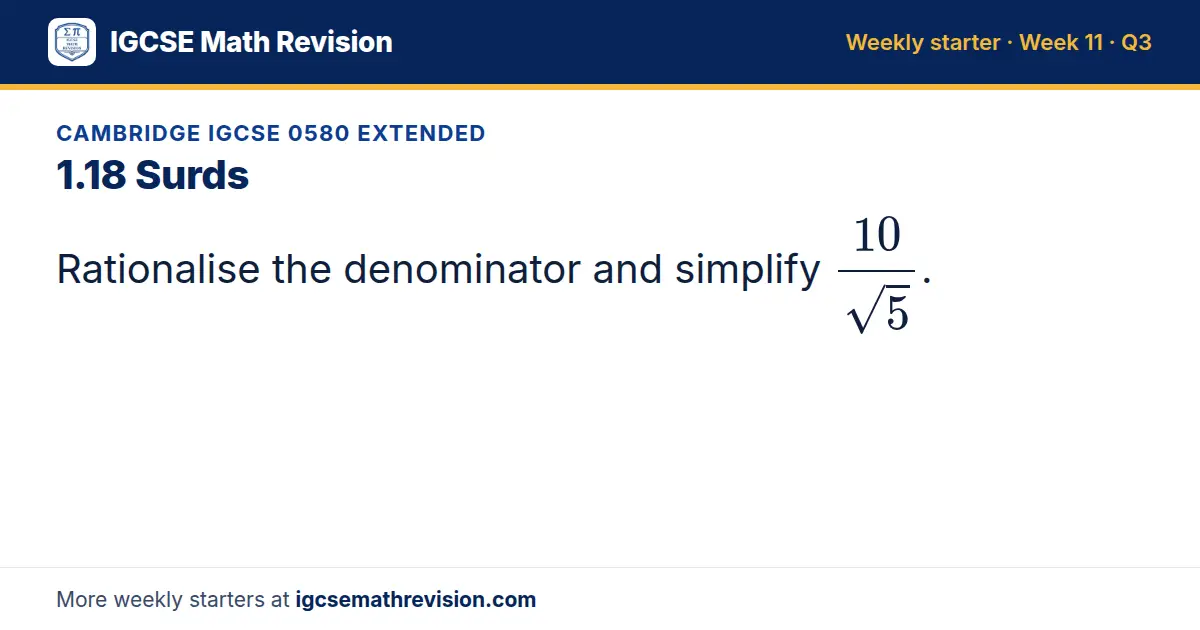
Question 3: 1.18 Surds
Simplify √8 + √50.
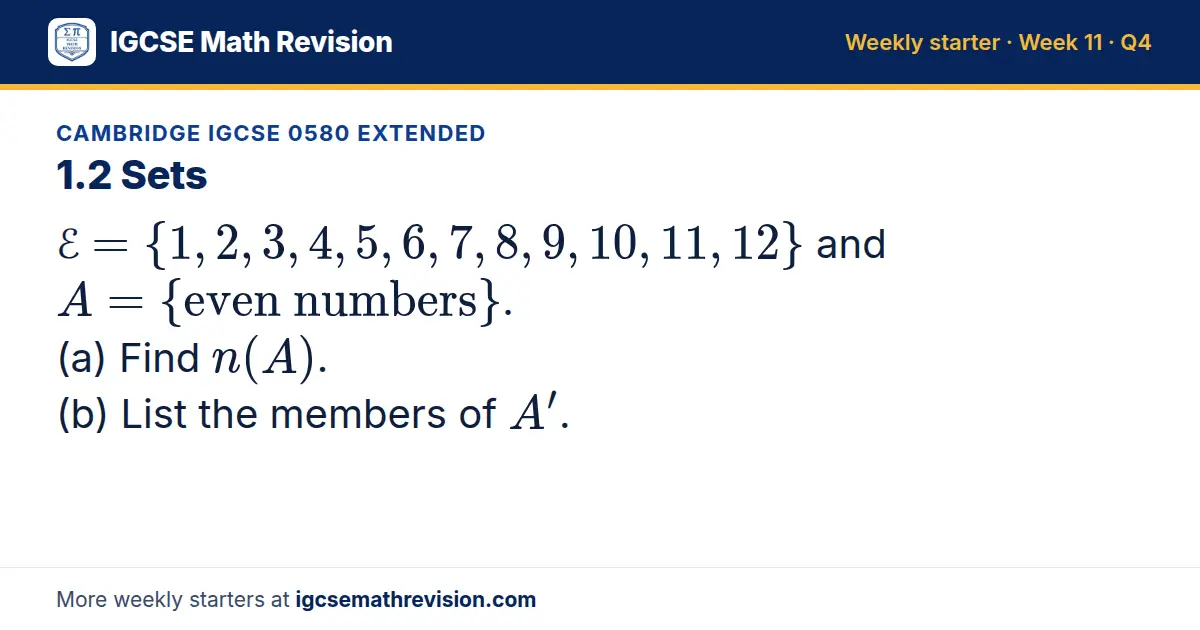
Question 4: 1.2 Sets
ℰ = 1, 2, 3, 4, 5, 6, 7, 8, 9, 10, 11, 12 and A = even numbers. (a) Find n(A). (b) List the members of A'.
More starter questions
Other weeks: Weeks 1–11 · Weeks 12–22 · Weeks 23–33 · Weeks 34–44 · Weeks 45–55. Answers and mark schemes, free for everyone, are on the free weekly starters page.
Keep your streak going
Save your answers and track your progressA free account remembers the questions you have done and brings you back to this page.
Join freeAlready have an account? Sign in