Cambridge IGCSE 0580 Extended starter questions: weeks 12–22
44 short questions to open a lesson for Cambridge IGCSE Mathematics 0580, Extended, weeks 12–22 of the teaching year, three or four a week. Each question is shown as an image with its text underneath; answers and mark schemes stay with teachers.
- ← Cambridge IGCSE 0580 Extended, weeks 1–11
- Cambridge IGCSE 0580 Extended, weeks 23–33 →
- All IGCSE Maths daily and weekly questions
Week 12
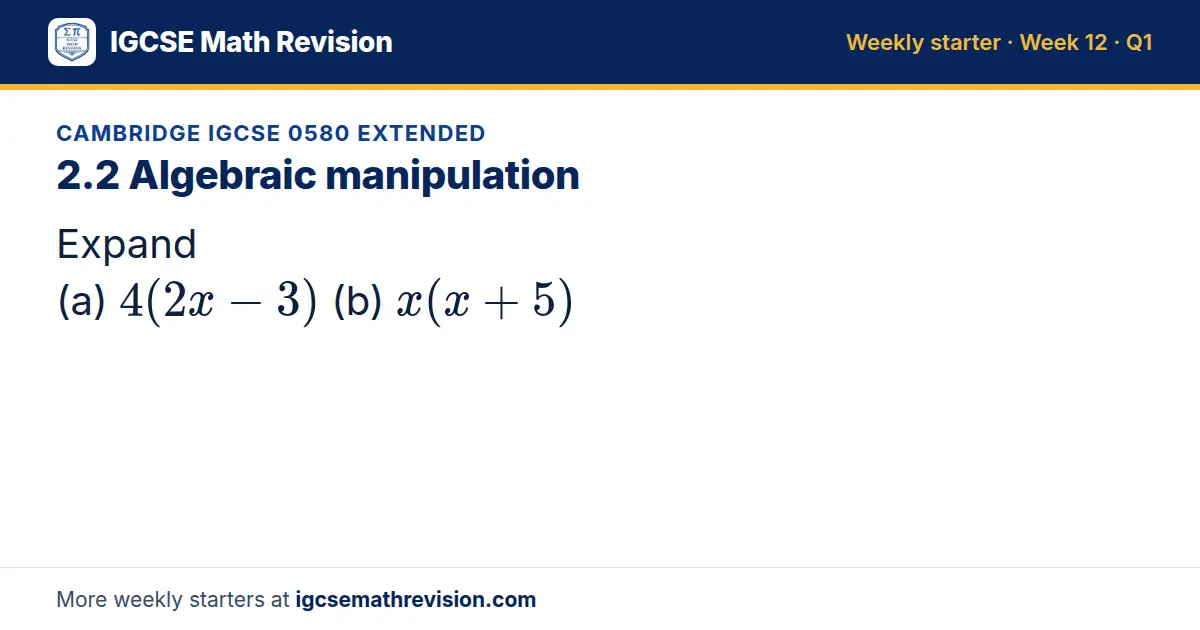
Question 1: 2.2 Algebraic manipulation
Expand (a) 4(2x - 3) (b) x(x + 5)
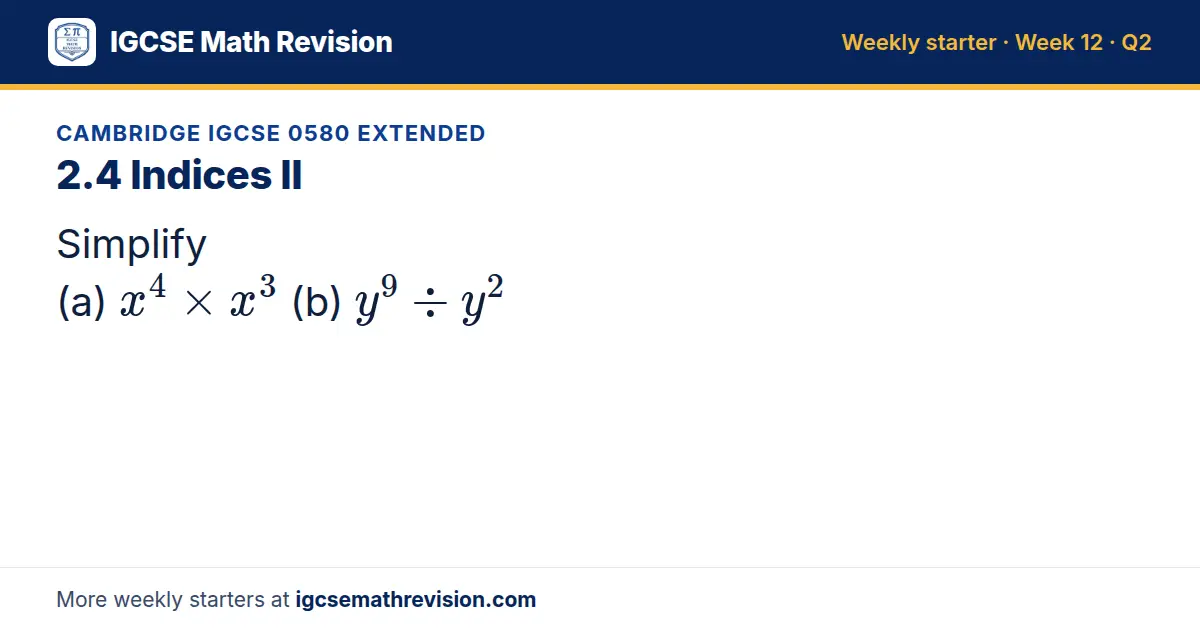
Question 2: 2.4 Indices II
Simplify (a) x⁴ × x³ (b) y⁹ ÷ y²
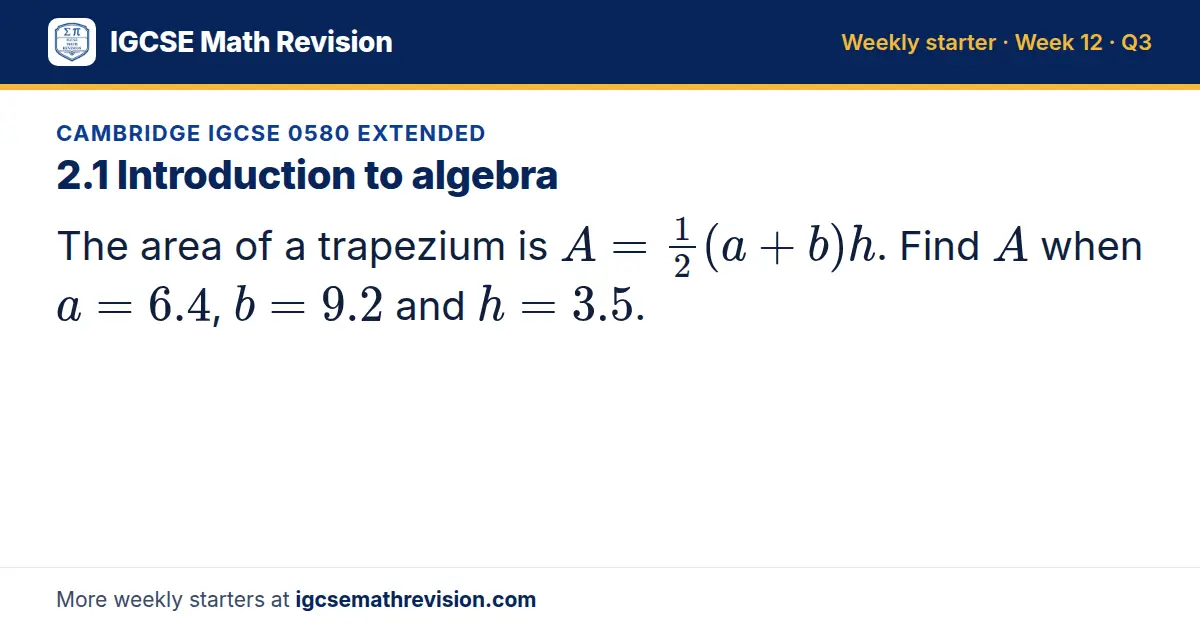
Question 3: 2.1 Introduction to algebra
The area of a trapezium is A = 1/2(a + b)h. Find A when a = 6.4, b = 9.2 and h = 3.5.
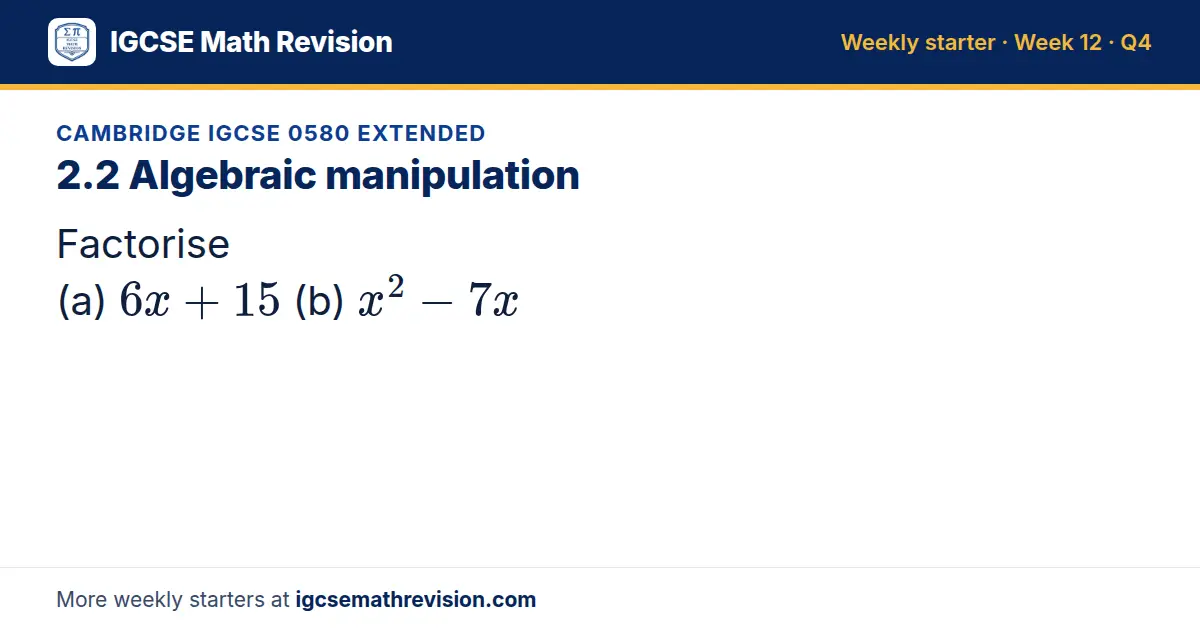
Question 4: 2.2 Algebraic manipulation
Factorise (a) 6x + 15 (b) x² - 7x
Week 13
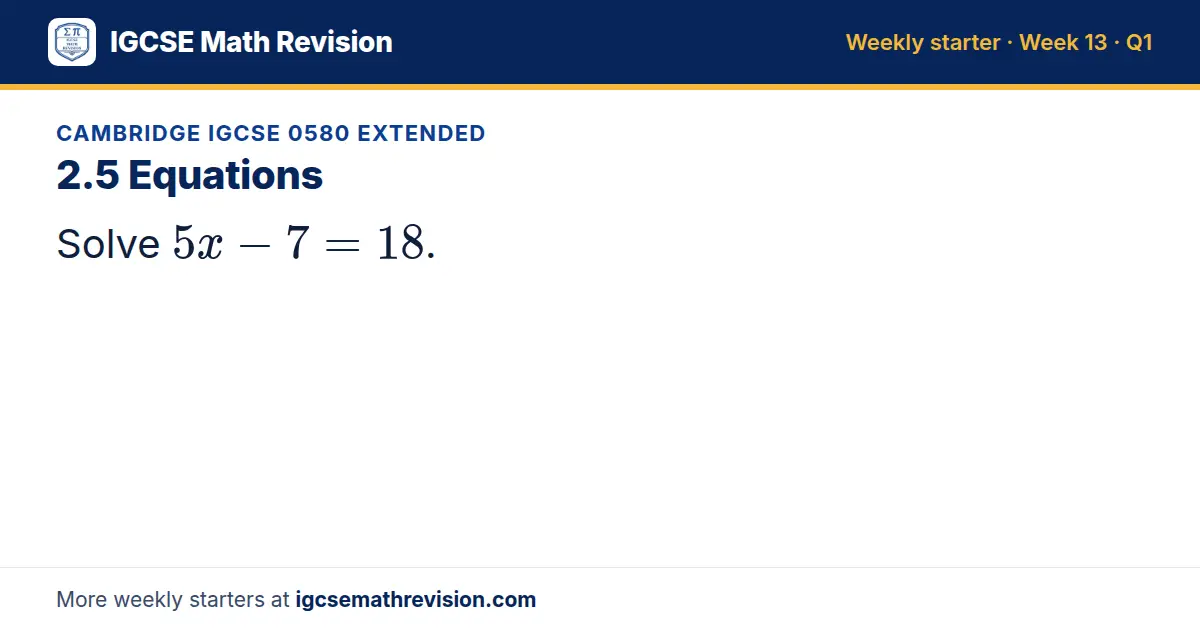
Question 1: 2.5 Equations
Solve 5x - 7 = 18.
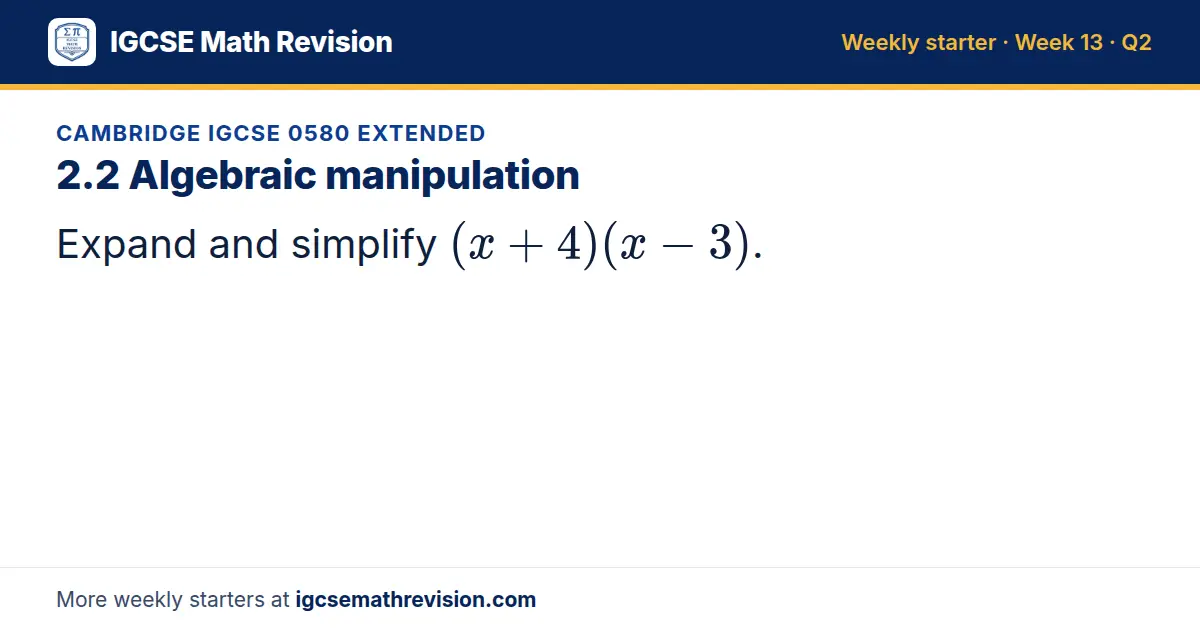
Question 2: 2.2 Algebraic manipulation
Expand and simplify (x + 4)(x - 3).
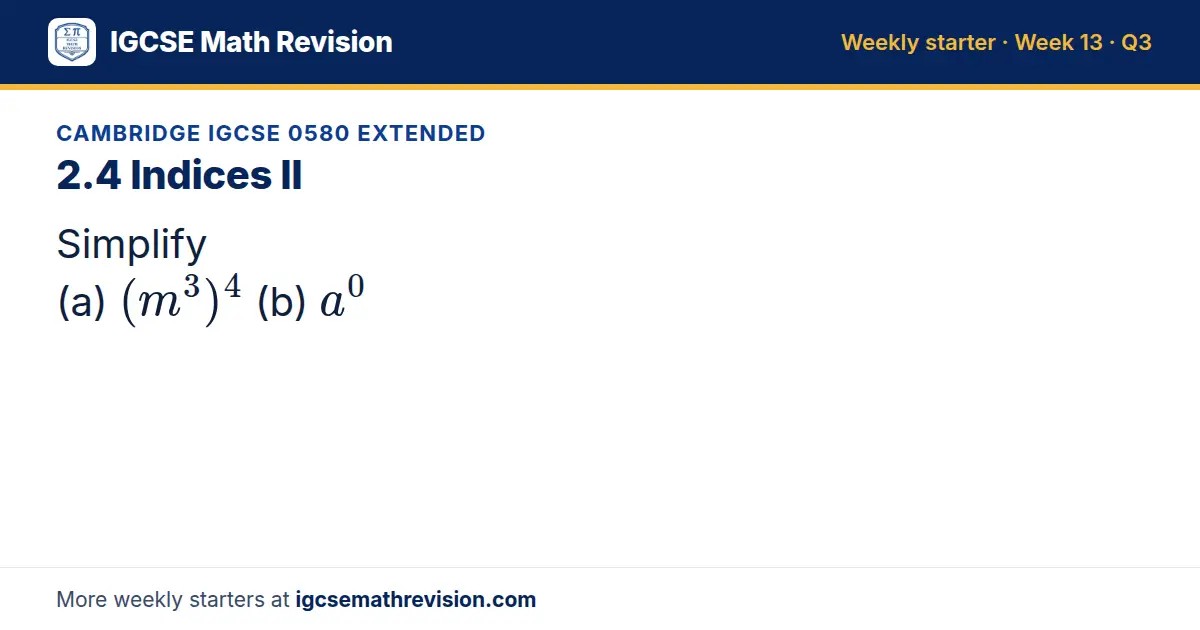
Question 3: 2.4 Indices II
Simplify (a) (m³)⁴ (b) a⁰
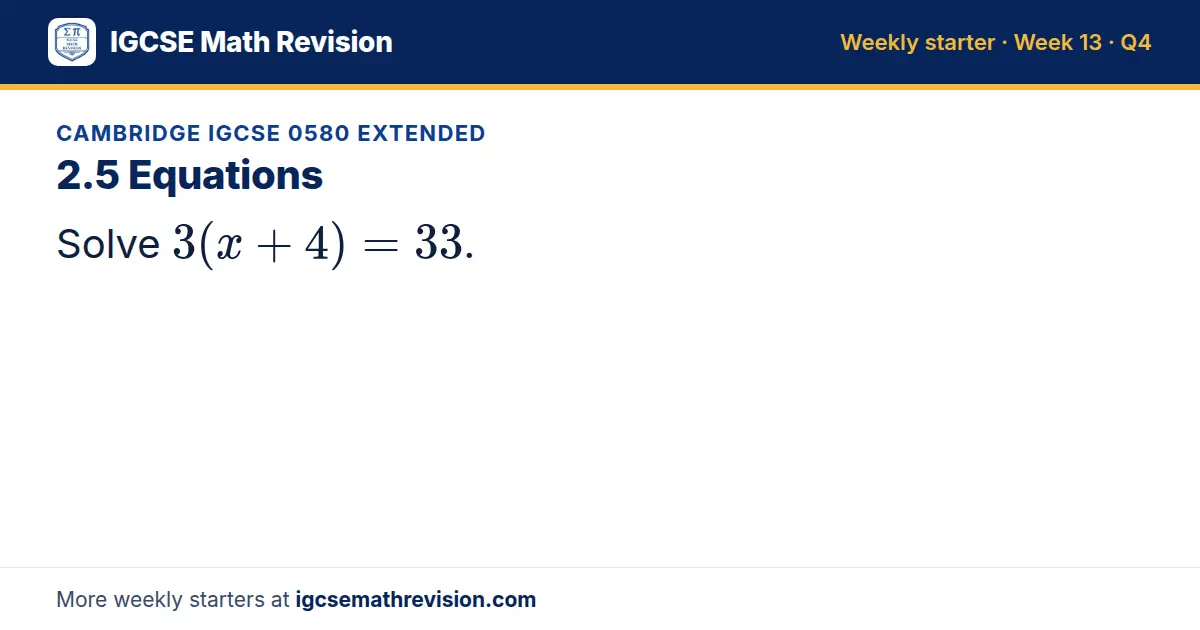
Question 4: 2.5 Equations
Solve 3(x + 4) = 33.
Week 14
![Cambridge IGCSE 0580 Extended starter question on 2.5 Equations: Make the letter in brackets the subject of each formula. (a) C = 2π r [r] (b) y = 3x + 5 [x]](/igcse-frontend/img/questions/igcse-maths-0580-extended-2-5-equations-starter-question-cie0580e-w14-q1.webp)
Question 1: 2.5 Equations
Make the letter in brackets the subject of each formula. (a) C = 2π r [r] (b) y = 3x + 5 [x]
Question 2: 2.6 Inequalities
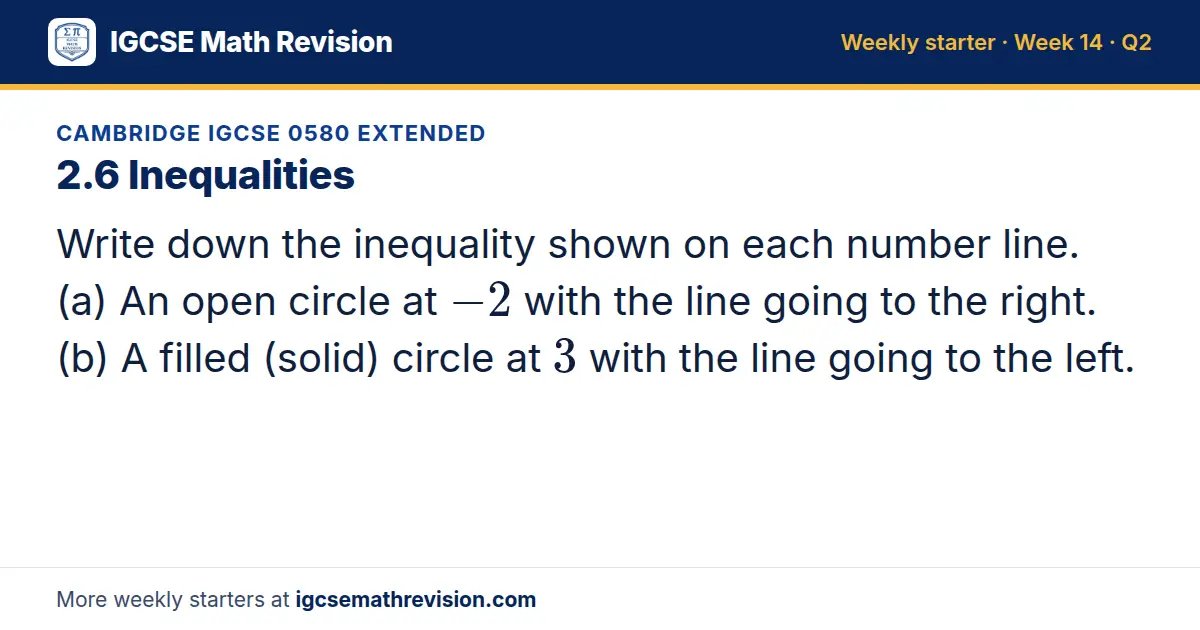
Write down the inequality shown on each number line. (a) An open circle at -2 with the line going to the right. (b) A filled (solid) circle at 3 with the line going to the left.
Question 3: 2.5 Equations
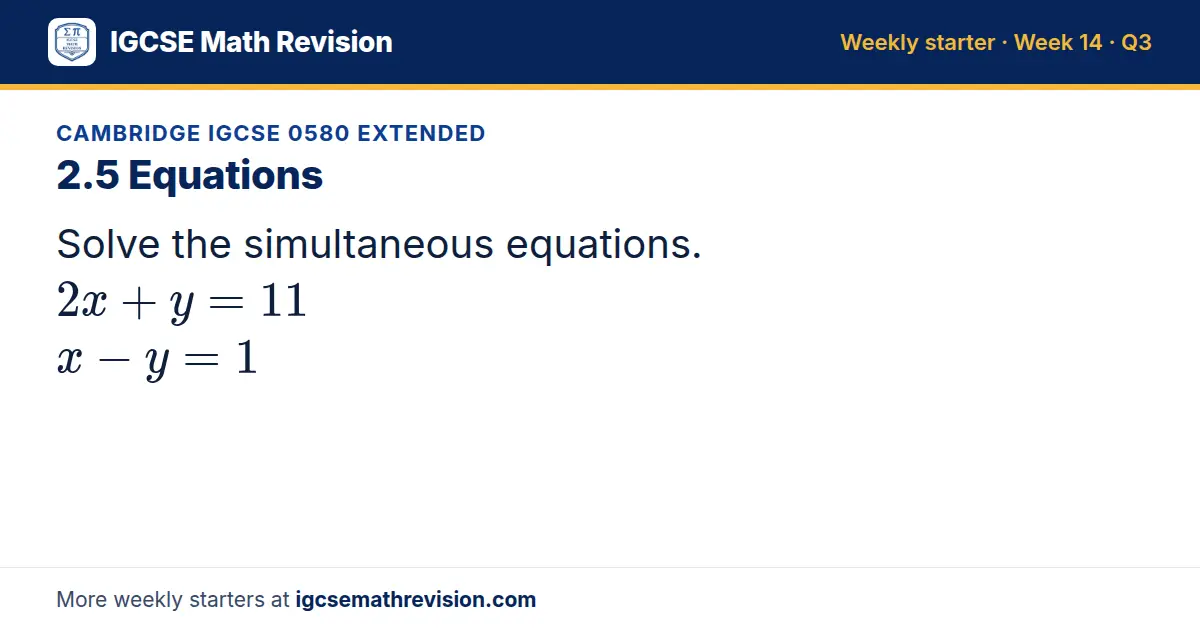
Solve the simultaneous equations. 2x + y = 11 x - y = 1
Question 4: 2.6 Inequalities
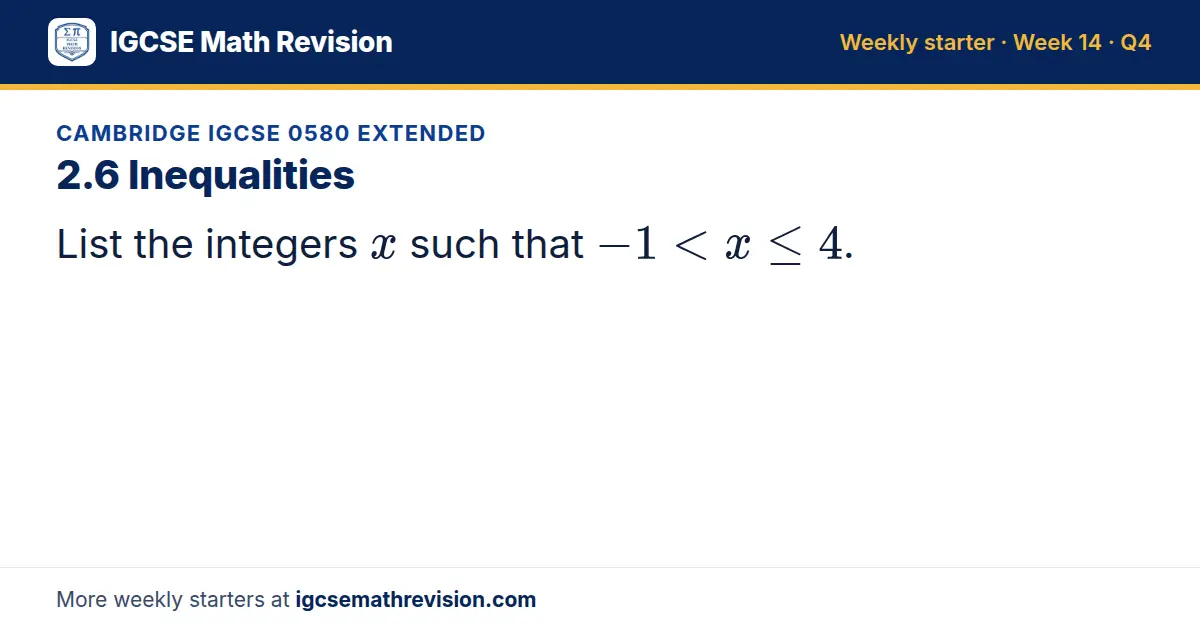
List the integers x such that -1 < x ≤ 4.
Week 15
Question 1: 2.7 Sequences
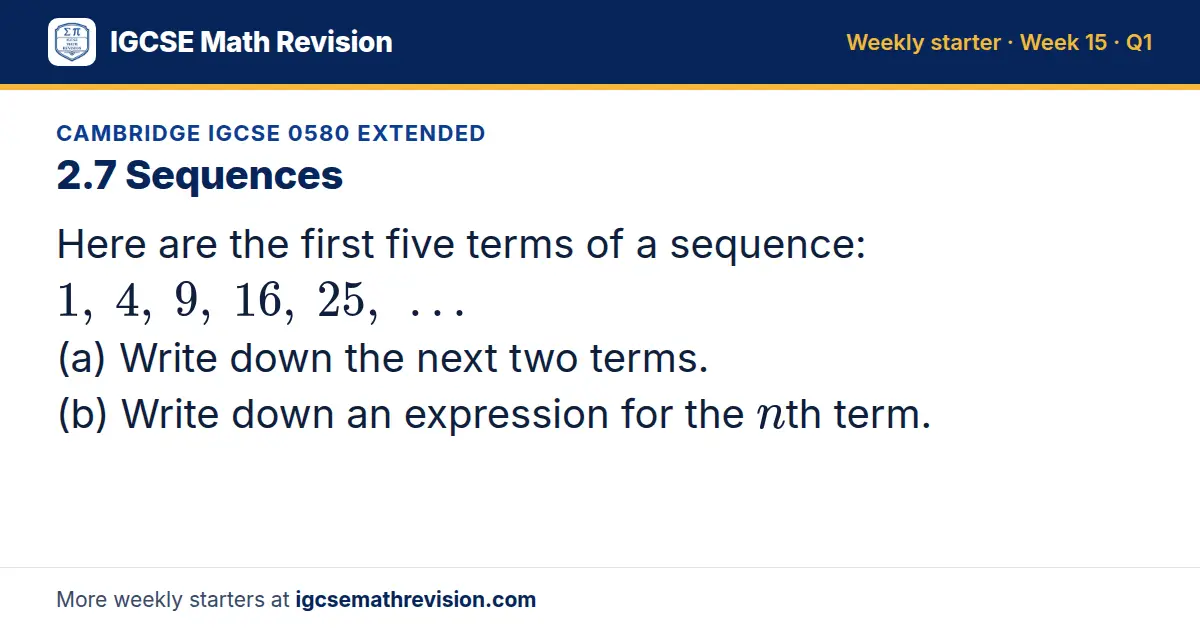
Here are the first five terms of a sequence: 1, 4, 9, 16, 25, … (a) Write down the next two terms. (b) Write down an expression for the nth term.
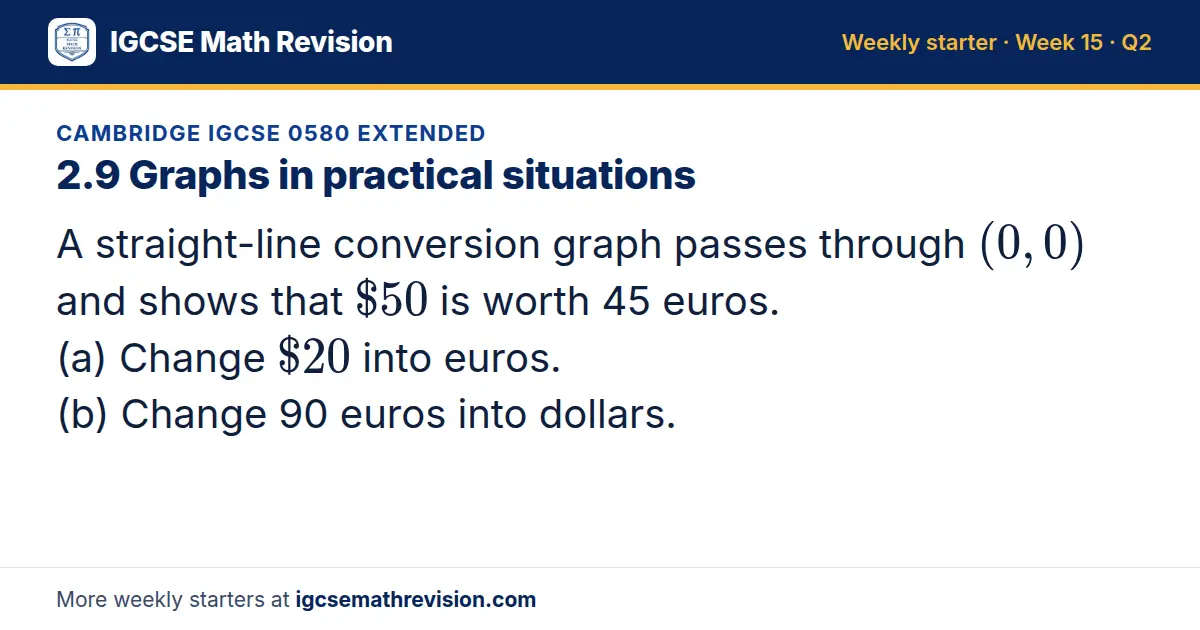
Question 2: 2.9 Graphs in practical situations
A straight-line conversion graph passes through (0, 0) and shows that $50 is worth 45 euros. (a) Change $20 into euros. (b) Change 90 euros into dollars.
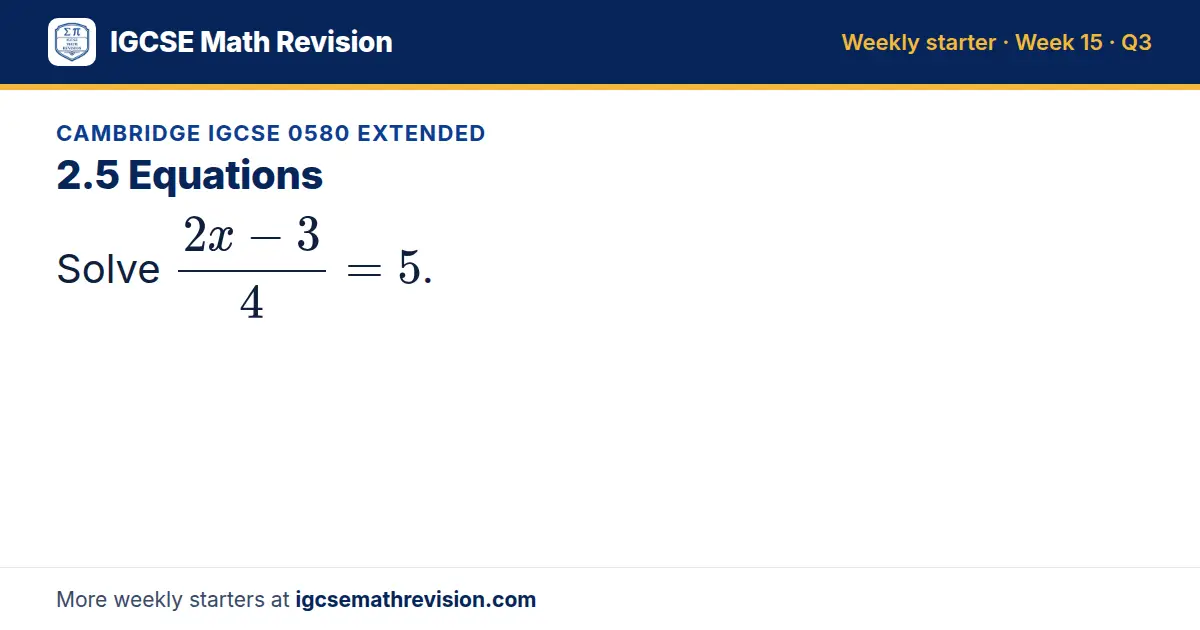
Question 3: 2.5 Equations
Solve (2x - 3)/4 = 5.
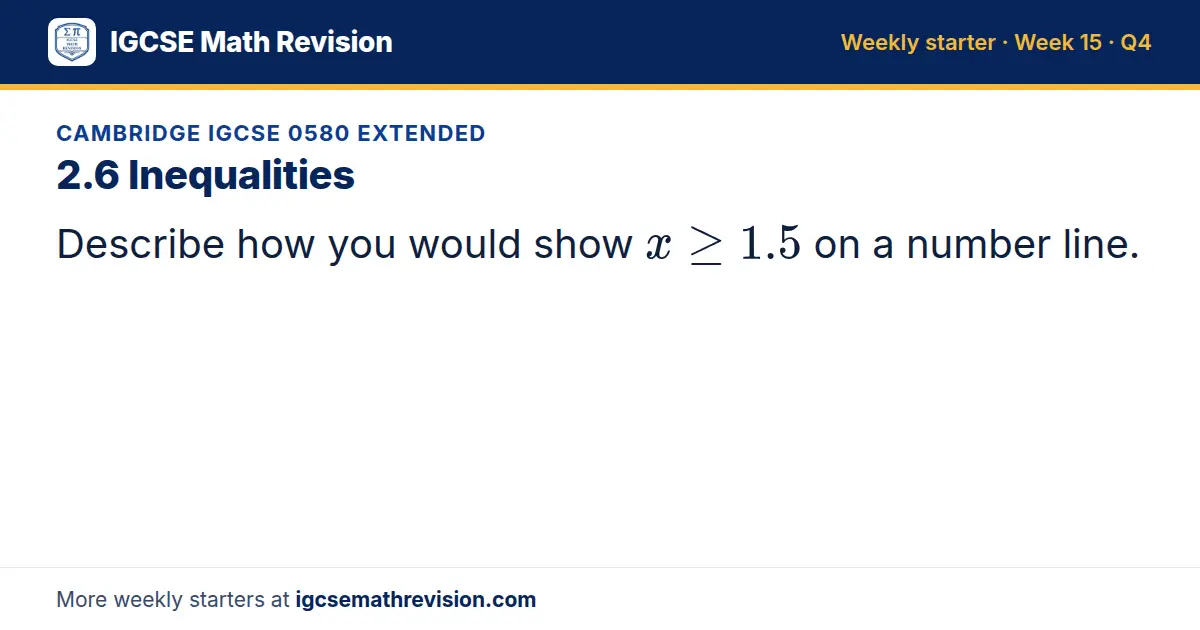
Question 4: 2.6 Inequalities
Describe how you would show x ≥ 1.5 on a number line.
Week 16
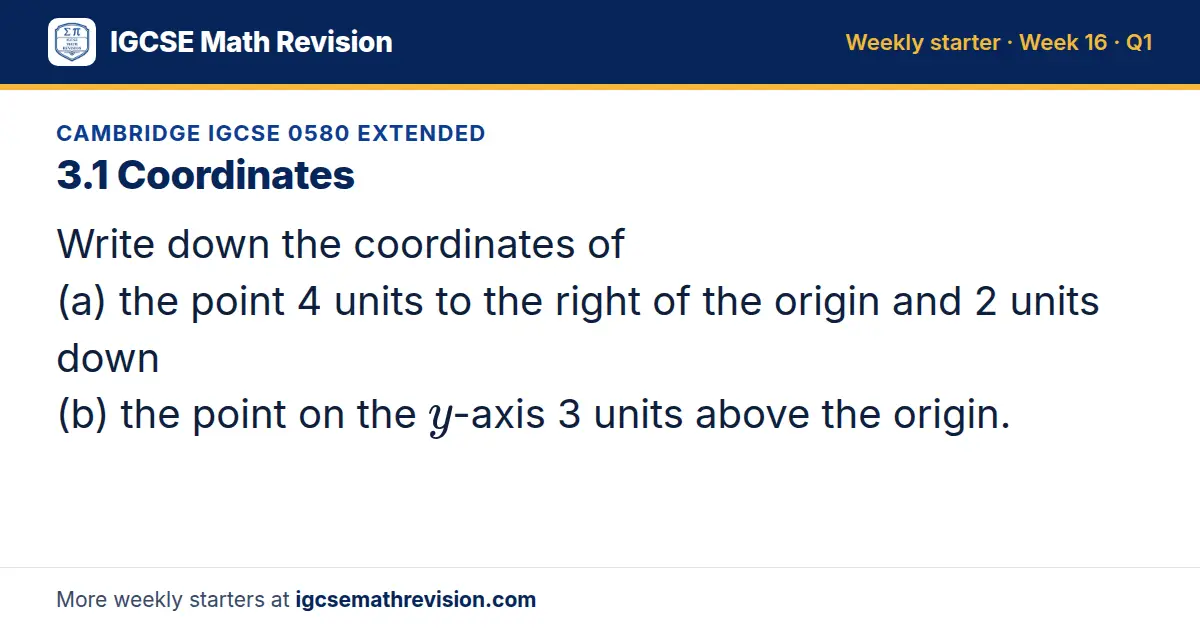
Question 1: 3.1 Coordinates
Write down the coordinates of (a) the point 4 units to the right of the origin and 2 units down (b) the point on the y-axis 3 units above the origin.
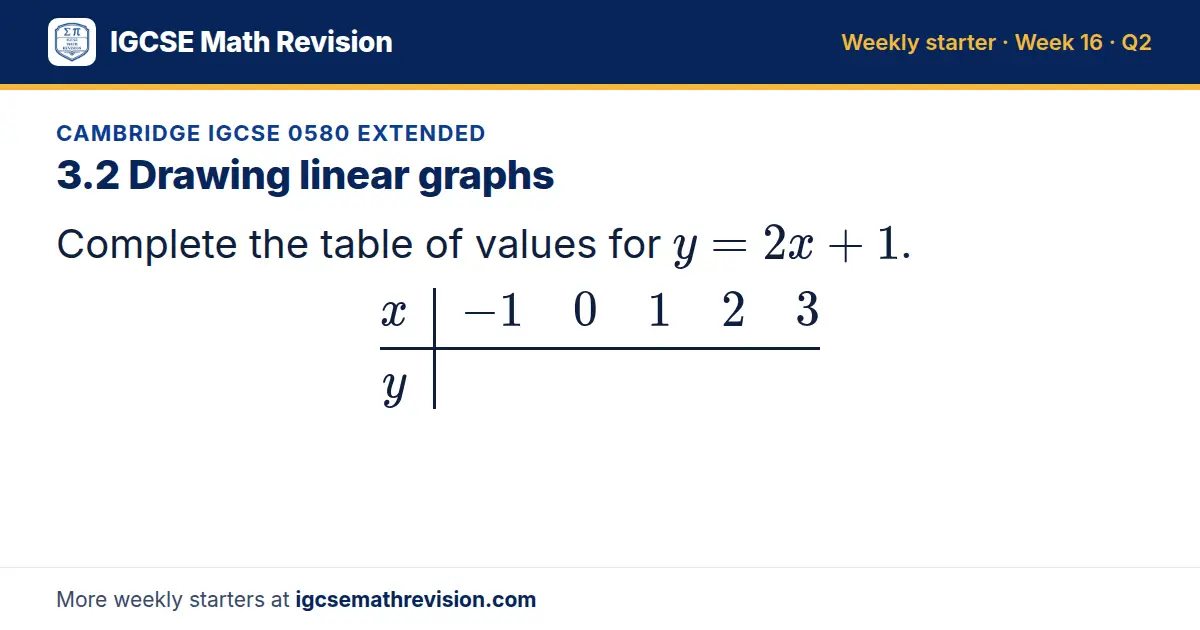
Question 2: 3.2 Drawing linear graphs
Complete the table of values for y = 2x + 1. x -1 0 1 2 3; y
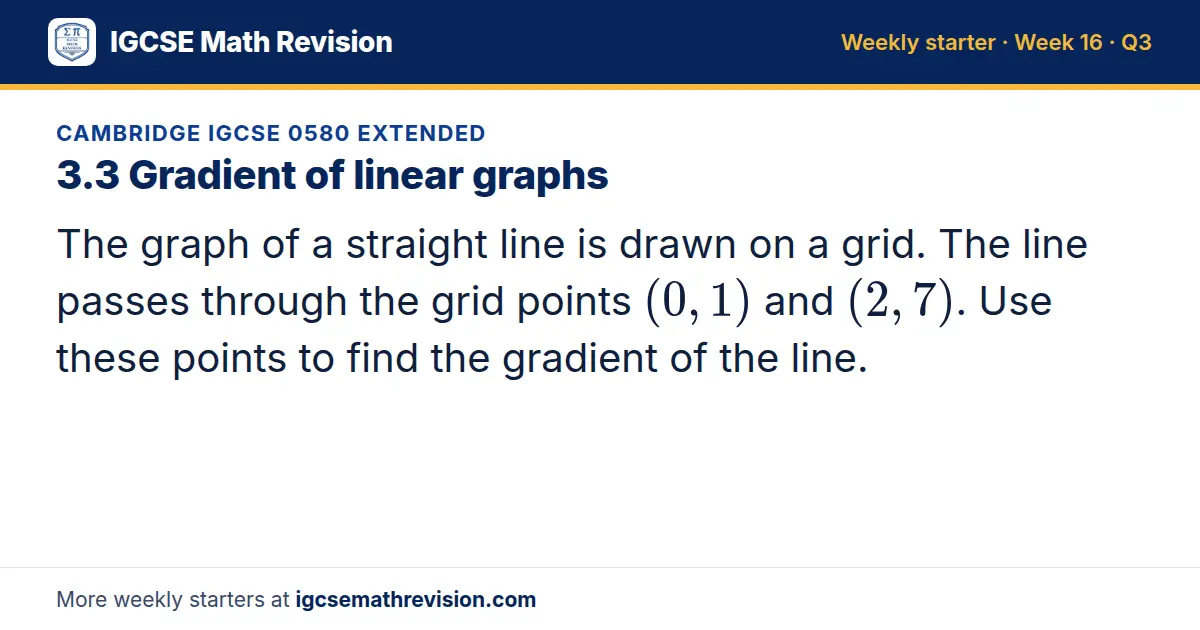
Question 3: 3.3 Gradient of linear graphs
The graph of a straight line is drawn on a grid. The line passes through the grid points (0, 1) and (2, 7). Use these points to find the gradient of the line.
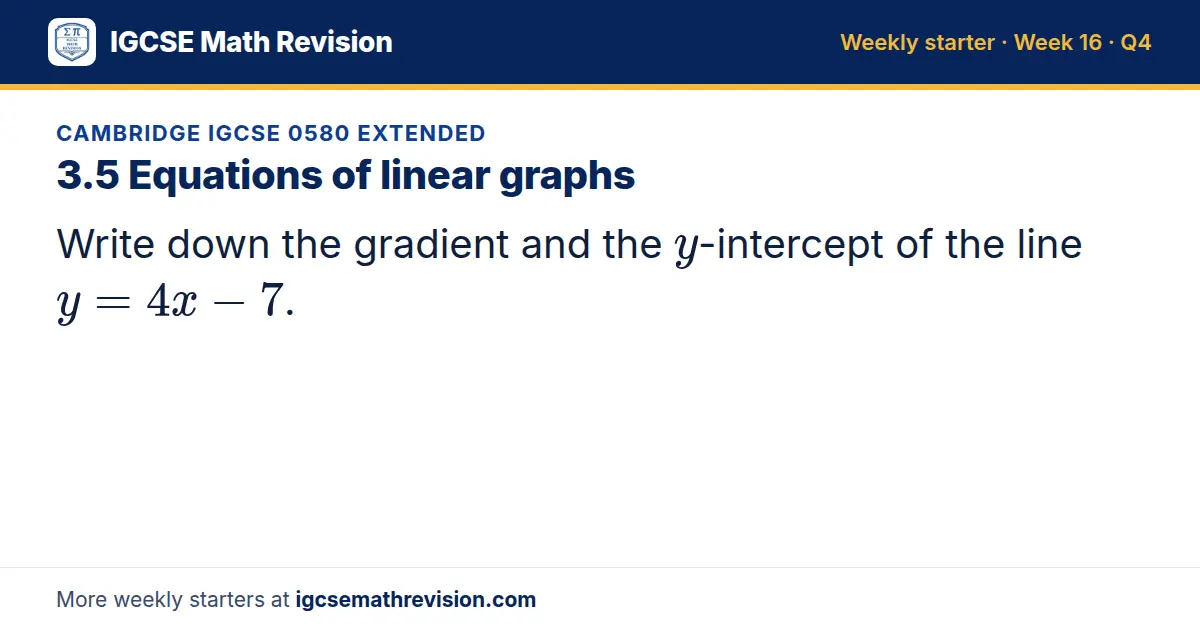
Question 4: 3.5 Equations of linear graphs
Write down the gradient and the y-intercept of the line y = 4x - 7.
Week 17
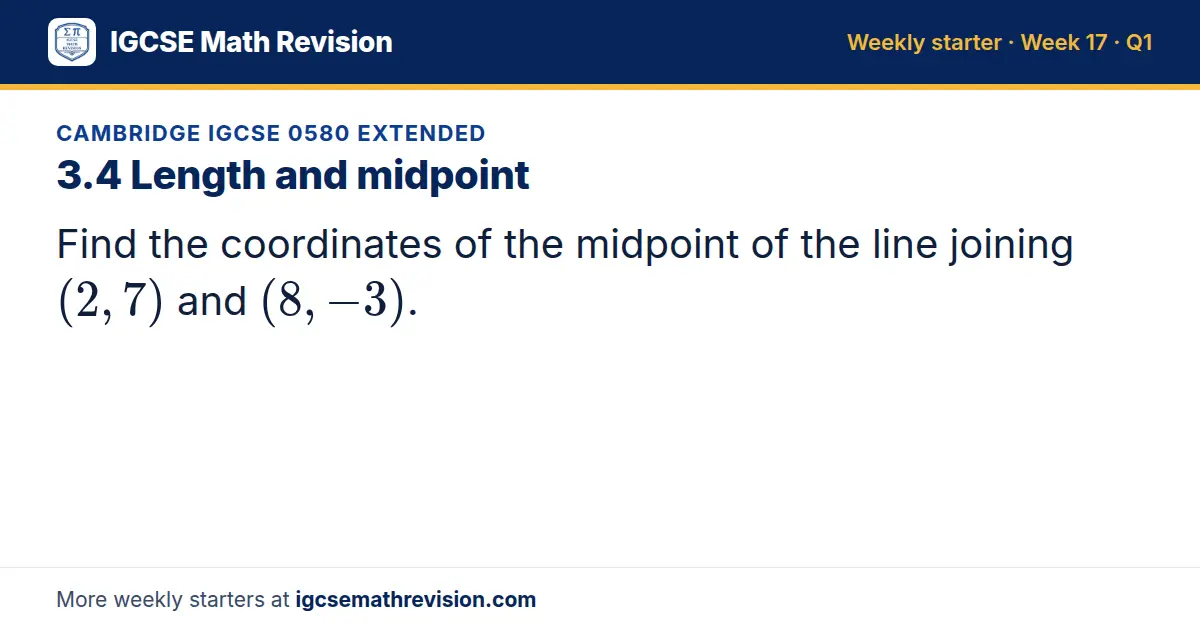
Question 1: 3.4 Length and midpoint
Find the coordinates of the midpoint of the line joining (2, 7) and (8, -3).
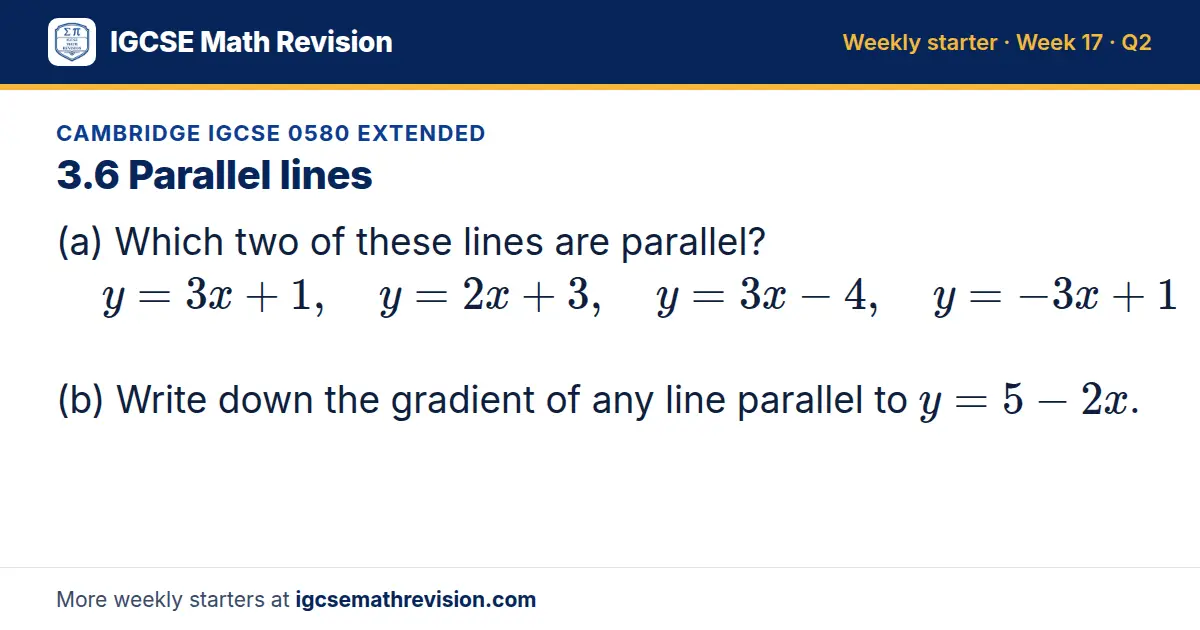
Question 2: 3.6 Parallel lines
(a) Which two of these lines are parallel? y = 3x + 1, y = 2x + 3, y = 3x - 4, y = -3x + 1 (b) Write down the gradient of any line parallel to y = 5 - 2x.
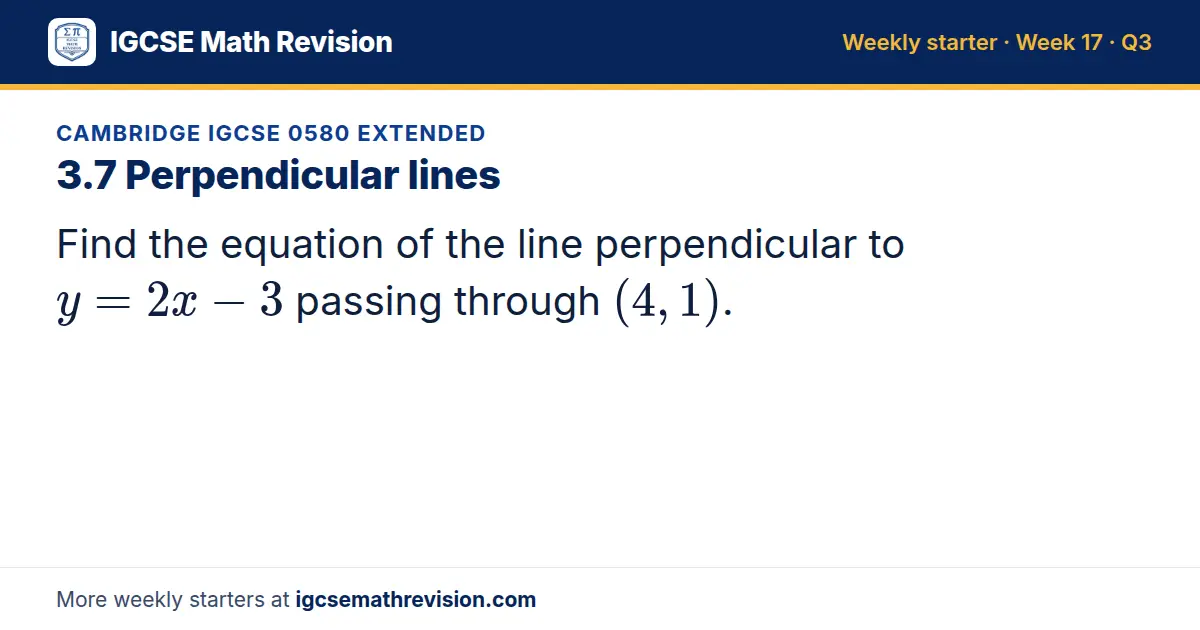
Question 3: 3.7 Perpendicular lines
Find the equation of the line perpendicular to y = 2x - 3 passing through (4, 1).
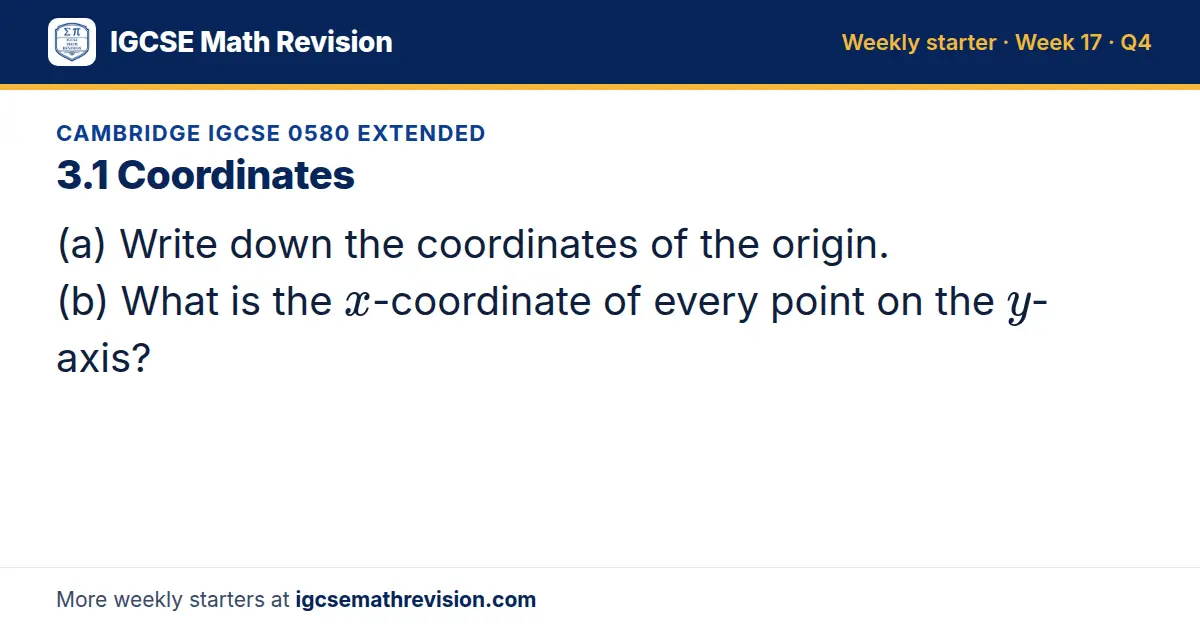
Question 4: 3.1 Coordinates
(a) Write down the coordinates of the origin. (b) What is the x-coordinate of every point on the y-axis?
Week 18
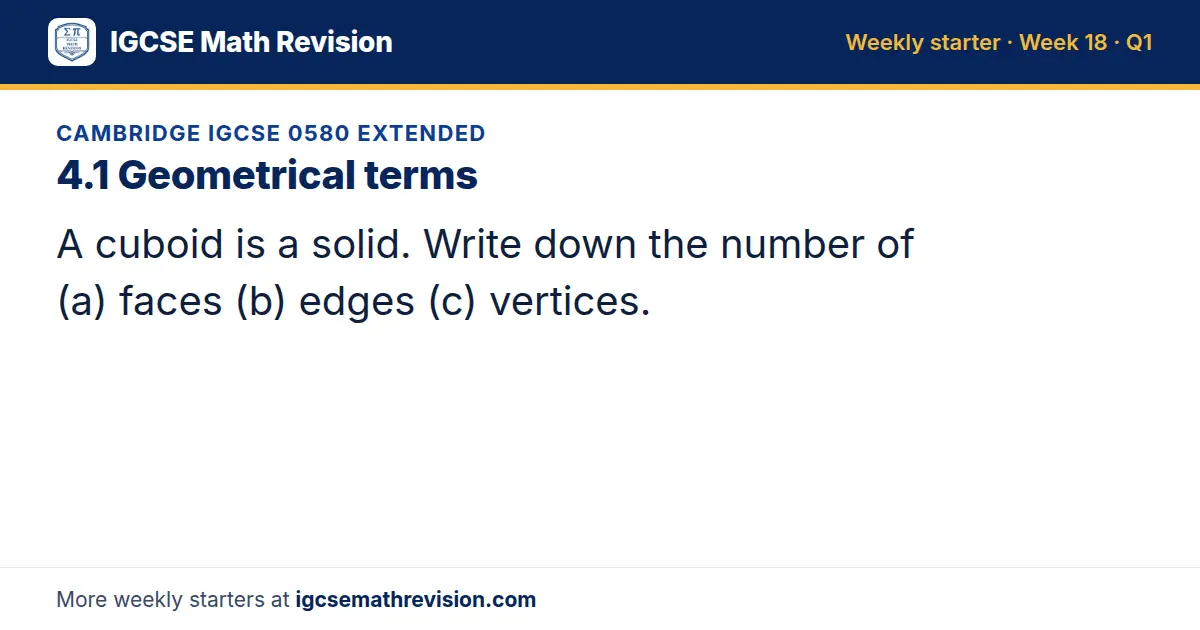
Question 1: 4.1 Geometrical terms
A cuboid is a solid. Write down the number of (a) faces (b) edges (c) vertices.
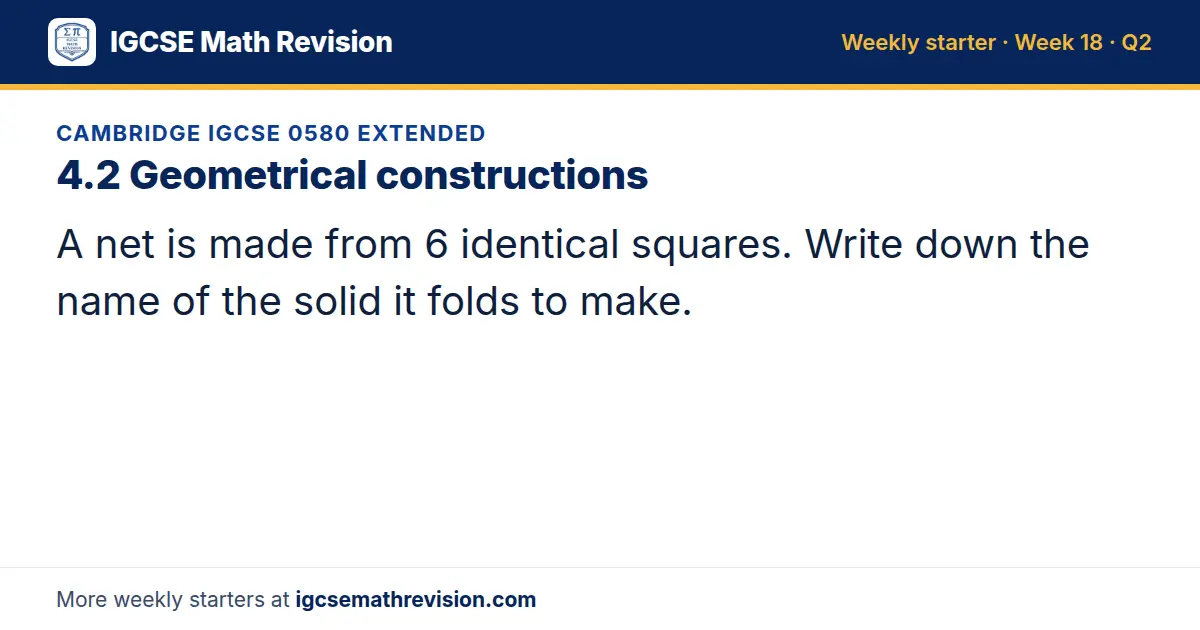
Question 2: 4.2 Geometrical constructions
A net is made from 6 identical squares. Write down the name of the solid it folds to make.
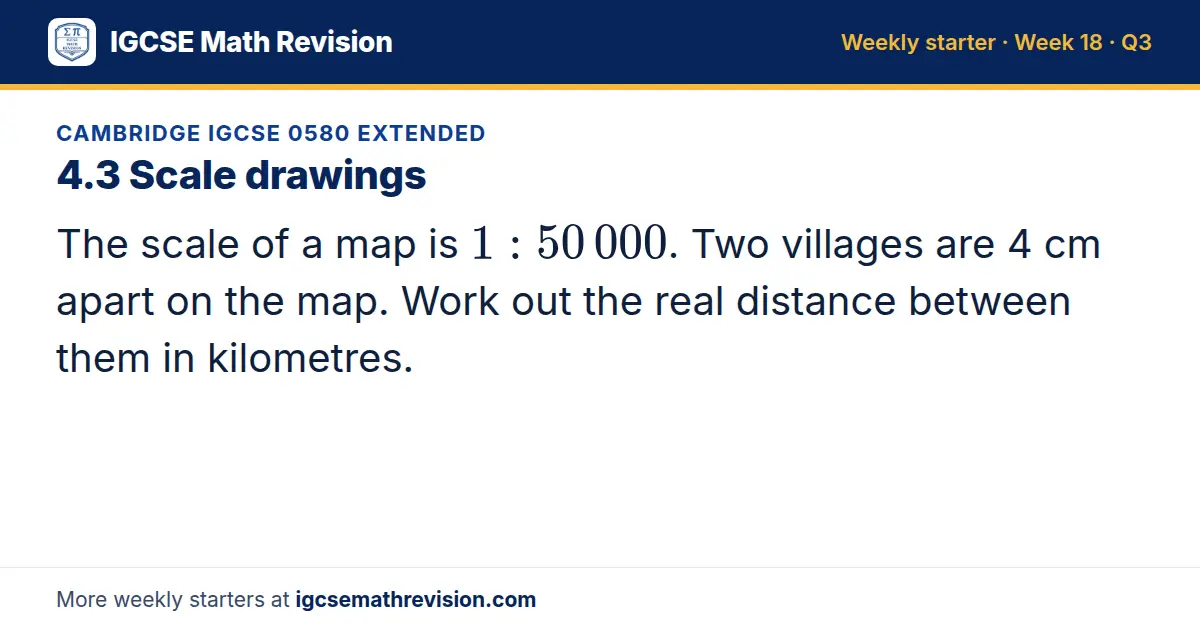
Question 3: 4.3 Scale drawings
The scale of a map is 1: 50 000. Two villages are 4 cm apart on the map. Work out the real distance between them in kilometres.
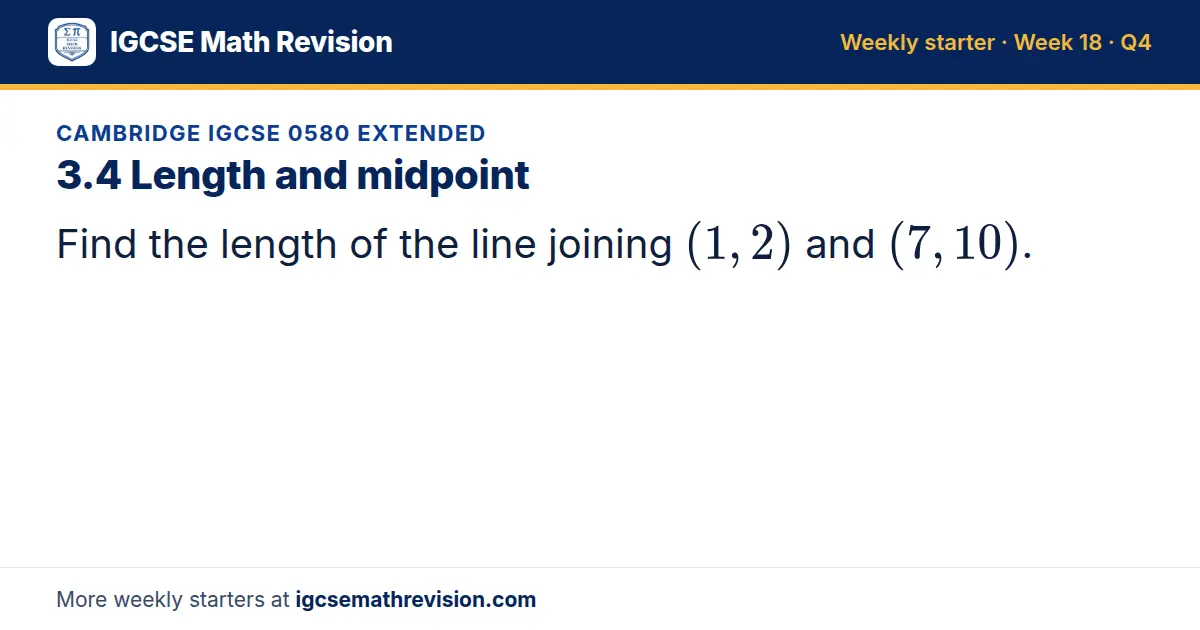
Question 4: 3.4 Length and midpoint
Find the length of the line joining (1, 2) and (7, 10).
Week 19
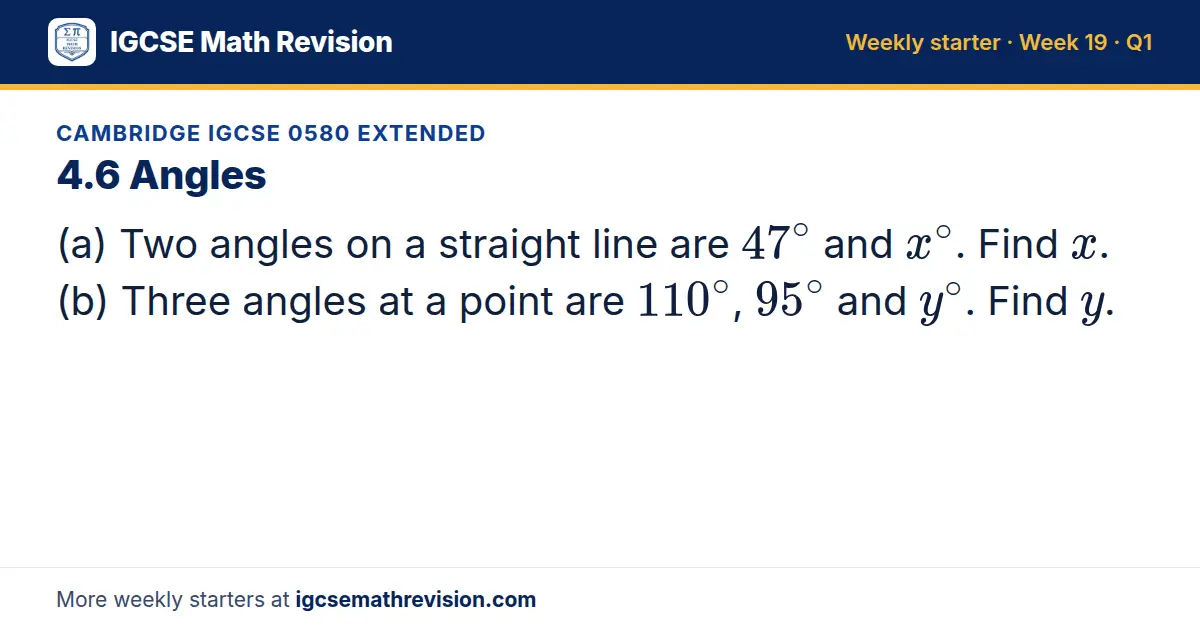
Question 1: 4.6 Angles
(a) Two angles on a straight line are 47^∘ and x^∘. Find x. (b) Three angles at a point are 110^∘, 95^∘ and y^∘. Find y.
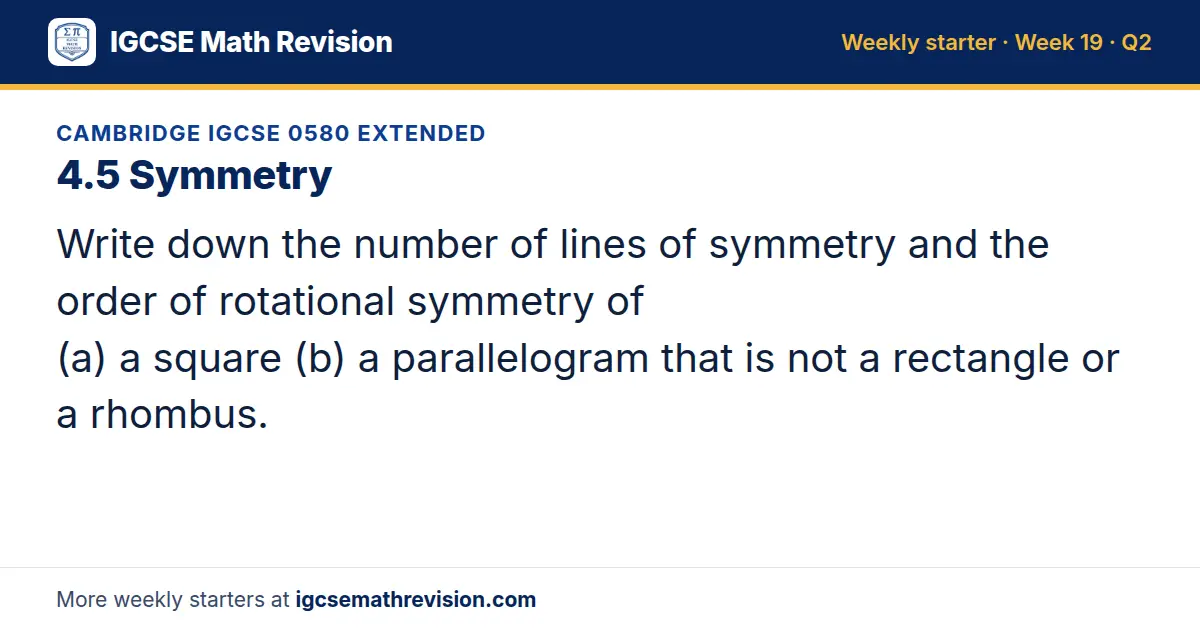
Question 2: 4.5 Symmetry
Write down the number of lines of symmetry and the order of rotational symmetry of (a) a square (b) a parallelogram that is not a rectangle or a rhombus.
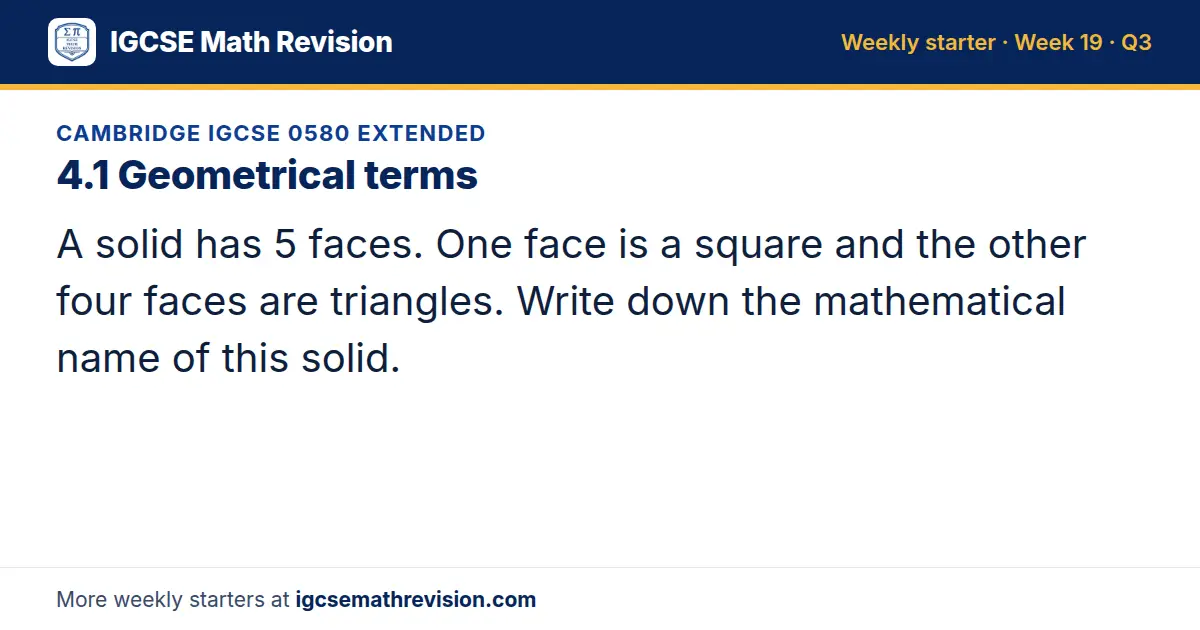
Question 3: 4.1 Geometrical terms
A solid has 5 faces. One face is a square and the other four faces are triangles. Write down the mathematical name of this solid.
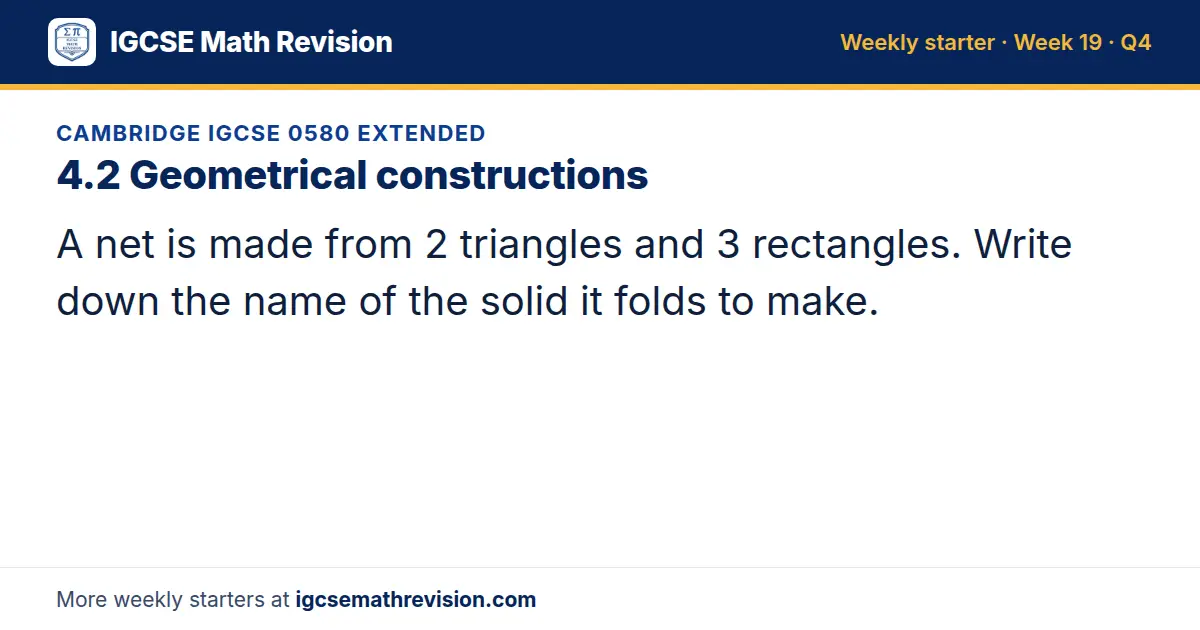
Question 4: 4.2 Geometrical constructions
A net is made from 2 triangles and 3 rectangles. Write down the name of the solid it folds to make.
Week 20
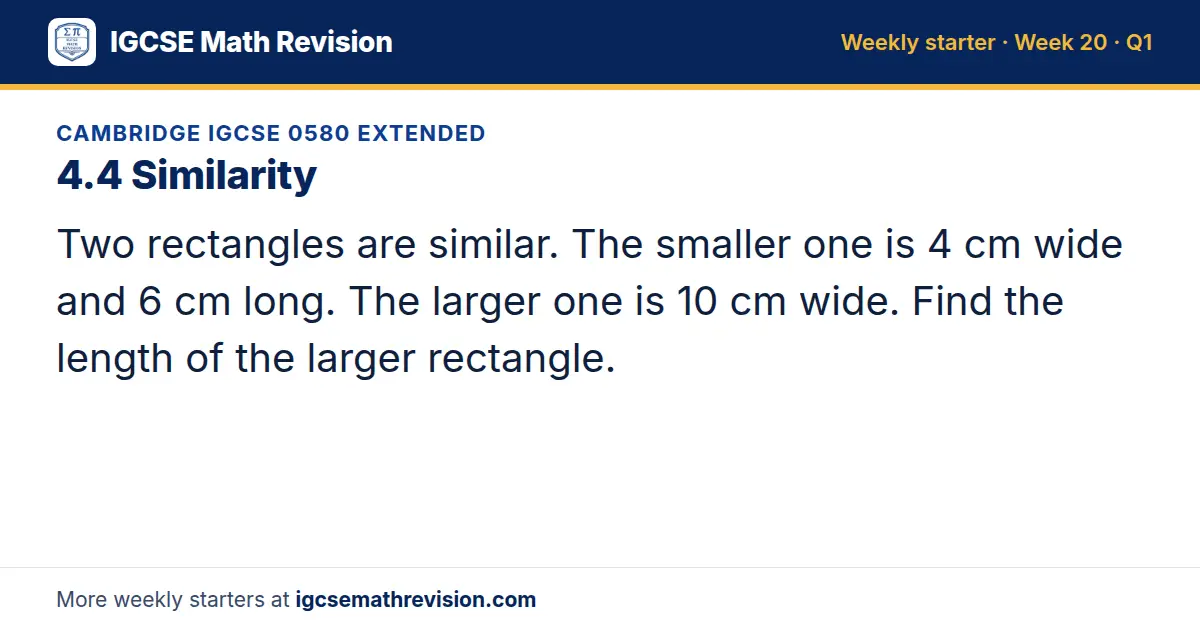
Question 1: 4.4 Similarity
Two rectangles are similar. The smaller one is 4 cm wide and 6 cm long. The larger one is 10 cm wide. Find the length of the larger rectangle.
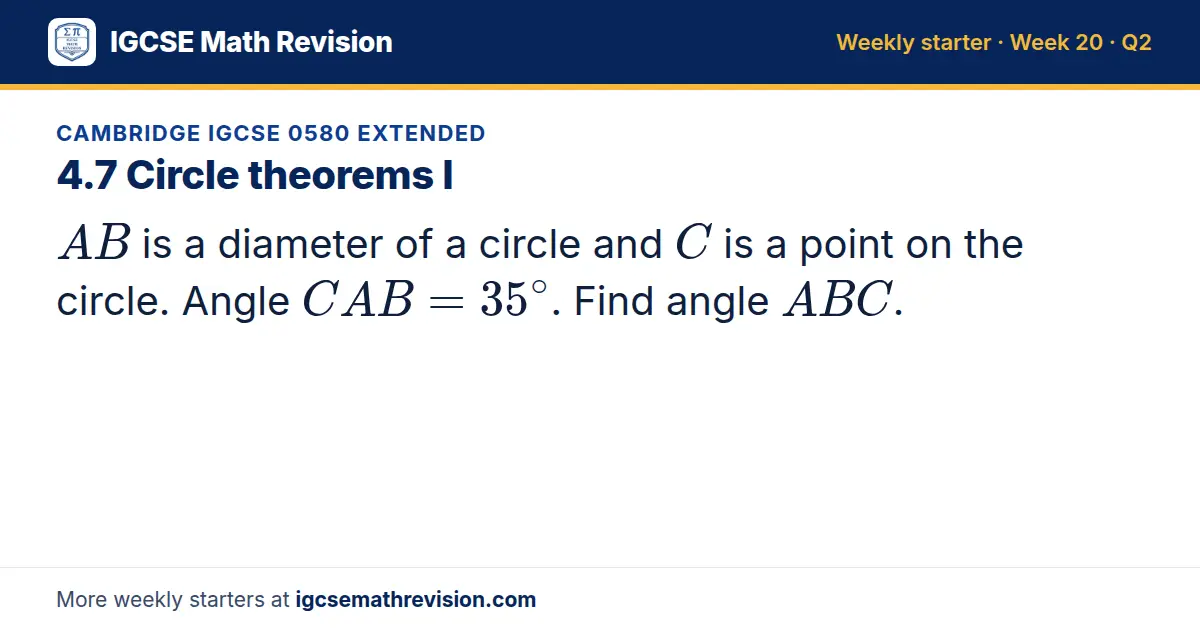
Question 2: 4.7 Circle theorems I
AB is a diameter of a circle and C is a point on the circle. Angle CAB = 35^∘. Find angle ABC.
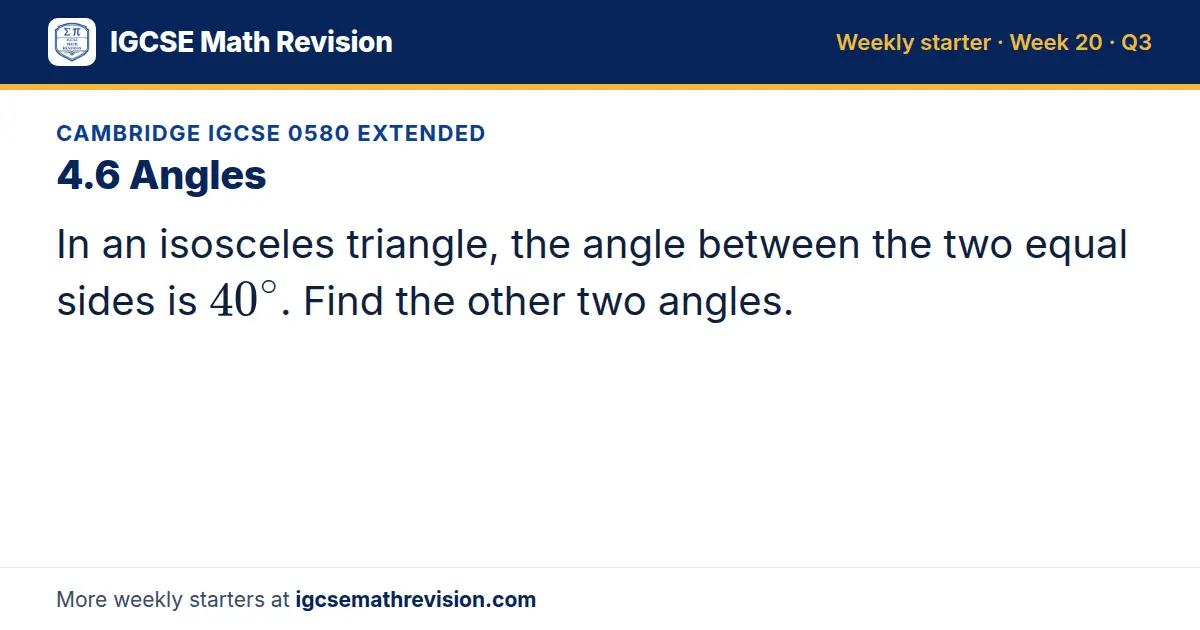
Question 3: 4.6 Angles
In an isosceles triangle, the angle between the two equal sides is 40^∘. Find the other two angles.
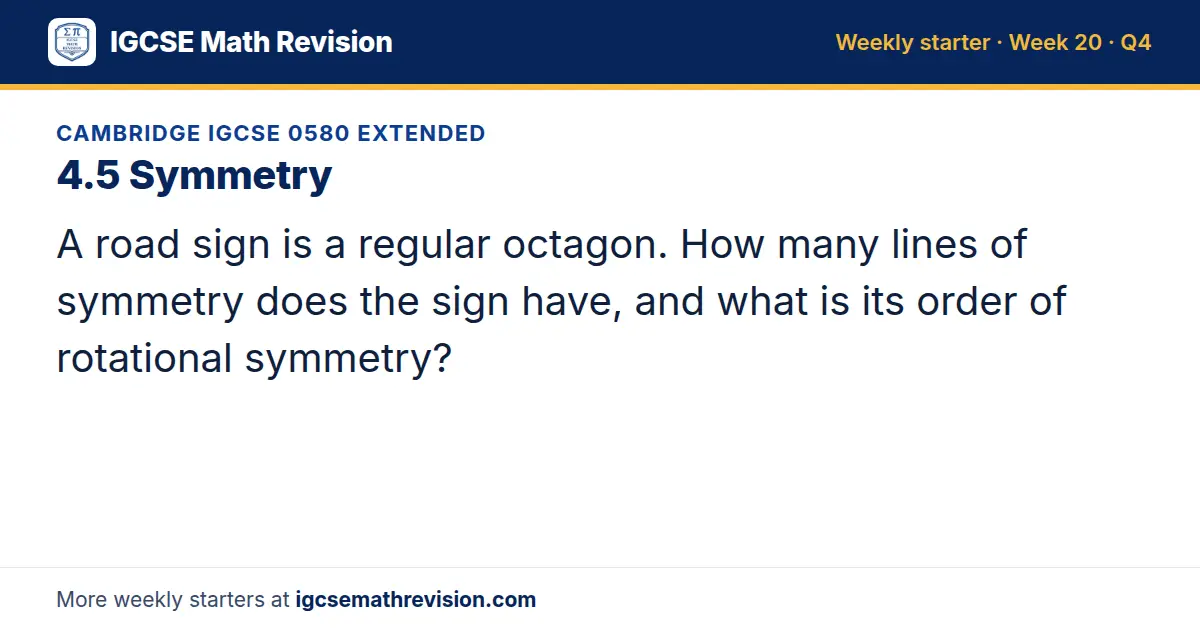
Question 4: 4.5 Symmetry
A road sign is a regular octagon. How many lines of symmetry does the sign have, and what is its order of rotational symmetry?
Week 21
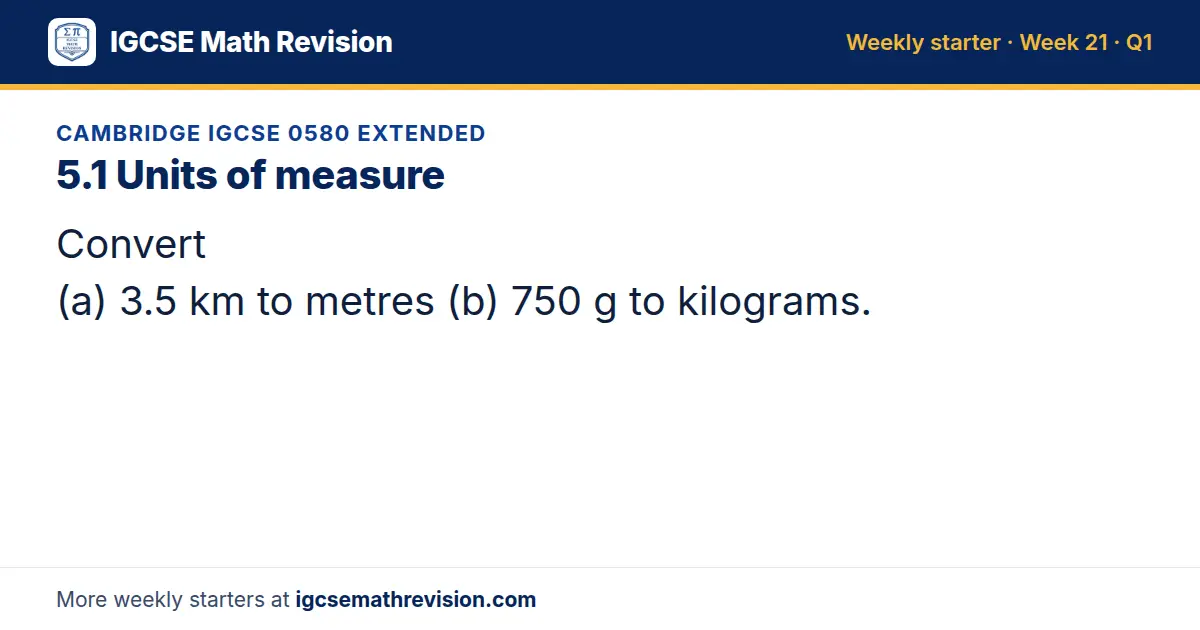
Question 1: 5.1 Units of measure
Convert (a) 3.5 km to metres (b) 750 g to kilograms.
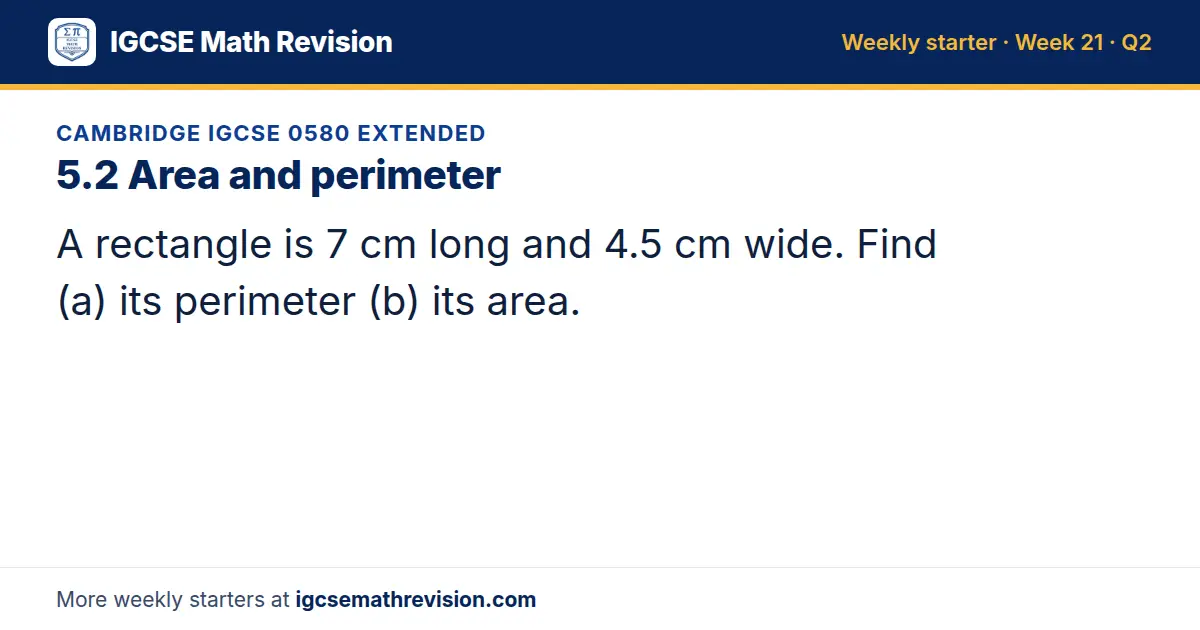
Question 2: 5.2 Area and perimeter
A rectangle is 7 cm long and 4.5 cm wide. Find (a) its perimeter (b) its area.
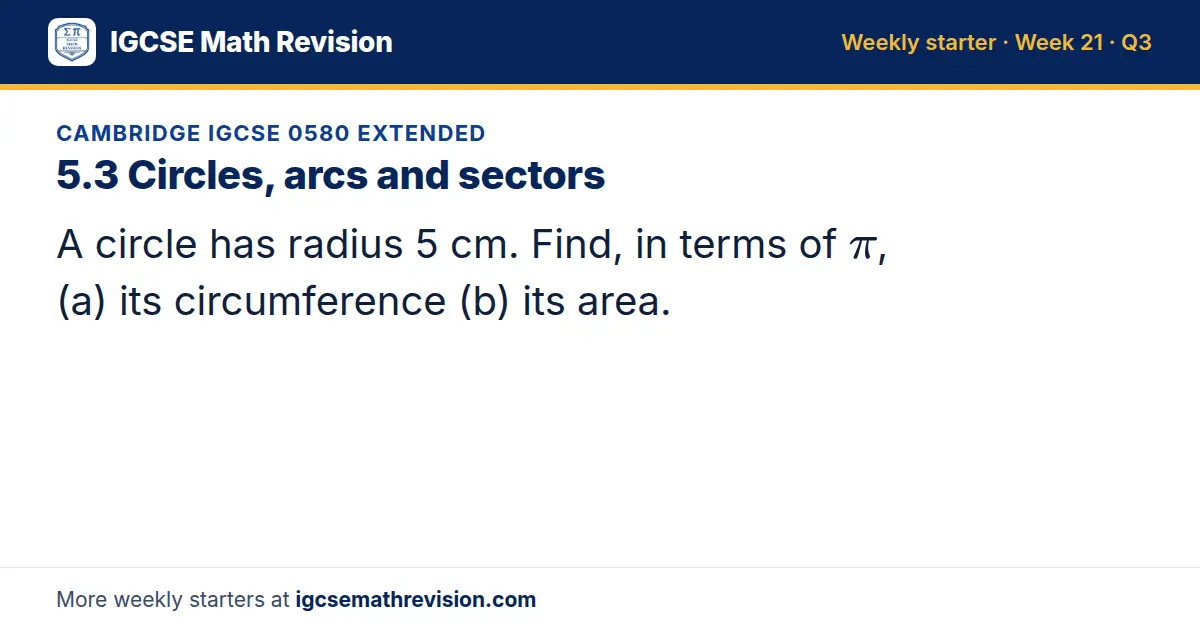
Question 3: 5.3 Circles, arcs and sectors
A circle has radius 5 cm. Find, in terms of π, (a) its circumference (b) its area.
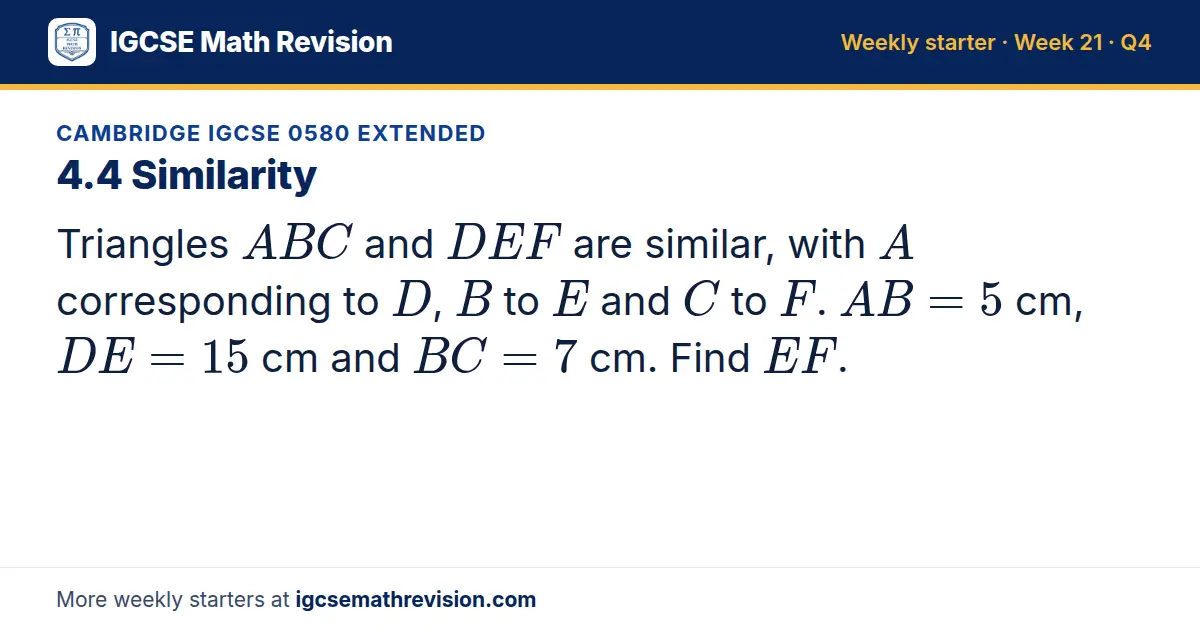
Question 4: 4.4 Similarity
Triangles ABC and DEF are similar, with A corresponding to D, B to E and C to F. AB = 5 cm, DE = 15 cm and BC = 7 cm. Find EF.
Week 22
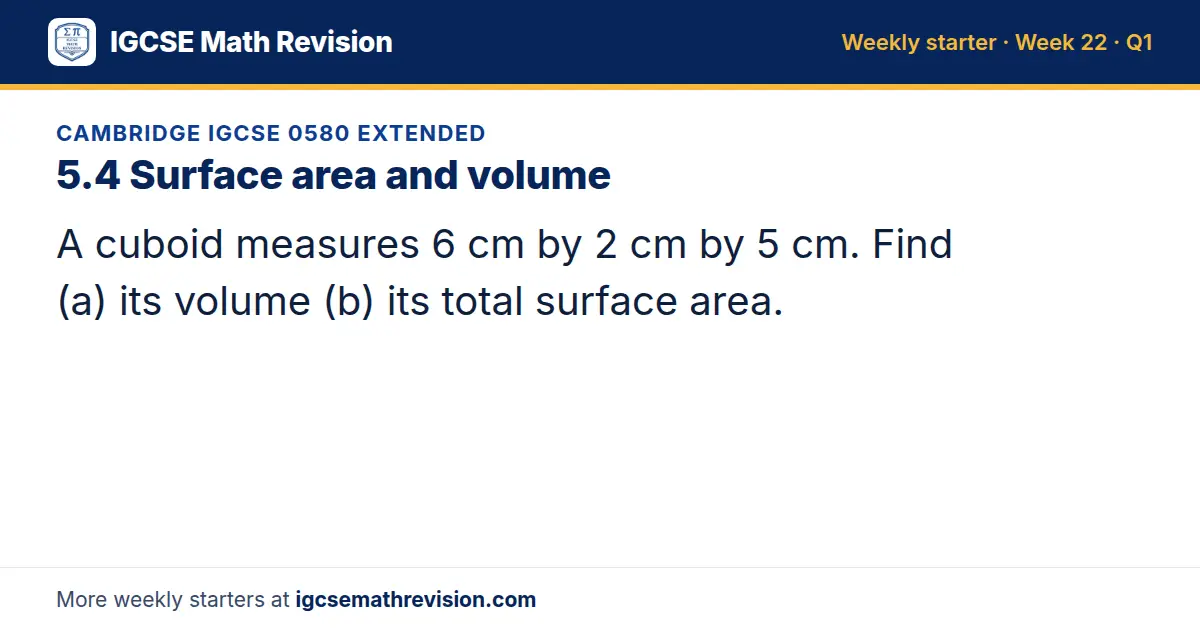
Question 1: 5.4 Surface area and volume
A cuboid measures 6 cm by 2 cm by 5 cm. Find (a) its volume (b) its total surface area.
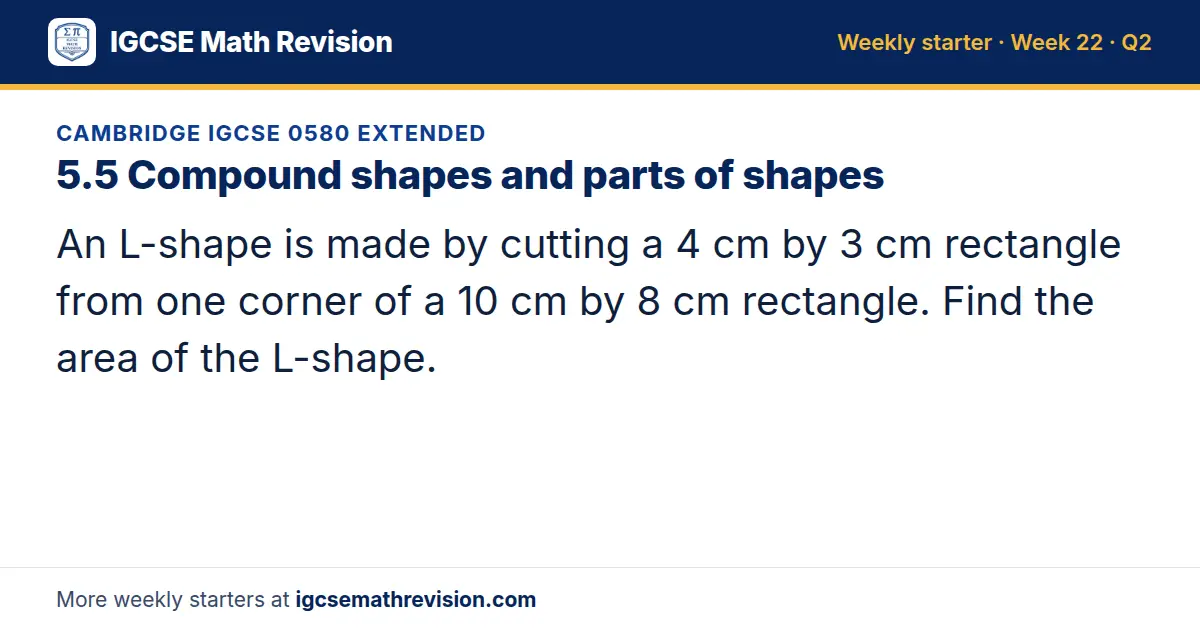
Question 2: 5.5 Compound shapes and parts of shapes
An L-shape is made by cutting a 4 cm by 3 cm rectangle from one corner of a 10 cm by 8 cm rectangle. Find the area of the L-shape.
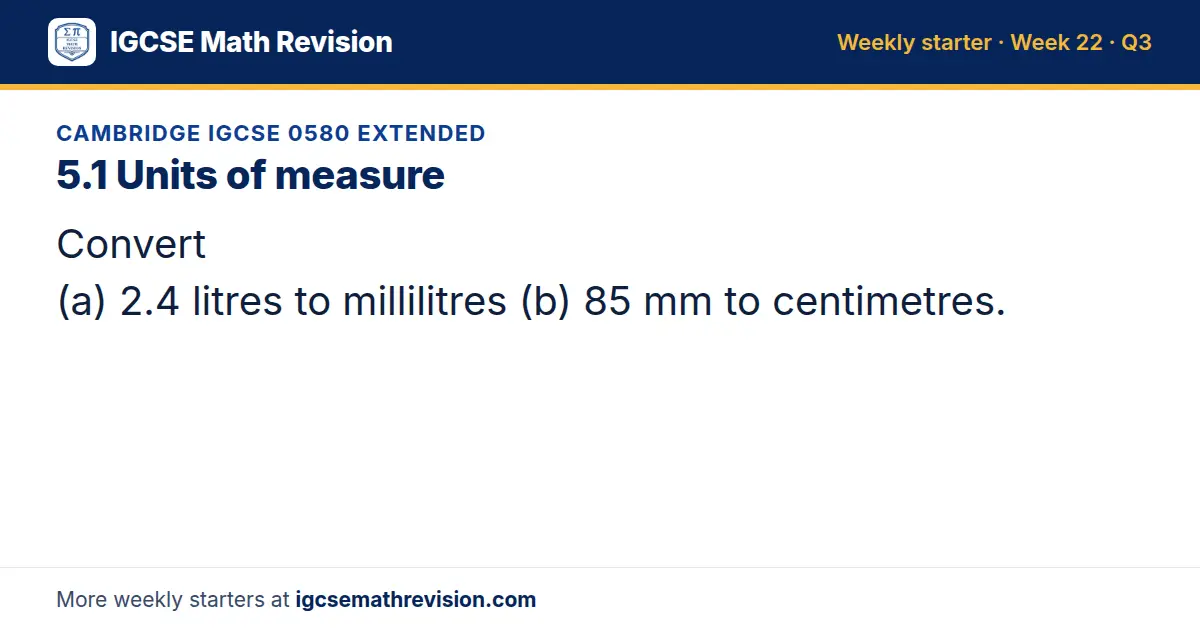
Question 3: 5.1 Units of measure
Convert (a) 2.4 litres to millilitres (b) 85 mm to centimetres.
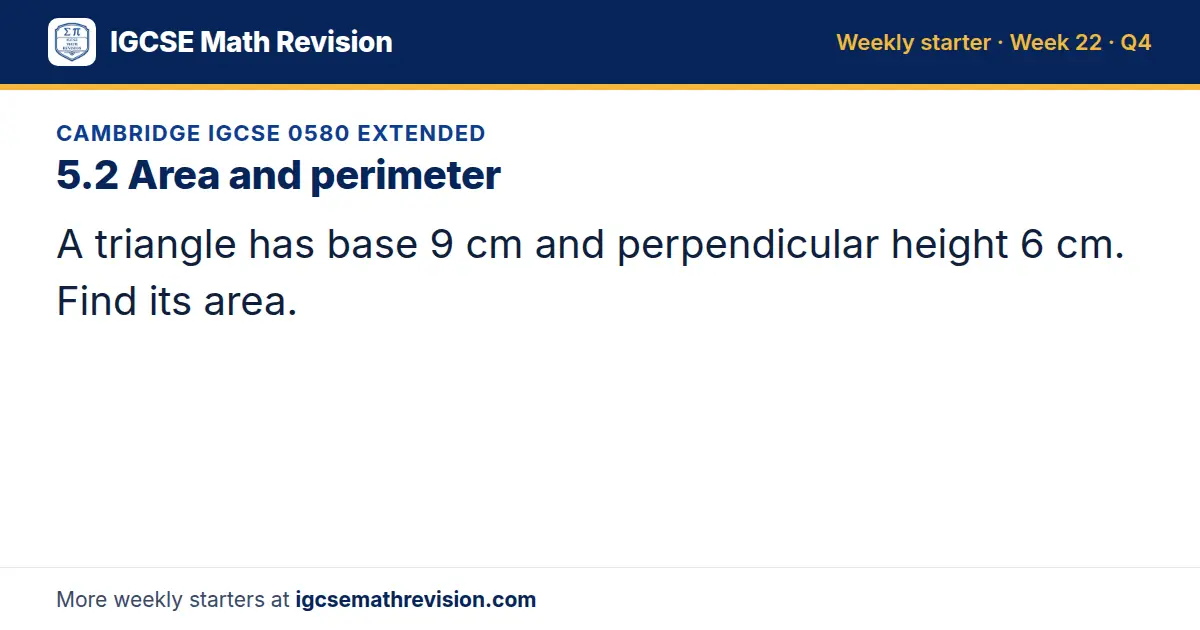
Question 4: 5.2 Area and perimeter
A triangle has base 9 cm and perpendicular height 6 cm. Find its area.
More starter questions
Other weeks: Weeks 1–11 · Weeks 12–22 · Weeks 23–33 · Weeks 34–44 · Weeks 45–55. Answers and mark schemes are in the teacher tools.