Cambridge IGCSE 0580 Extended starter questions: weeks 23–33
44 short questions to open a lesson for Cambridge IGCSE Mathematics 0580, Extended, weeks 23–33 of the teaching year, three or four a week. Each question is shown as an image with its text underneath; the answers and mark schemes are free on the free weekly starters page, to show or project in class.
- Answers and mark schemes (free)
- ← Cambridge IGCSE 0580 Extended, weeks 12–22
- Cambridge IGCSE 0580 Extended, weeks 34–44 →
- All IGCSE Maths daily and weekly questions
Week 23
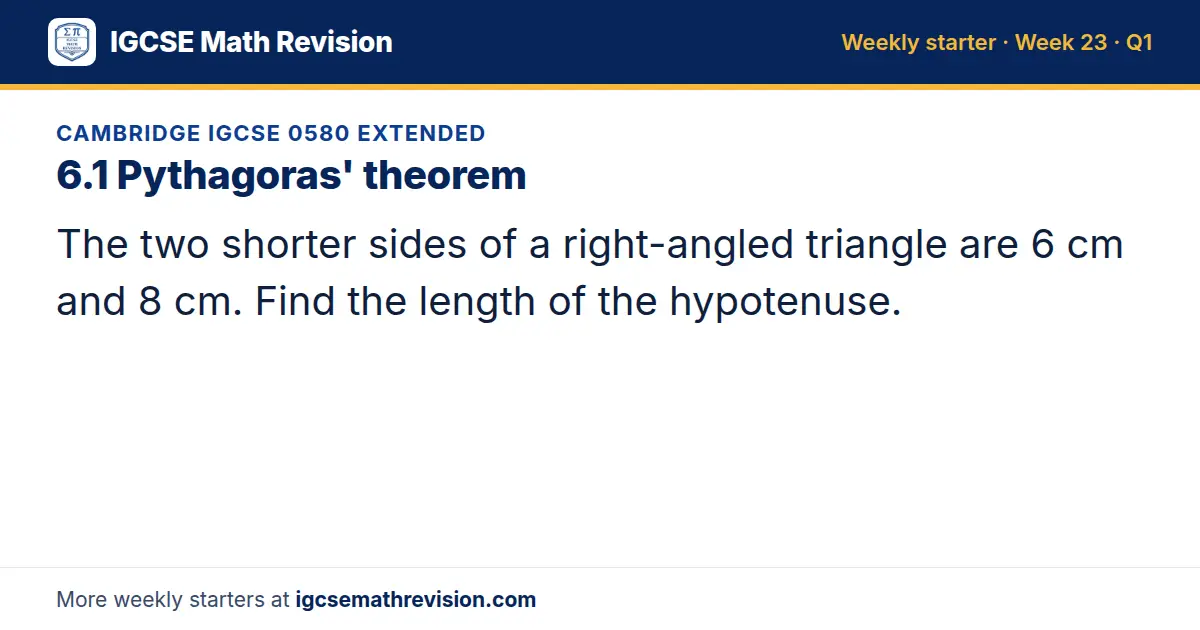
Question 1: 6.1 Pythagoras' theorem
The two shorter sides of a right-angled triangle are 6 cm and 8 cm. Find the length of the hypotenuse.
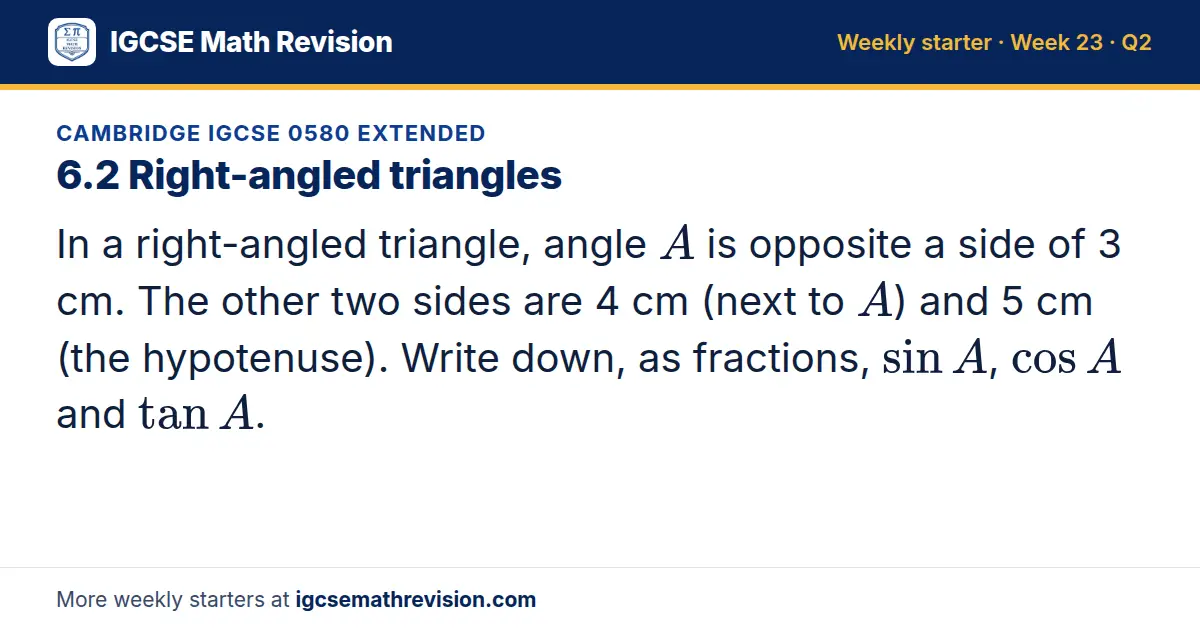
Question 2: 6.2 Right-angled triangles
In a right-angled triangle, angle A is opposite a side of 3 cm. The other two sides are 4 cm (next to A) and 5 cm (the hypotenuse). Write down, as fractions, sin A, cos A and tan A.
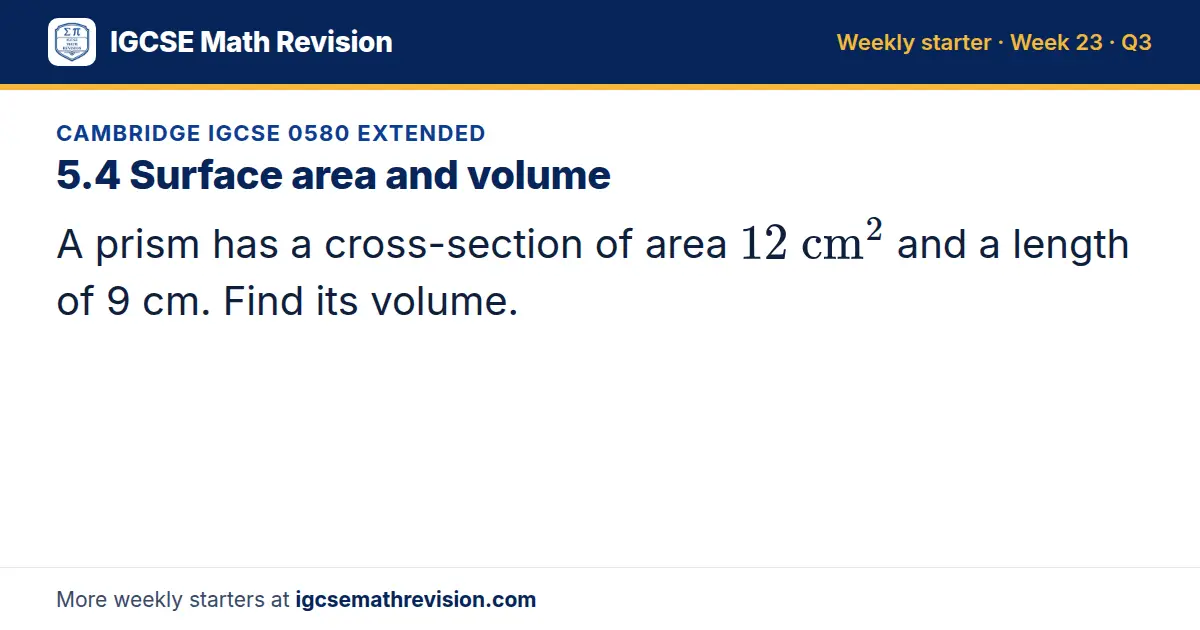
Question 3: 5.4 Surface area and volume
A prism has a cross-section of area 12 cm² and a length of 9 cm. Find its volume.
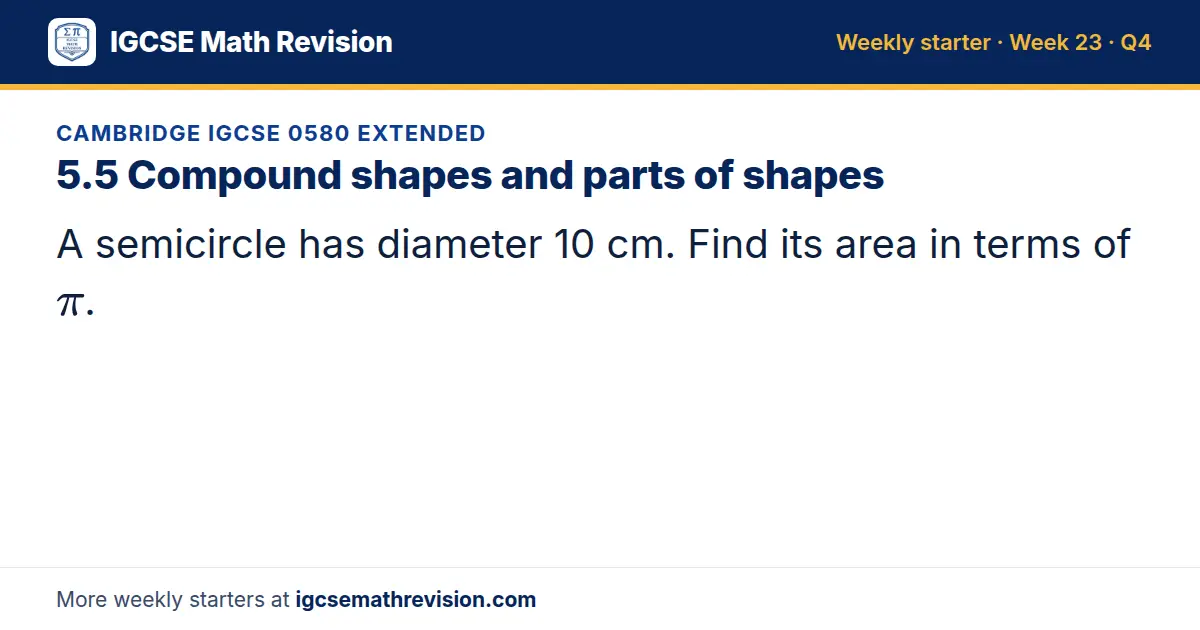
Question 4: 5.5 Compound shapes and parts of shapes
A quarter circle has radius 6 cm. Work out its area. Give your answer in terms of π.
Week 24
Question 1: 6.3 Exact trigonometric values
Use exact values, not a calculator, to show that 2sin 60° × cos 30° is a rational number, and write down its value.
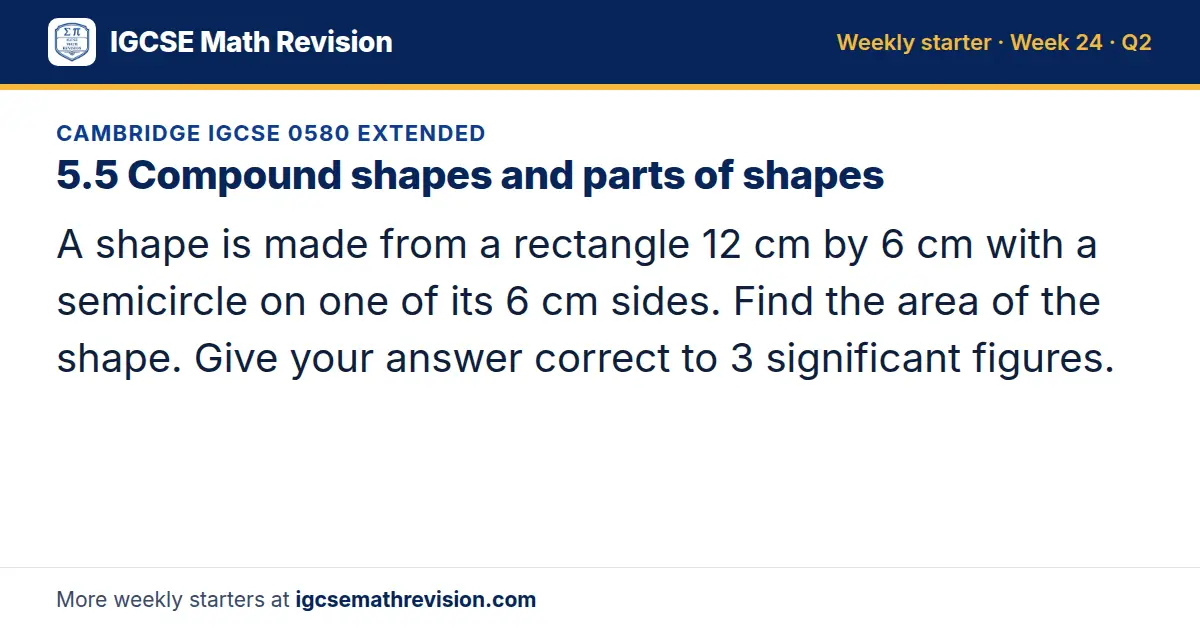
Question 2: 5.5 Compound shapes and parts of shapes
A metal plate is a rectangle 14 cm by 8 cm. A semicircle with diameter 8 cm is cut out of one of the 8 cm sides. Work out the area of the plate that is left. Give your answer correct to 3 significant figures.
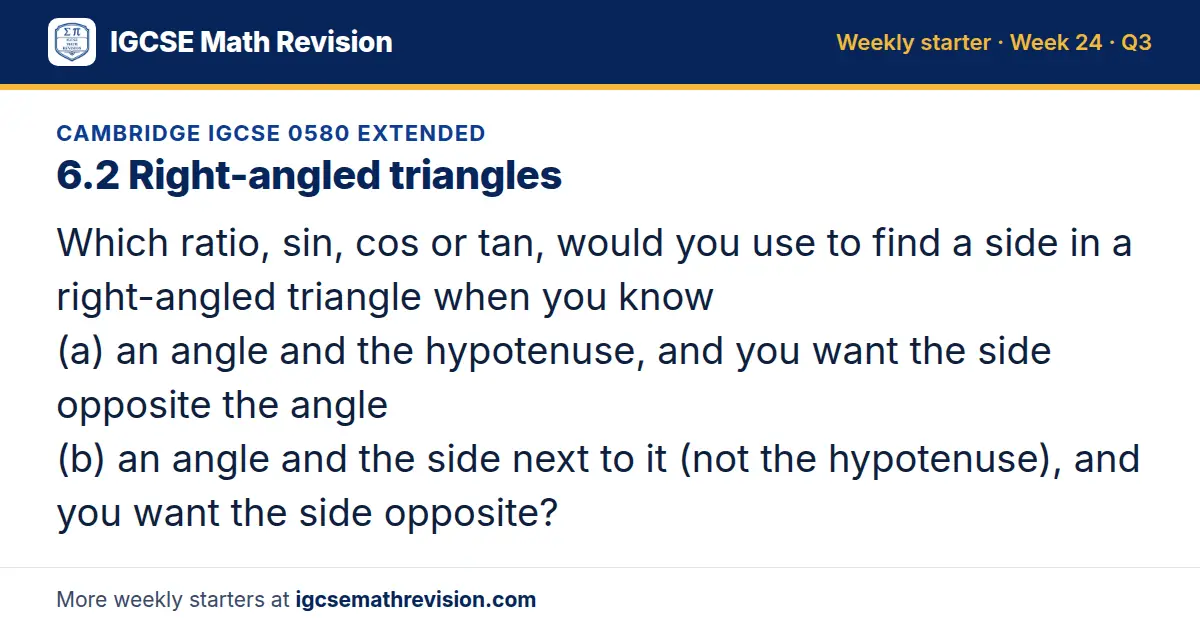
Question 3: 6.2 Right-angled triangles
Which ratio, sin, cos or tan, would you use to find a side in a right-angled triangle when you know (a) an angle and the hypotenuse, and you want the side opposite the angle (b) an angle and the side next to it (not the hypotenuse), and you want the side opposite?
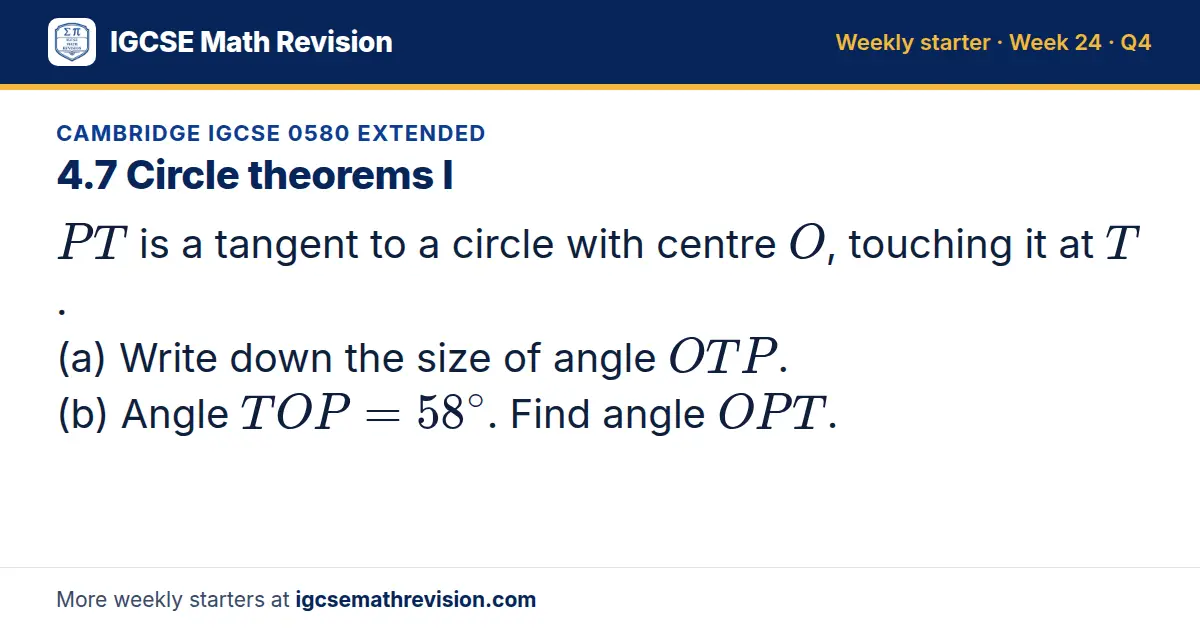
Question 4: 4.7 Circle theorems I
PT is a tangent to a circle with centre O, touching it at T. (a) Write down the size of angle OTP. (b) Angle TOP = 58°. Find angle OPT.
Week 25
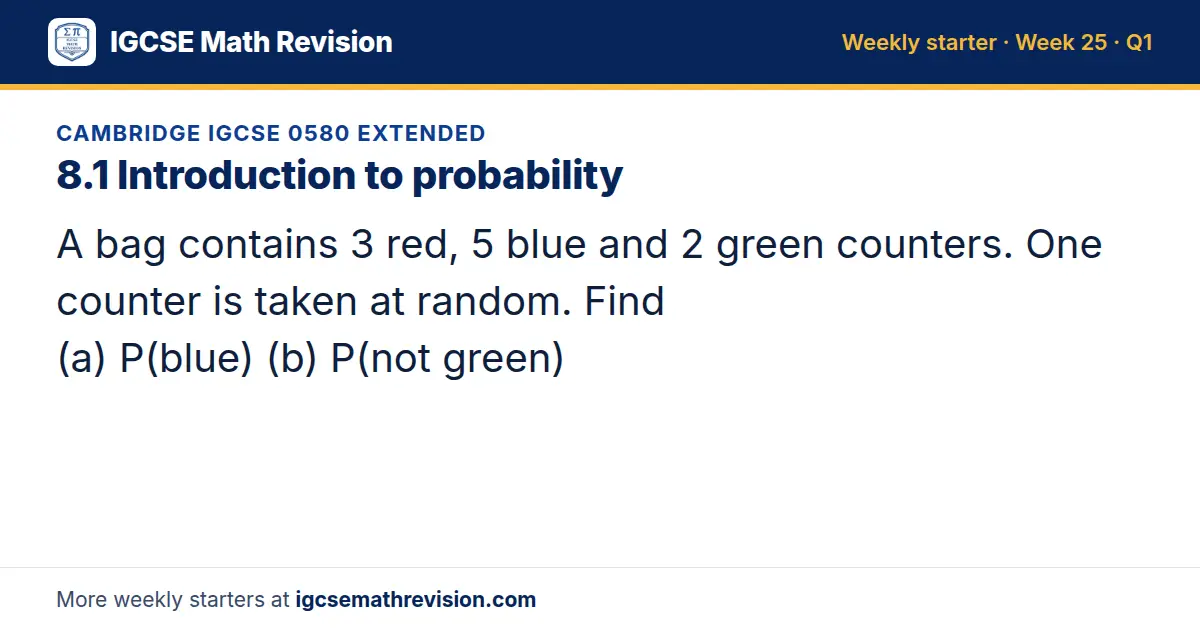
Question 1: 8.1 Introduction to probability
A bag contains 3 red, 5 blue and 2 green counters. One counter is taken at random. Find (a) P(blue) (b) P(not green)
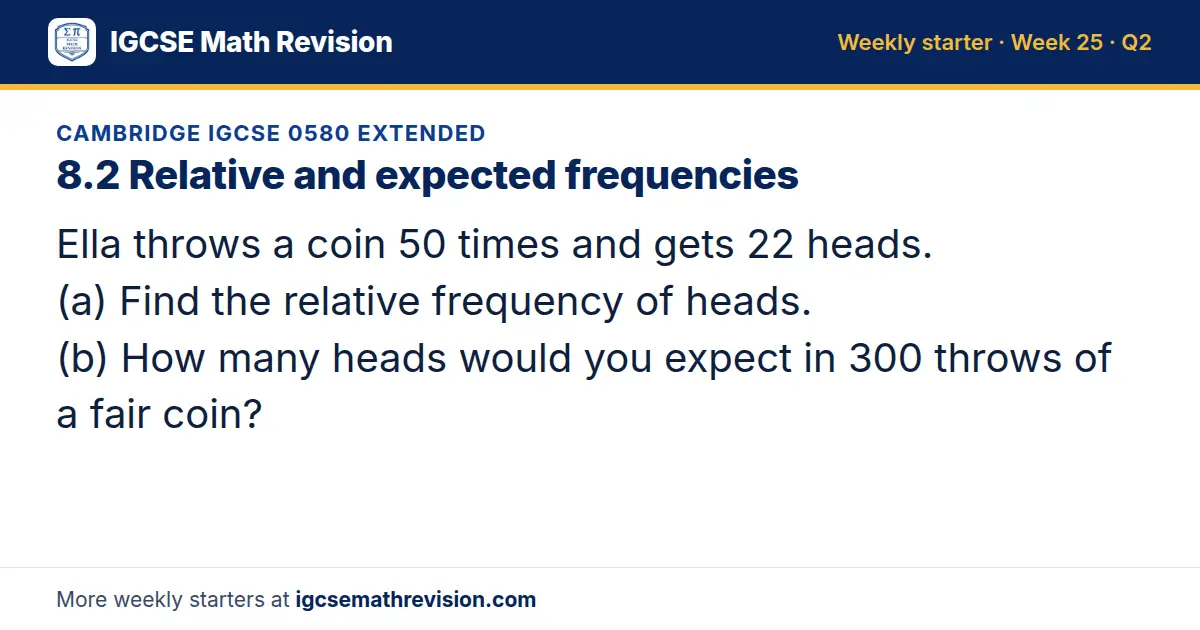
Question 2: 8.2 Relative and expected frequencies
Ella throws a coin 50 times and gets 22 heads. (a) Find the relative frequency of heads. (b) How many heads would you expect in 300 throws of a fair coin?
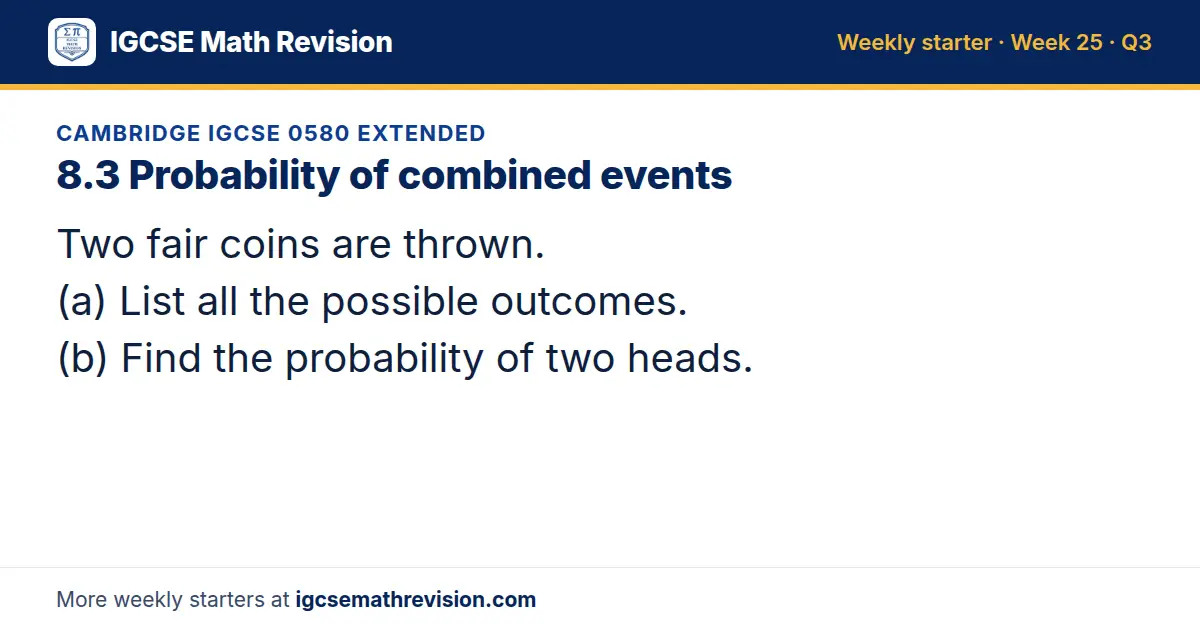
Question 3: 8.3 Probability of combined events
Two fair coins are thrown. (a) List all the possible outcomes. (b) Find the probability of two heads.
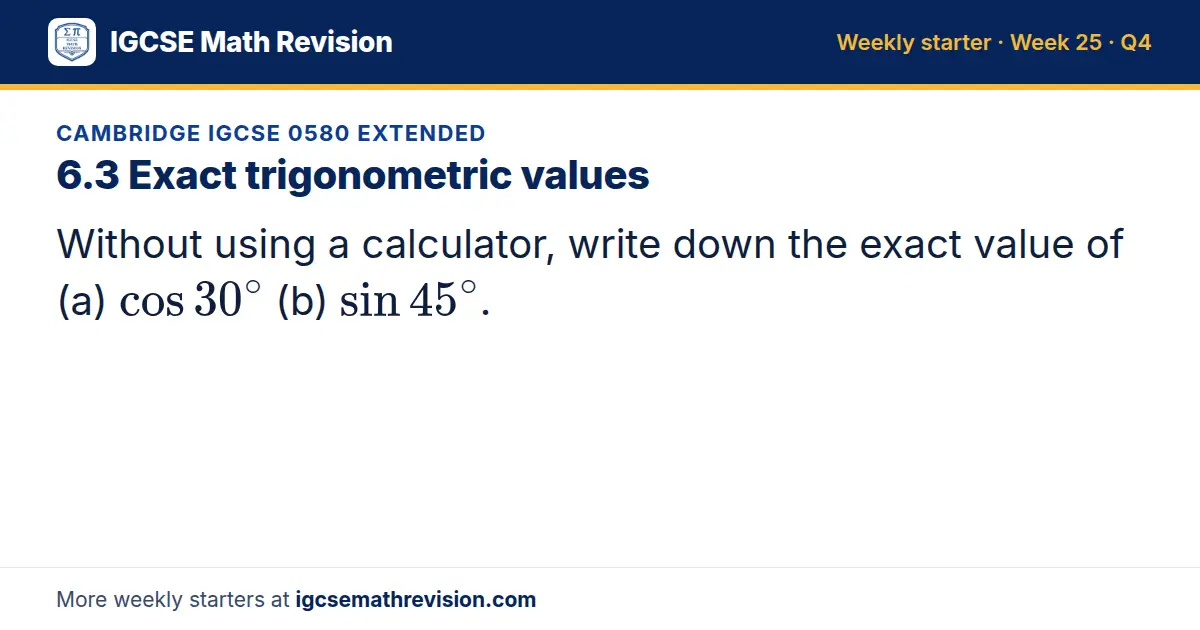
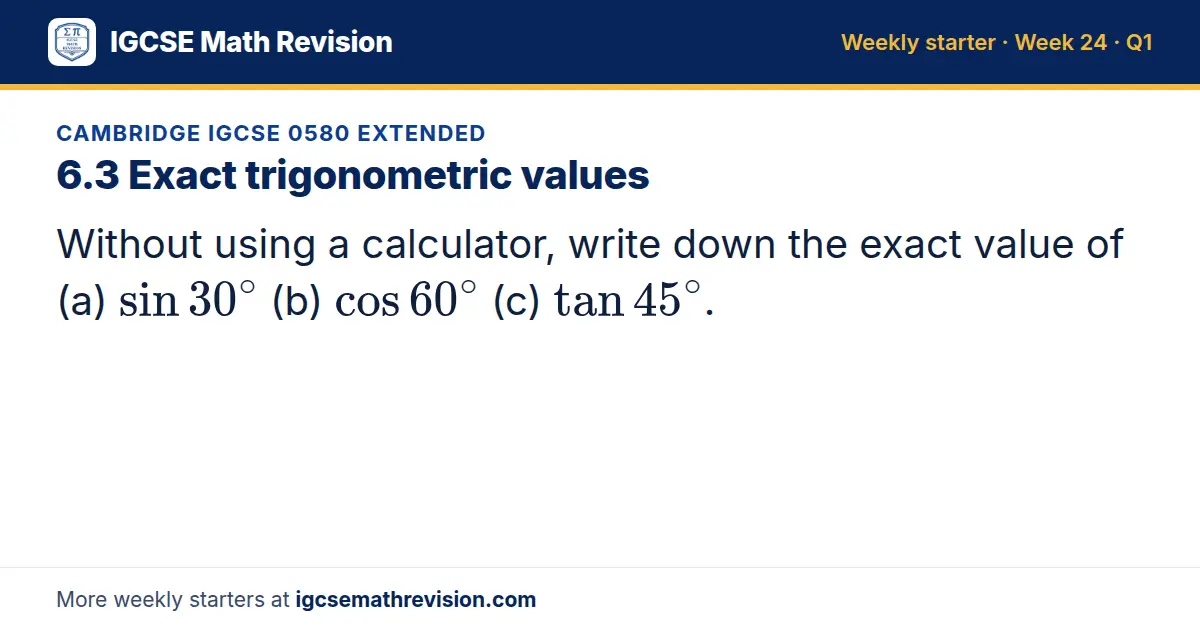
Question 4: 6.3 Exact trigonometric values
Without using a calculator, write down the exact value of (a) sin 30° (b) cos 60° (c) tan 45°.
Week 26
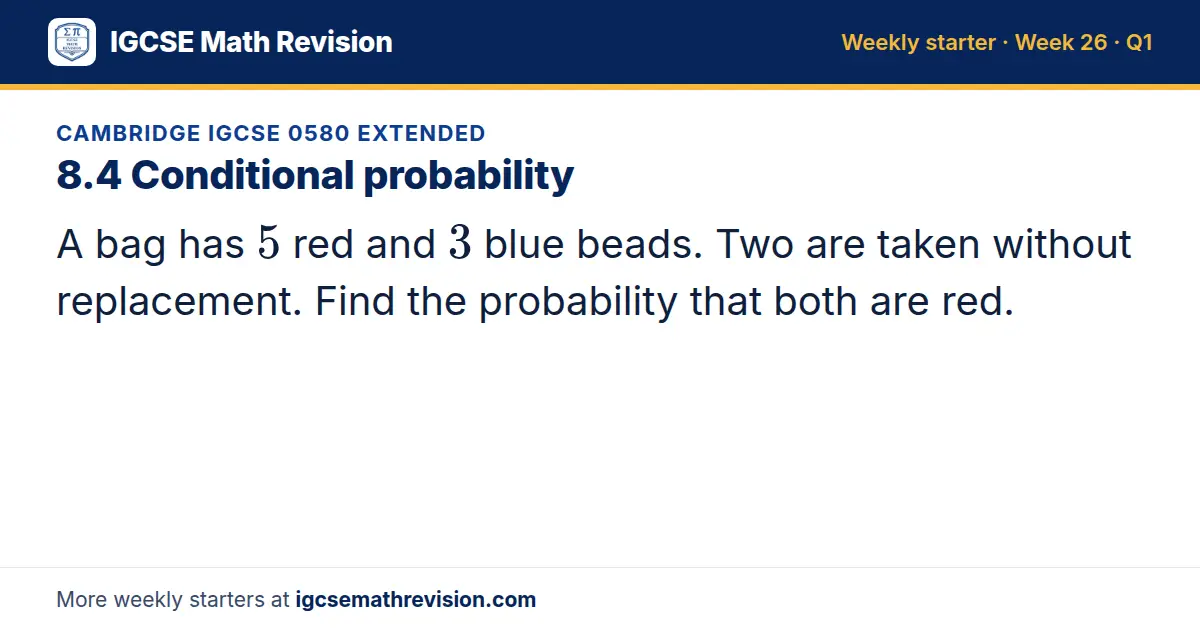
Question 1: 8.4 Conditional probability
60 students were asked how they travel to school. Walk Bus; Boys 12 16; Girls 18 14 A student who walks is chosen at random. Find the probability that the student is a girl.
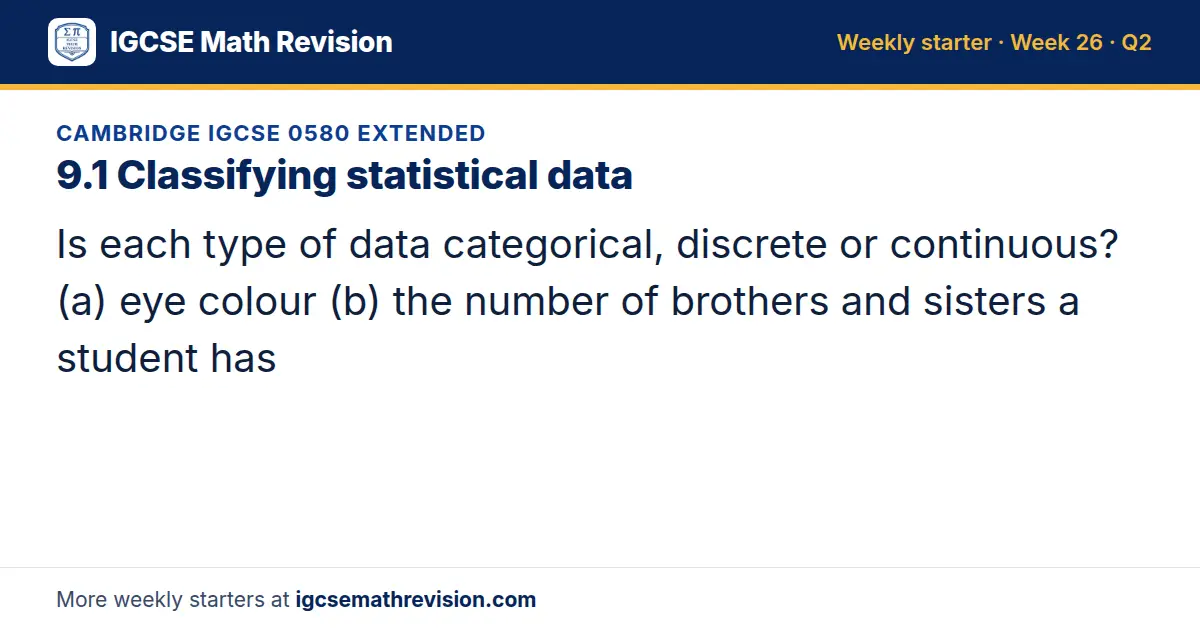
Question 2: 9.1 Classifying statistical data
Is each type of data categorical, discrete or continuous? (a) the mass of a letter (b) the number of pages in a book
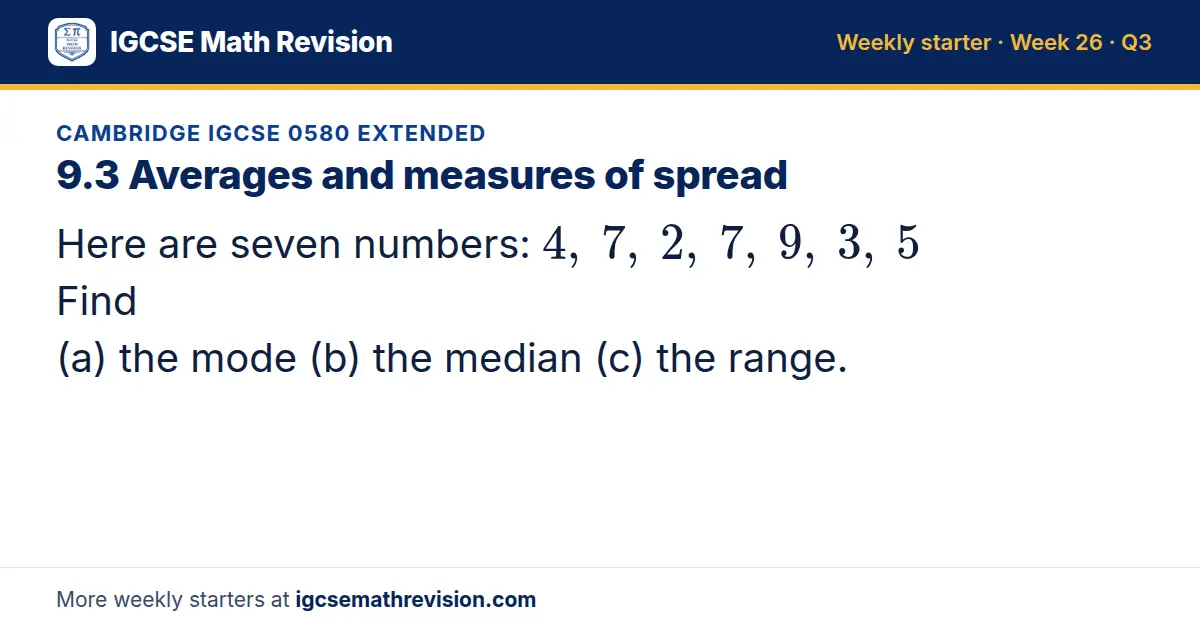
Question 3: 9.3 Averages and measures of spread
Here are eight numbers: 6, 3, 9, 3, 8, 5, 2, 4 Find (a) the mode (b) the median (c) the range.
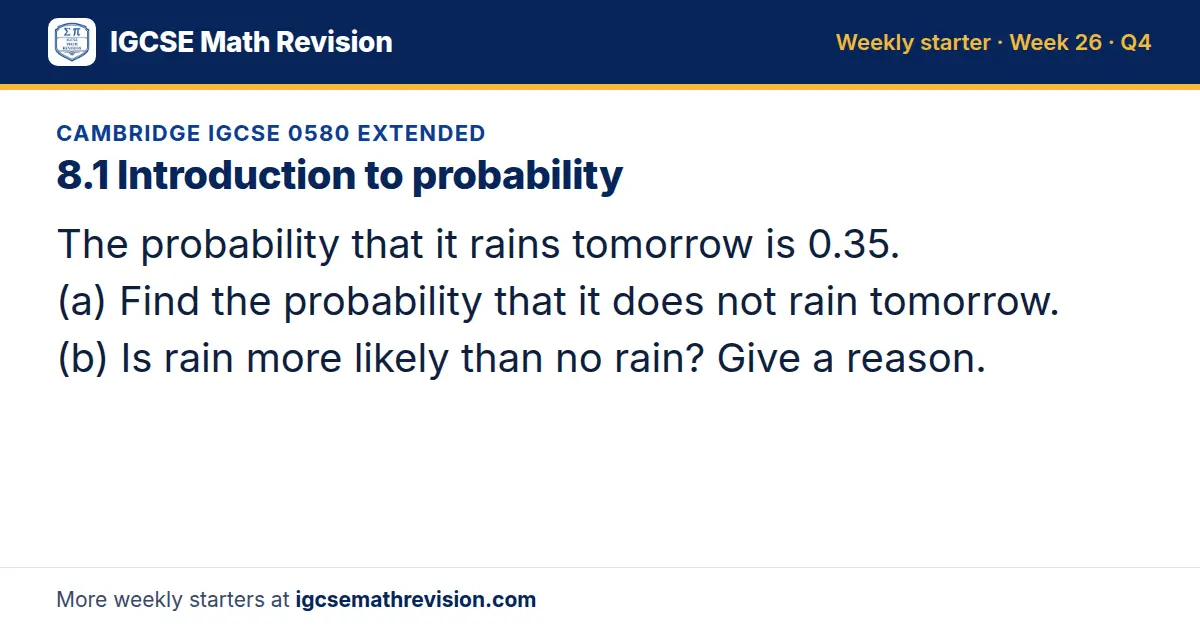
Question 4: 8.1 Introduction to probability
The probability that it rains tomorrow is 0.35. (a) Find the probability that it does not rain tomorrow. (b) Is rain more likely than no rain? Give a reason.
Week 27
Question 1: 9.4 Statistical charts and diagrams
A pie chart shows the favourite sports of 45 students. (a) 14 students chose swimming. Work out the angle of the sector for swimming. (b) The sector for running has angle 72°. How many students chose running?
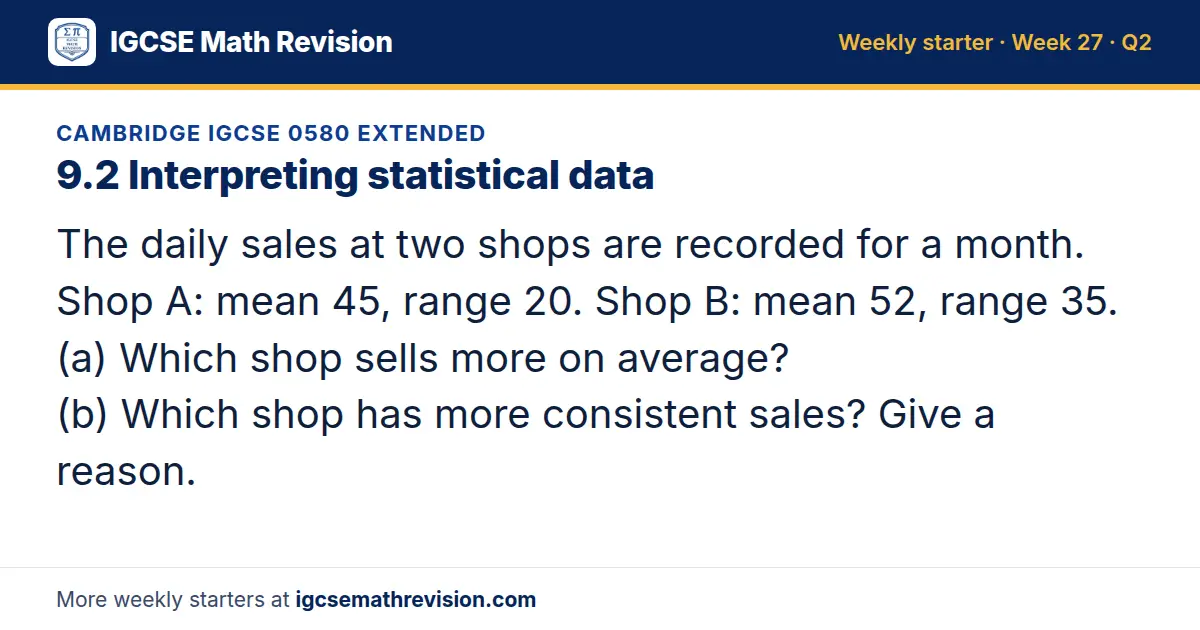
Question 2: 9.2 Interpreting statistical data
The table shows the number of visitors to a museum on four days. Day Mon Tue Wed Thu; Visitors 120 95 140 110 (a) Which day had the most visitors? (b) How many more visitors were there on Wednesday than on Tuesday?
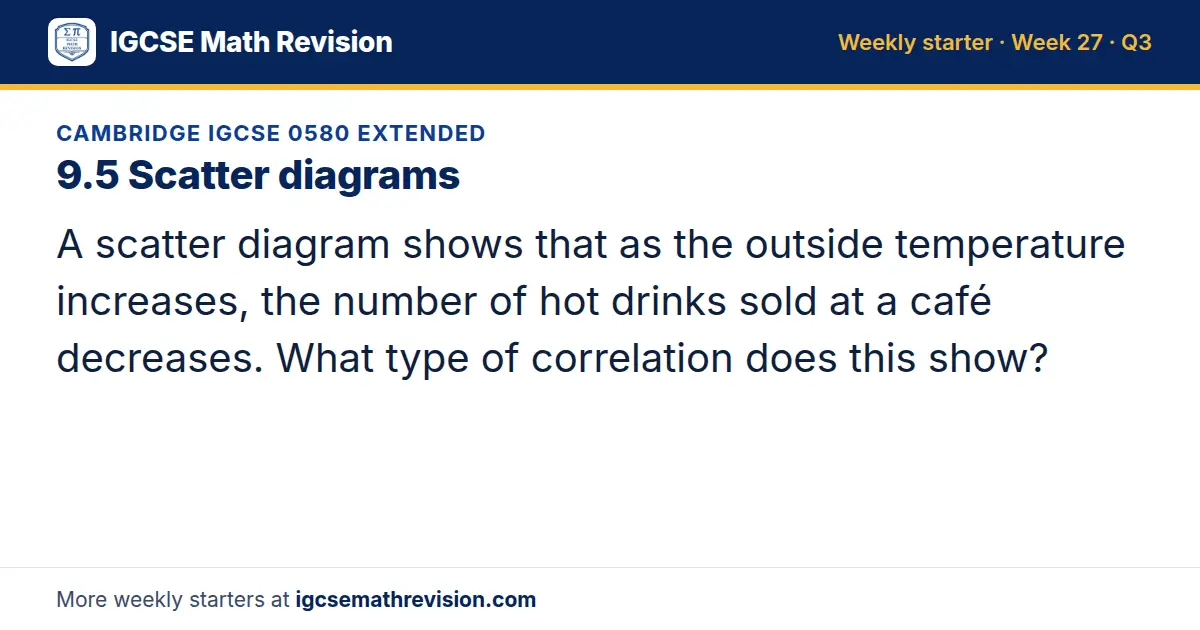
Question 3: 9.5 Scatter diagrams
A scatter diagram shows that as the outside temperature increases, the number of hot drinks sold at a café decreases. What type of correlation does this show?
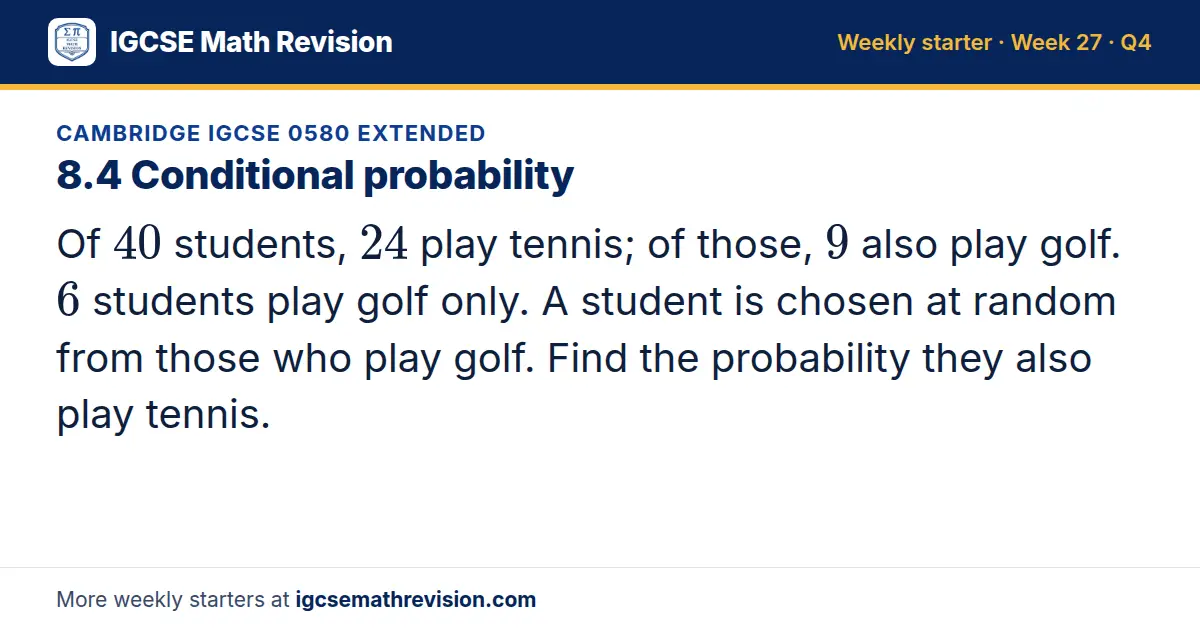
Question 4: 8.4 Conditional probability
In a Venn diagram for sets A and B, there are 7 elements in A only, 5 in A ∩ B, 9 in B only and 4 outside both sets. An element of A is chosen at random. Find the probability that it is also in B.
Week 28
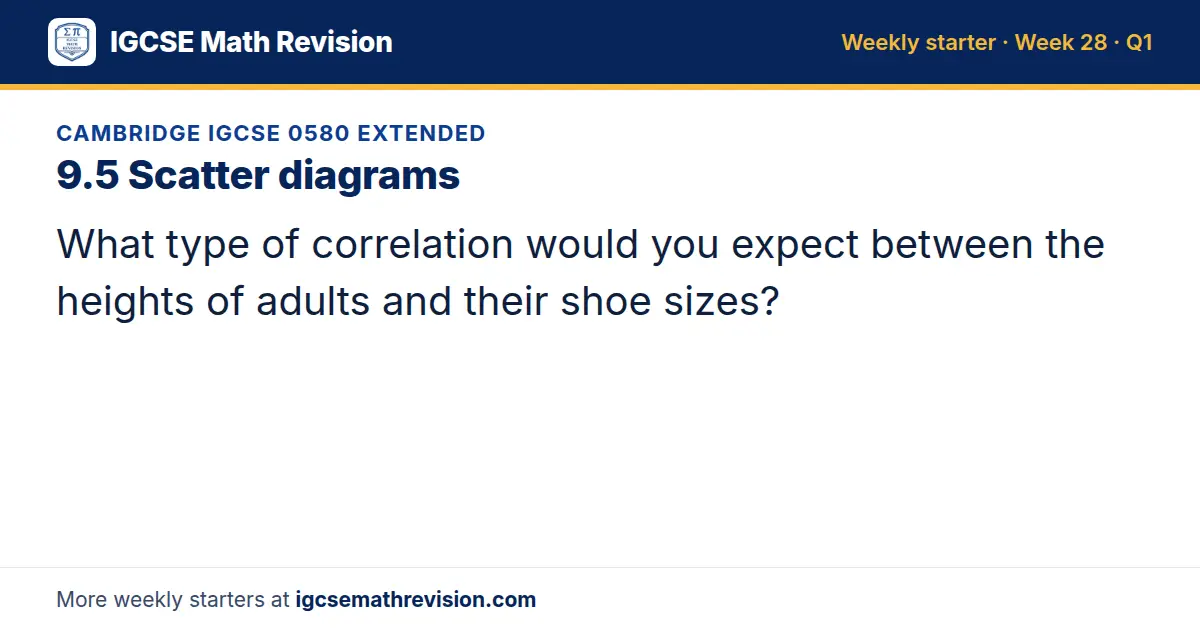
Question 1: 9.5 Scatter diagrams
What type of correlation would you expect between the heights of adults and their shoe sizes?
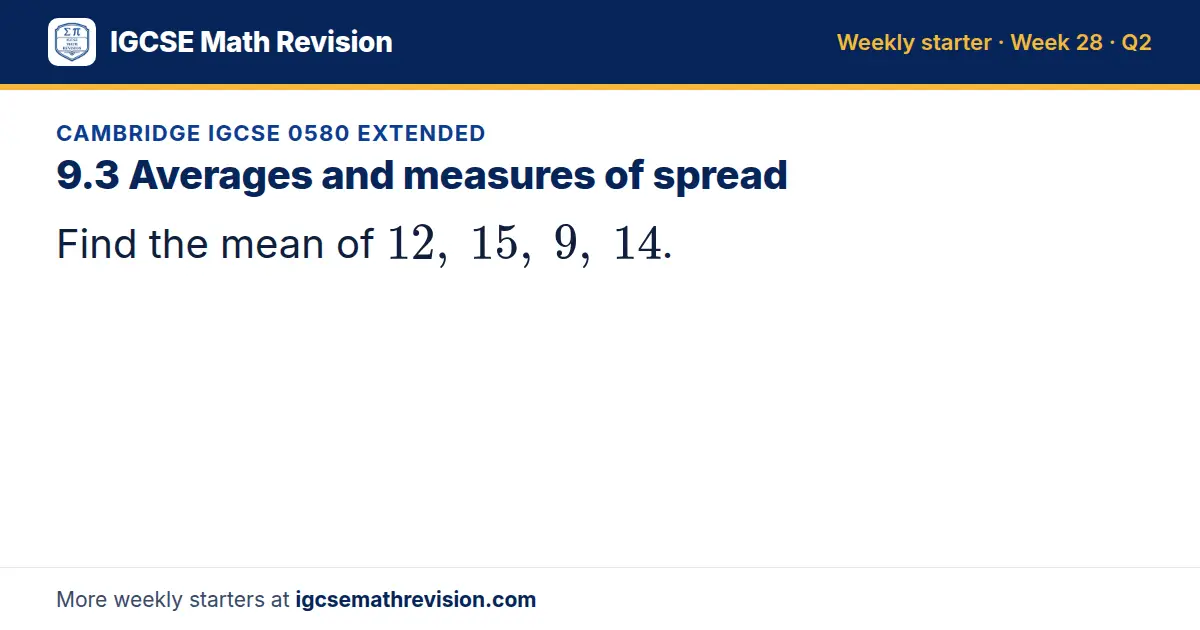
Question 2: 9.3 Averages and measures of spread
Find the mean of 2.4, 3.1, 1.9, 2.6.
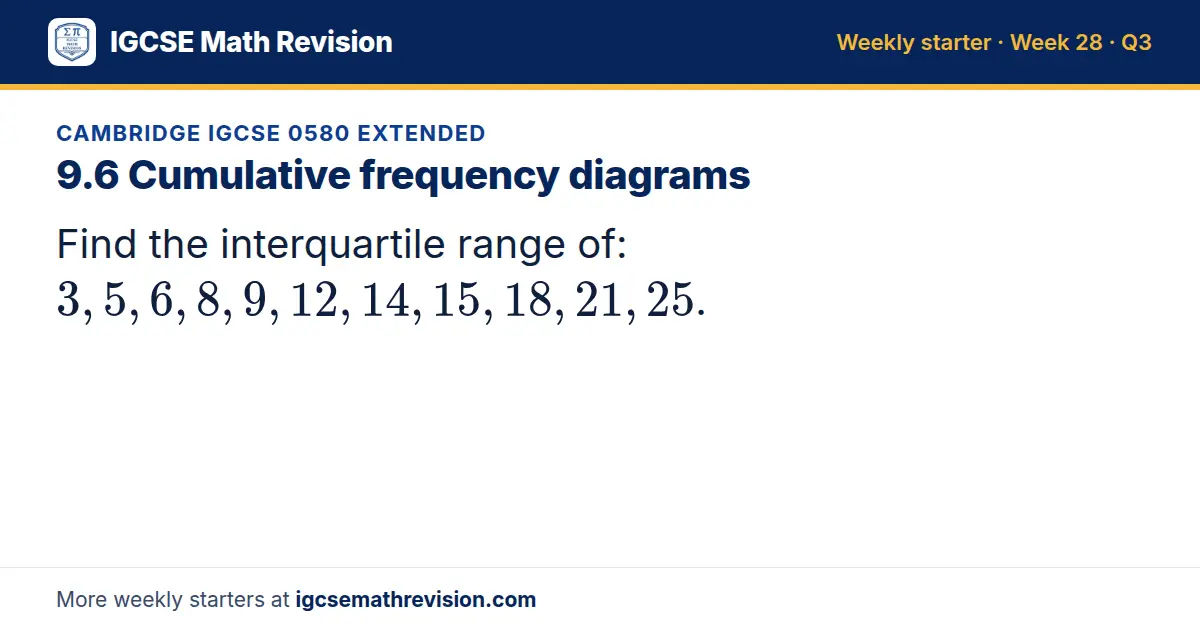
Question 3: 9.6 Cumulative frequency diagrams
The masses, m kg, of 60 parcels are summarised below. Mass m Frequency; 0 < m ≤ 20 6; 20 < m ≤ 40 14; 40 < m ≤ 60 23; 60 < m ≤ 80 12; 80 < m ≤ 100 5 Write down the cumulative frequencies for m ≤ 20, m ≤ 40, m ≤ 60, m ≤ 80 and m ≤ 100.
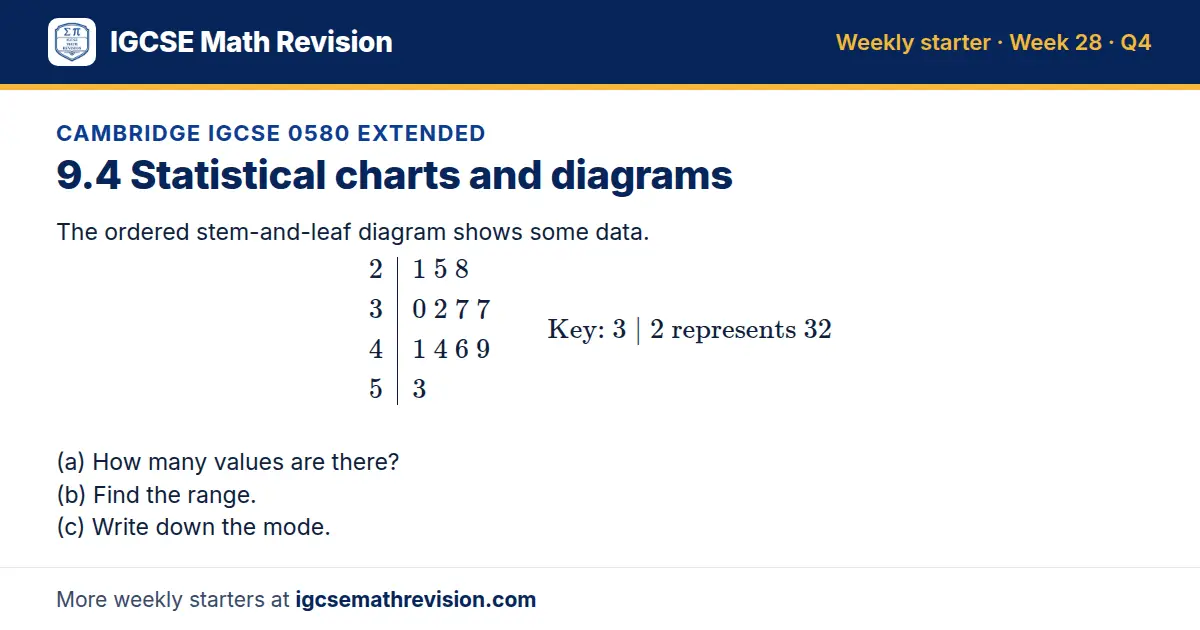
Question 4: 9.4 Statistical charts and diagrams
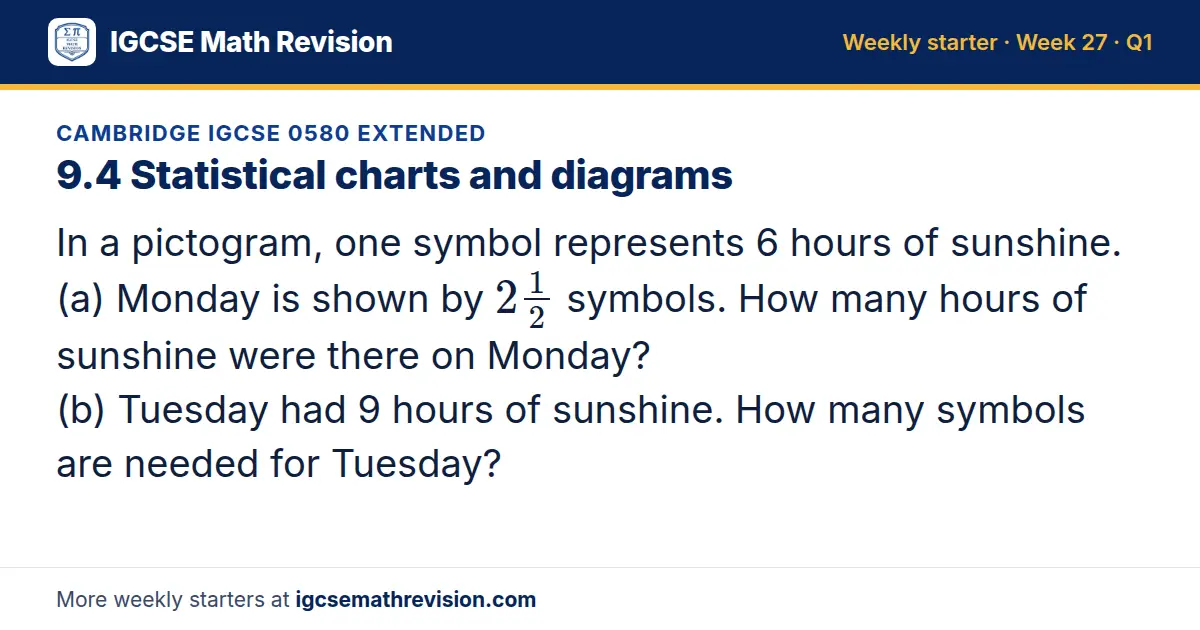
In a pictogram, one symbol represents 6 hours of sunshine. (a) Monday is shown by 21/2 symbols. How many hours of sunshine were there on Monday? (b) Tuesday had 9 hours of sunshine. How many symbols are needed for Tuesday?
Week 29
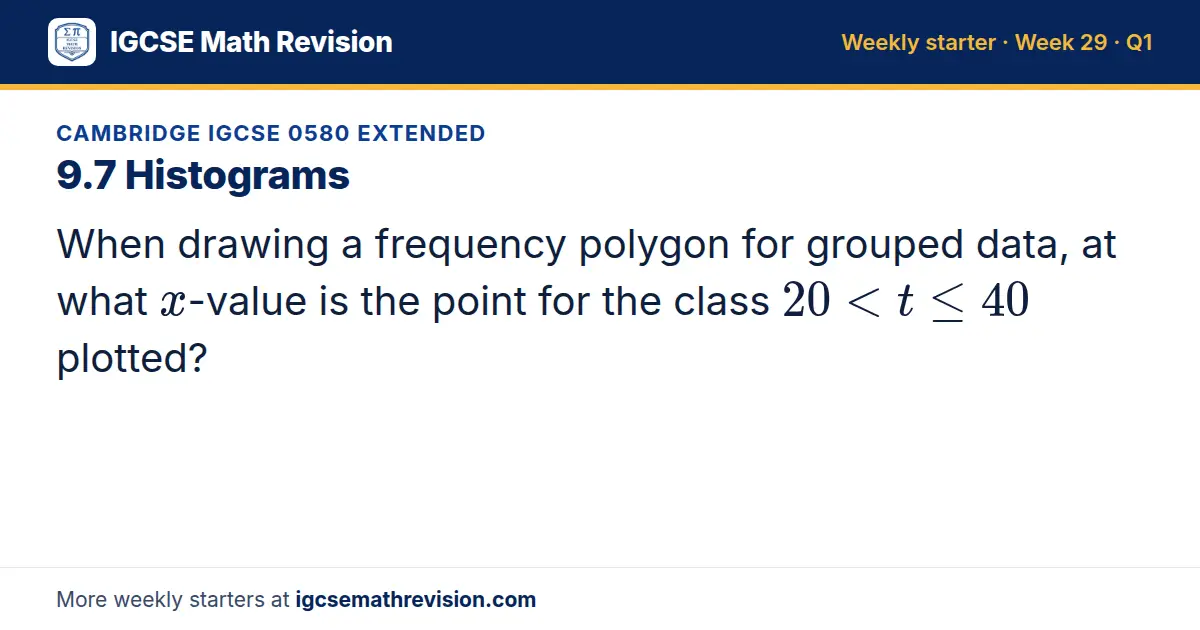
Question 1: 9.7 Histograms
In a frequency table, the class 10 < x ≤ 30 has frequency 36. Work out the frequency density for this class.
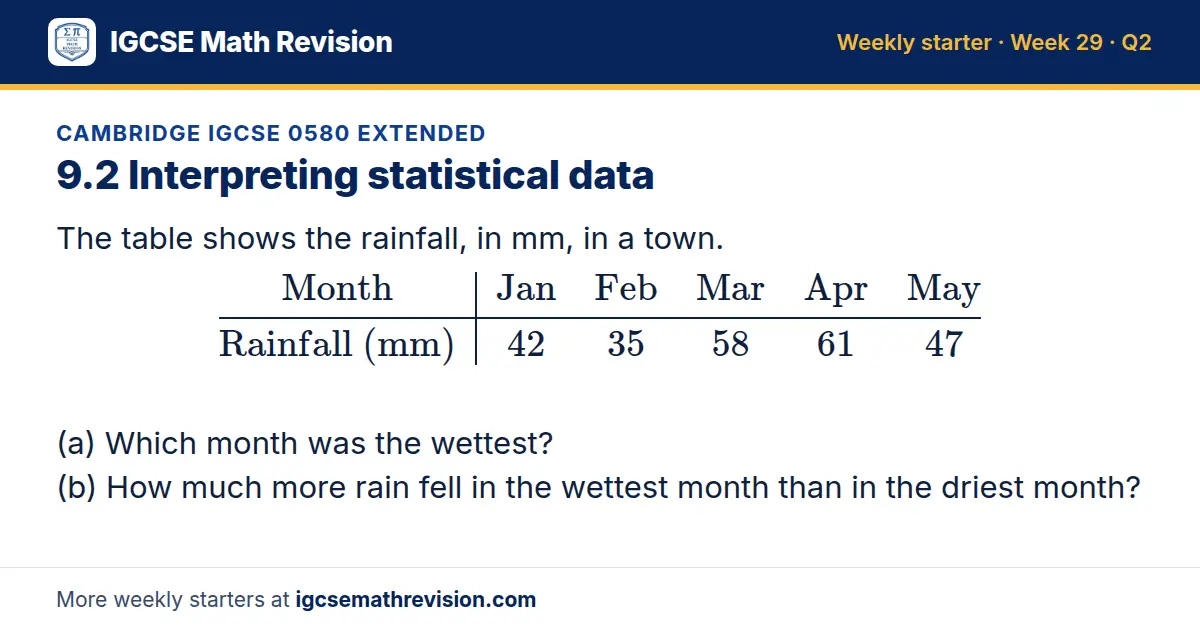
Question 2: 9.2 Interpreting statistical data
Ravi compares the test marks of two classes. Class A: mean 62, range 30. Class B: mean 58, range 12. Ravi says, \"Class A did better and its marks were more consistent.\" Is Ravi right? Give a reason for each part of his statement.
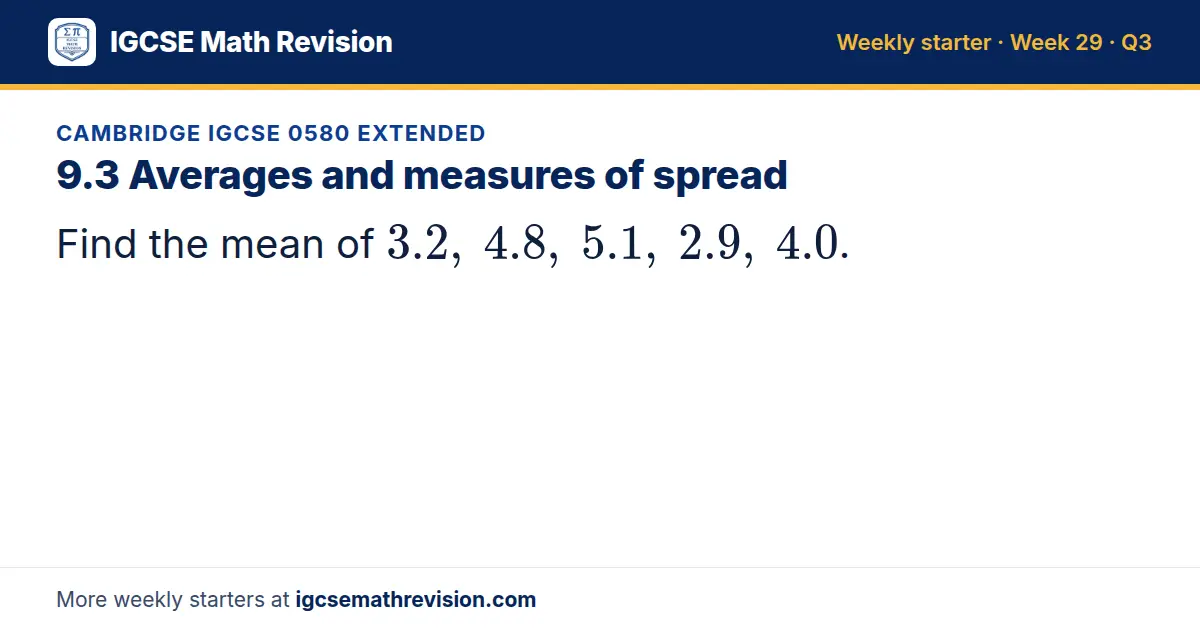
Question 3: 9.3 Averages and measures of spread
The table shows the shoe sizes of 25 students. Shoe size 4 5 6 7; Frequency 3 9 8 5 Find (a) the mode (b) the median.
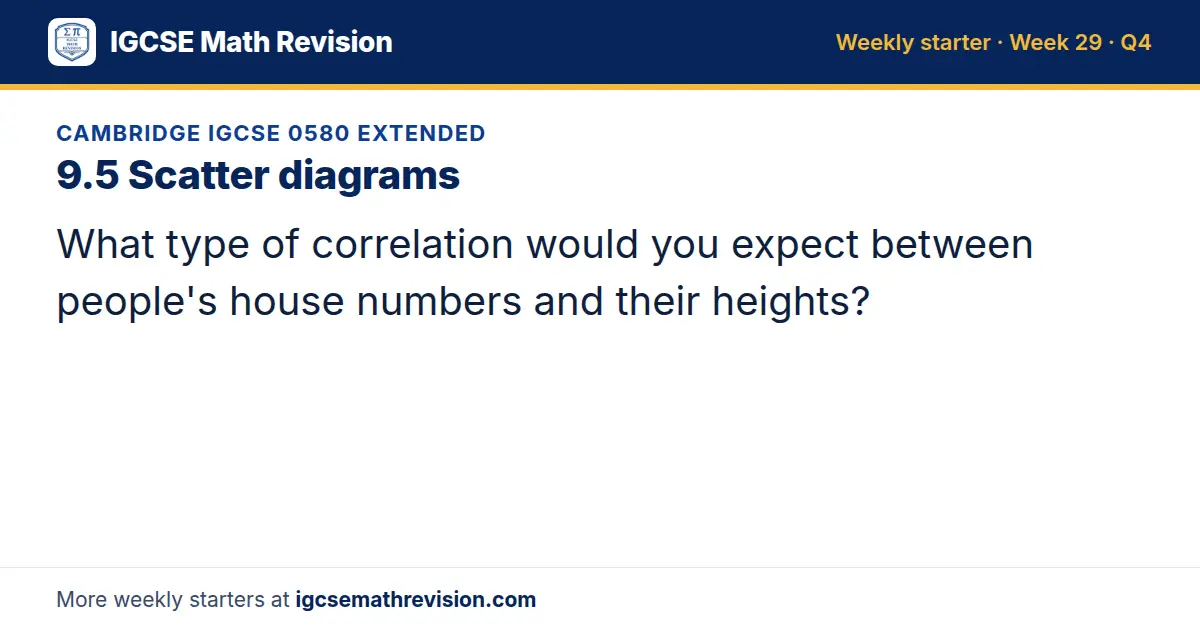
Question 4: 9.5 Scatter diagrams
What type of correlation would you expect between people's house numbers and their heights?
Week 30
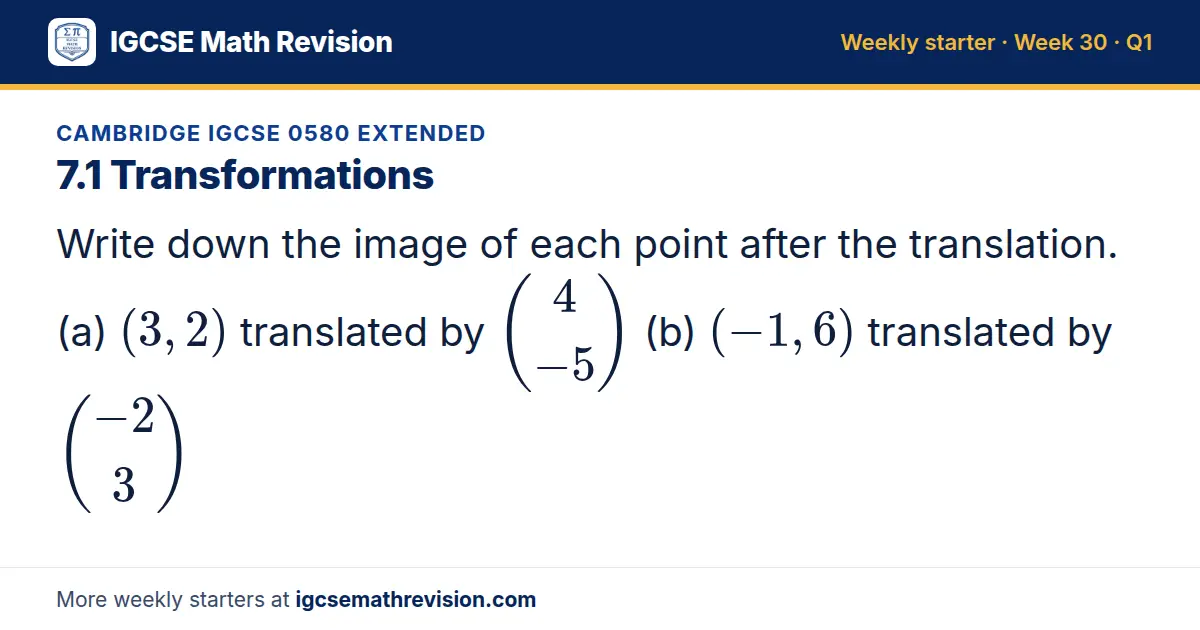
Question 1: 7.1 Transformations
Write down the image of each point after the translation. (a) (3, 2) translated by 4; -5 (b) (-1, 6) translated by -2; 3
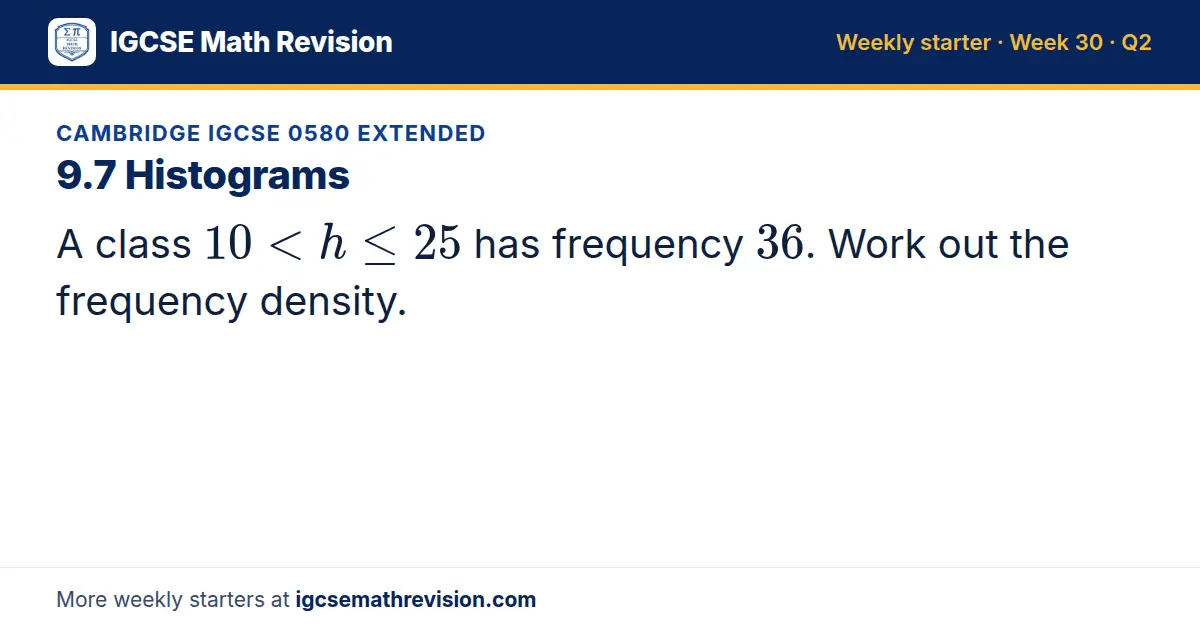
Question 2: 9.7 Histograms
In a histogram, the bar for the class 0 < t ≤ 5 has frequency density 2.4. Work out the frequency of this class.
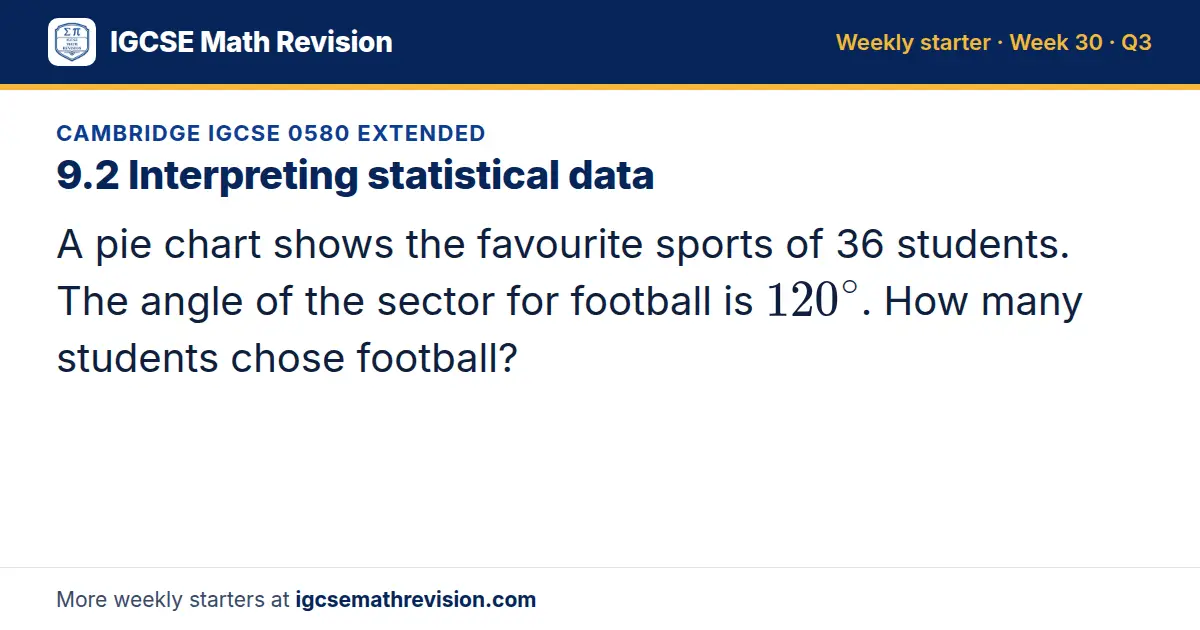
Question 3: 9.2 Interpreting statistical data
Pie chart A shows how 120 students travel to school; its sector for cycling has angle 90°. Pie chart B shows how 300 students travel to another school; its sector for cycling has angle 60°. Lee says, \"More students cycle to school A than to school B.\" Is Lee correct? Show your working.
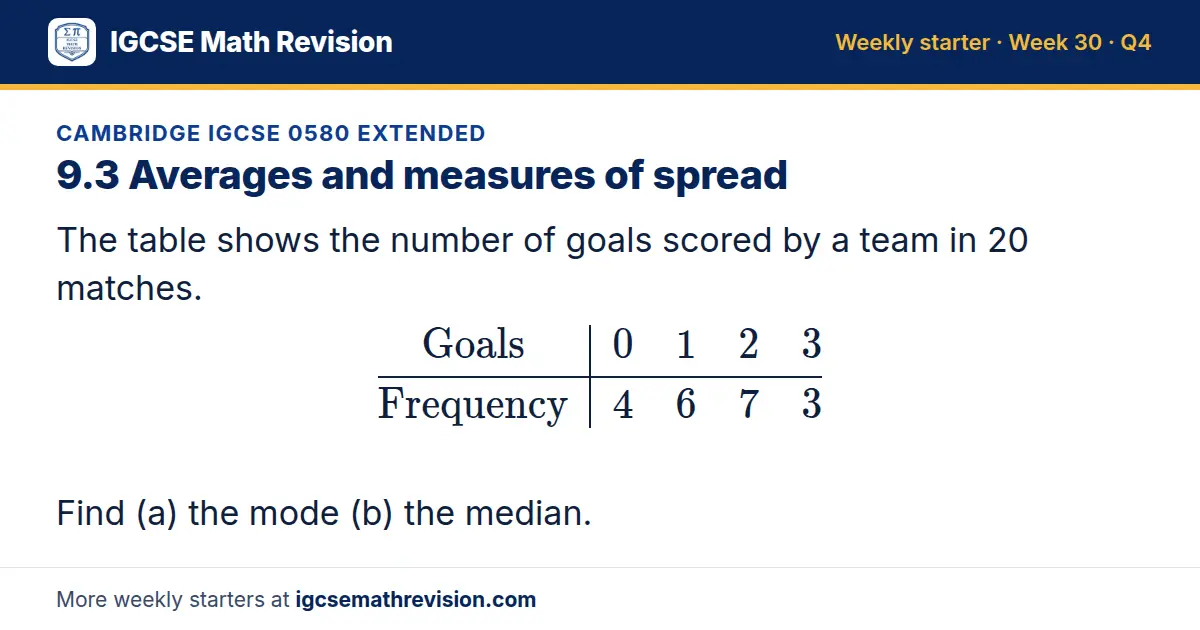
Question 4: 9.3 Averages and measures of spread
The table shows how many tickets 40 people bought for a concert. Tickets 1 2 3 4; Frequency 12 15 8 5 Calculate the mean number of tickets per person.
Week 31
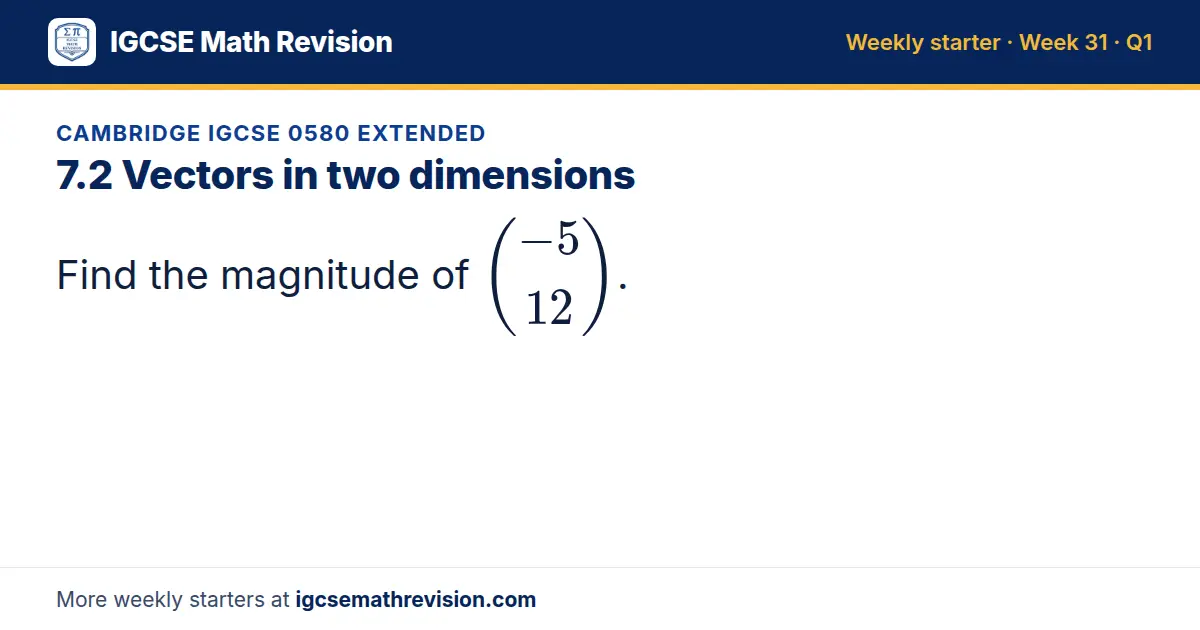
Question 1: 7.2 Vectors in two dimensions
a = 5; -3 and b = -2; 6. Find (a) a + b (b) 3a.
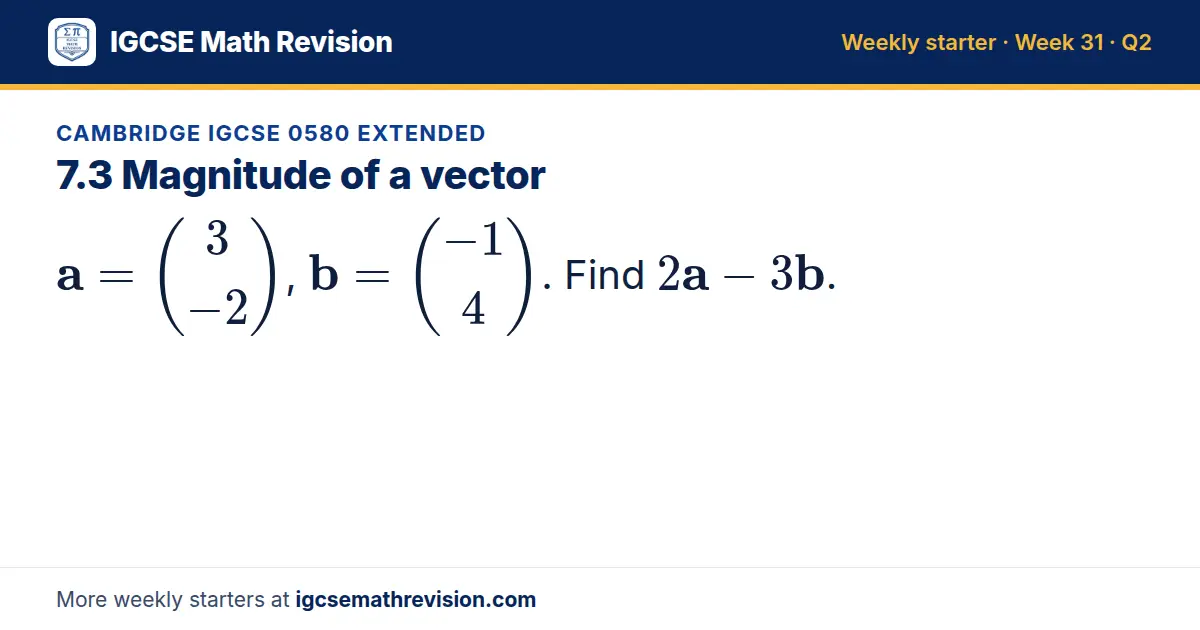
Question 2: 7.3 Magnitude of a vector
Find the magnitude of 6; 8.
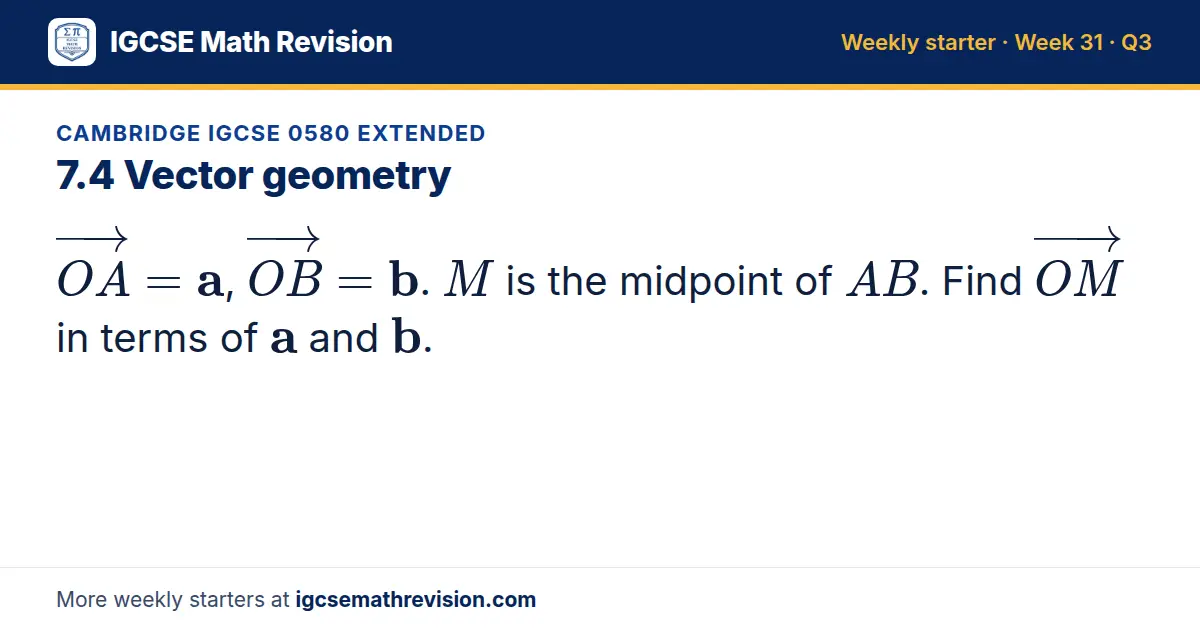
Question 3: 7.4 Vector geometry
In triangle OAB, OA = a and OB = b. The point N is halfway along OB. Write down, in terms of a and b, (a) the vector from B to A (b) the vector from A to N.
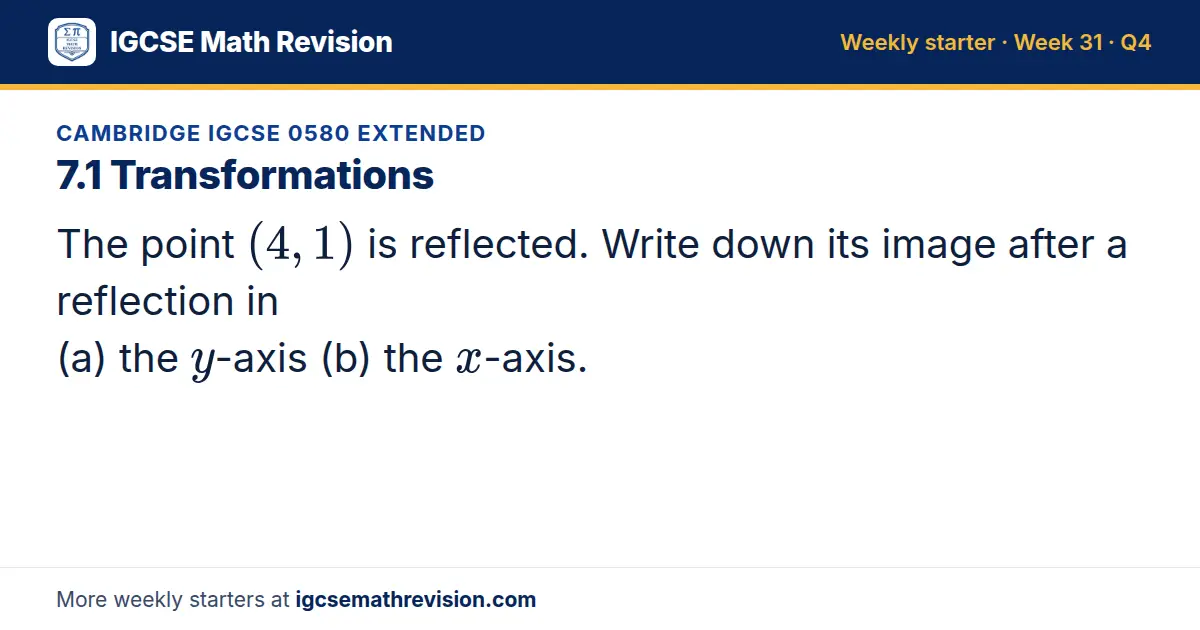
Question 4: 7.1 Transformations
The point (4, 1) is reflected. Write down its image after a reflection in (a) the y-axis (b) the x-axis.
Week 32
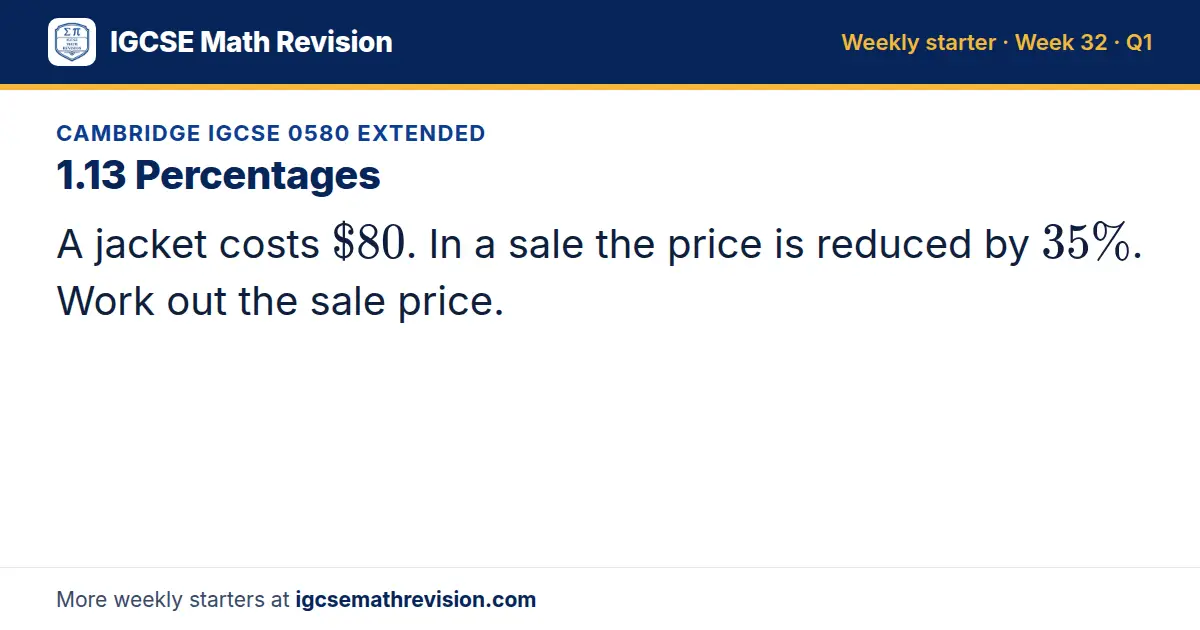
Question 1: 1.13 Percentages
A jacket costs £80. In a sale the price is reduced by 35%. Work out the sale price.
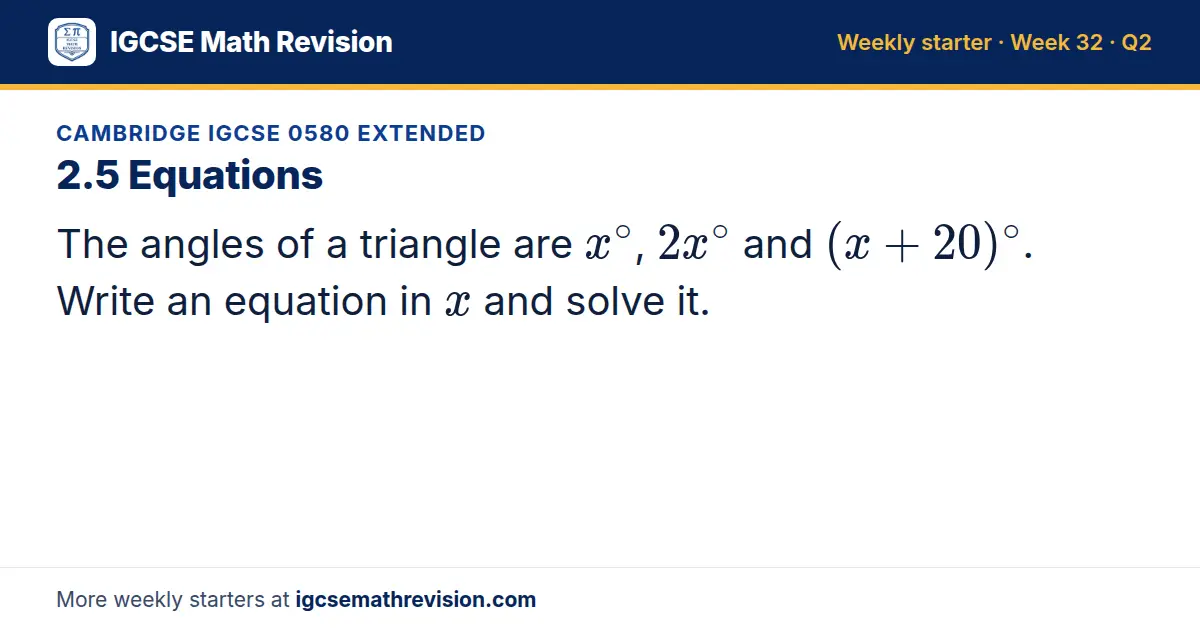
Question 2: 2.5 Equations
The angles of a triangle are x°, 2x° and (x + 20)°. Write an equation in x and solve it.
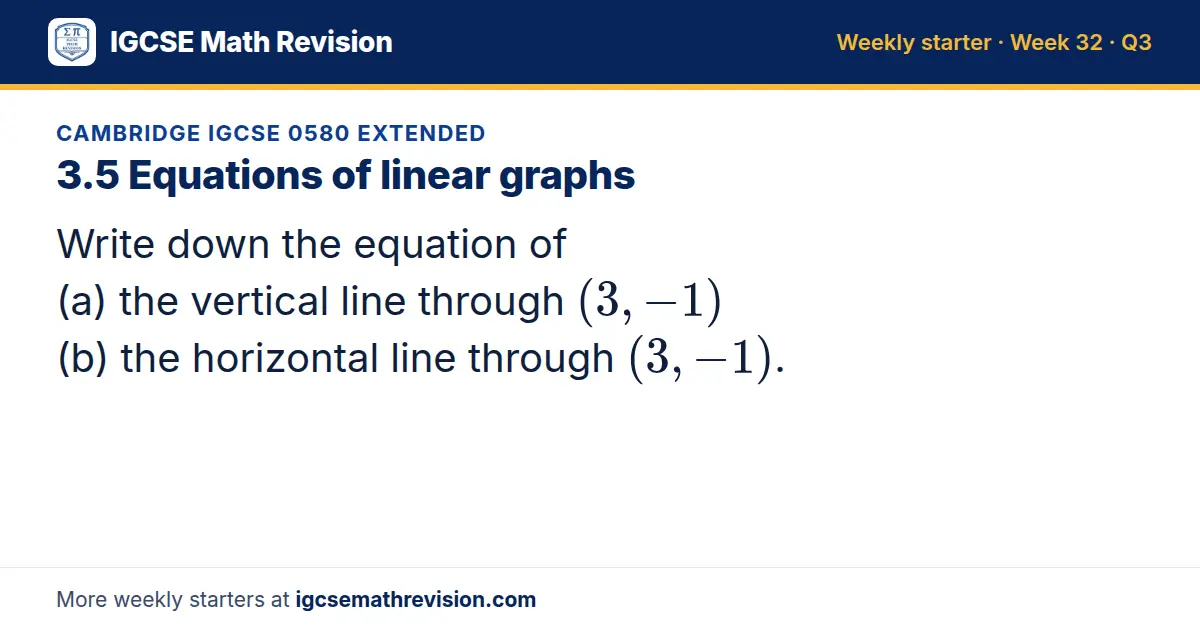
Question 3: 3.5 Equations of linear graphs
A straight line cuts the y-axis at (0, 7) and goes down 3 units for every 1 unit it goes across to the right. Write down the equation of the line.
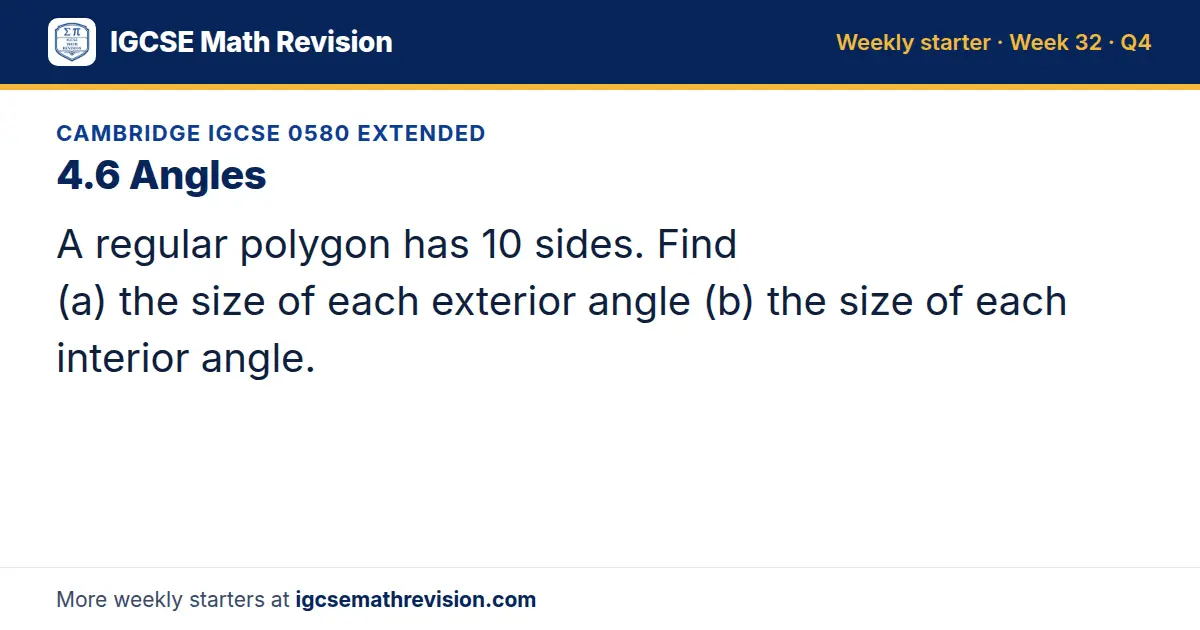
Question 4: 4.6 Angles
A regular polygon has 10 sides. Find (a) the size of each exterior angle (b) the size of each interior angle.
Week 33
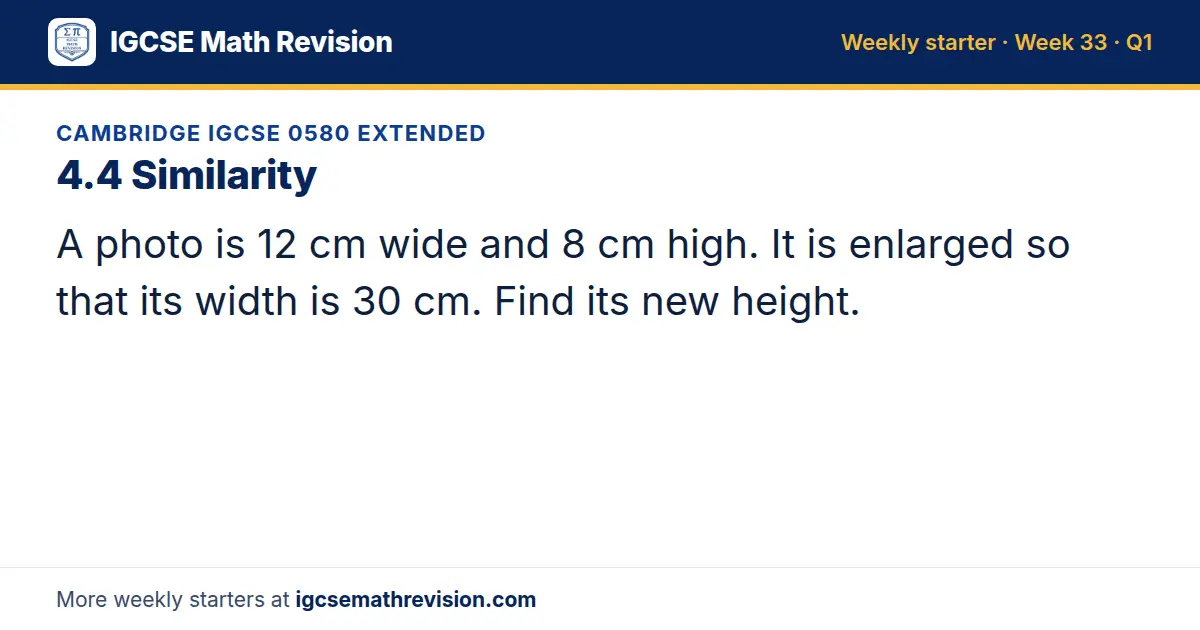
Question 1: 4.4 Similarity
A photo is 12 cm wide and 8 cm high. It is enlarged so that its width is 30 cm. Find its new height.
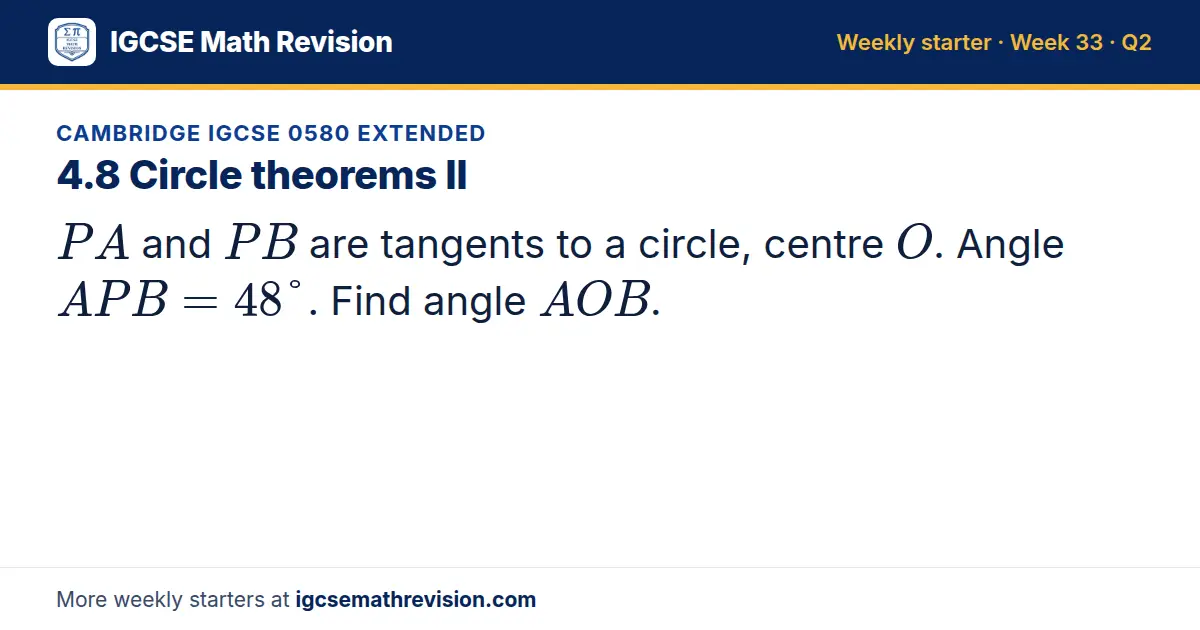
Question 2: 4.8 Circle theorems II
Two chords of a circle each have length 10 cm. One chord is 4 cm from the centre of the circle. How far is the other chord from the centre? Give a reason.
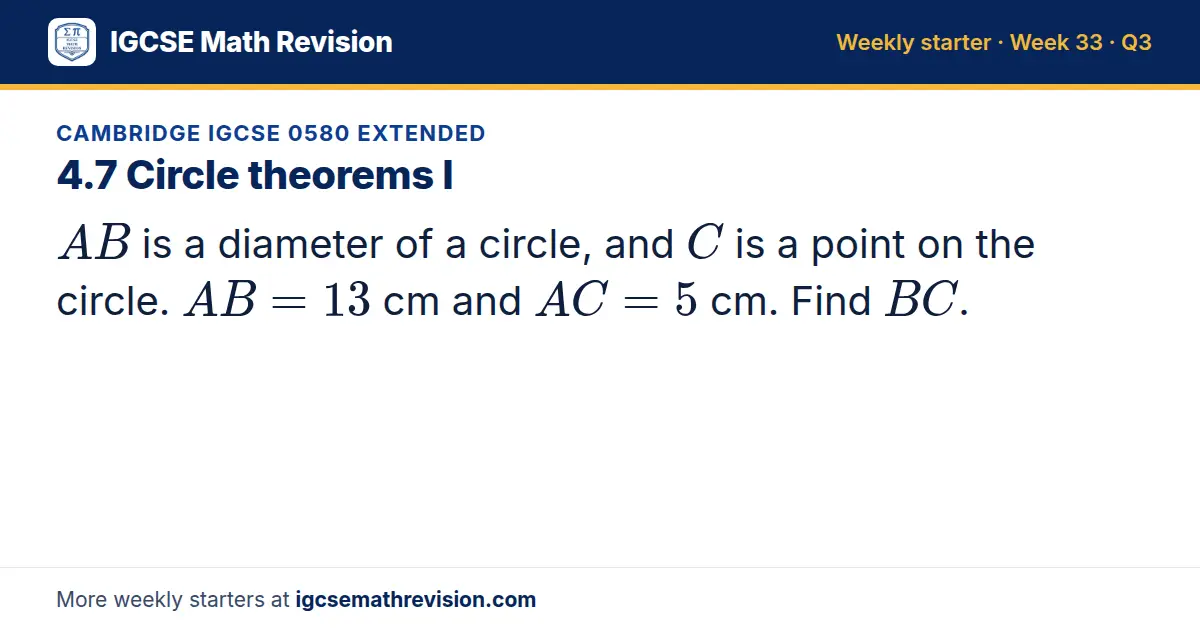
Question 3: 4.7 Circle theorems I
AB is a diameter of a circle, and C is a point on the circle. AB = 13 cm and AC = 5 cm. Find BC.
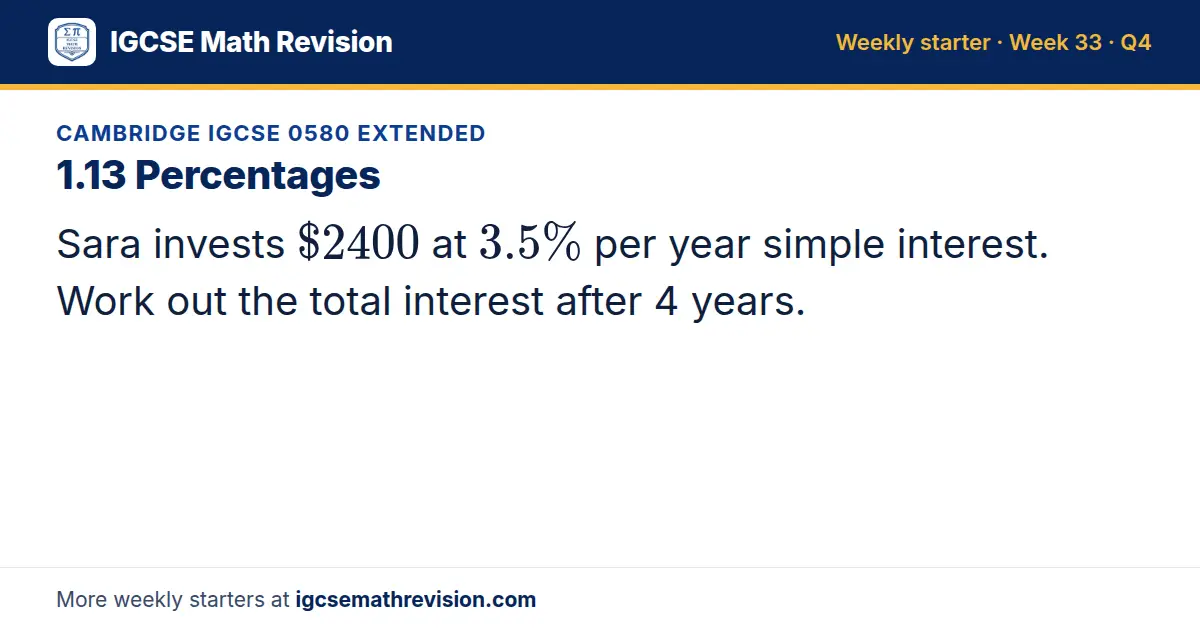
Question 4: 1.13 Percentages
Sara invests £2400 at 3.5% per year simple interest. Work out the total interest after 4 years.
More starter questions
Other weeks: Weeks 1–11 · Weeks 12–22 · Weeks 23–33 · Weeks 34–44 · Weeks 45–55. Answers and mark schemes, free for everyone, are on the free weekly starters page.
Keep your streak going
Save your answers and track your progressA free account remembers the questions you have done and brings you back to this page.
Join freeAlready have an account? Sign in