Cambridge IGCSE 0580 Core starter questions: weeks 40–51
48 short questions to open a lesson for Cambridge IGCSE Mathematics 0580, Core, weeks 40–51 of the teaching year, three or four a week. Each question is shown as an image with its text underneath; the answers and mark schemes are free on the free weekly starters page, to show or project in class.
- Answers and mark schemes (free)
- ← Cambridge IGCSE 0580 Core, weeks 27–39
- All IGCSE Maths daily and weekly questions
Week 40
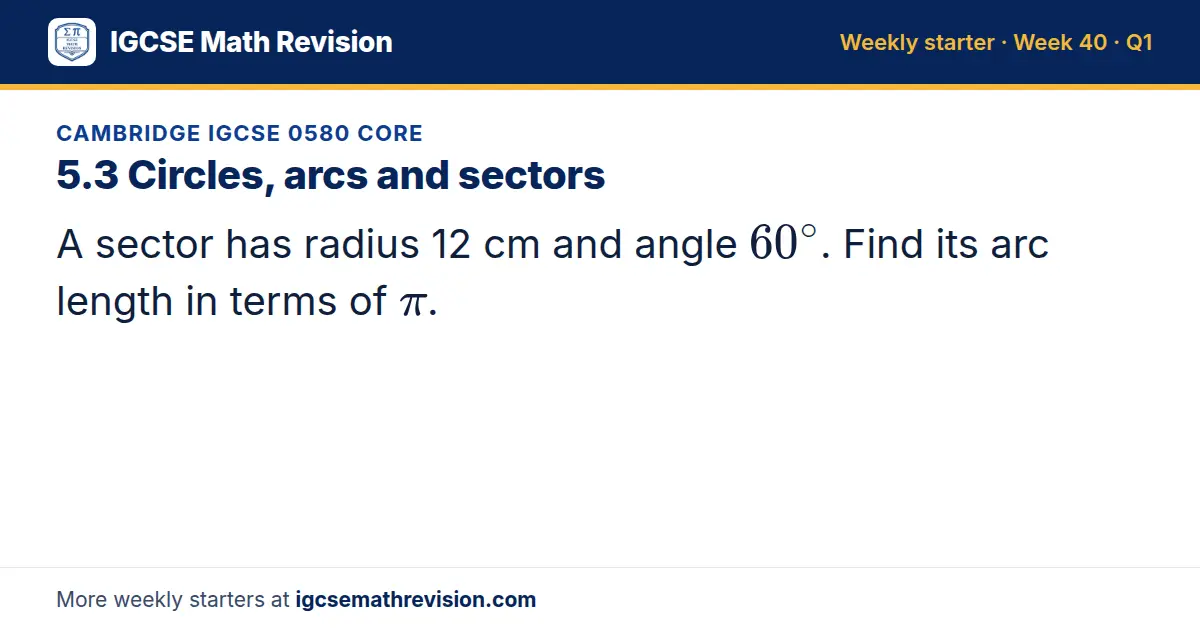
Question 1: 5.3 Circles, arcs and sectors
A sector has radius 12 cm and angle 60°. Find its arc length in terms of π.
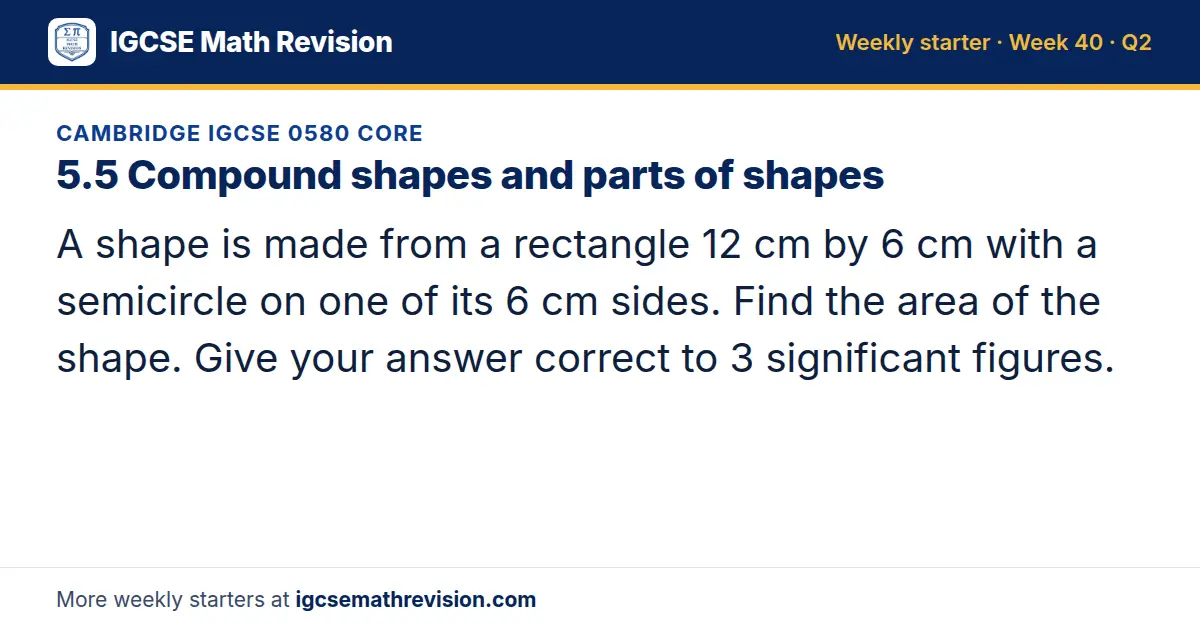
Question 2: 5.5 Compound shapes and parts of shapes
A metal plate is a rectangle 14 cm by 8 cm. A semicircle with diameter 8 cm is cut out of one of the 8 cm sides. Work out the area of the plate that is left. Give your answer correct to 3 significant figures.
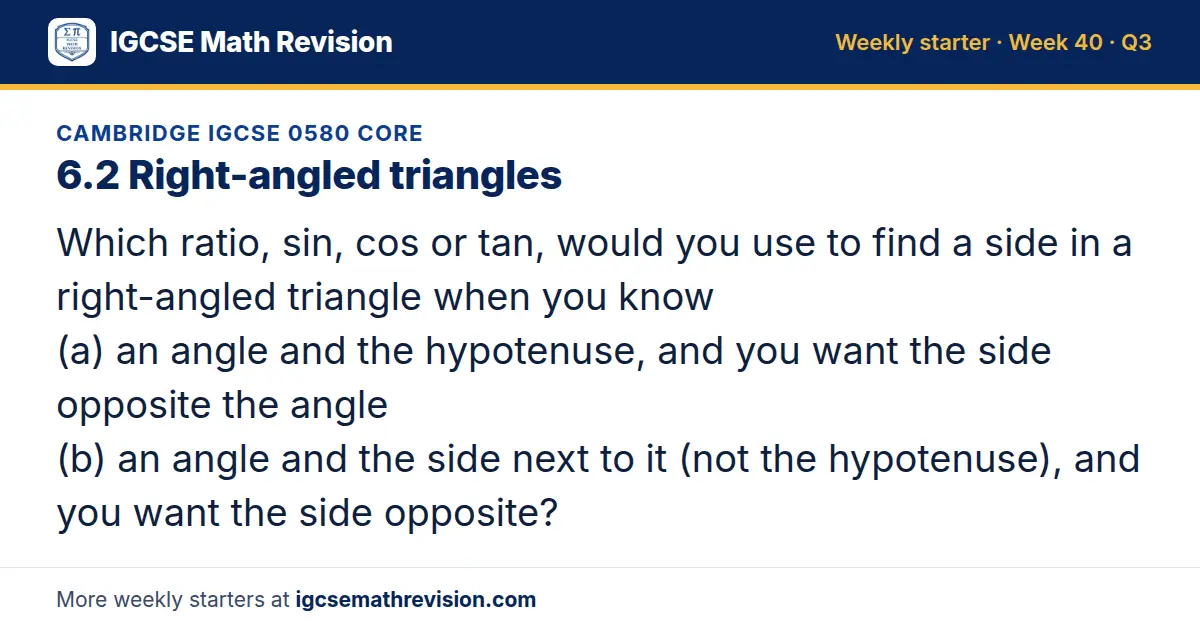
Question 3: 6.2 Right-angled triangles
Which ratio, sin, cos or tan, would you use to find a side in a right-angled triangle when you know (a) an angle and the hypotenuse, and you want the side opposite the angle (b) an angle and the side next to it (not the hypotenuse), and you want the side opposite?
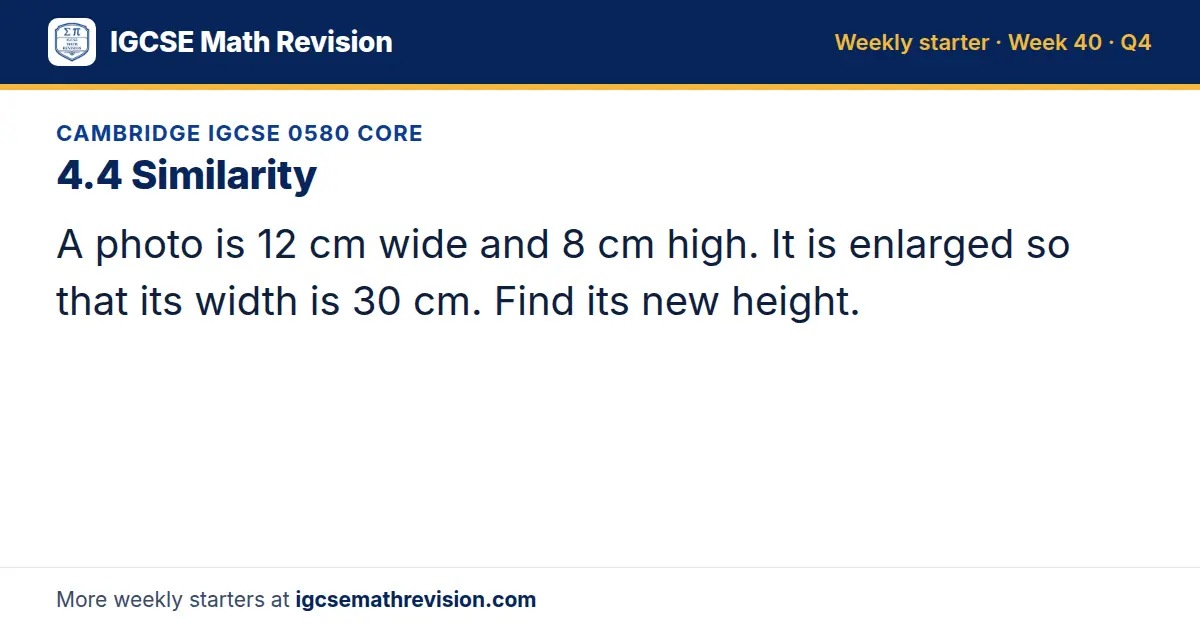
Question 4: 4.4 Similarity
A photo is 12 cm wide and 8 cm high. It is enlarged so that its width is 30 cm. Find its new height.
Week 41
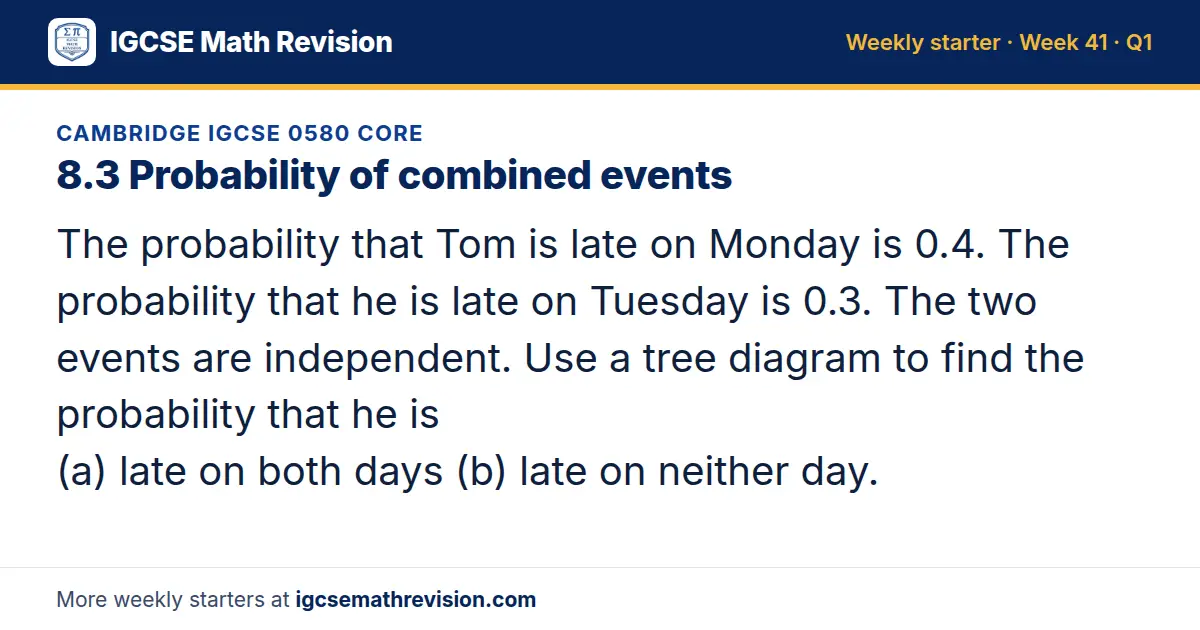
Question 1: 8.3 Probability of combined events
The probability that Tom is late on Monday is 0.4. The probability that he is late on Tuesday is 0.3. The two events are independent. Use a tree diagram to find the probability that he is (a) late on both days (b) late on neither day.
Question 2: 9.4 Statistical charts and diagrams
A bar chart shows the favourite fruit of some students: apples 7, bananas 12, grapes 5, oranges 6. (a) How many students were asked? (b) What fraction of the students chose bananas? Give your answer in its simplest form.
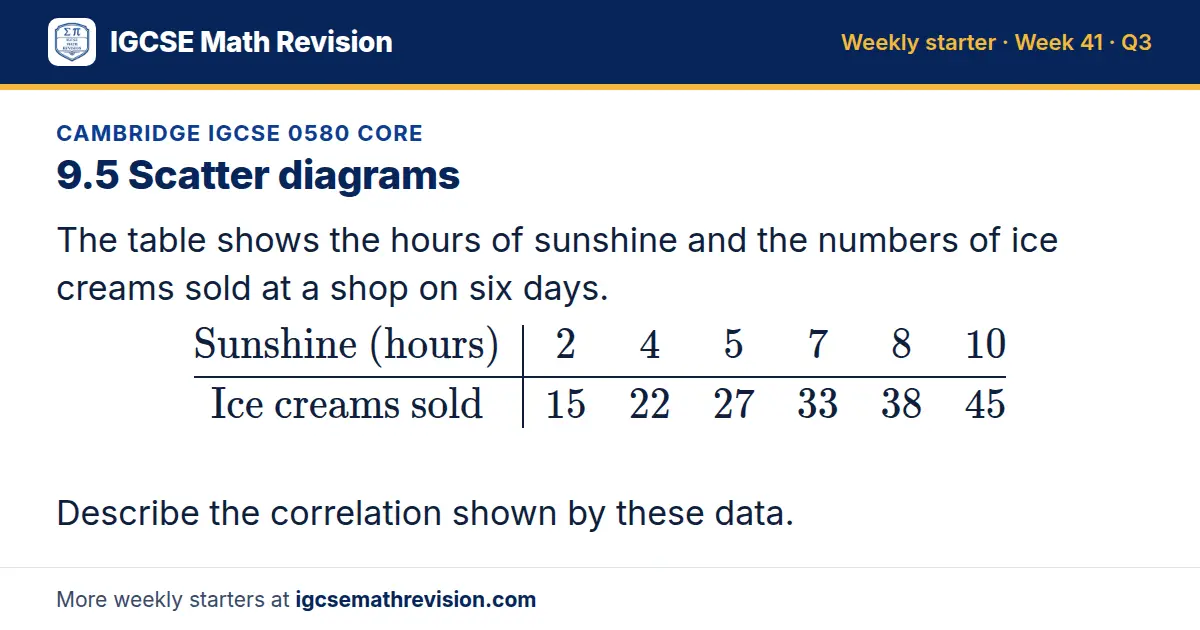
Question 3: 9.5 Scatter diagrams
The table shows the hours of sunshine and the numbers of ice creams sold at a shop on six days. Sunshine (hours) 2 4 5 7 8 10; Ice creams sold 15 22 27 33 38 45 Describe the correlation shown by these data.
Question 4: 9.2 Interpreting statistical data
A pie chart shows the favourite sports of 36 students. The angle of the sector for football is 120°. How many students chose football?
Week 42
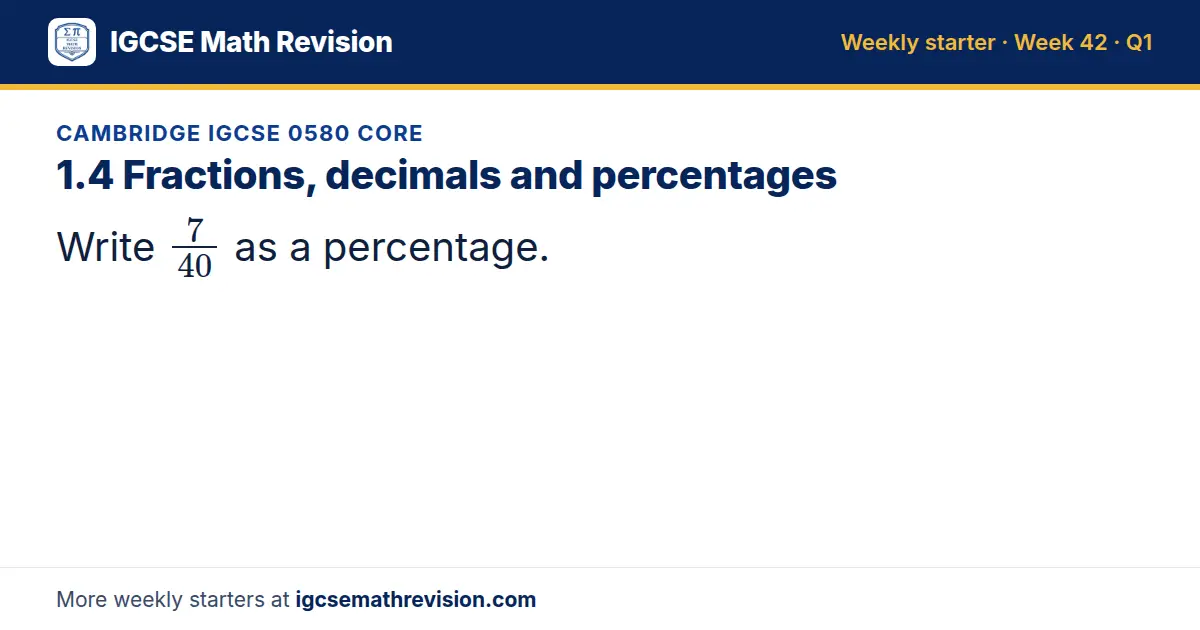
Question 1: 1.4 Fractions, decimals and percentages
Write 7/40 as a percentage.
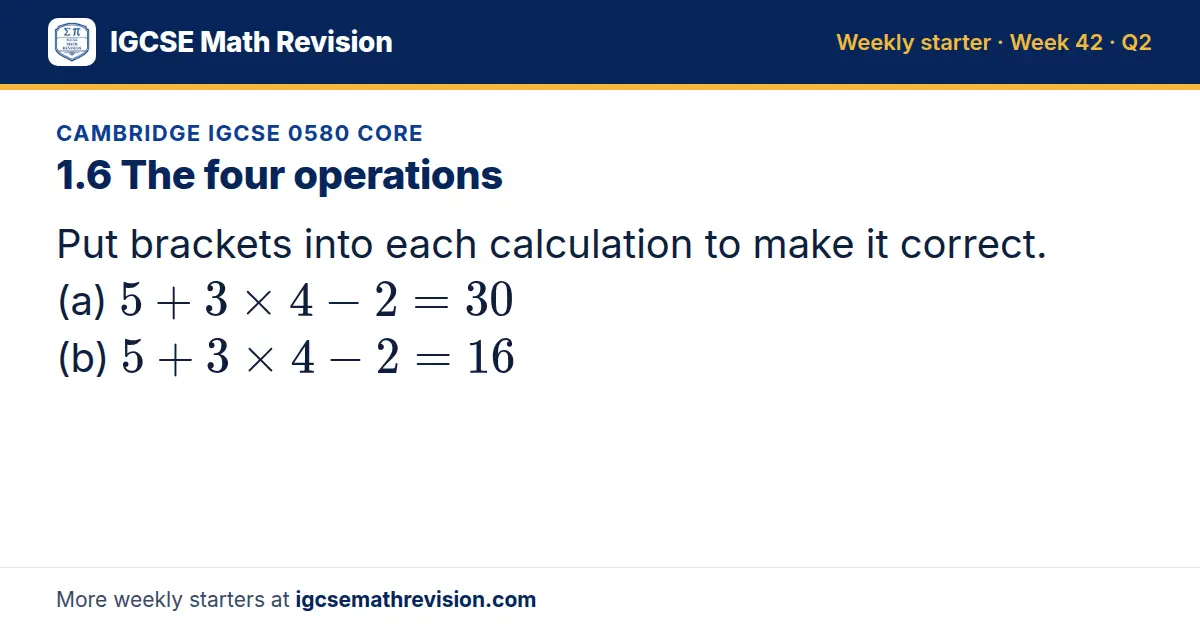
Question 2: 1.6 The four operations
Without using a calculator, work out 31/2 - 15/6. Give your answer as a mixed number in its simplest form.
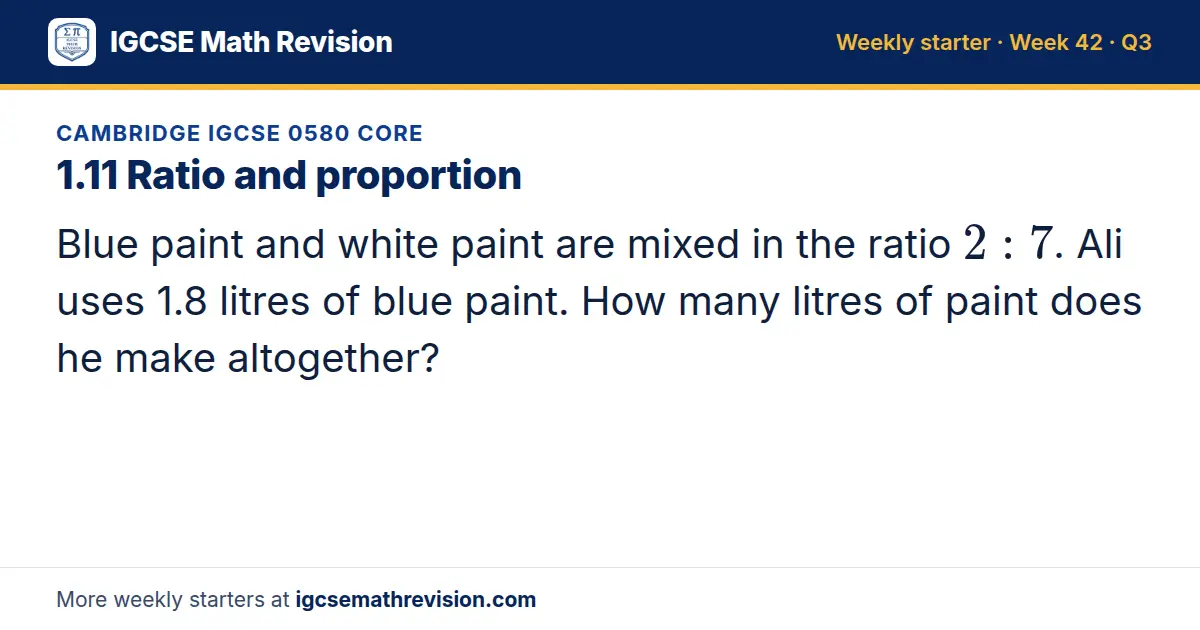
Question 3: 1.11 Ratio and proportion
Blue paint and white paint are mixed in the ratio 2: 7. Ali uses 1.8 litres of blue paint. How many litres of paint does he make altogether?
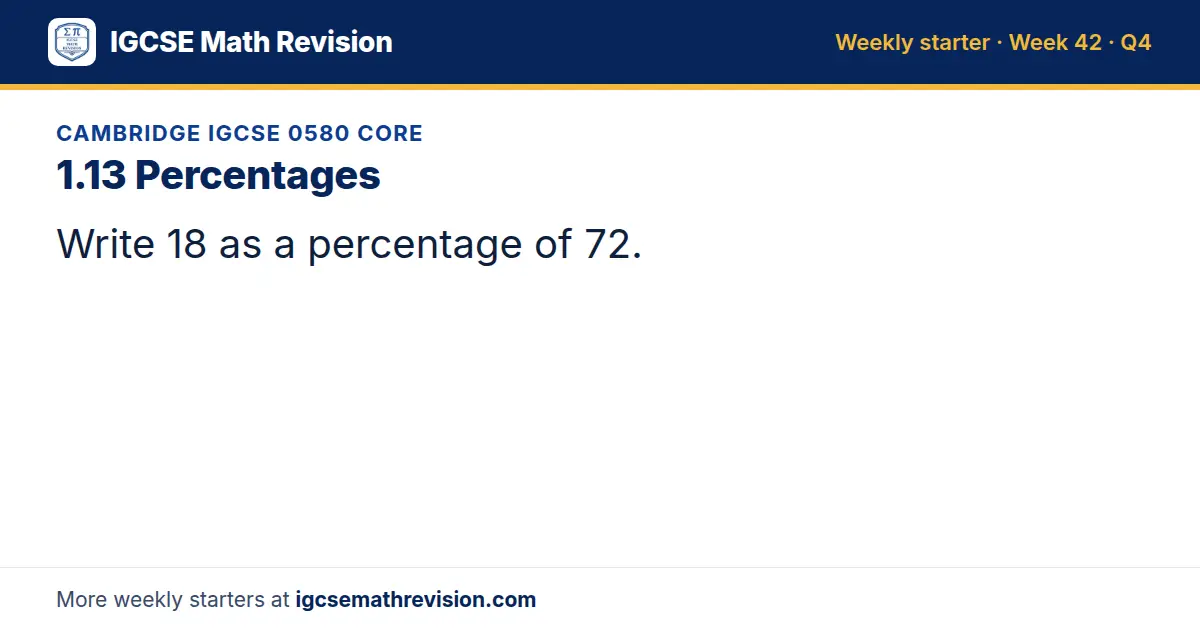
Question 4: 1.13 Percentages
Find 15% of £60.
Week 43
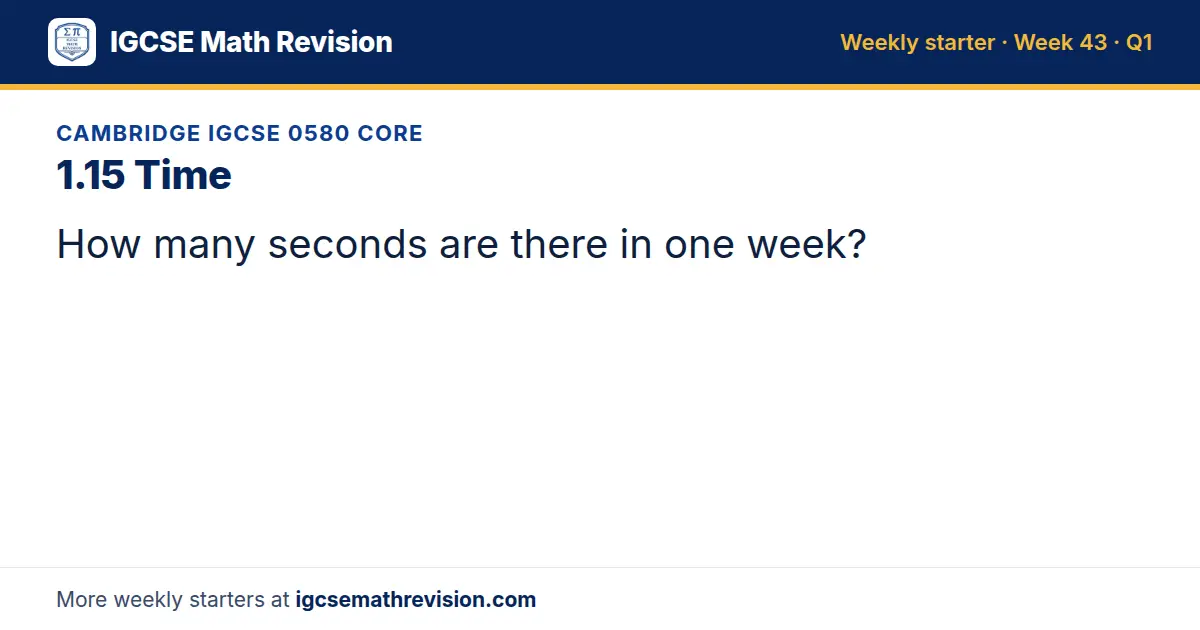
Question 1: 1.15 Time
Write 7.45 pm as a time on the 24-hour clock.
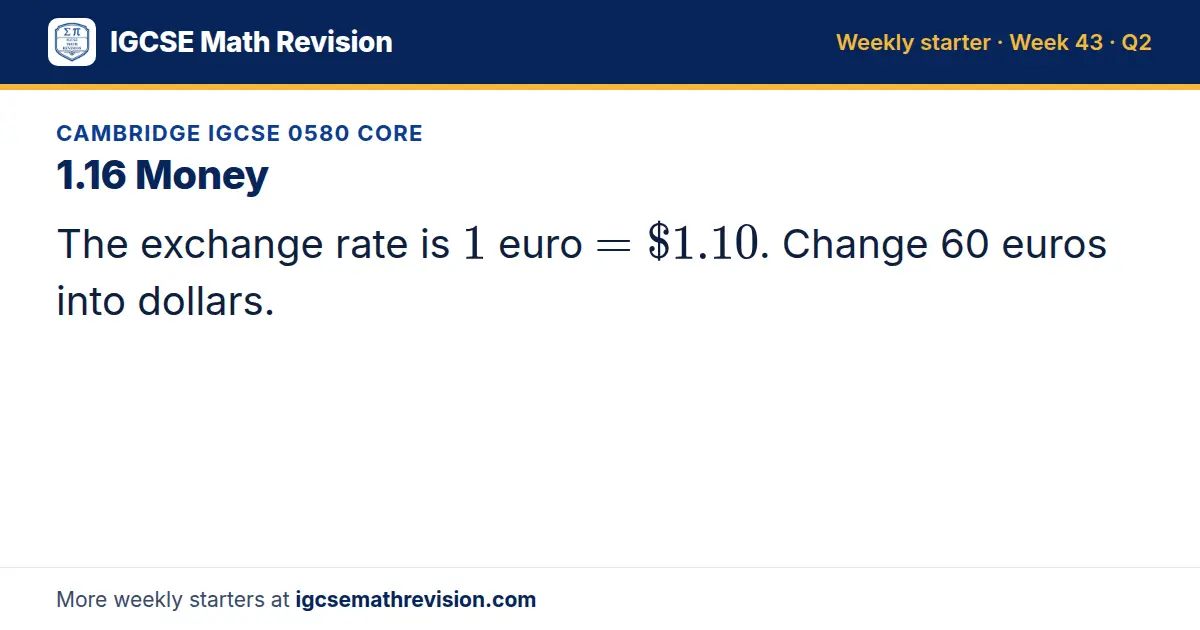
Question 2: 1.16 Money
The exchange rate is £1 = 0.92 euros. Change 375 euros into pounds. Give your answer correct to the nearest penny.
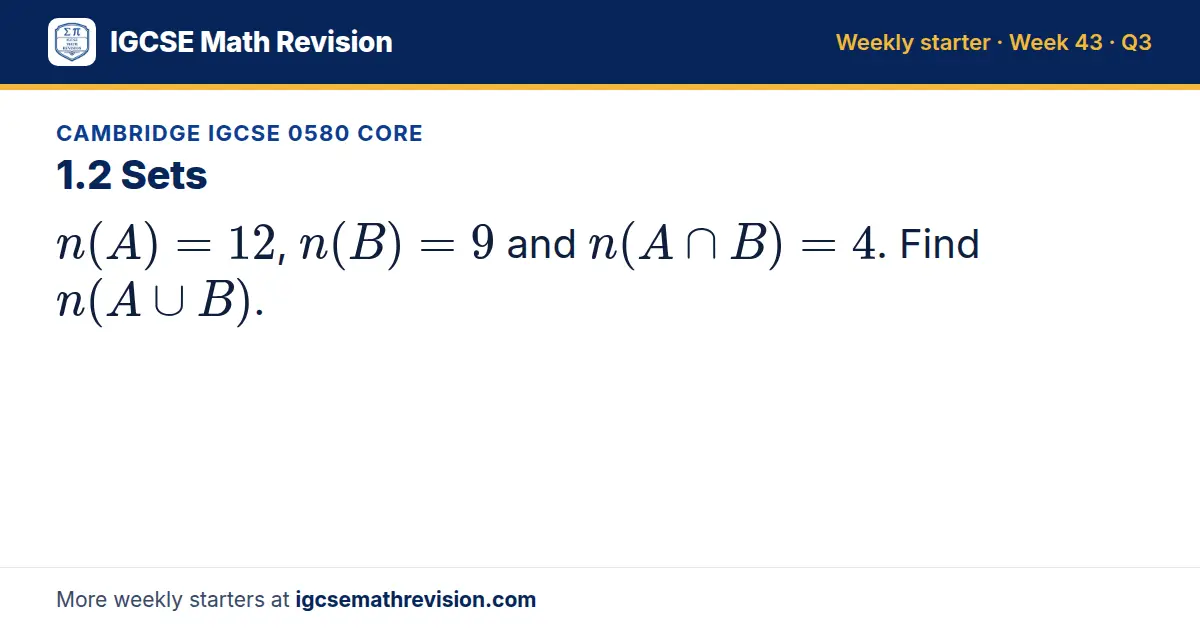
Question 3: 1.2 Sets
n(A) = 12, n(B) = 9 and n(A ∩ B) = 4. Find n(A ∪ B).
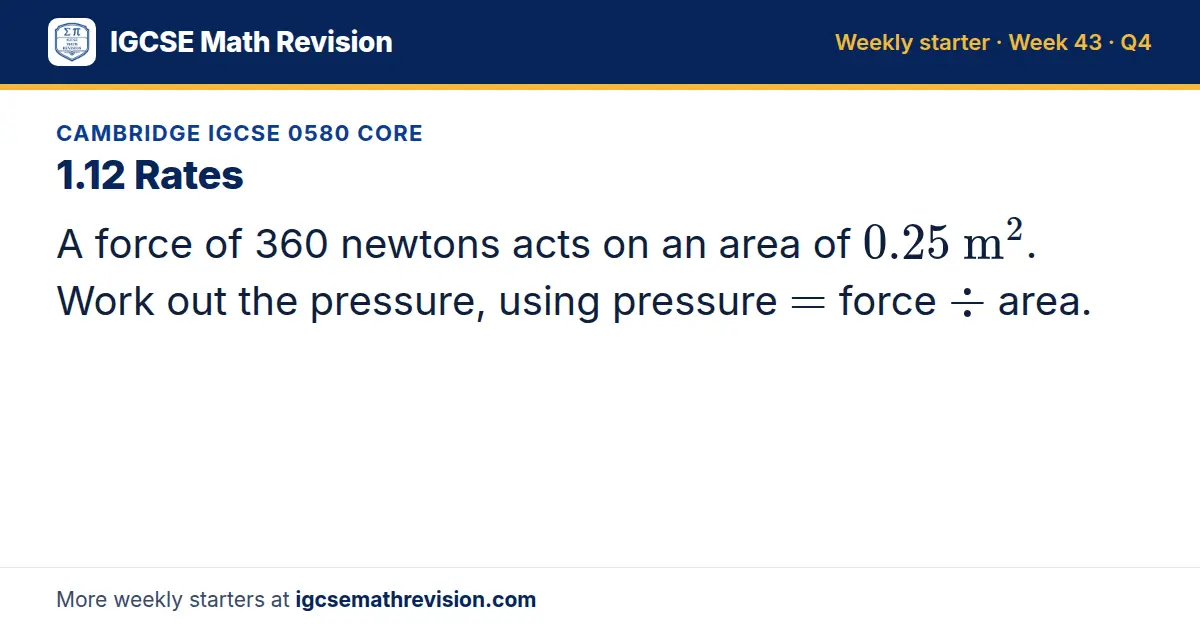
Question 4: 1.12 Rates
A force of 360 newtons acts on an area of 0.25 m^2. Work out the pressure, using pressure = force ÷ area.
Week 44
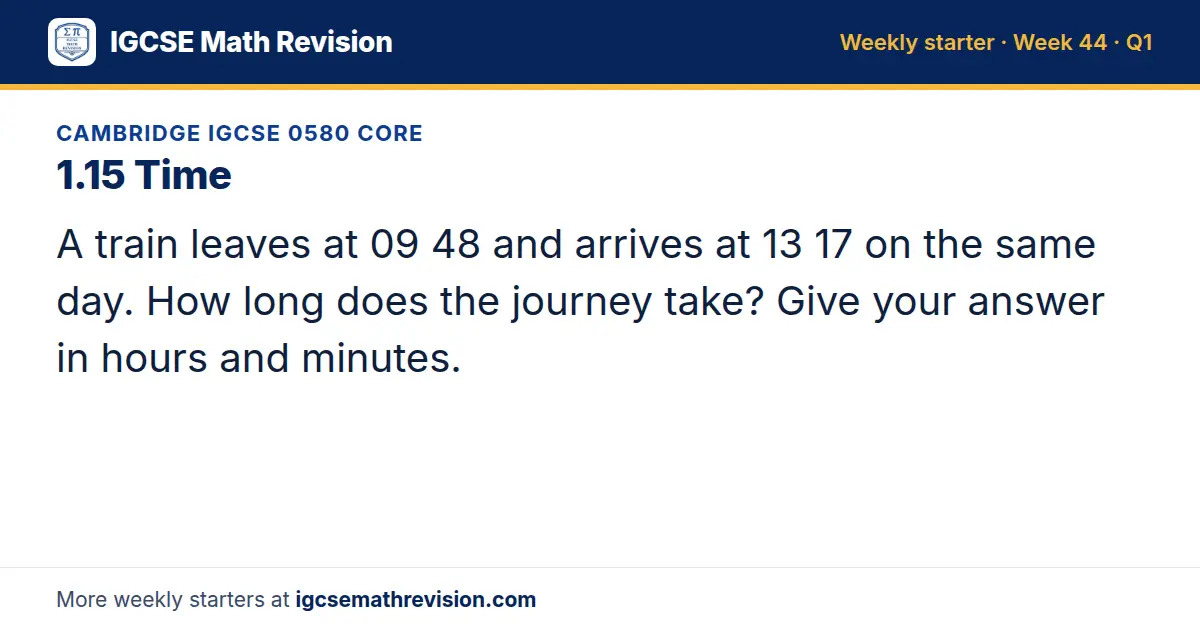
Question 1: 1.15 Time
Write each 24-hour clock time as a 12-hour clock time using am or pm. (a) 04 20 (b) 16 05
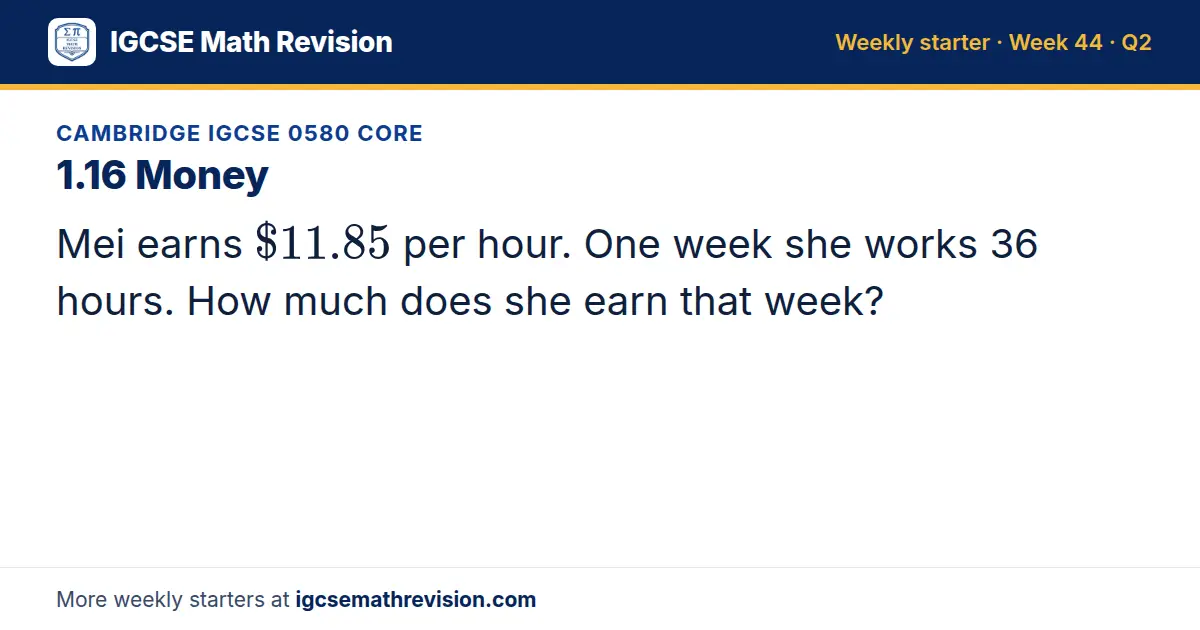
Question 2: 1.16 Money
Shop A sells a pack of 6 cans of juice for £4.32. Shop B sells a pack of 8 of the same cans for £5.60. Which shop gives the better value? Show your working.
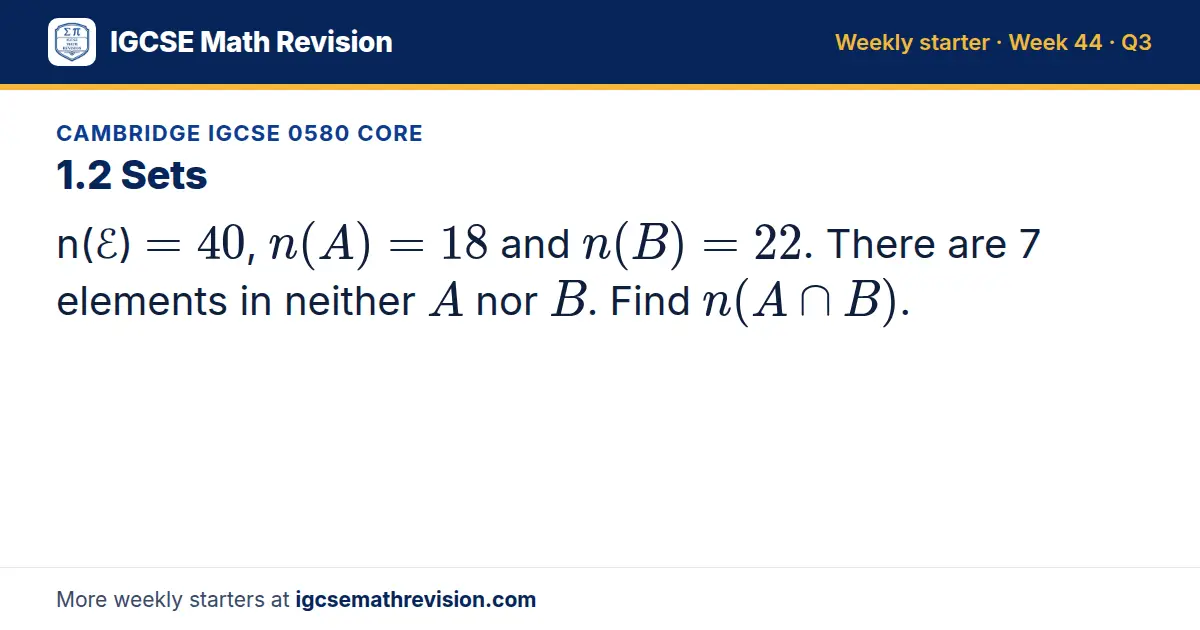
Question 3: 1.2 Sets
n(ℰ) = 40, n(A) = 18 and n(B) = 22. There are 7 elements in neither A nor B. Find n(A ∩ B).
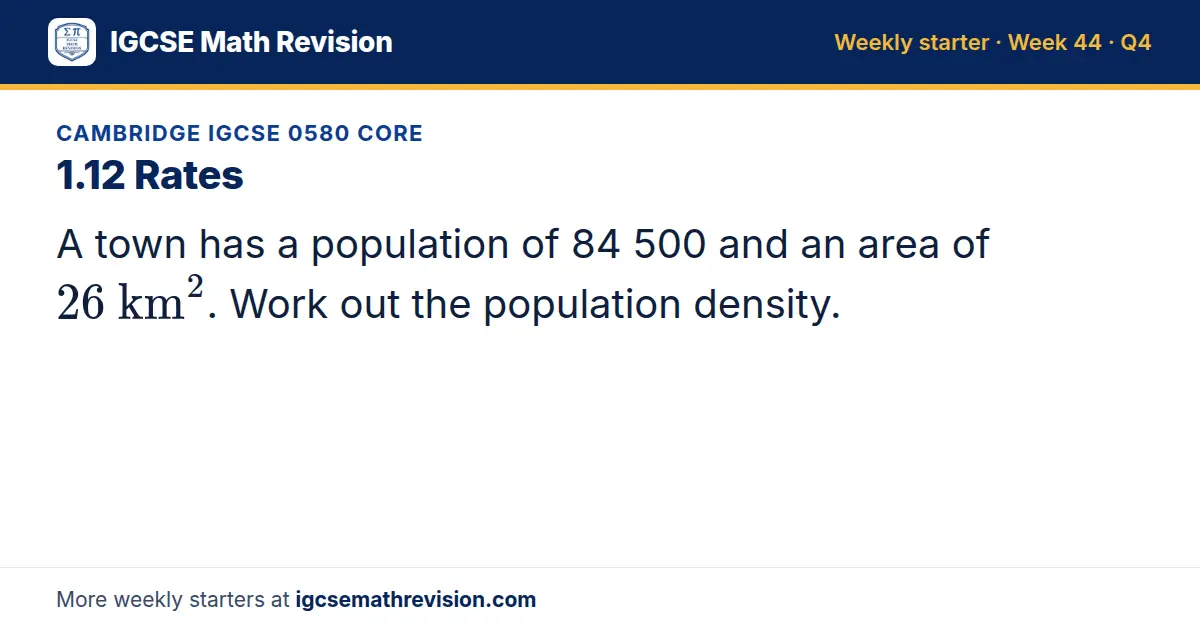
Question 4: 1.12 Rates
A town has a population of 84 500 and an area of 26 km^2. Work out the population density.
Week 45
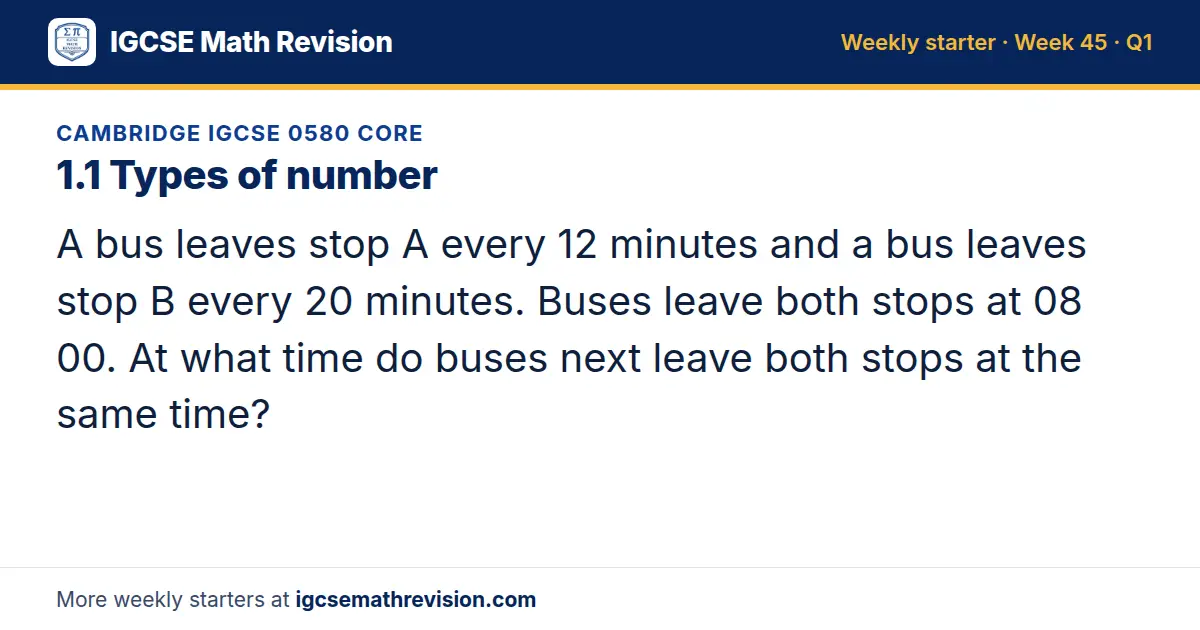
Question 1: 1.1 Types of number
A bus leaves stop A every 12 minutes and a bus leaves stop B every 20 minutes. Buses leave both stops at 08 00. At what time do buses next leave both stops at the same time?
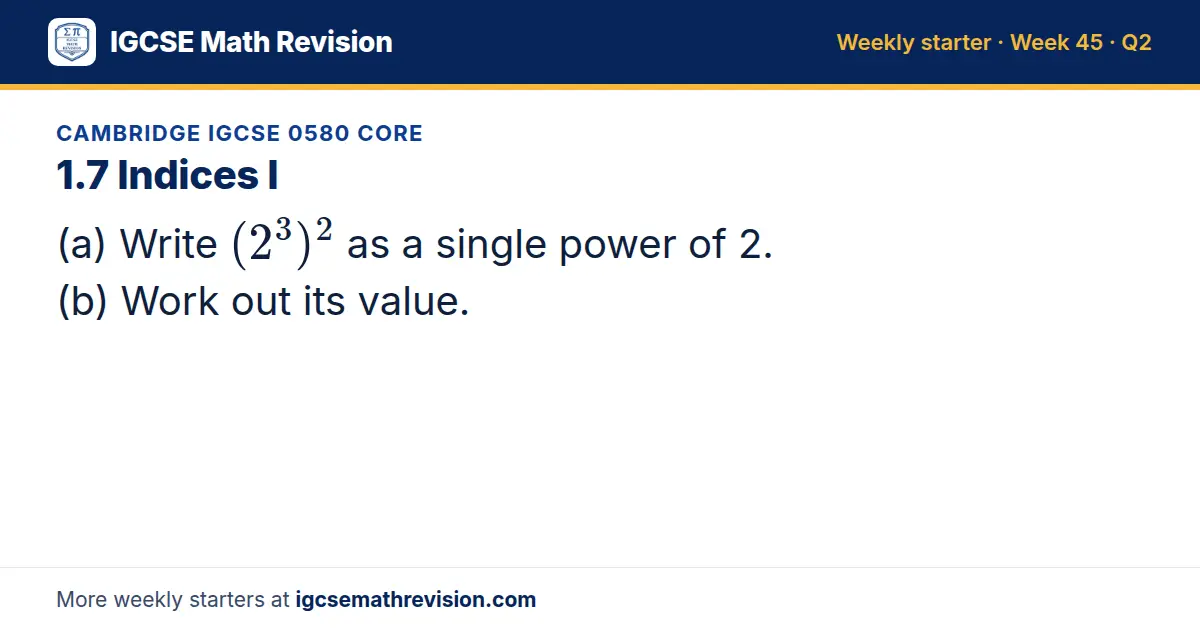
Question 2: 1.7 Indices I
(a) Write (2³)² as a single power of 2. (b) Work out its value.
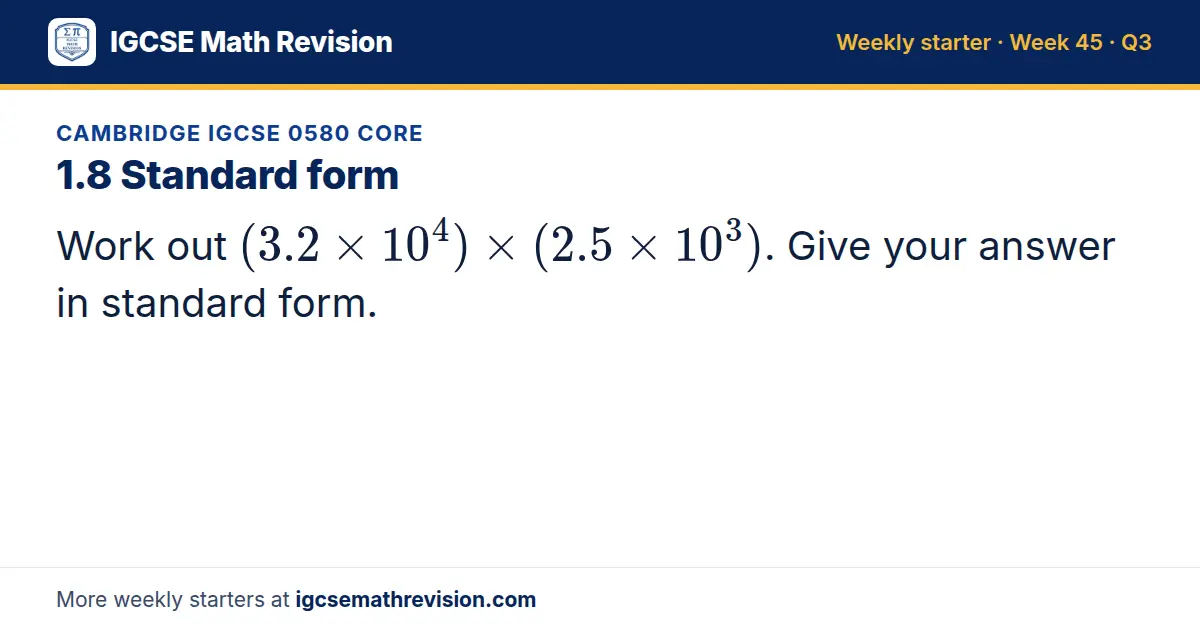
Question 3: 1.8 Standard form
Work out (3.2 × 10⁴) × (2.5 × 10³). Give your answer in standard form.
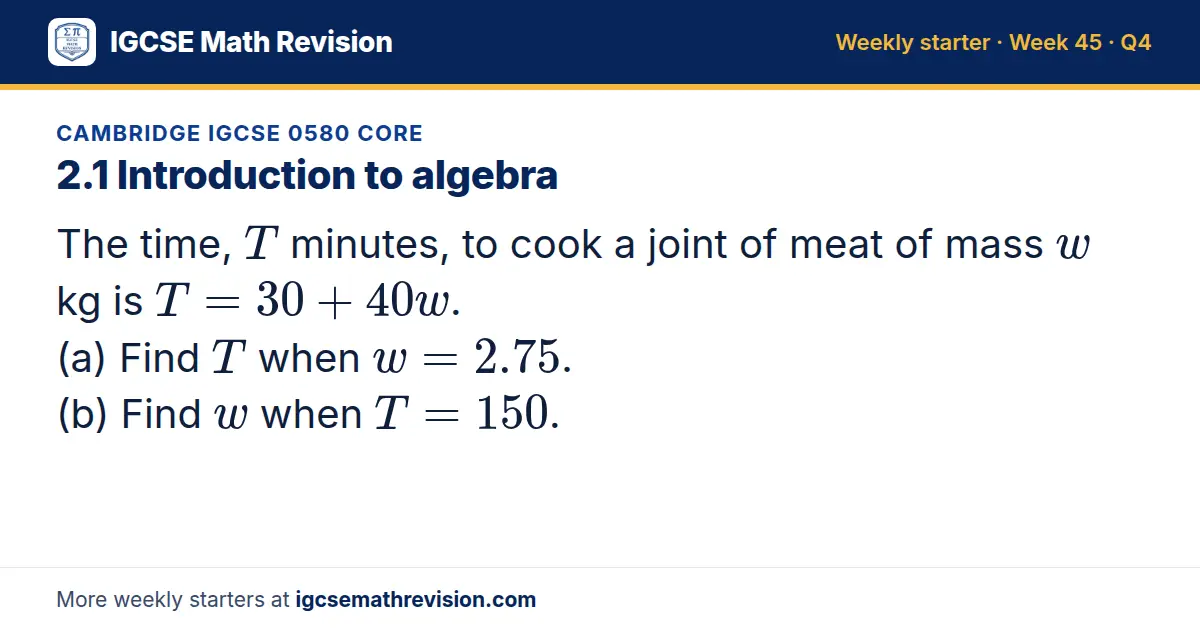
Question 4: 2.1 Introduction to algebra
The time, T minutes, to cook a joint of meat of mass w kg is T = 30 + 40w. (a) Find T when w = 2.75. (b) Find w when T = 150.
Week 46
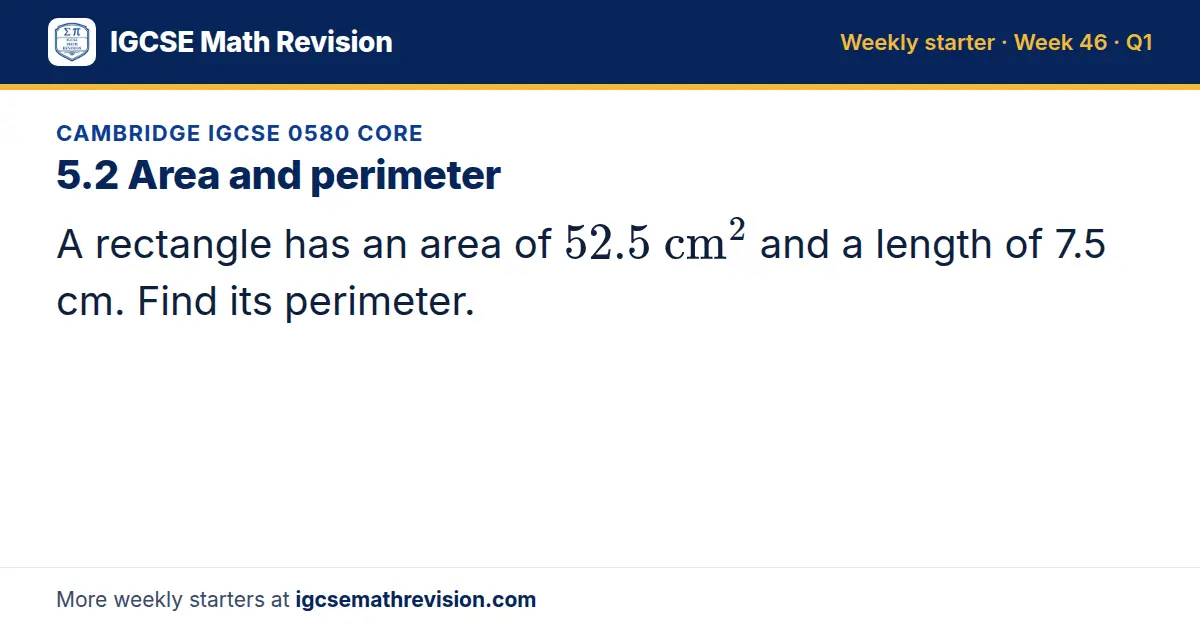
Question 1: 5.2 Area and perimeter
A rectangle has an area of 52.5 cm² and a length of 7.5 cm. Find its perimeter.
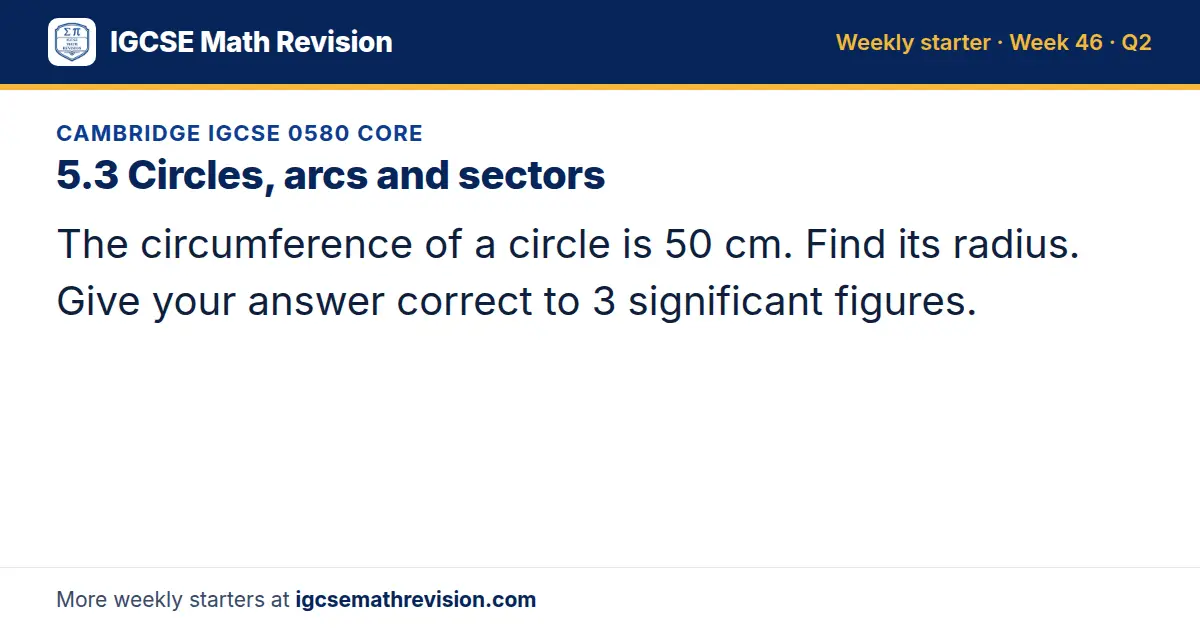
Question 2: 5.3 Circles, arcs and sectors
The circumference of a circle is 50 cm. Find its radius. Give your answer correct to 3 significant figures.
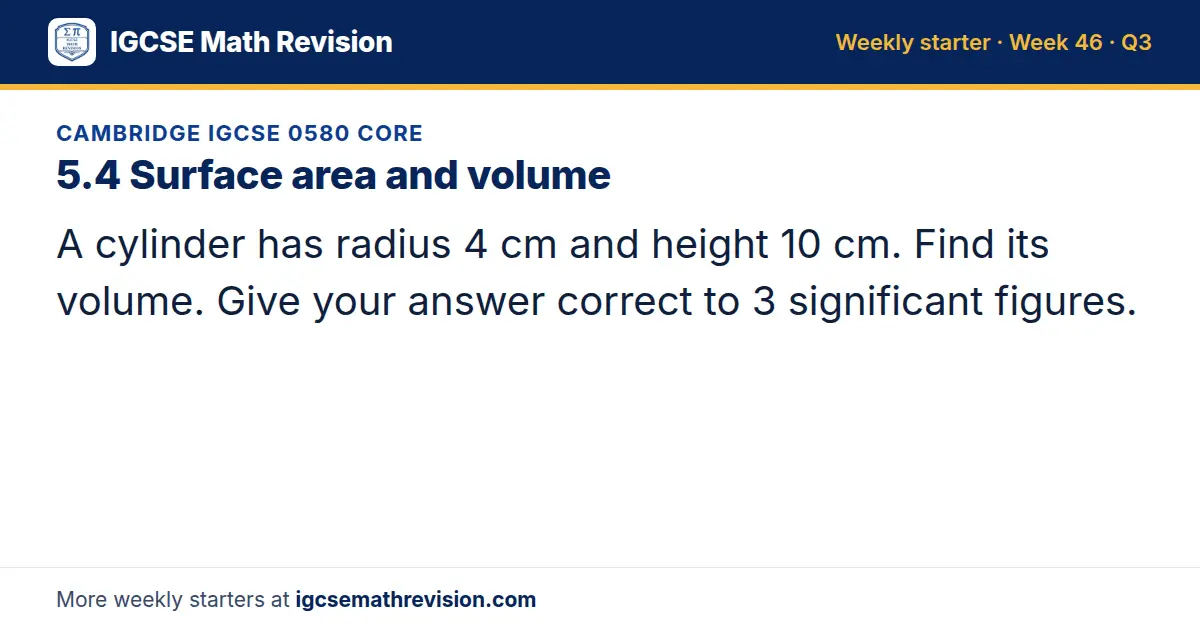
Question 3: 5.4 Surface area and volume
A cylinder has radius 4 cm and height 10 cm. Find its volume. Give your answer correct to 3 significant figures.
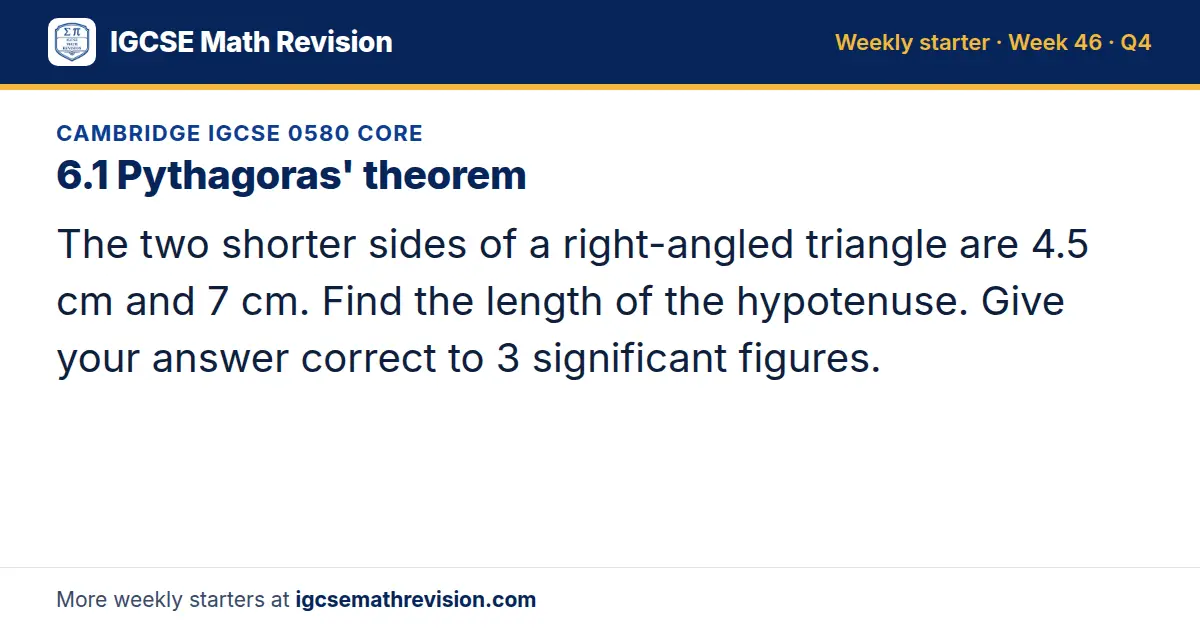
Question 4: 6.1 Pythagoras' theorem
The two shorter sides of a right-angled triangle are 4.5 cm and 7 cm. Find the length of the hypotenuse. Give your answer correct to 3 significant figures.
Week 47
Question 1: 9.1 Classifying statistical data
A club has 40 members. 18 of them are juniors and the rest are seniors. Every member plays tennis or squash, but not both. 12 juniors and 9 seniors play tennis. (a) Complete a two-way table for this information. (b) How many seniors play squash?
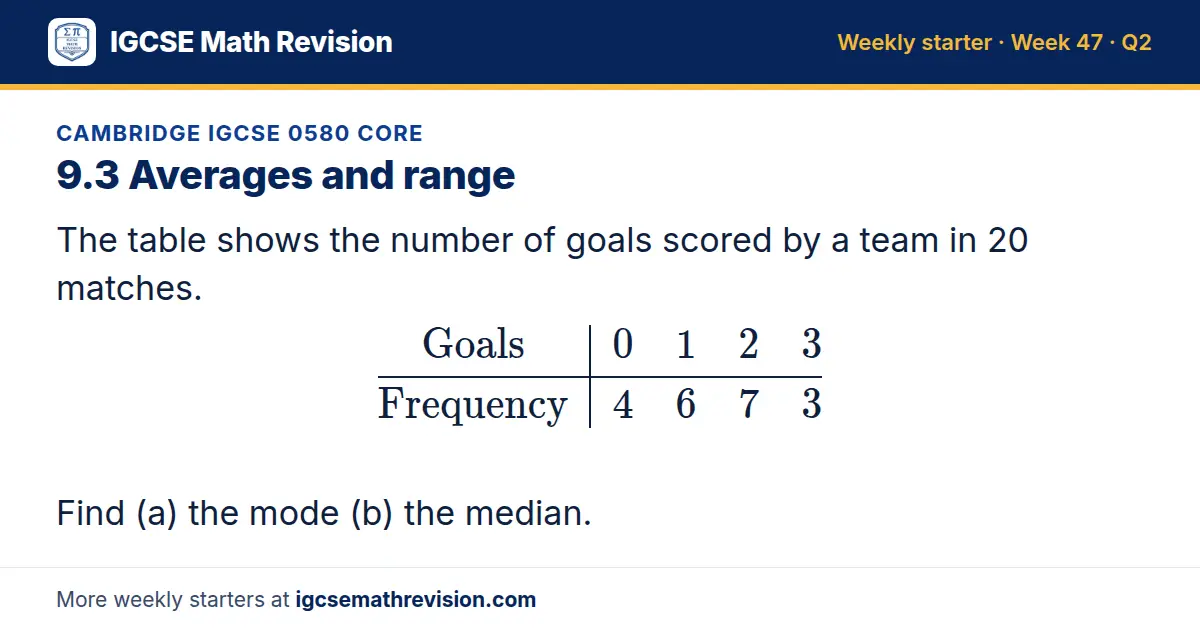
Question 2: 9.3 Averages and range
The table shows how many tickets 40 people bought for a concert. Tickets 1 2 3 4; Frequency 12 15 8 5 Calculate the mean number of tickets per person.
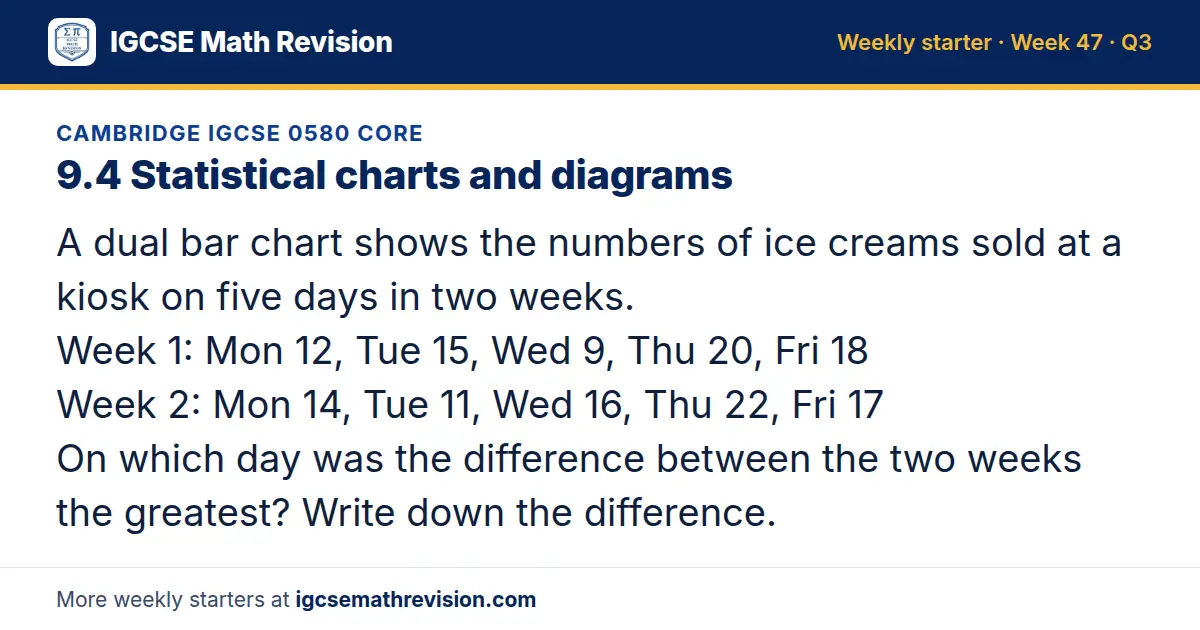
Question 3: 9.4 Statistical charts and diagrams
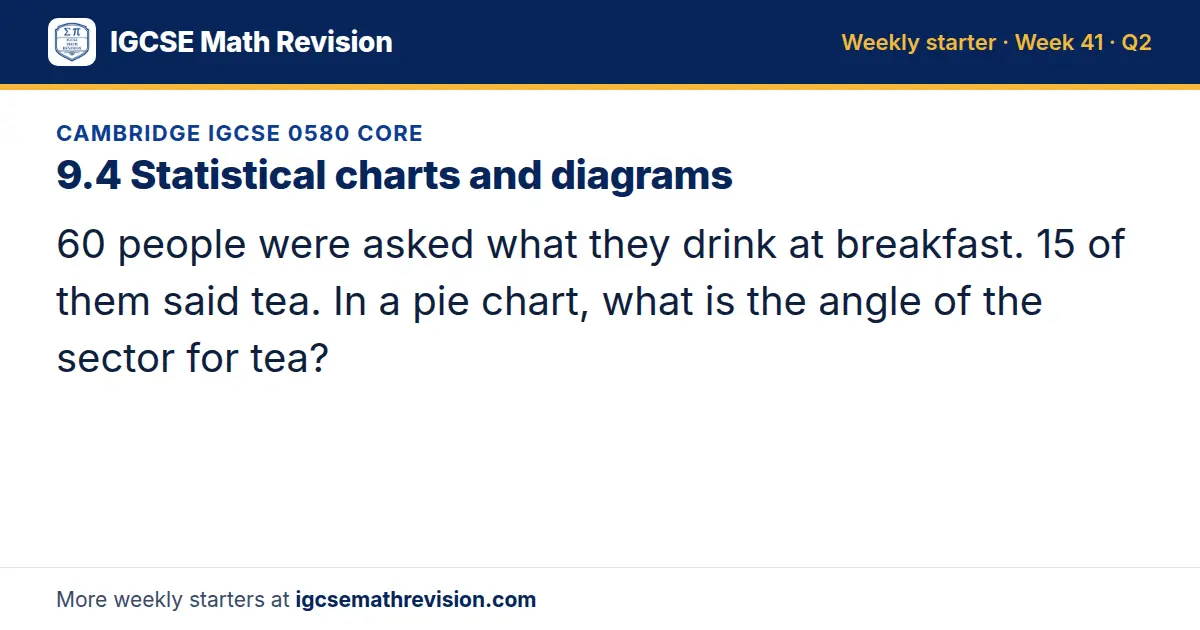
60 people were asked what they drink at breakfast. 15 of them said tea. In a pie chart, what is the angle of the sector for tea?
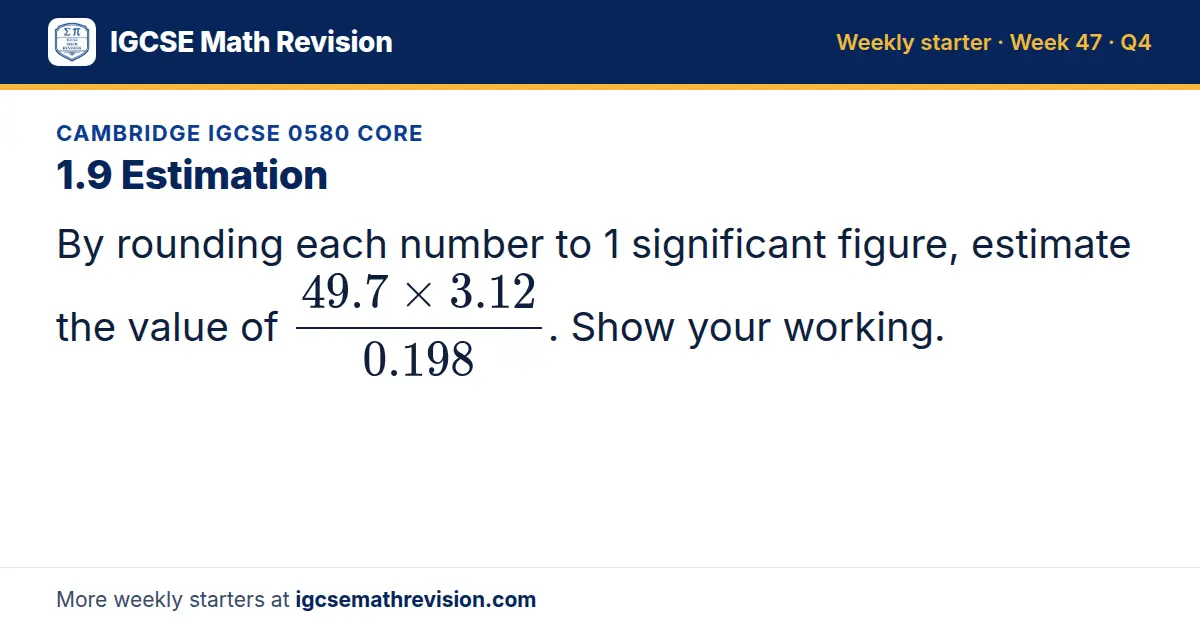
Question 4: 1.9 Estimation
By rounding each number to 1 significant figure, estimate the value of (49.7 × 3.12)/0.198. Show your working.
Week 48
Question 1: 9.1 Classifying statistical data
Is each type of data categorical, discrete or continuous? (a) eye colour (b) the number of brothers and sisters a student has
Question 2: 9.3 Averages and range
The mean of 8 numbers is 14. One more number is added and the mean of the 9 numbers is 15. Find the number that was added.
Question 3: 9.4 Statistical charts and diagrams
A dual bar chart shows the numbers of ice creams sold at a kiosk on five days in two weeks. Week 1: Mon 12, Tue 15, Wed 9, Thu 20, Fri 18 Week 2: Mon 14, Tue 11, Wed 16, Thu 22, Fri 17 On which day was the difference between the two weeks the greatest? Write down the difference.
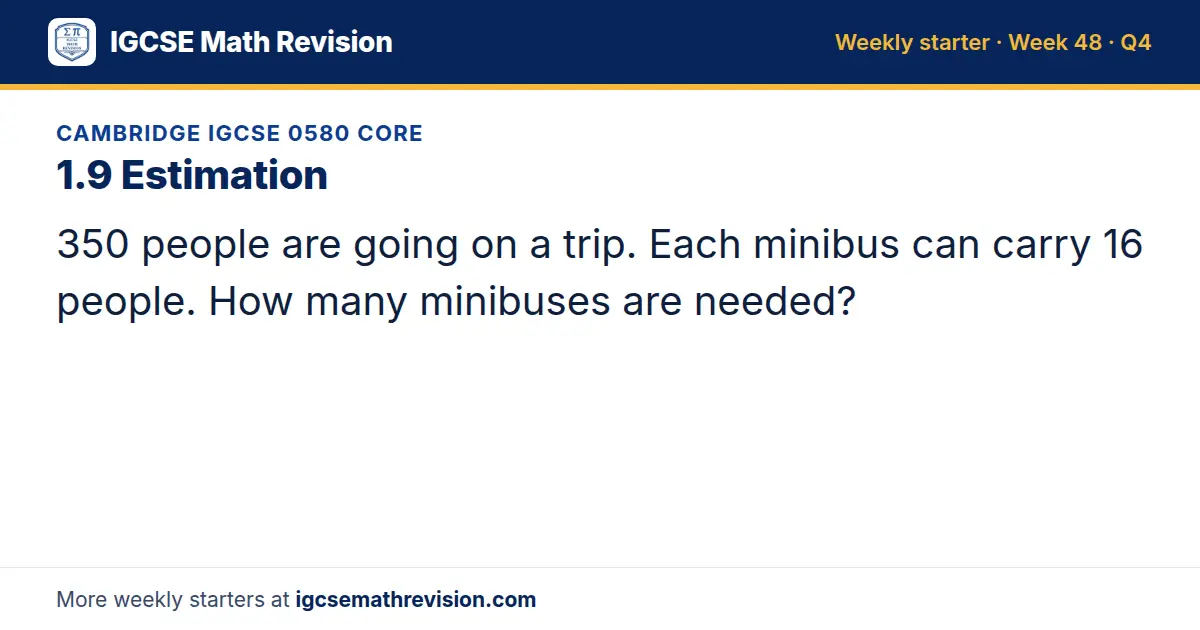
Question 4: 1.9 Estimation
350 people are going on a trip. Each minibus can carry 16 people. How many minibuses are needed?
Week 49
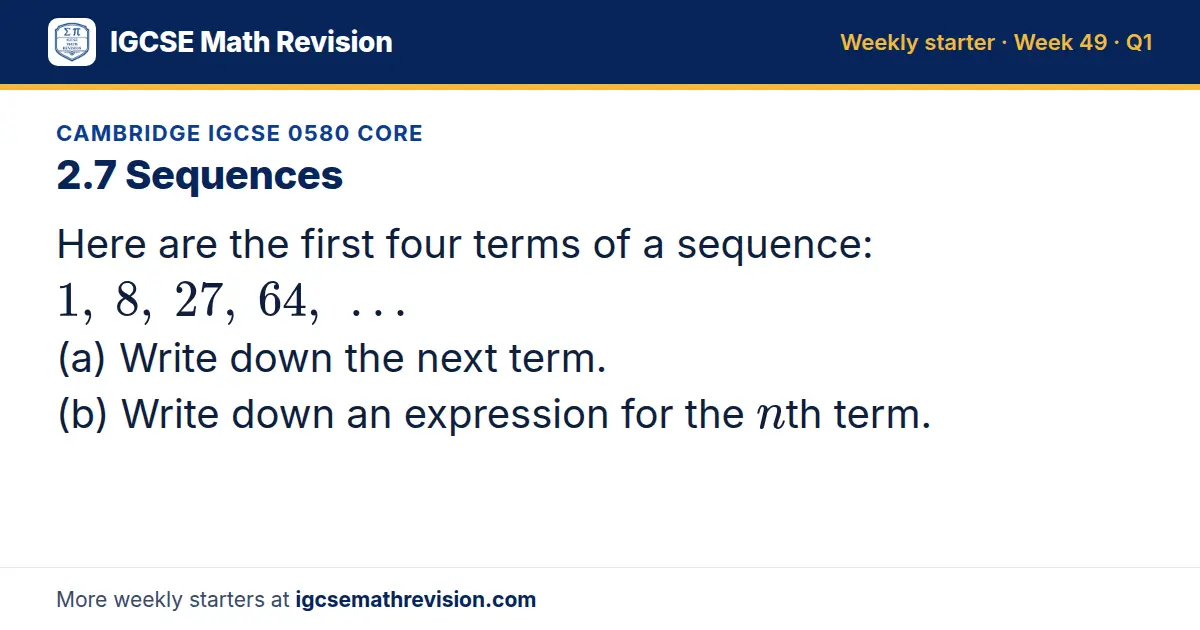
Question 1: 2.7 Sequences
Here are the first four terms of a sequence: 1, 8, 27, 64, … (a) Write down the next term. (b) Write down an expression for the nth term.
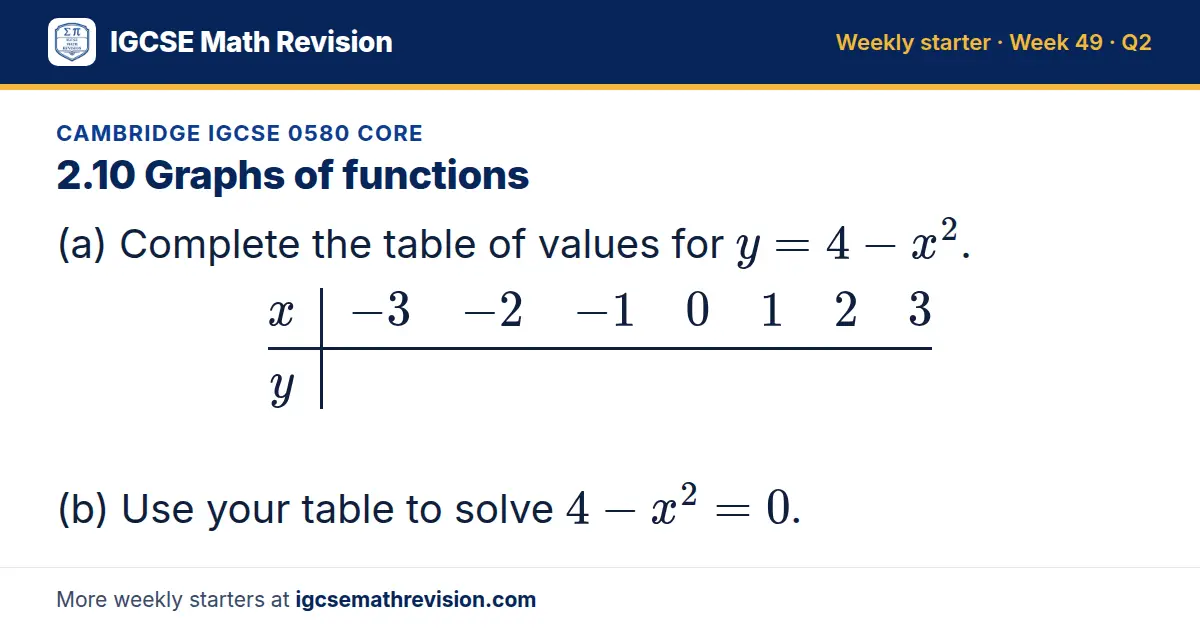
Question 2: 2.10 Graphs of functions
(a) Complete the table of values for y = 4 - x^2. x -3 -2 -1 0 1 2 3; y (b) Use your table to solve 4 - x² = 0.
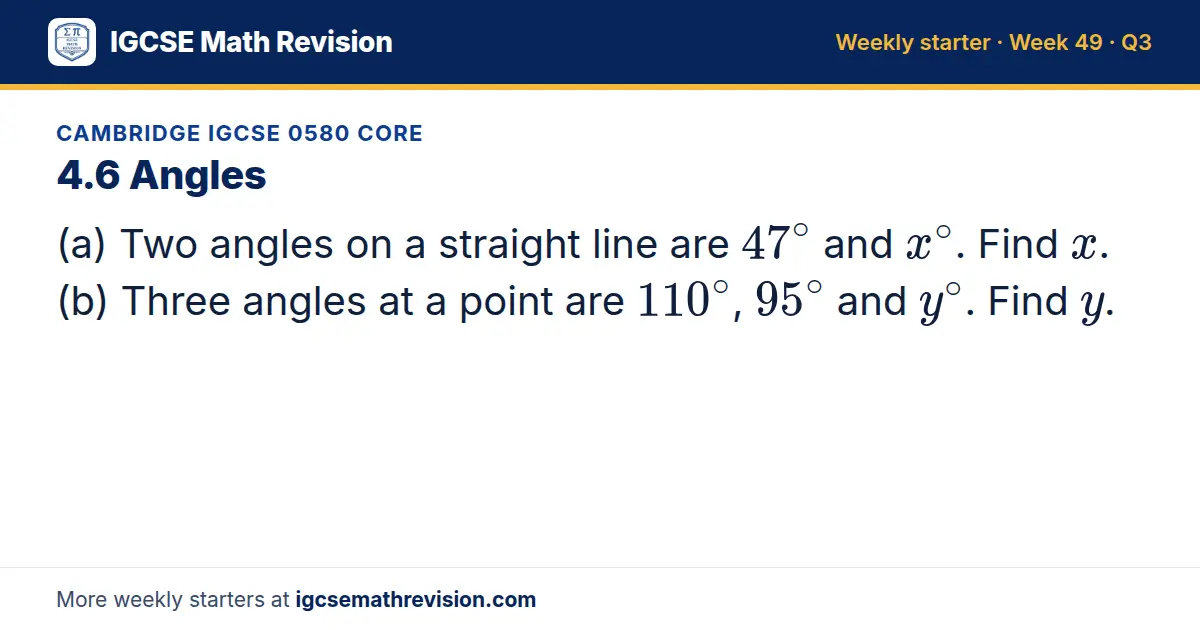
Question 3: 4.6 Angles
Two parallel lines are crossed by a straight line. A pair of co-interior angles are (3x + 20)° and (2x - 5)°. Find x and the size of the larger angle.
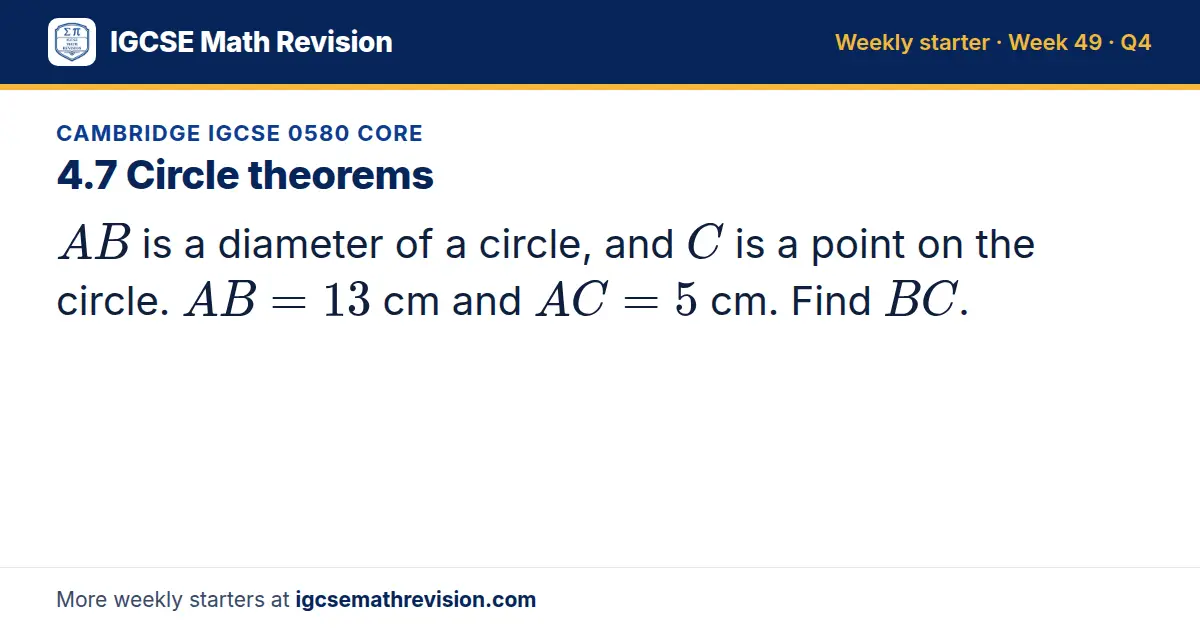
Question 4: 4.7 Circle theorems
AB is a diameter of a circle, and C is a point on the circle. AB = 13 cm and AC = 5 cm. Find BC.
Week 50
Question 1: 1.3 Powers and roots
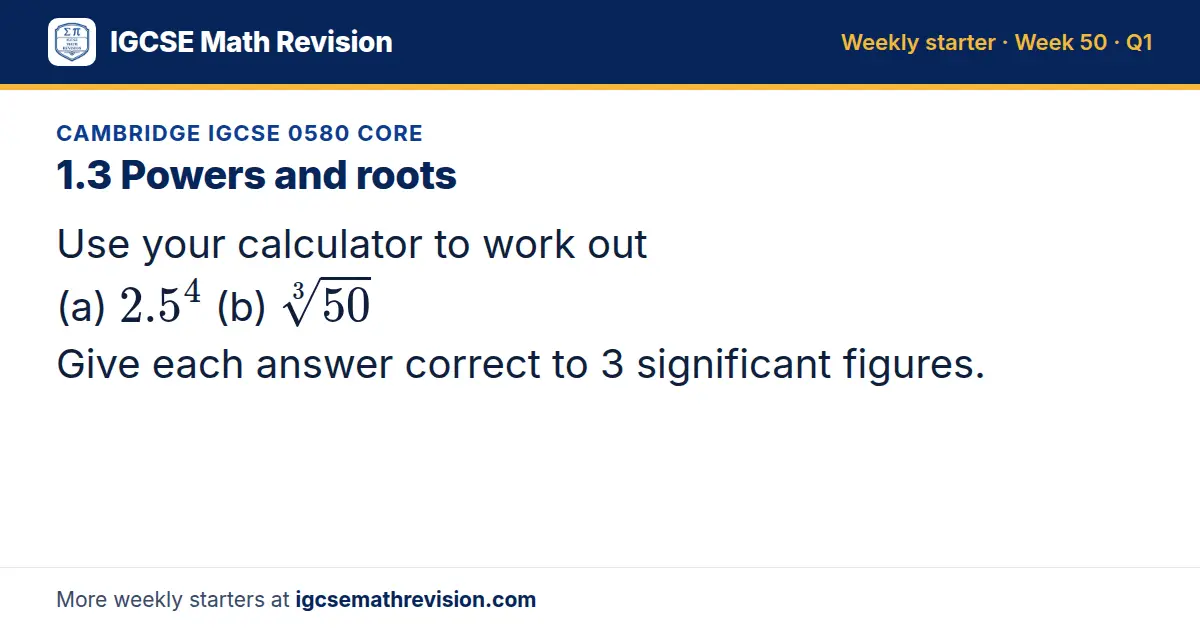
Use your calculator to work out (a) 2.5⁴ (b) 3√(50) Give each answer correct to 3 significant figures.
Question 2: 1.10 Limits of accuracy
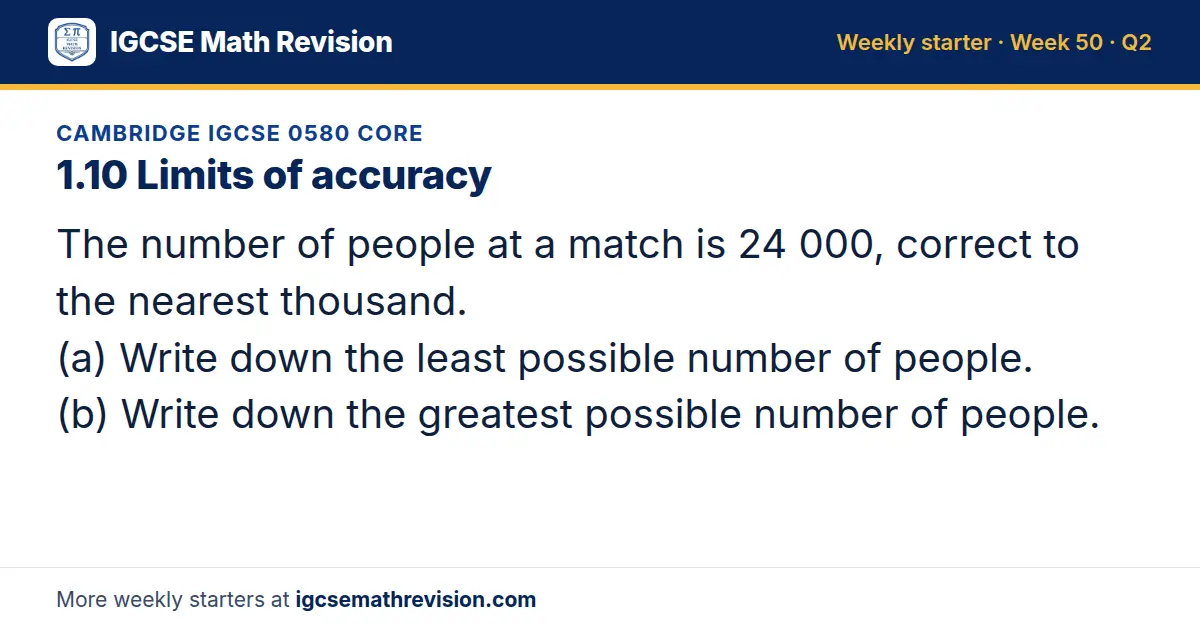
The number of people at a match is 24 000, correct to the nearest thousand. (a) Write down the least possible number of people. (b) Write down the greatest possible number of people.
Question 3: 1.12 Rates
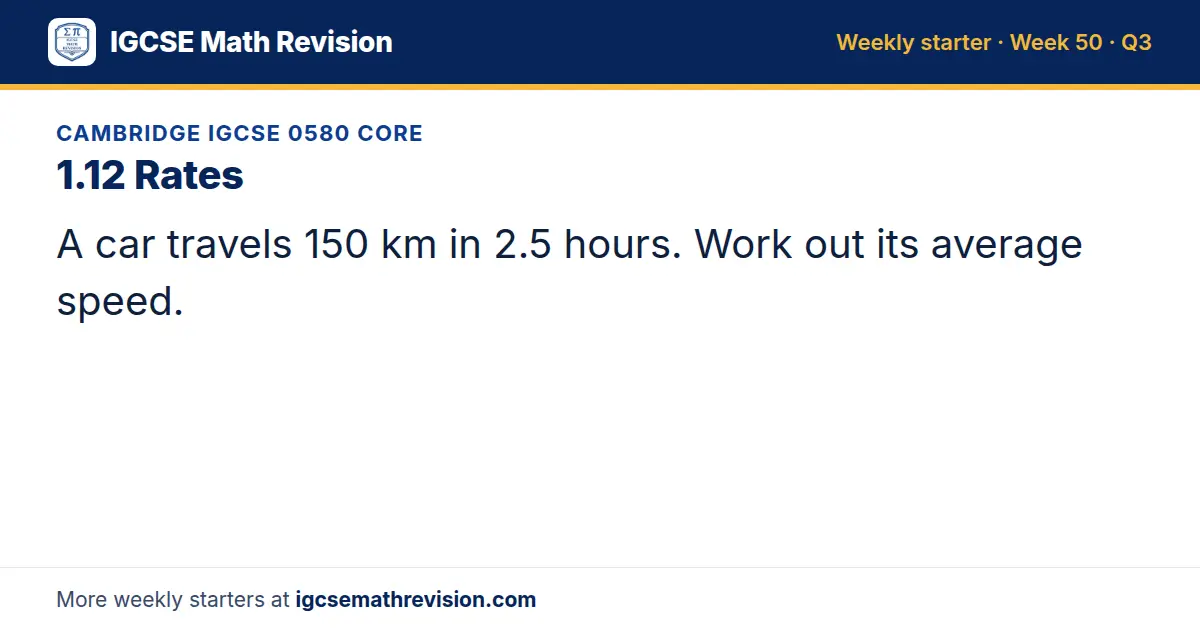
A car travels 84 km in 1 hour 10 minutes. Work out its average speed in km/h.
Question 4: 2.9 Graphs in practical situations
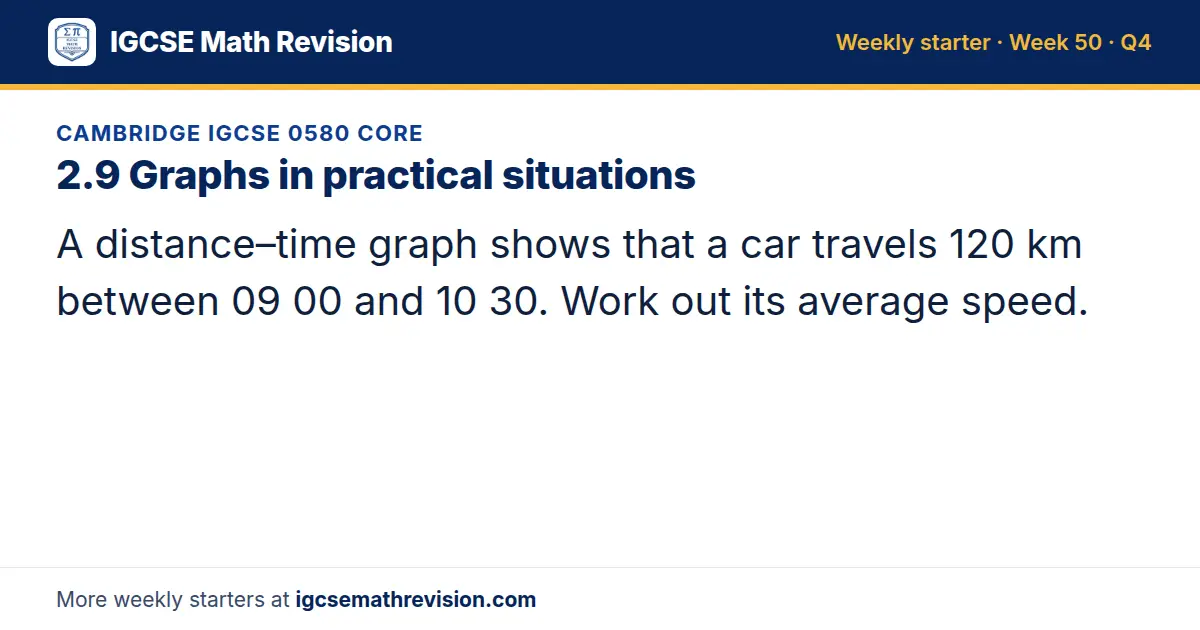
A distance–time graph shows that a car travels 120 km between 09 00 and 10 30. Work out its average speed.
Week 51
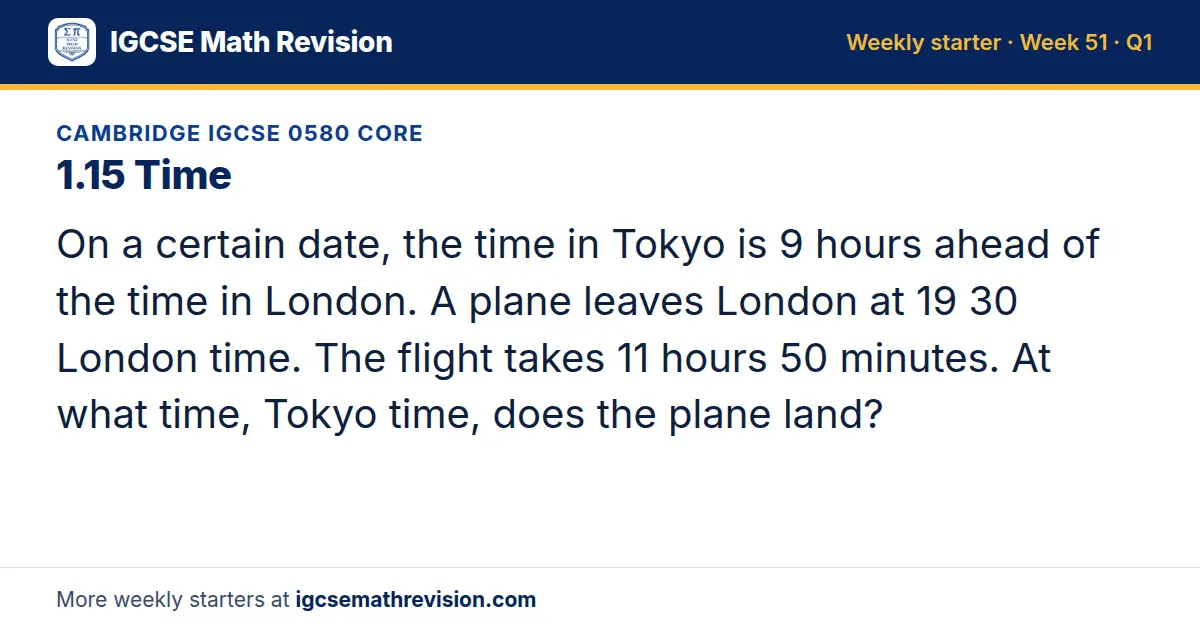
Question 1: 1.15 Time
A film starts at 18 40. It lasts 1 hour 55 minutes. At what time does the film finish?
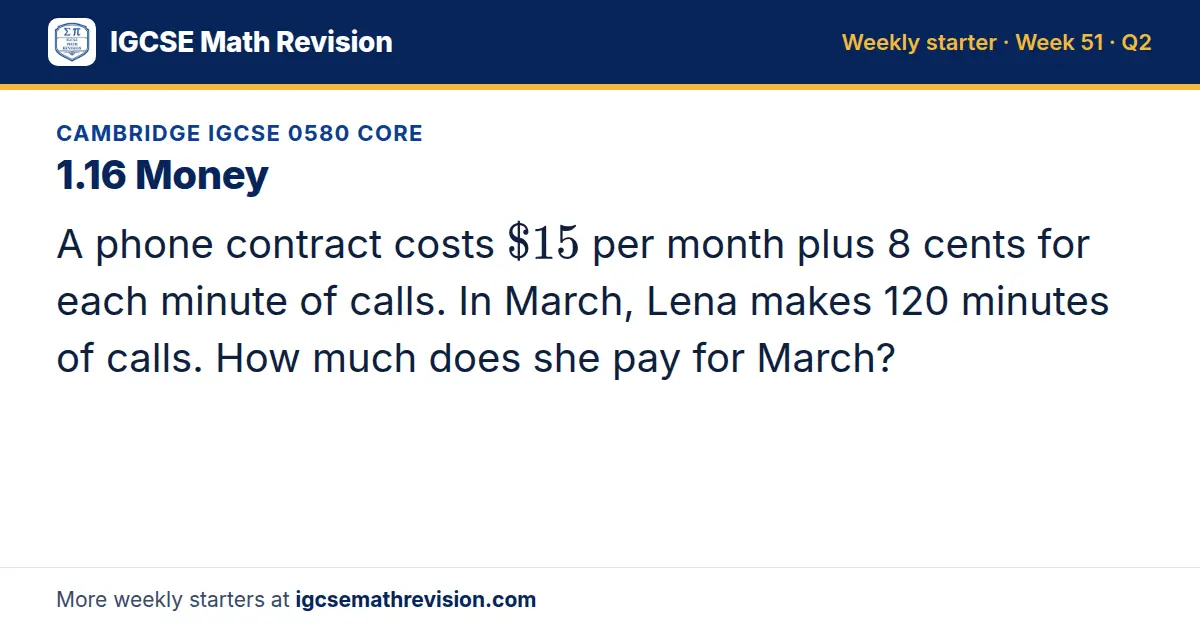
Question 2: 1.16 Money
Ravi buys 3 notebooks costing £2.45 each and a pen costing £1.30. He pays with a £10 note. How much change does he get?
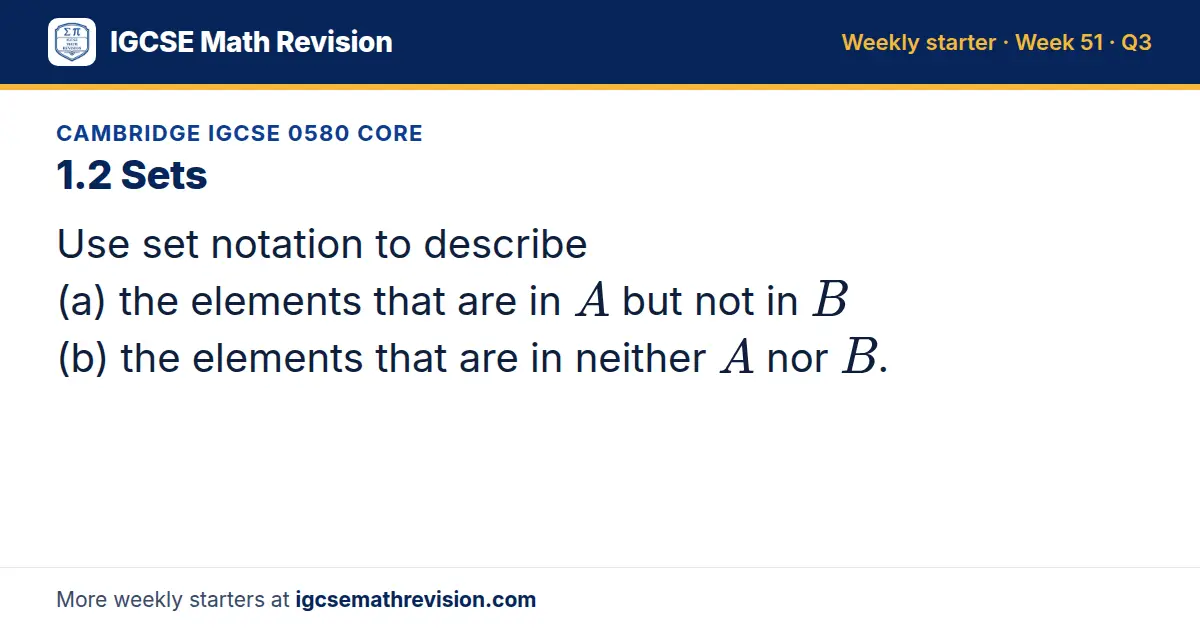
Question 3: 1.2 Sets
Use set notation to describe (a) the elements that are in A but not in B (b) the elements that are in neither A nor B.
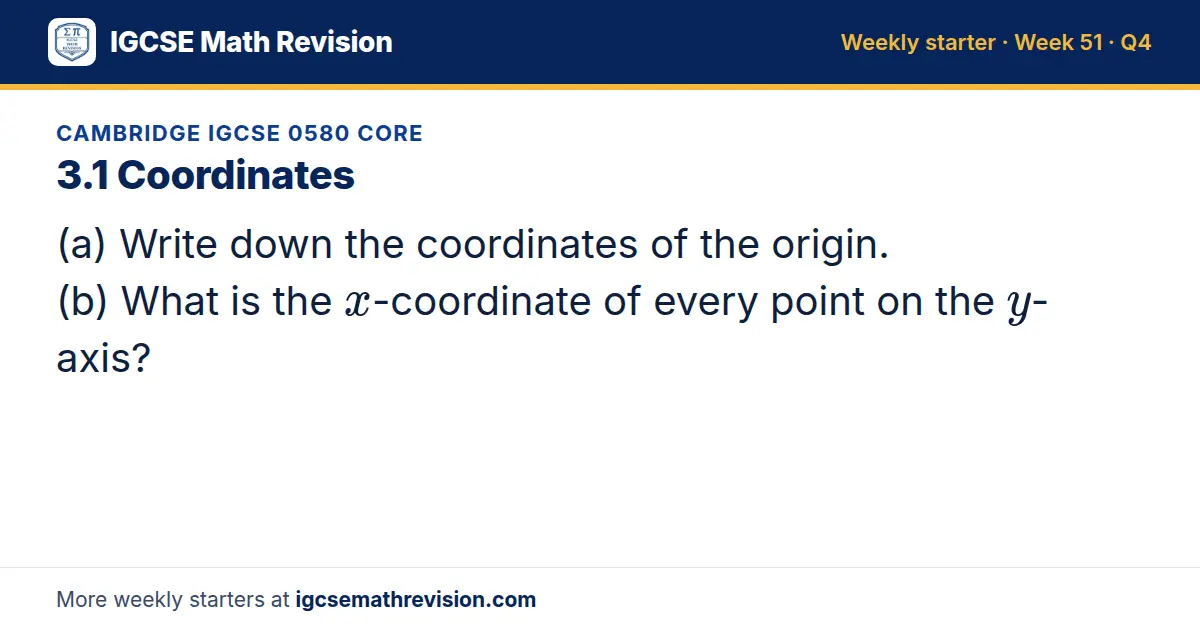
Question 4: 3.1 Coordinates
(a) Write down the coordinates of the origin. (b) What is the x-coordinate of every point on the y-axis?
More starter questions
Other weeks: Weeks 1–13 · Weeks 14–26 · Weeks 27–39 · Weeks 40–51. Answers and mark schemes, free for everyone, are on the free weekly starters page.
Keep your streak going
Save your answers and track your progressA free account remembers the questions you have done and brings you back to this page.
Join freeAlready have an account? Sign in