IGCSE Maths 4MA1 Year 11 starter questions: weeks 13–24
48 short questions to open a lesson for Edexcel IGCSE Maths A (4MA1) Higher, Year 11, weeks 13–24 of the teaching year, three or four a week. Each question is shown as an image with its text underneath; answers and mark schemes stay with teachers.
Week 13
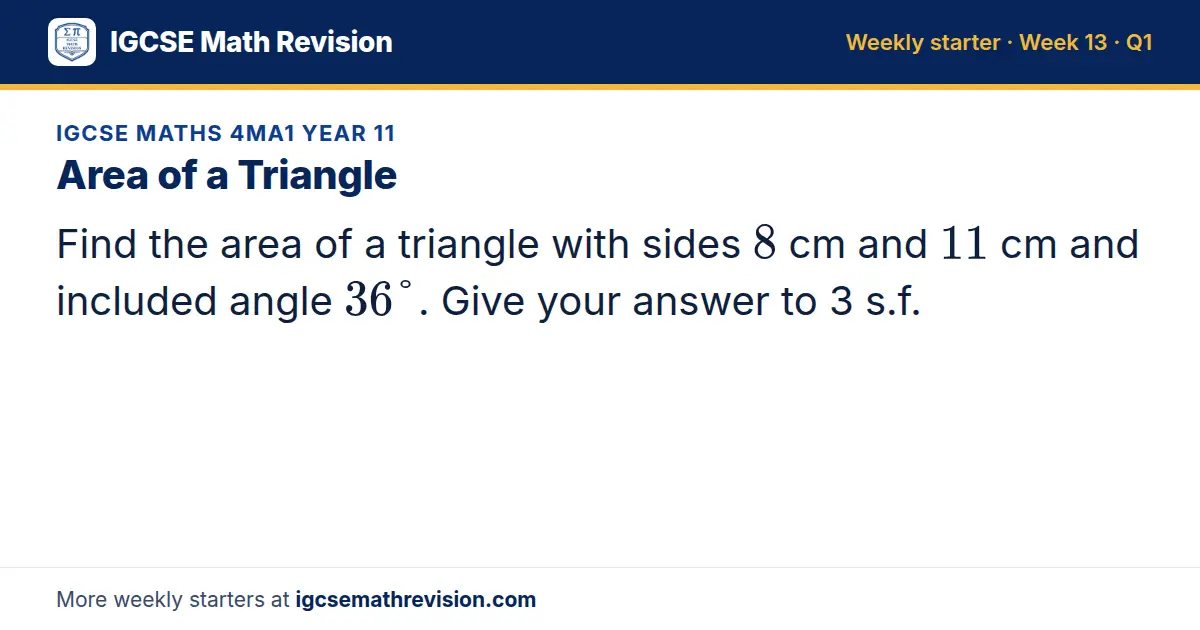
Question 1: Area of a Triangle
Find the area of a triangle with sides 8 cm and 11 cm and included angle 36°. Give your answer to 3 s.f.
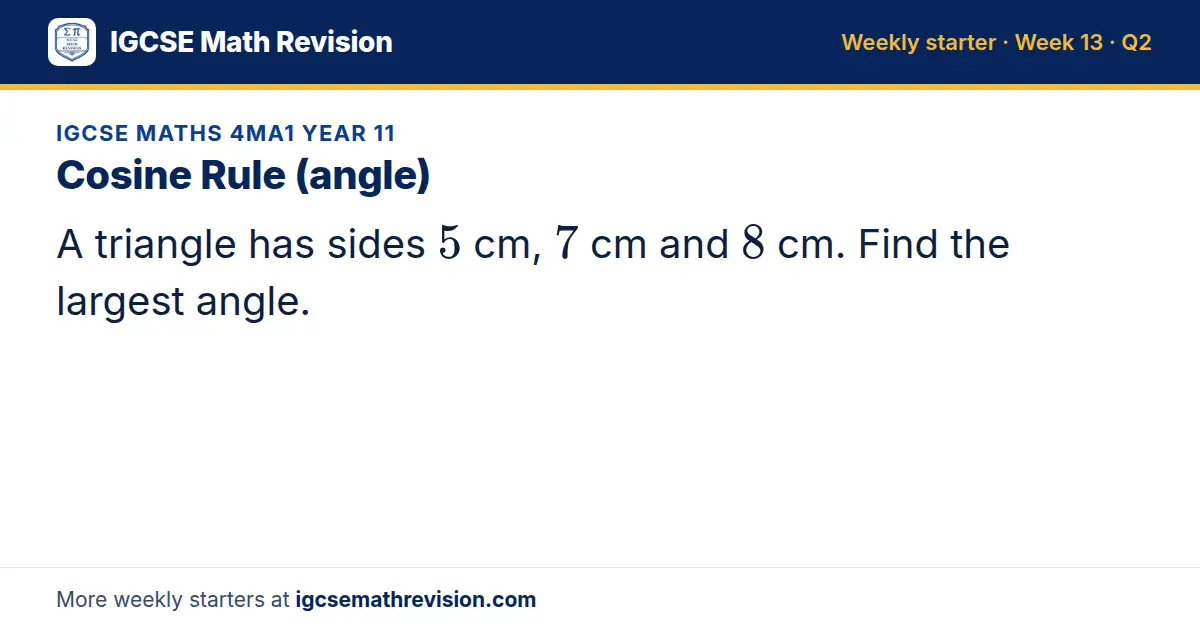
Question 2: Cosine Rule (angle)
A triangle has sides 5 cm, 7 cm and 8 cm. Find the largest angle.
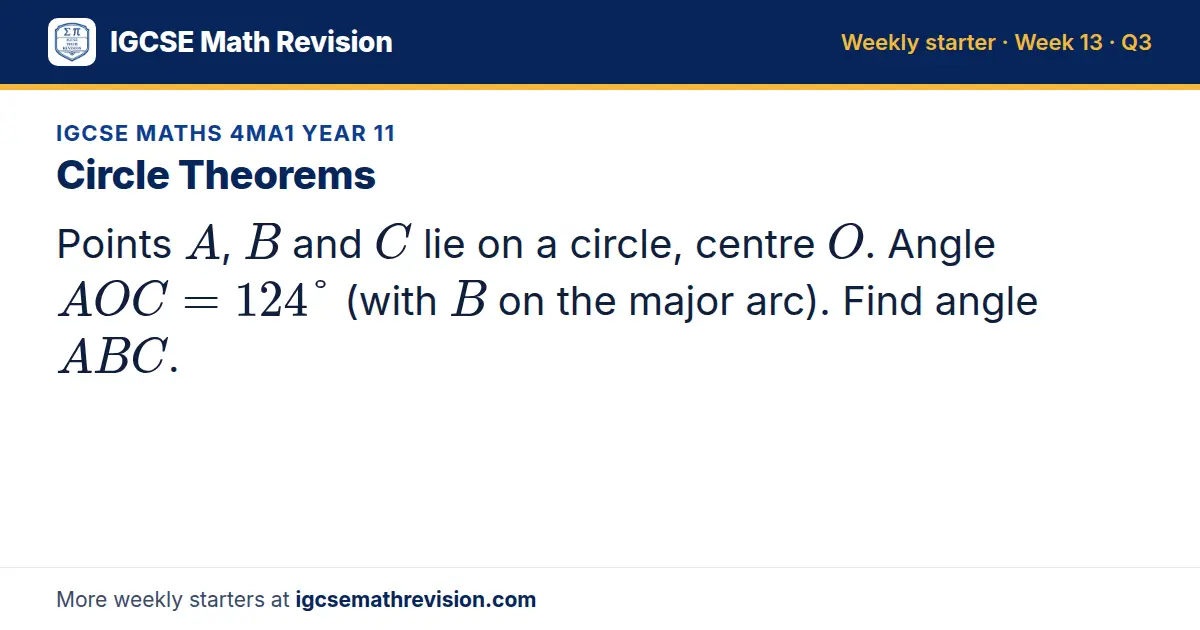
Question 3: Circle Theorems
Points A, B and C lie on a circle, centre O. Angle AOC = 124° (with B on the major arc). Find angle ABC.
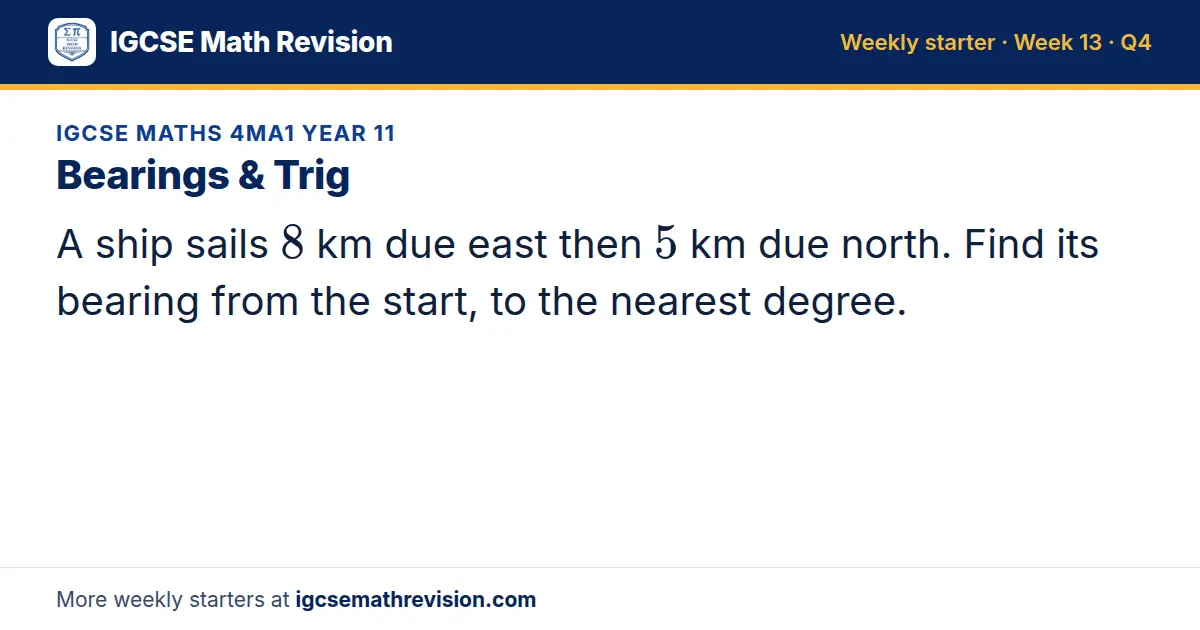
Question 4: Bearings & Trig
A ship sails 8 km due east then 5 km due north. Find its bearing from the start, to the nearest degree.
Week 14
Question 1: Cyclic Quadrilaterals
ABCD is a cyclic quadrilateral with angle A = (3x + 10)° and angle C = (2x - 5)°. Find x.
Question 2: Alternate Segment Theorem
A tangent at A makes an angle of 58° with chord AB. C is a point on the major arc. State angle ACB and the reason.
Question 3: Pythagoras in 3D
A cuboid measures 6 cm by 8 cm by 5 cm. Find the length of the space diagonal to 3 s.f.
Question 4: Angles in a Semicircle
AB is a diameter of a circle and C lies on the circumference. Angle CAB = 27°. Find angle CBA.
Week 15
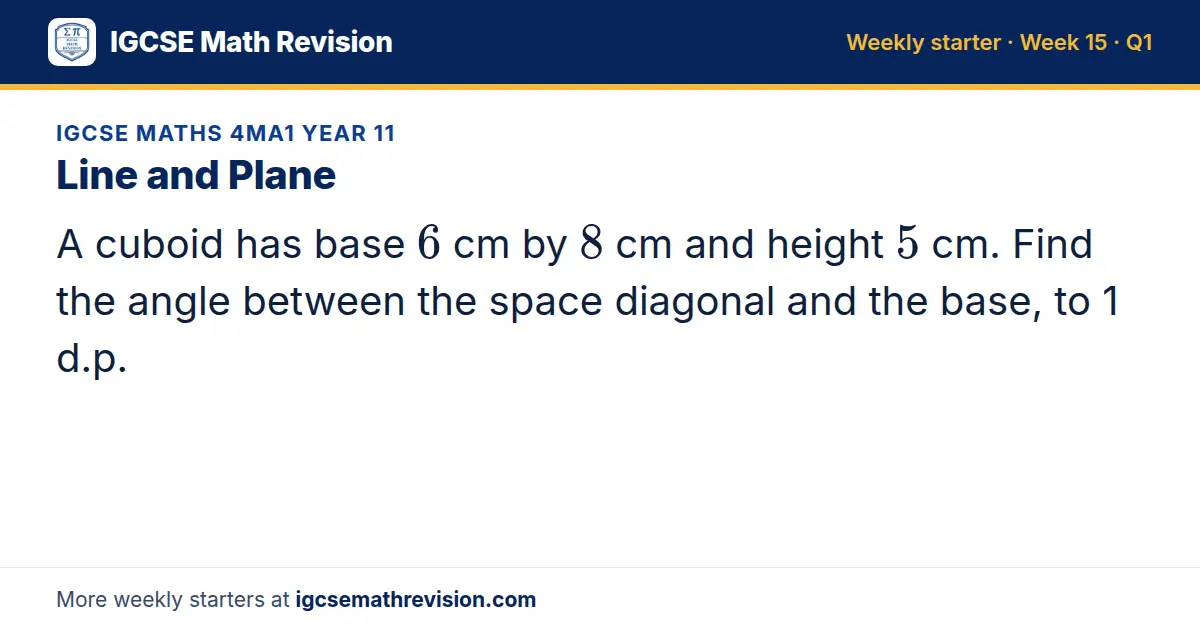
Question 1: Line and Plane
A cuboid has base 6 cm by 8 cm and height 5 cm. Find the angle between the space diagonal and the base, to 1 d.p.
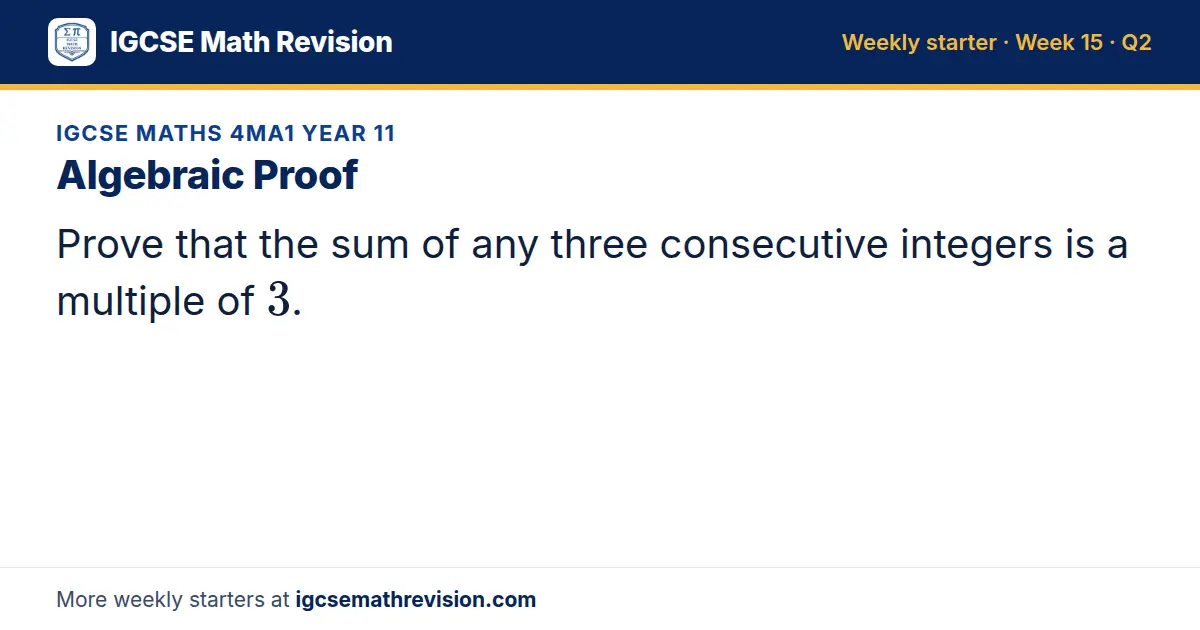
Question 2: Algebraic Proof
Prove that the sum of any three consecutive integers is a multiple of 3.
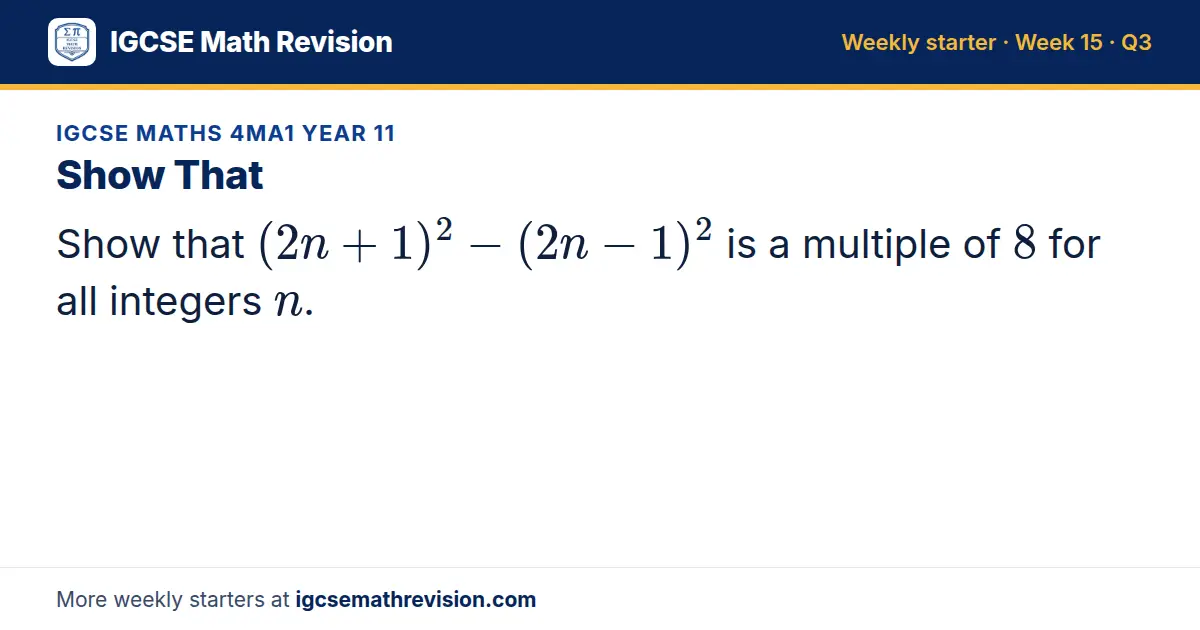
Question 3: Show That
Show that (2n + 1)² - (2n - 1)² is a multiple of 8 for all integers n.
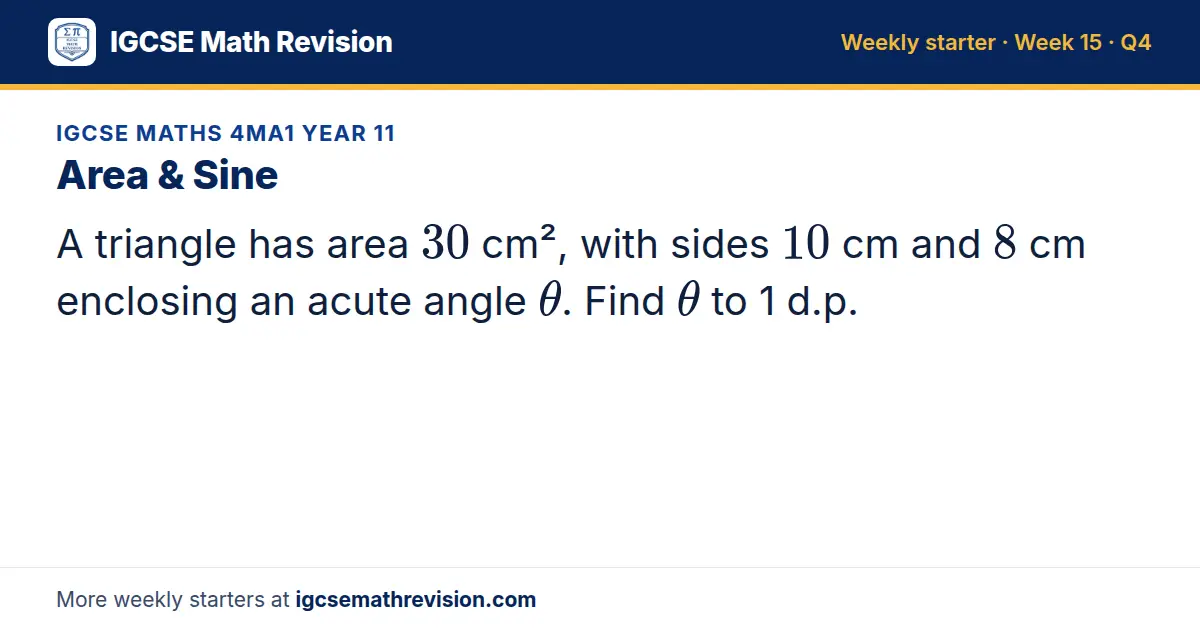
Question 4: Area & Sine
A triangle has area 30 cm², with sides 10 cm and 8 cm enclosing an acute angle θ. Find θ to 1 d.p.
Week 16
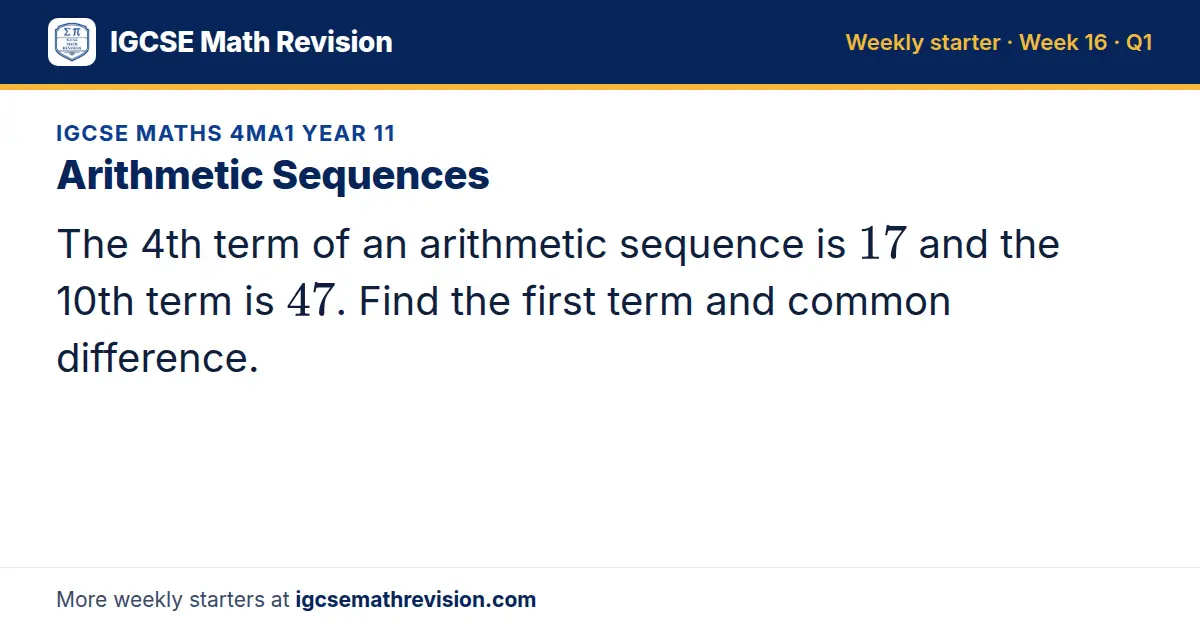
Question 1: Arithmetic Sequences
The 4th term of an arithmetic sequence is 17 and the 10th term is 47. Find the first term and common difference.
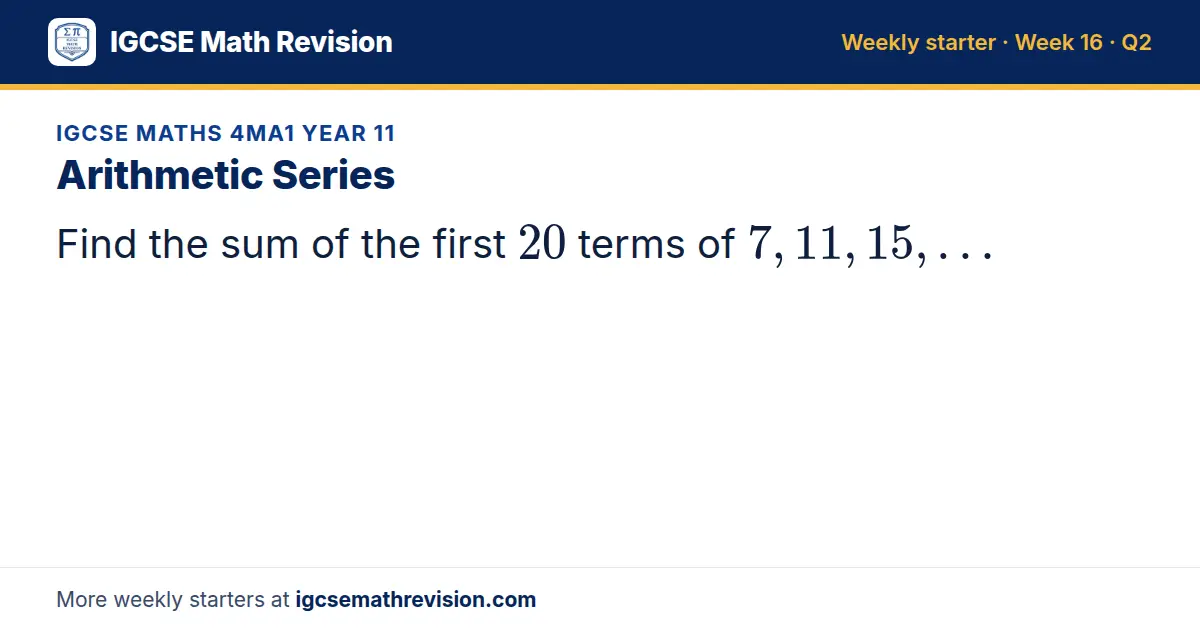
Question 2: Arithmetic Series
Find the sum of the first 20 terms of 7, 11, 15, …
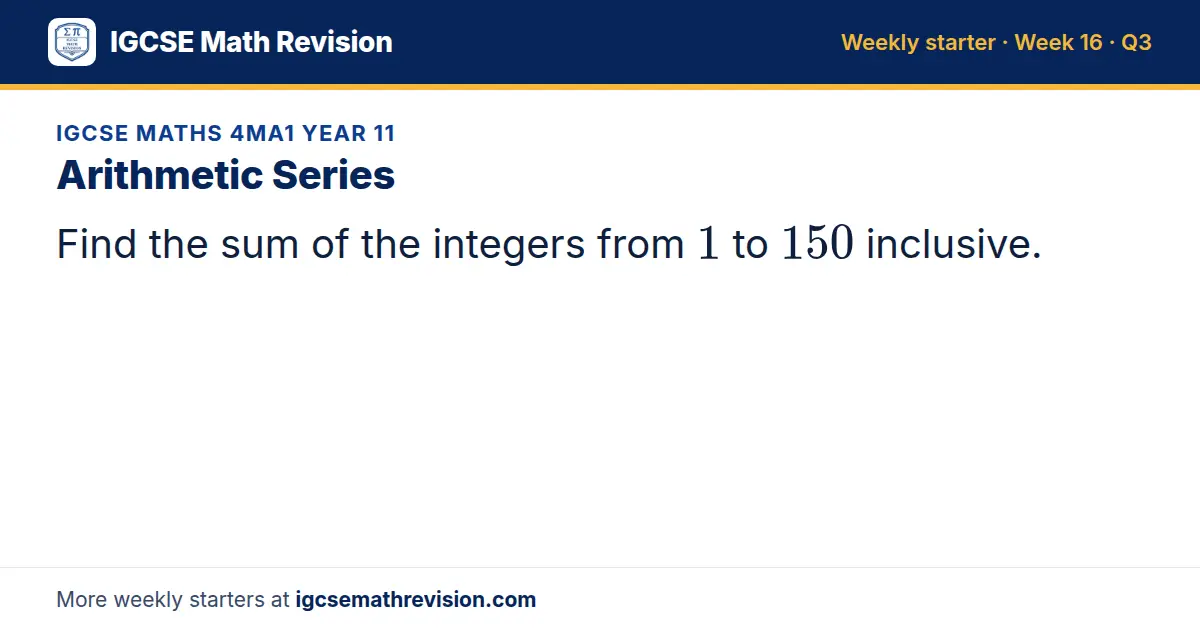
Question 3: Arithmetic Series
Find the sum of the integers from 1 to 150 inclusive.
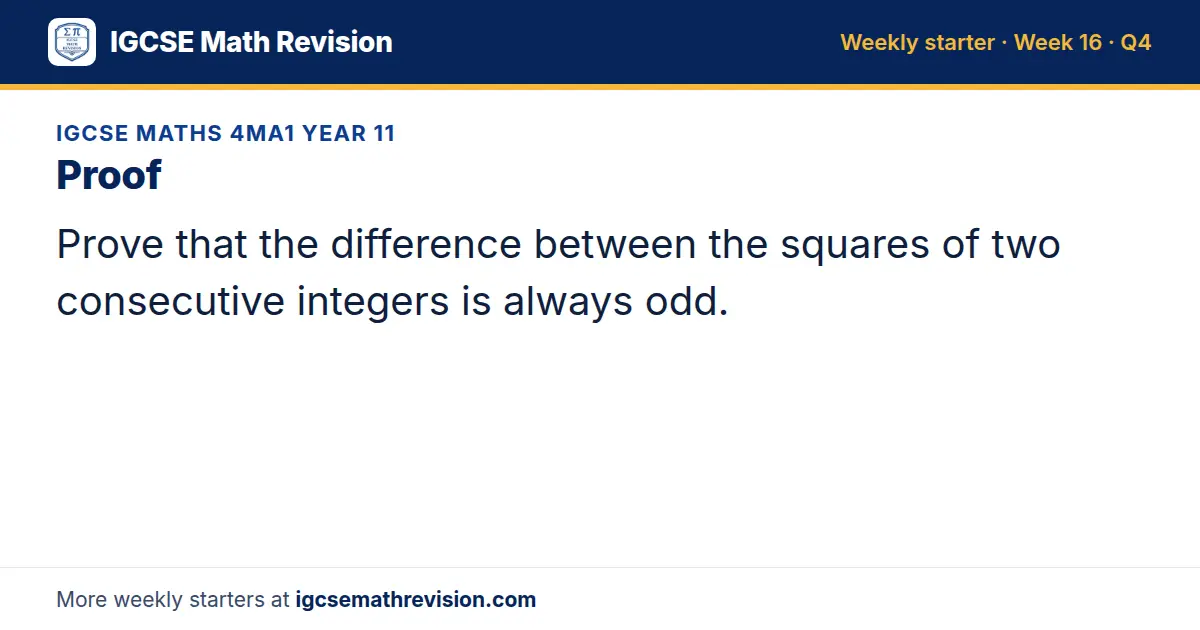
Question 4: Proof
Prove that the difference between the squares of two consecutive integers is always odd.
Week 17
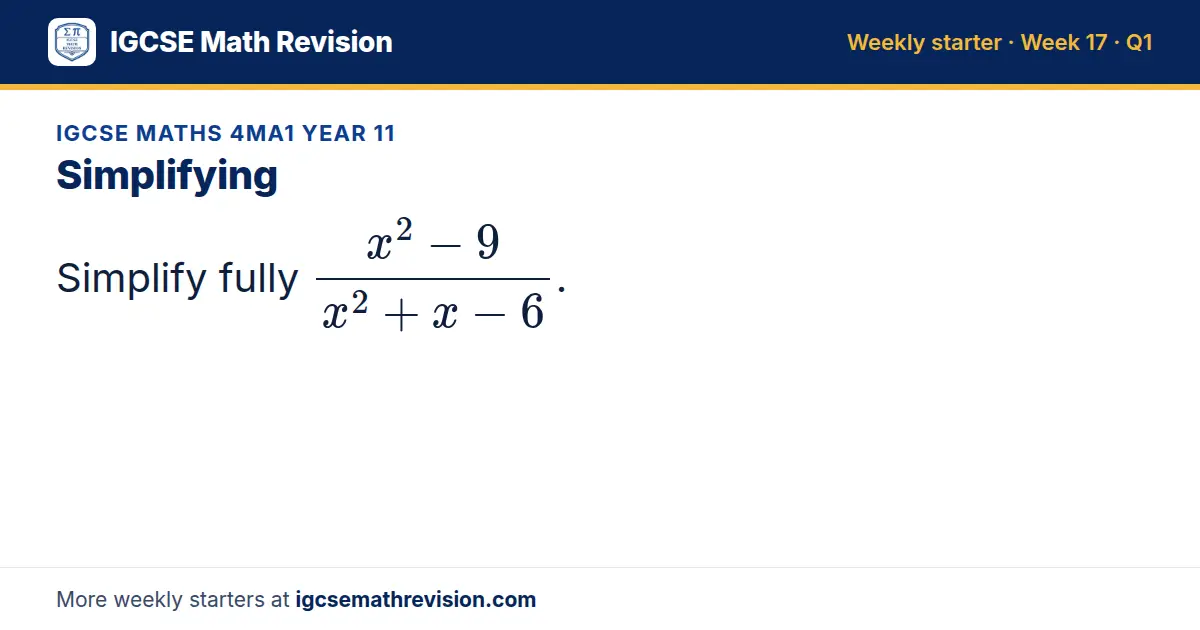
Question 1: Simplifying
Simplify fully (x² - 9)/(x² + x - 6).
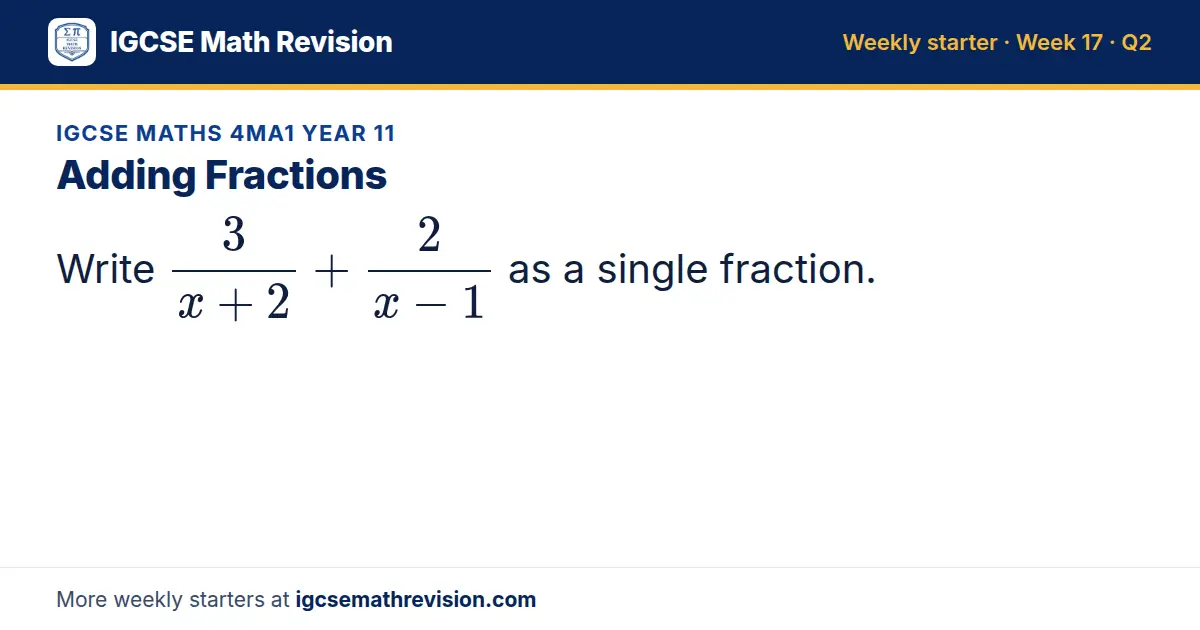
Question 2: Adding Fractions
Write 3/(x + 2) + 2/(x - 1) as a single fraction.
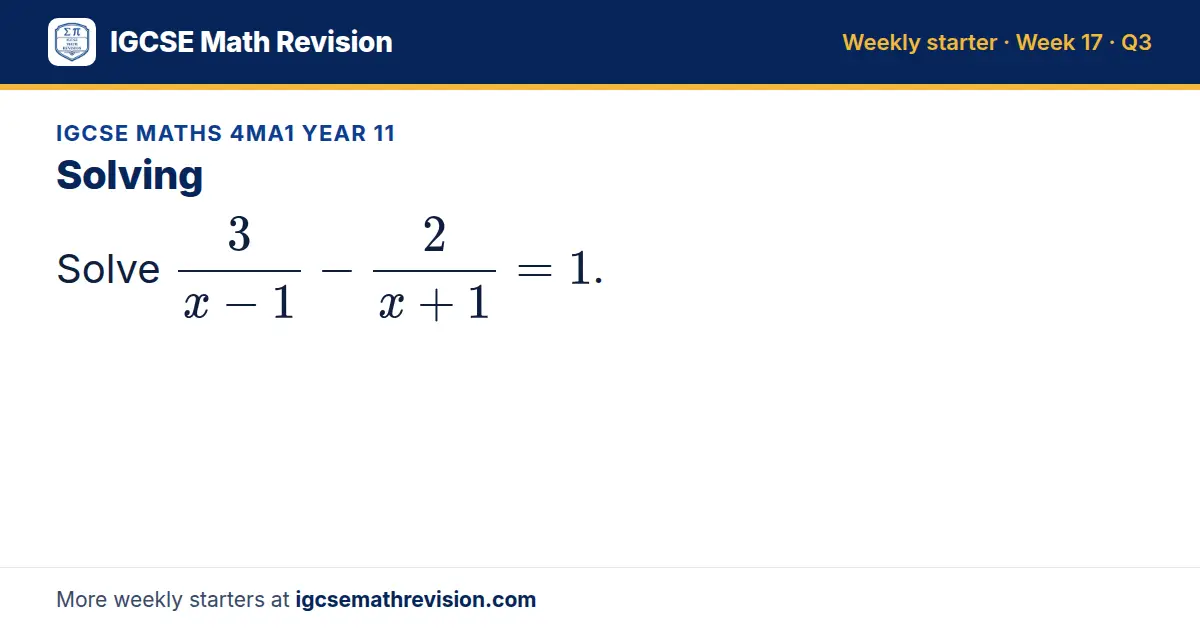
Question 3: Solving
Solve 3/(x - 1) - 2/(x + 1) = 1.
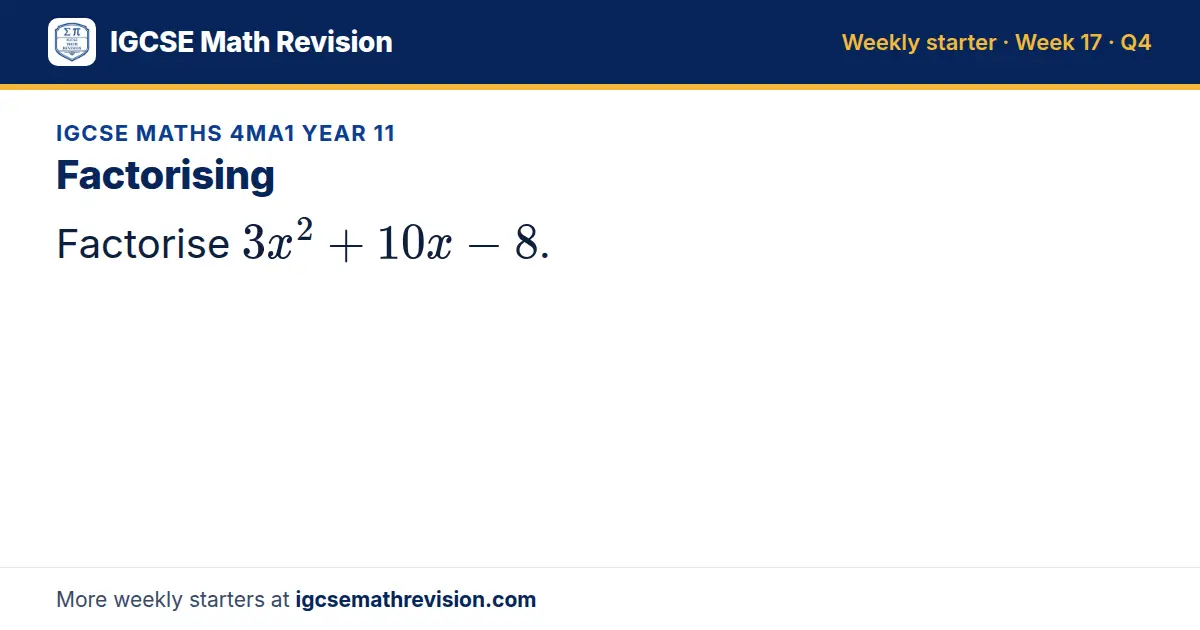
Question 4: Factorising
Factorise 3x² + 10x - 8.
Week 18
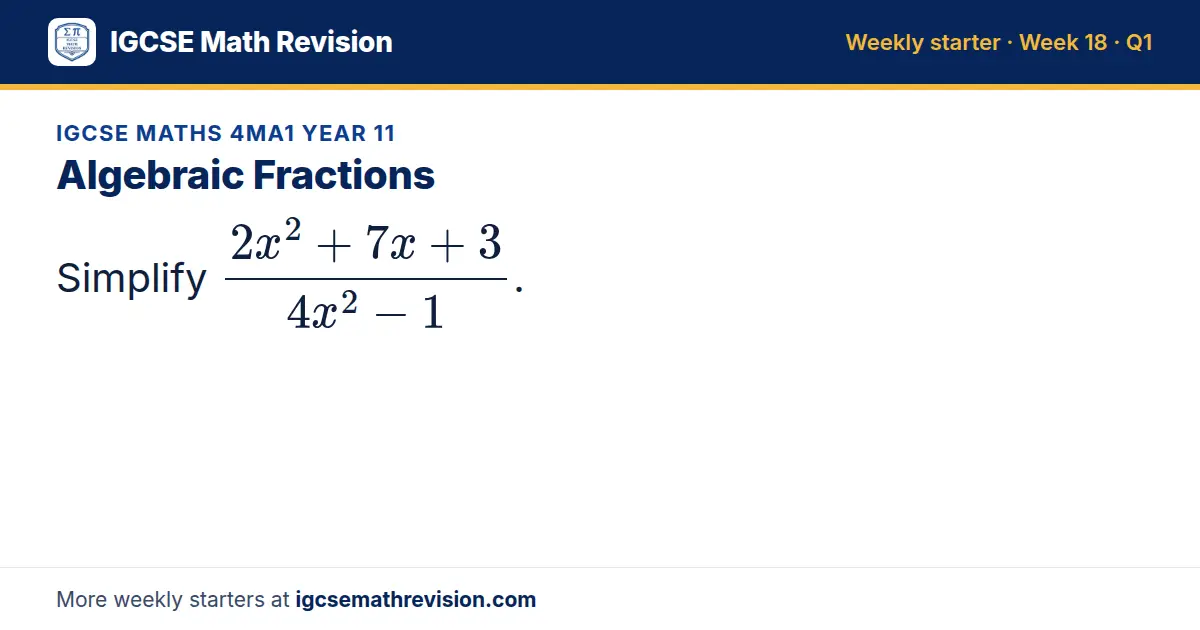
Question 1: Algebraic Fractions
Simplify (2x² + 7x + 3)/(4x² - 1).
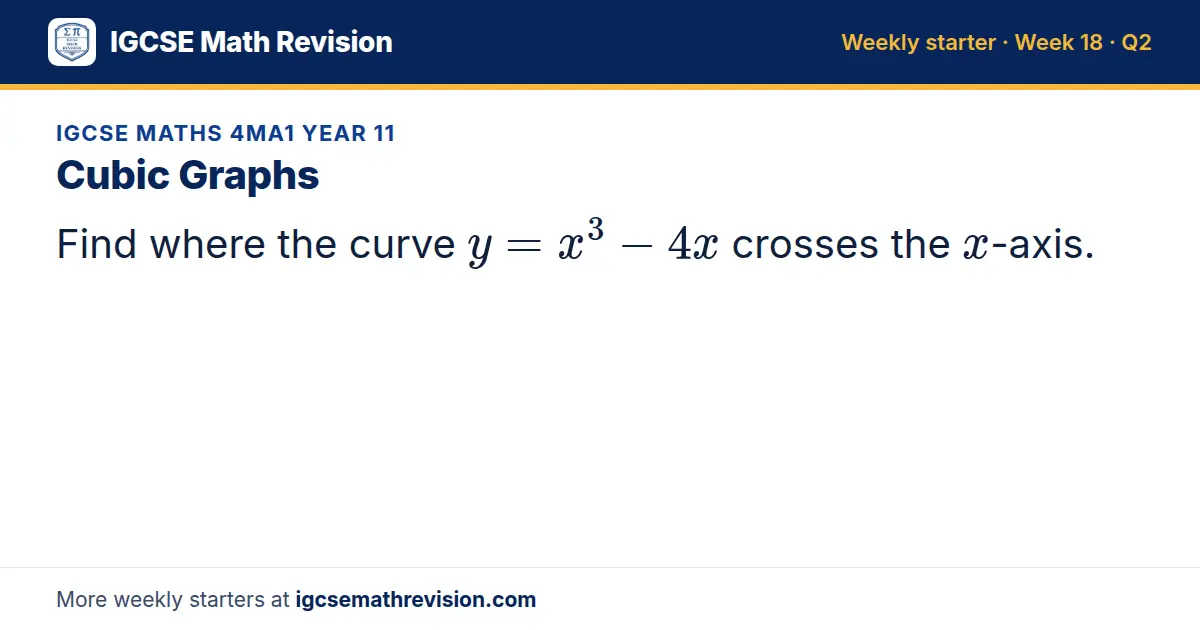
Question 2: Cubic Graphs
Find where the curve y = x³ - 4x crosses the x-axis.
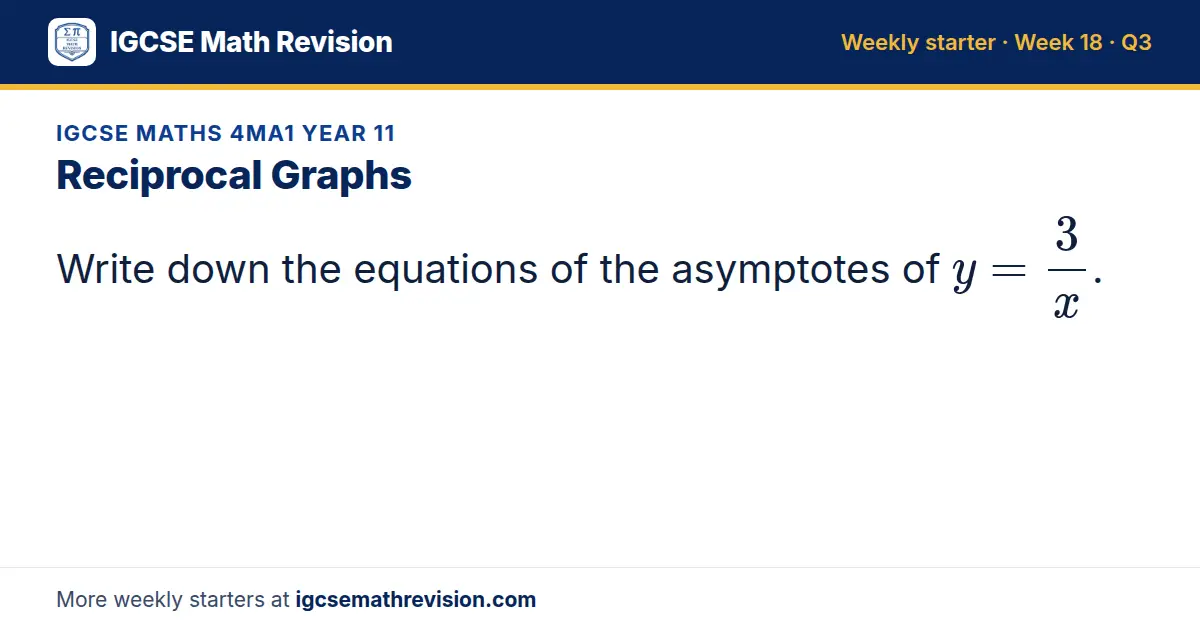
Question 3: Reciprocal Graphs
Write down the equations of the asymptotes of y = 3/x.
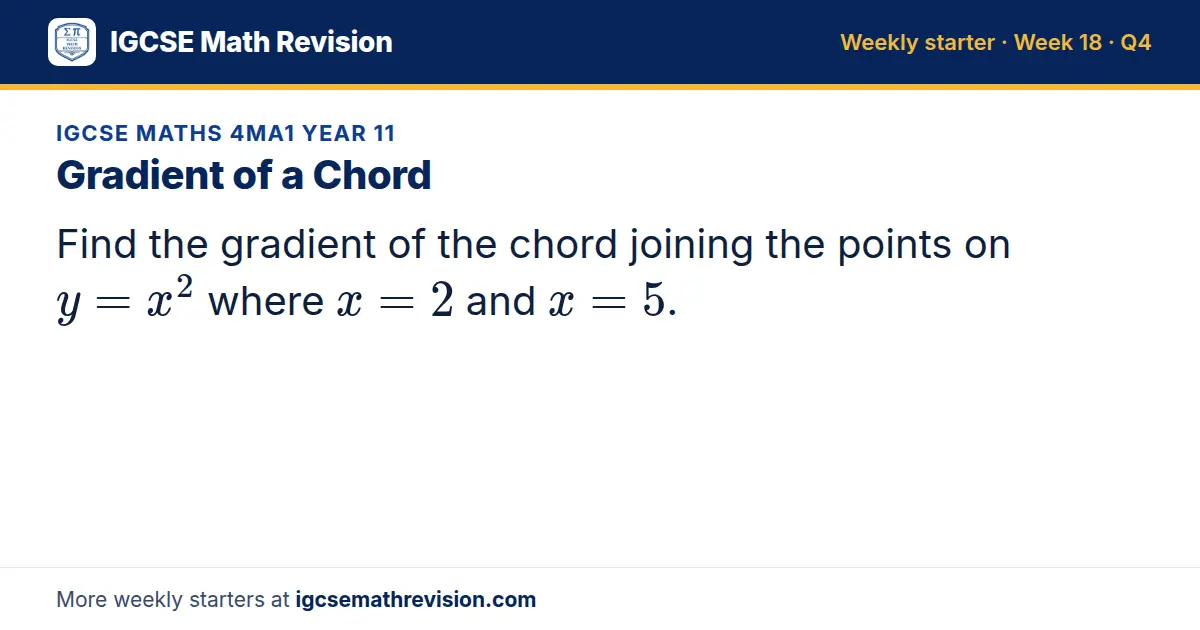
Question 4: Gradient of a Chord
Find the gradient of the chord joining the points on y = x² where x = 2 and x = 5.
Week 19
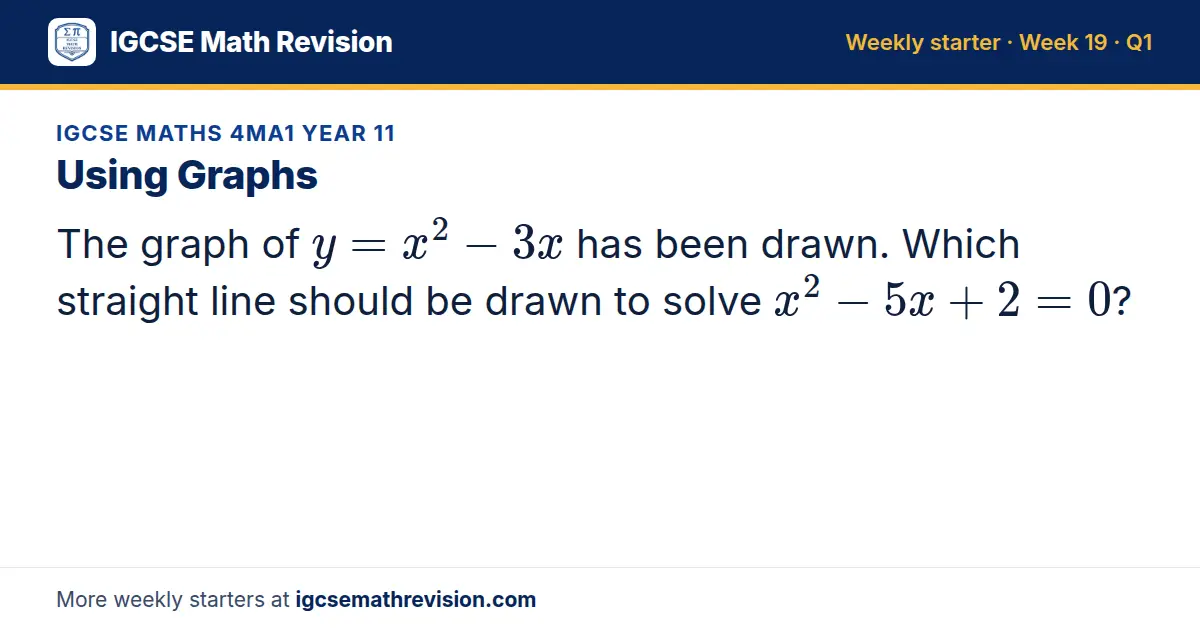
Question 1: Using Graphs
The graph of y = x² - 3x has been drawn. Which straight line should be drawn to solve x² - 5x + 2 = 0?
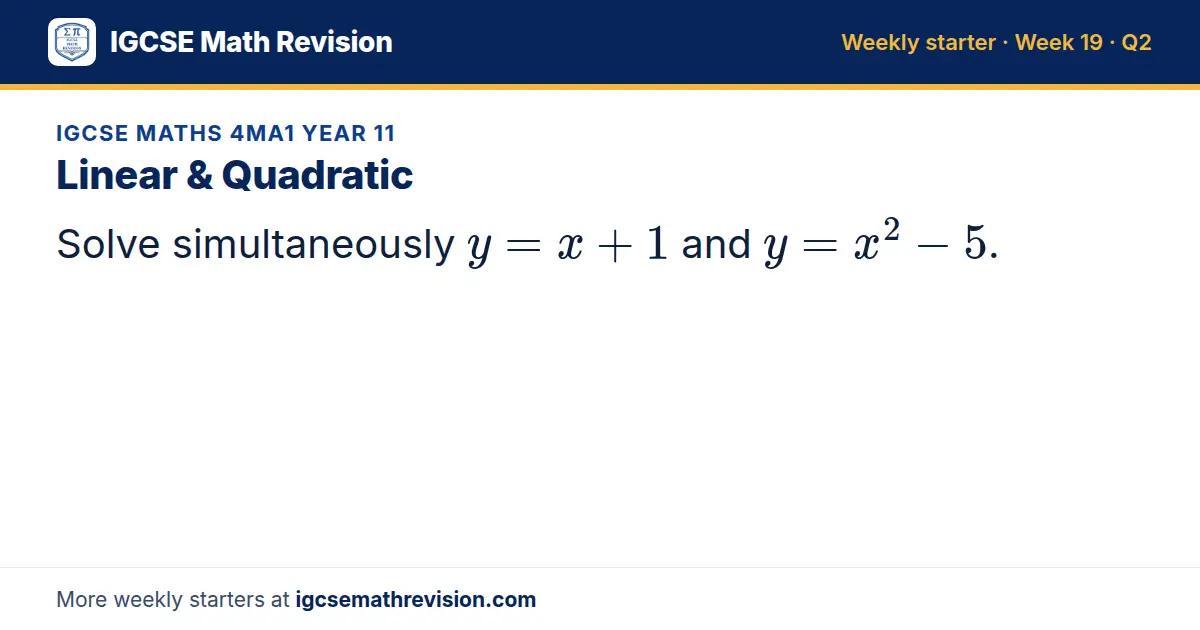
Question 2: Linear & Quadratic
Solve simultaneously y = x + 1 and y = x² - 5.
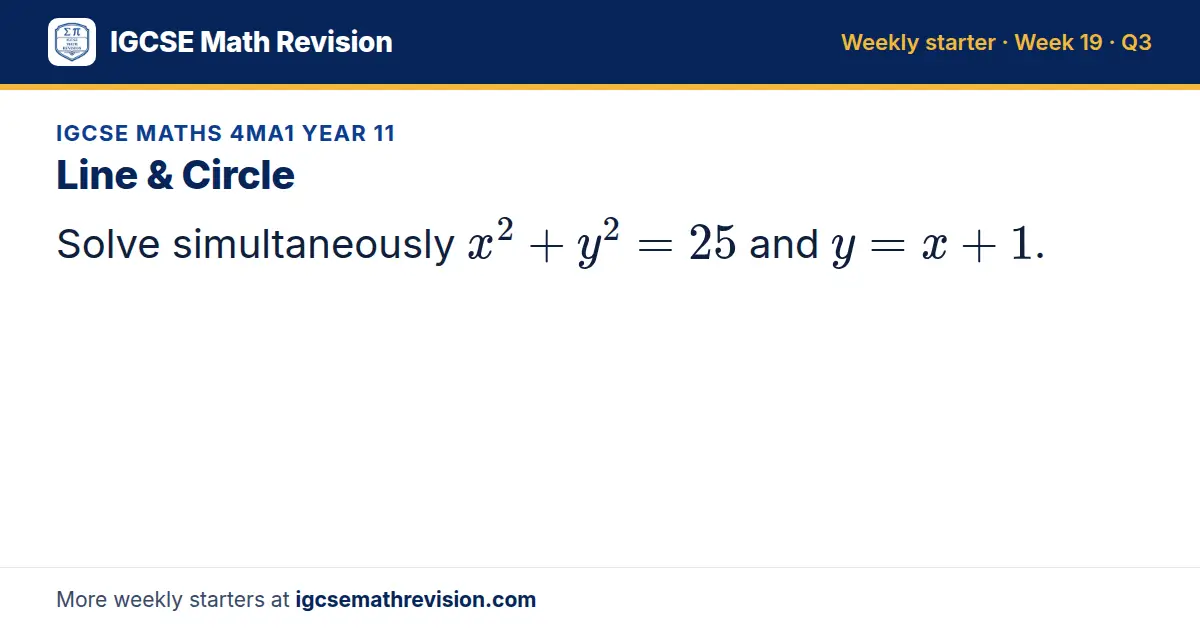
Question 3: Line & Circle
Solve simultaneously x² + y² = 25 and y = x + 1.
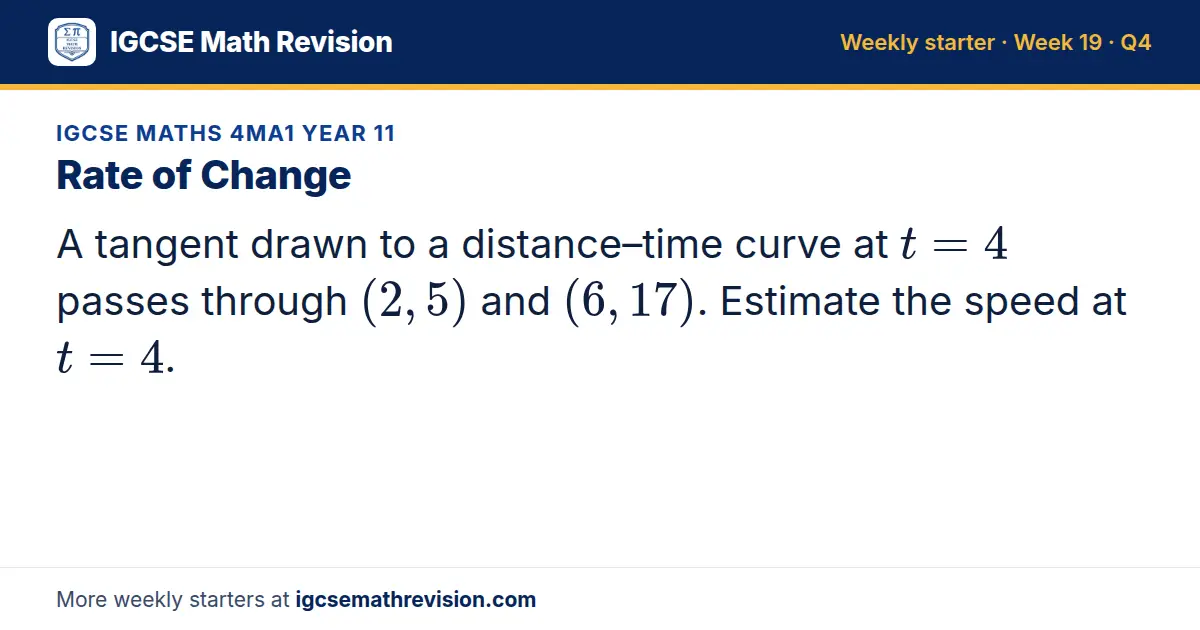
Question 4: Rate of Change
A tangent drawn to a distance–time curve at t = 4 passes through (2, 5) and (6, 17). Estimate the speed at t = 4.
Week 20
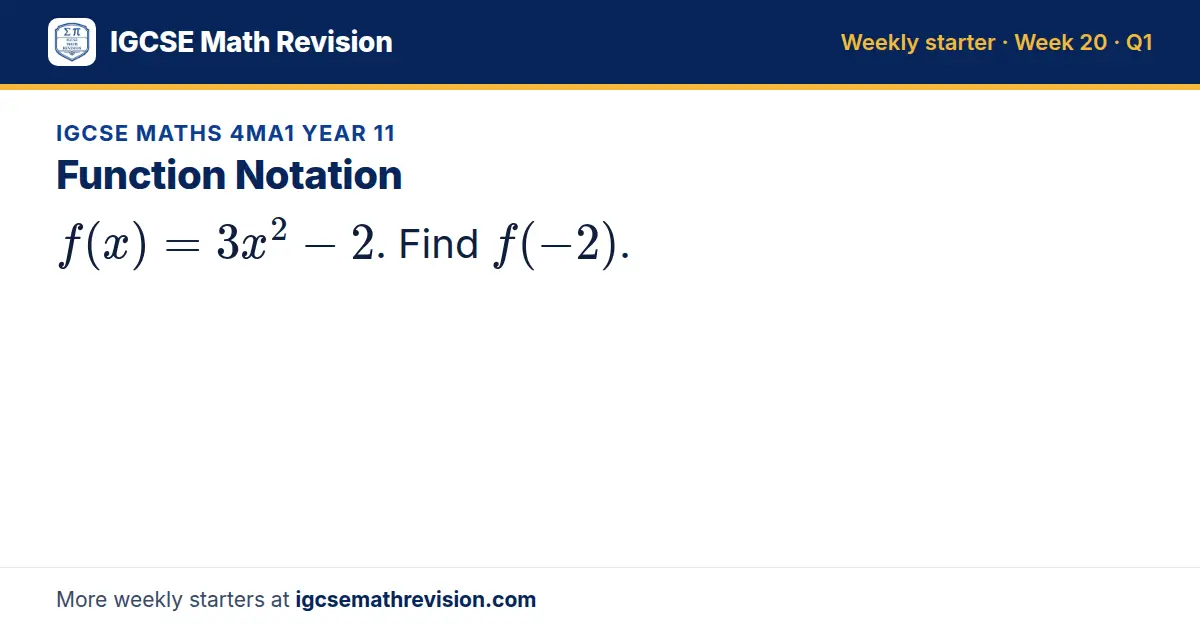
Question 1: Function Notation
f(x) = 3x² - 2. Find f(-2).
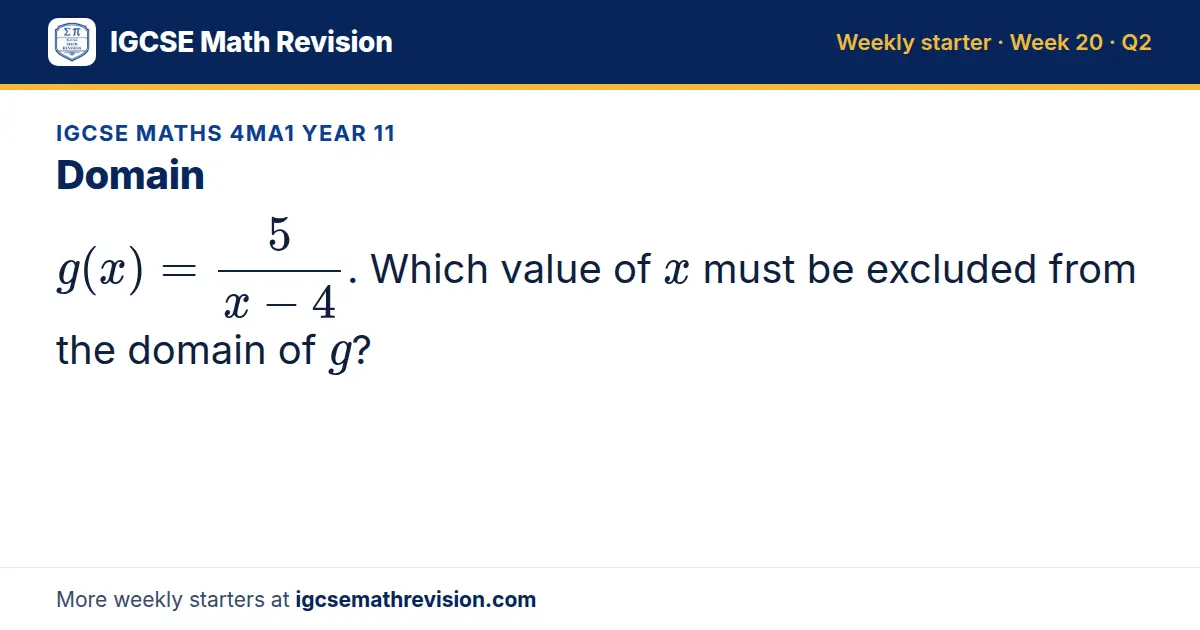
Question 2: Domain
g(x) = 5/(x - 4). Which value of x must be excluded from the domain of g?
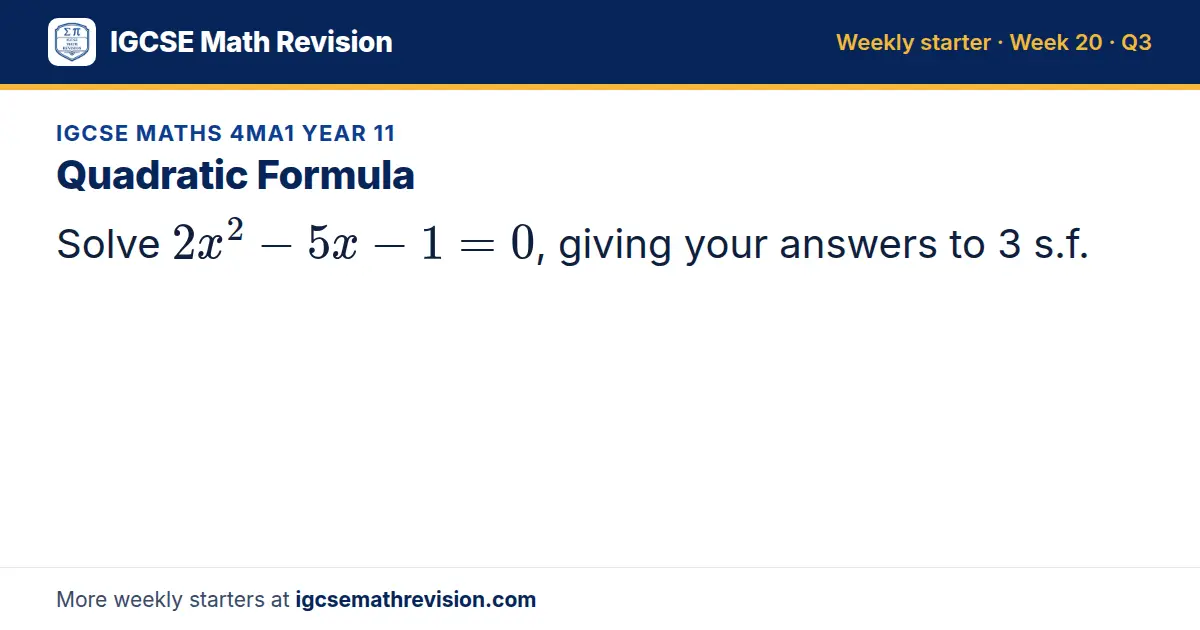
Question 3: Quadratic Formula
Solve 2x² - 5x - 1 = 0, giving your answers to 3 s.f.
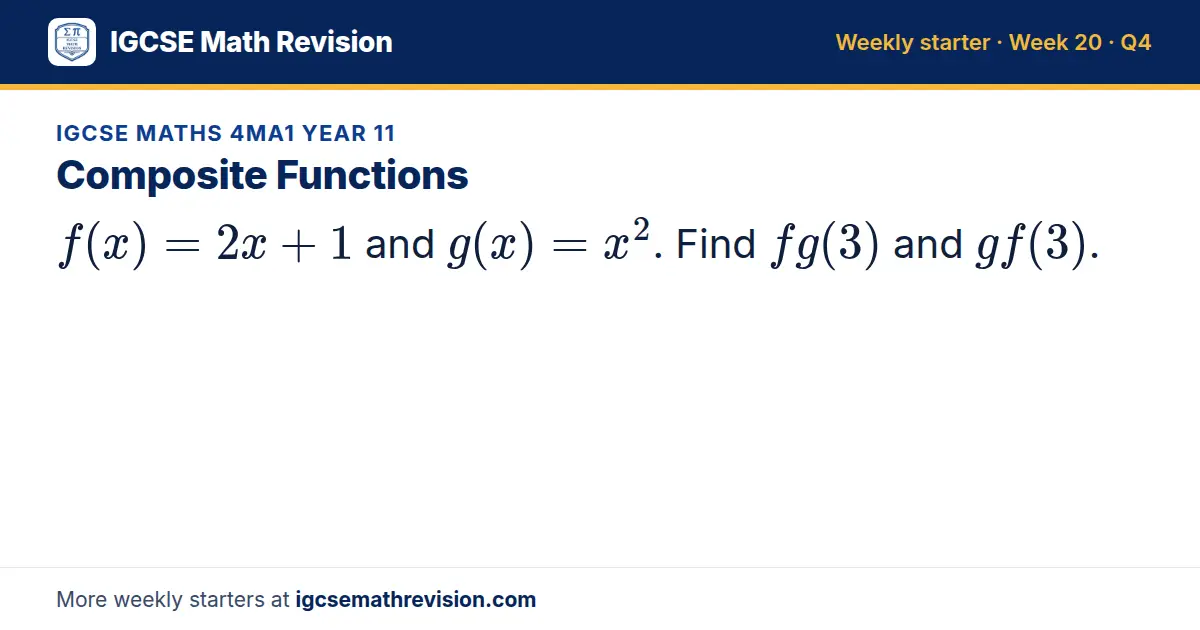
Question 4: Composite Functions
f(x) = 2x + 1 and g(x) = x^2. Find fg(3) and gf(3).
Week 21
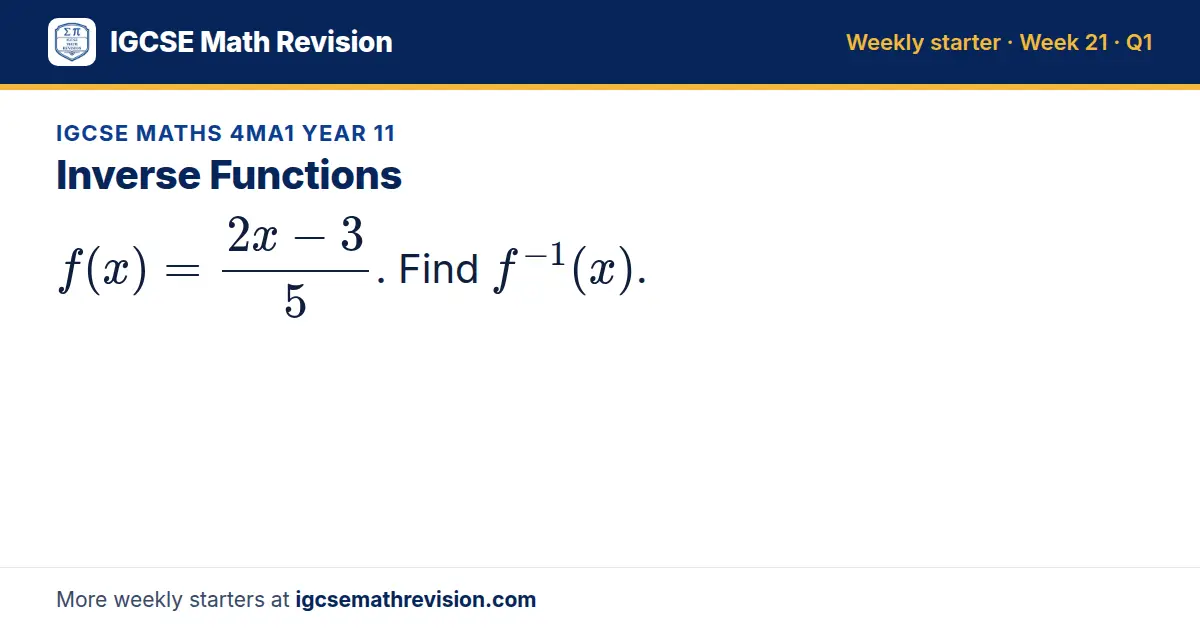
Question 1: Inverse Functions
f(x) = (2x - 3)/5. Find f⁻¹(x).
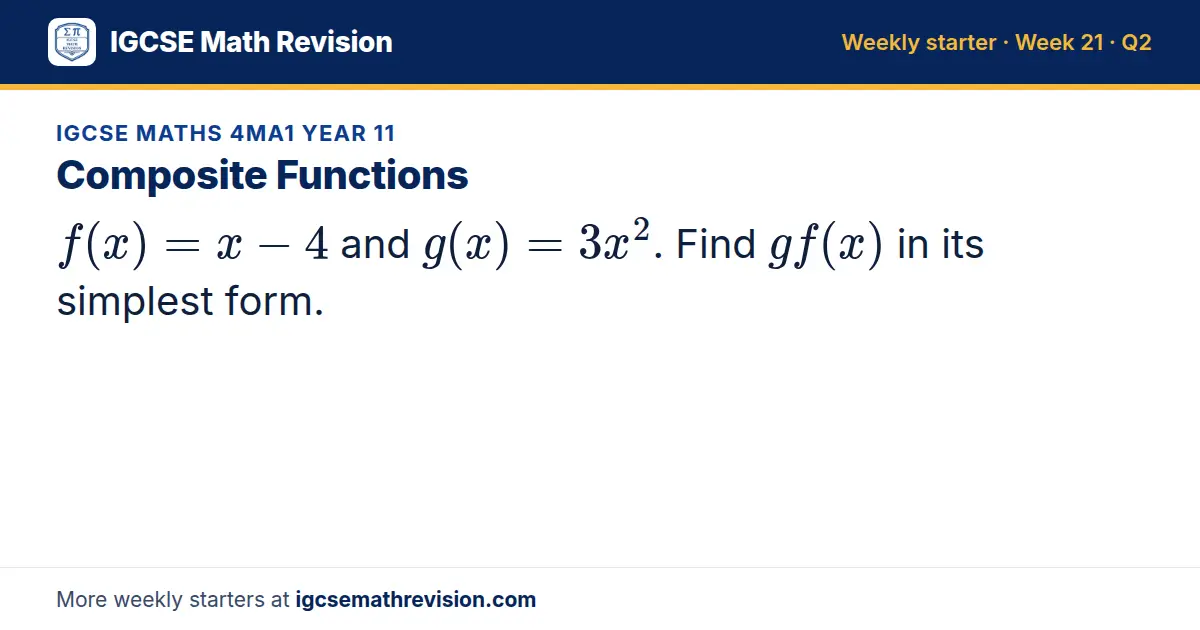
Question 2: Composite Functions
f(x) = x - 4 and g(x) = 3x^2. Find gf(x) in its simplest form.
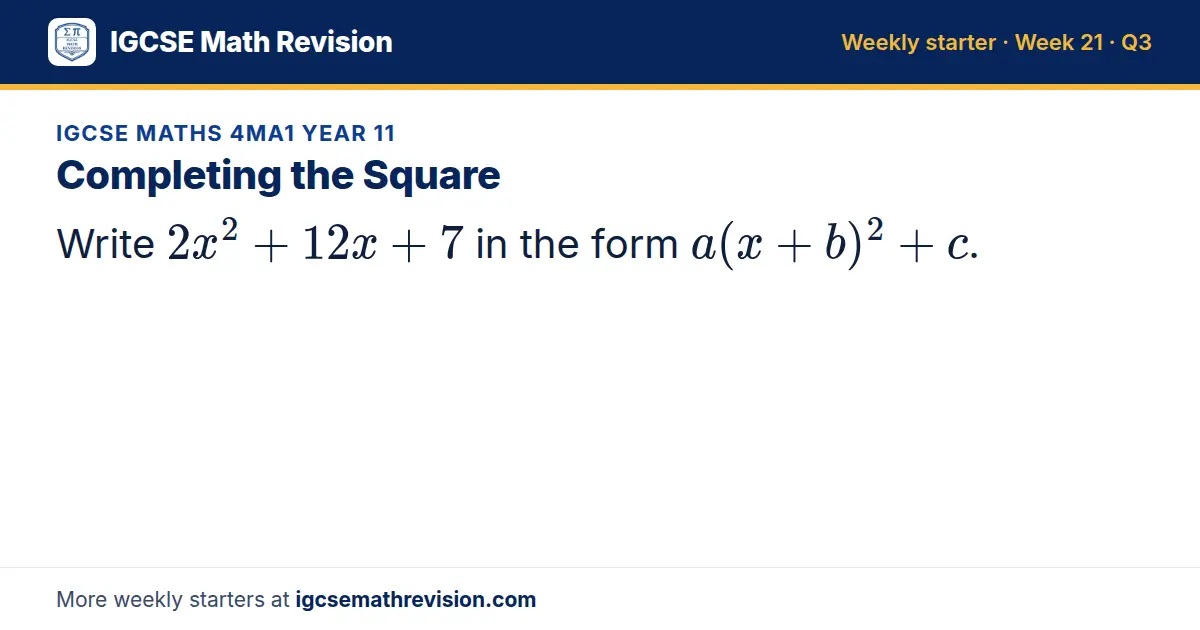
Question 3: Completing the Square
Write 2x² + 12x + 7 in the form a(x + b)² + c.
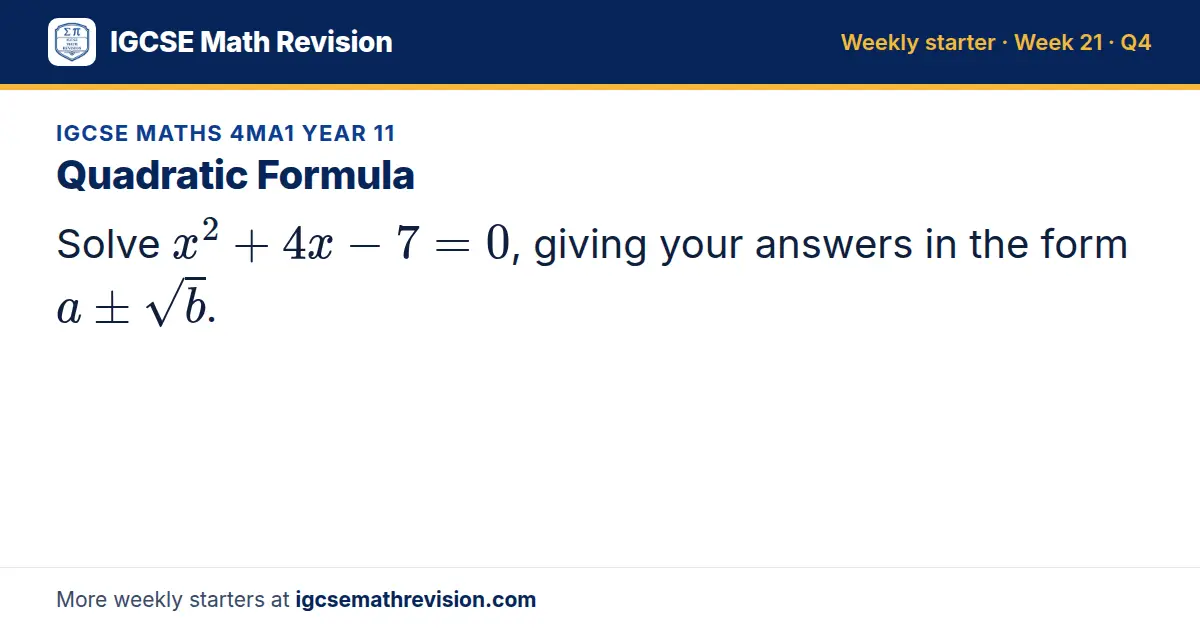
Question 4: Quadratic Formula
Solve x² + 4x - 7 = 0, giving your answers in the form a ± √b.
Week 22
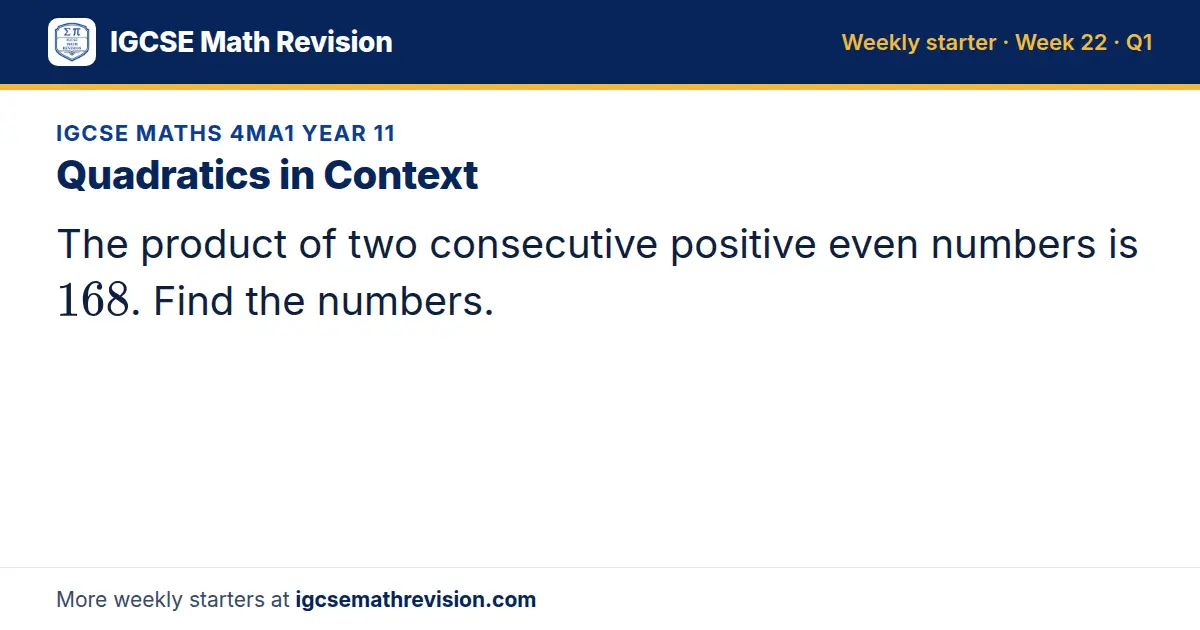
Question 1: Quadratics in Context
The product of two consecutive positive even numbers is 168. Find the numbers.
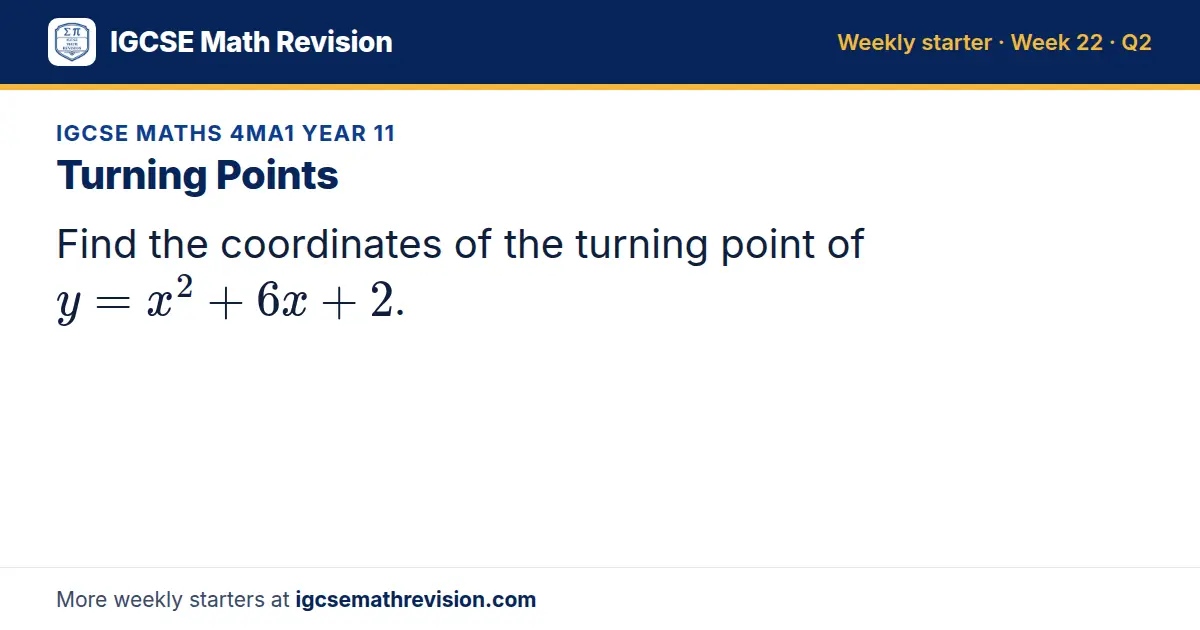
Question 2: Turning Points
Find the coordinates of the turning point of y = x² + 6x + 2.
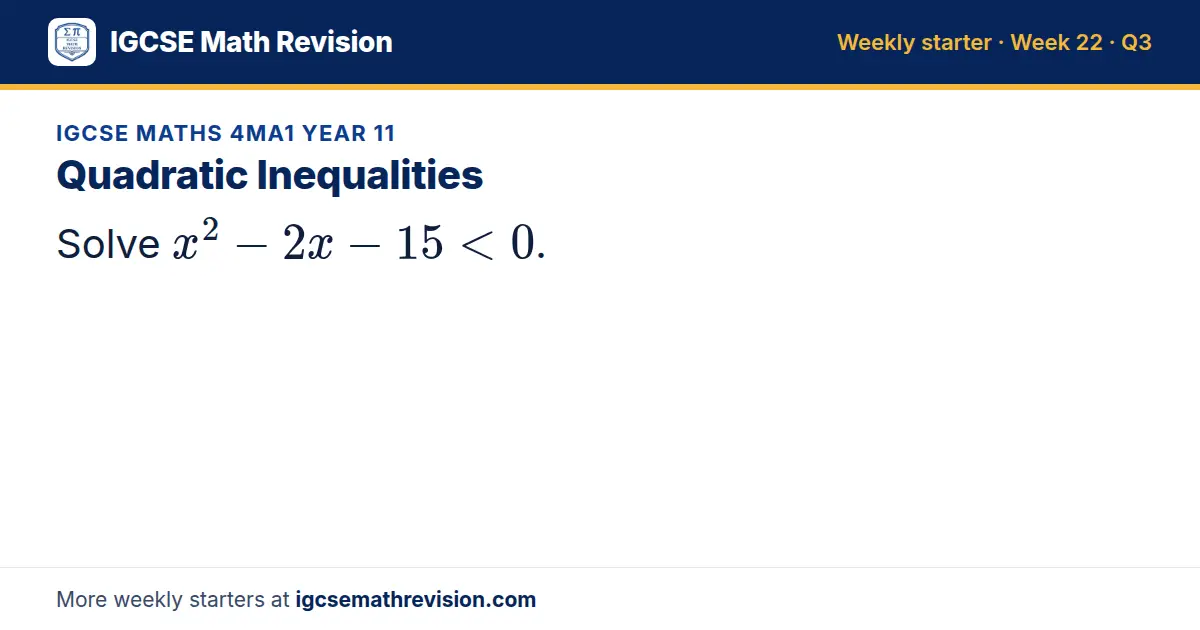
Question 3: Quadratic Inequalities
Solve x² - 2x - 15 < 0.
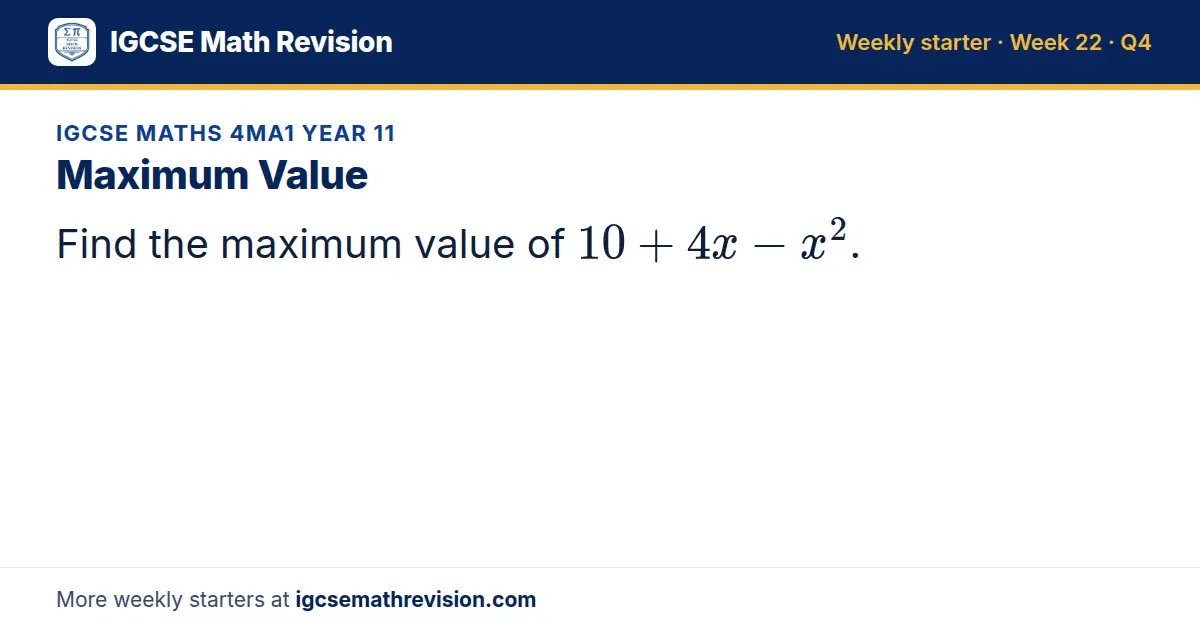
Question 4: Maximum Value
Find the maximum value of 10 + 4x - x^2.
Week 23
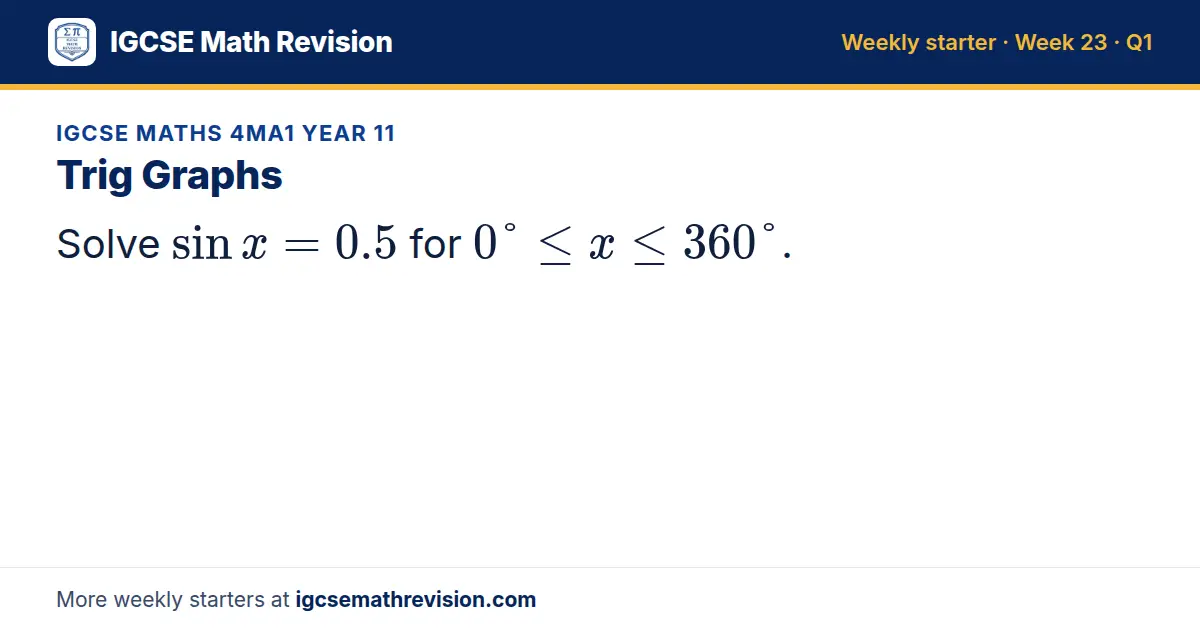
Question 1: Trig Graphs
Solve sin x = 0.5 for 0° ≤ x ≤ 360°.
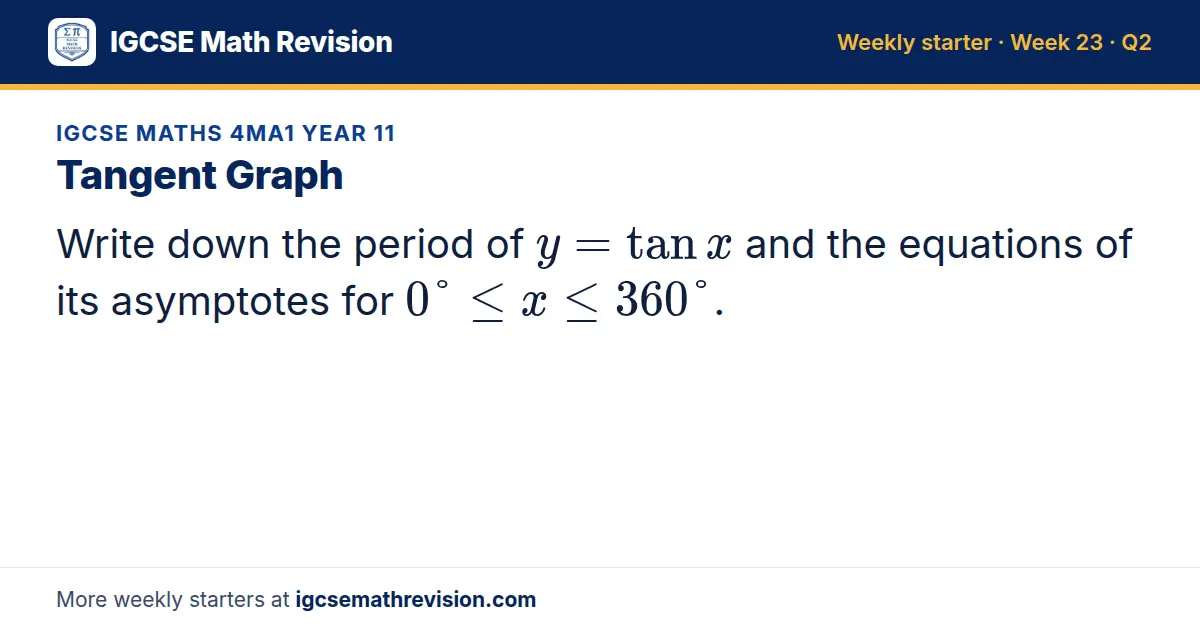
Question 2: Tangent Graph
Write down the period of y = tan x and the equations of its asymptotes for 0° ≤ x ≤ 360°.
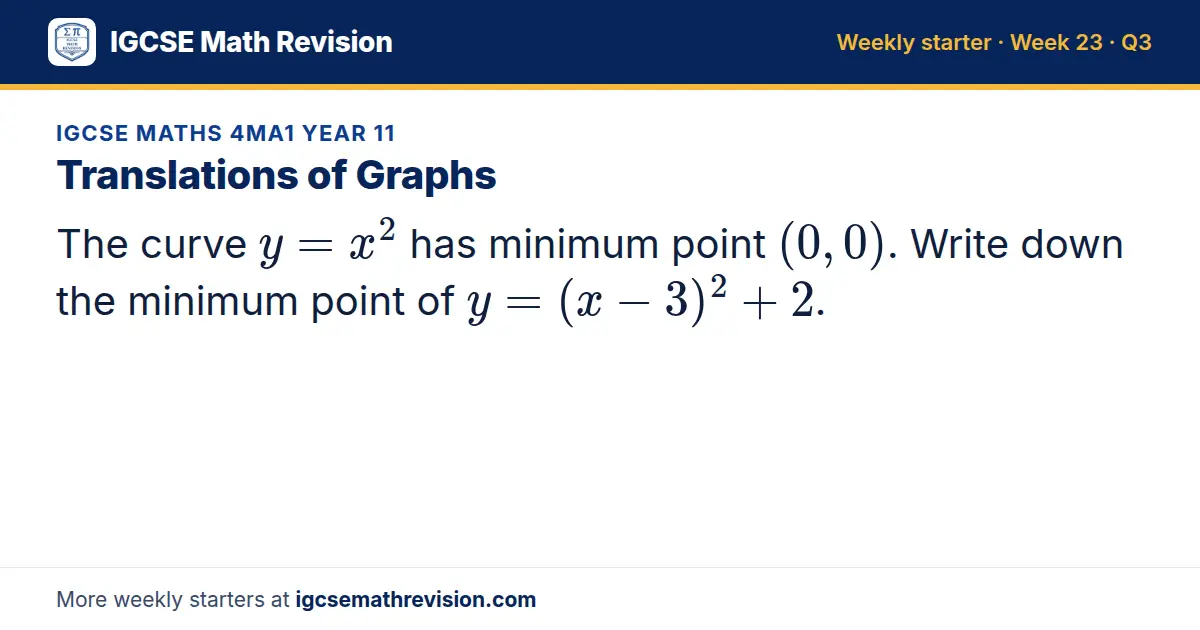
Question 3: Translations of Graphs
The curve y = x² has minimum point (0, 0). Write down the minimum point of y = (x - 3)² + 2.
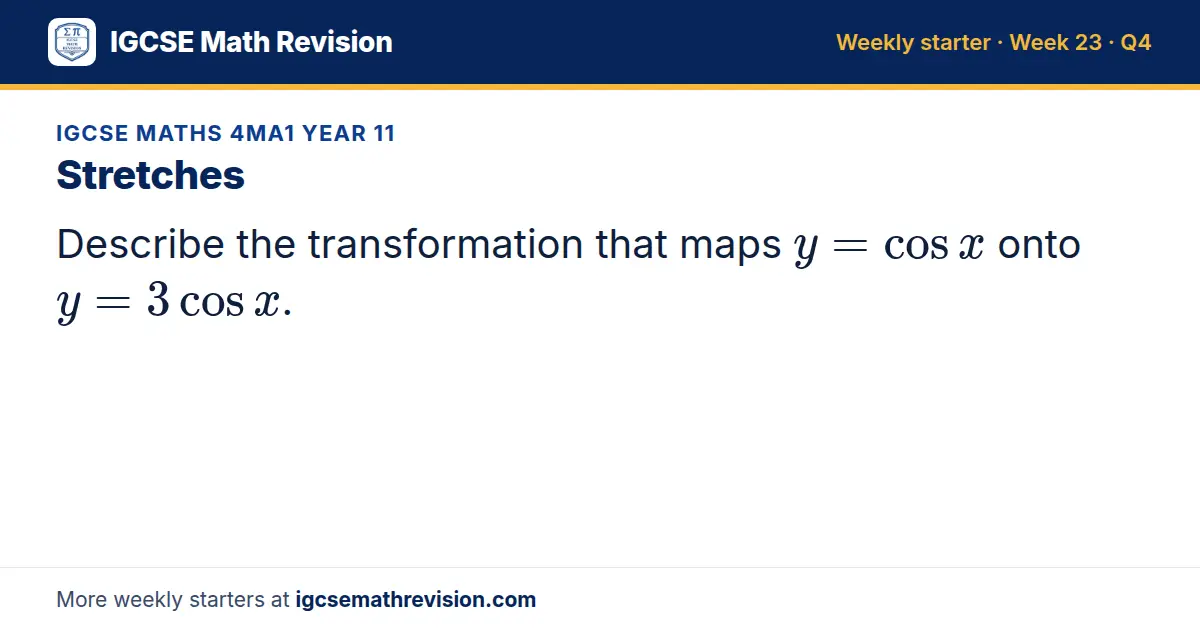
Question 4: Stretches
Describe the transformation that maps y = cos x onto y = 3cos x.
Week 24
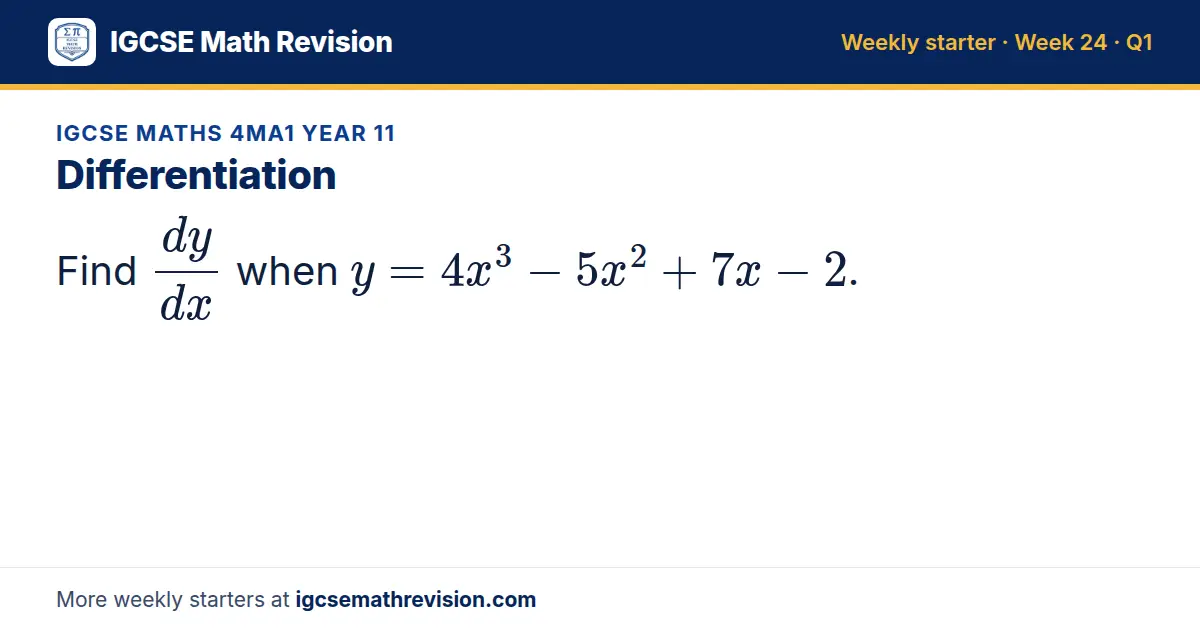
Question 1: Differentiation
Find dy/dx when y = 4x³ - 5x² + 7x - 2.
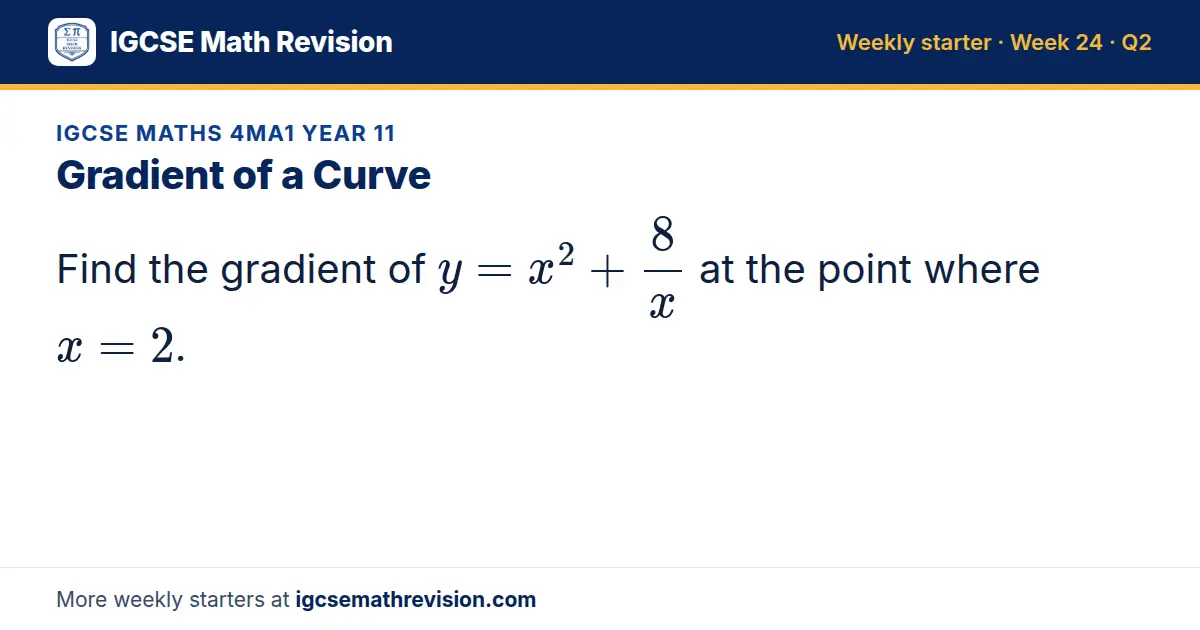
Question 2: Gradient of a Curve
Find the gradient of y = x² + 8/x at the point where x = 2.
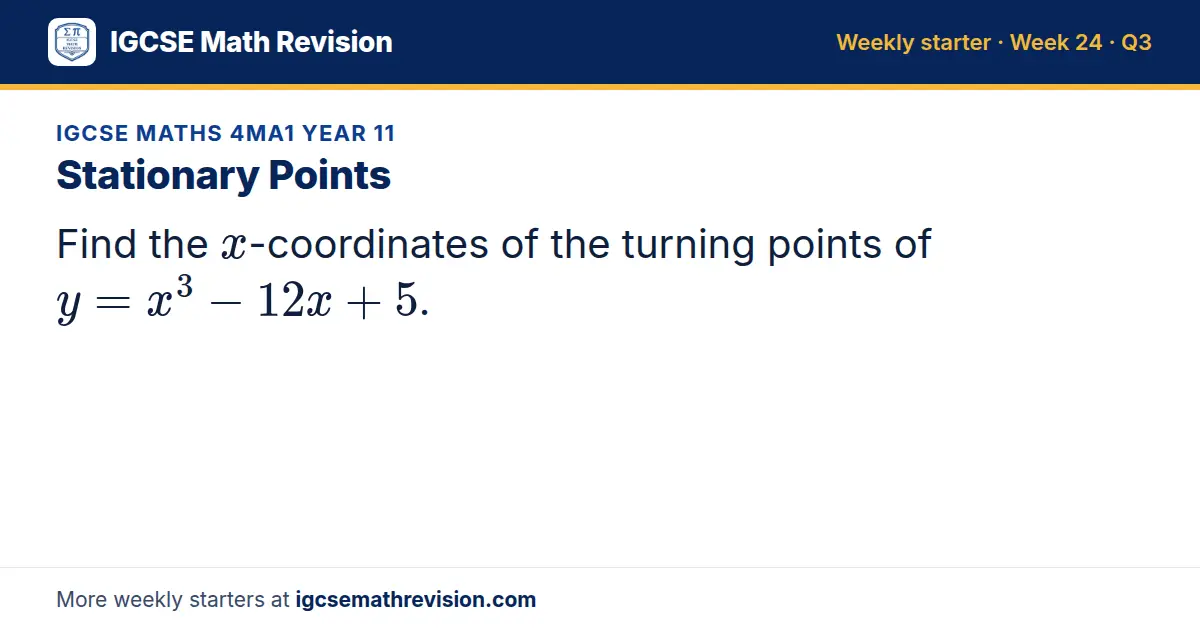
Question 3: Stationary Points
Find the x-coordinates of the turning points of y = x³ - 12x + 5.
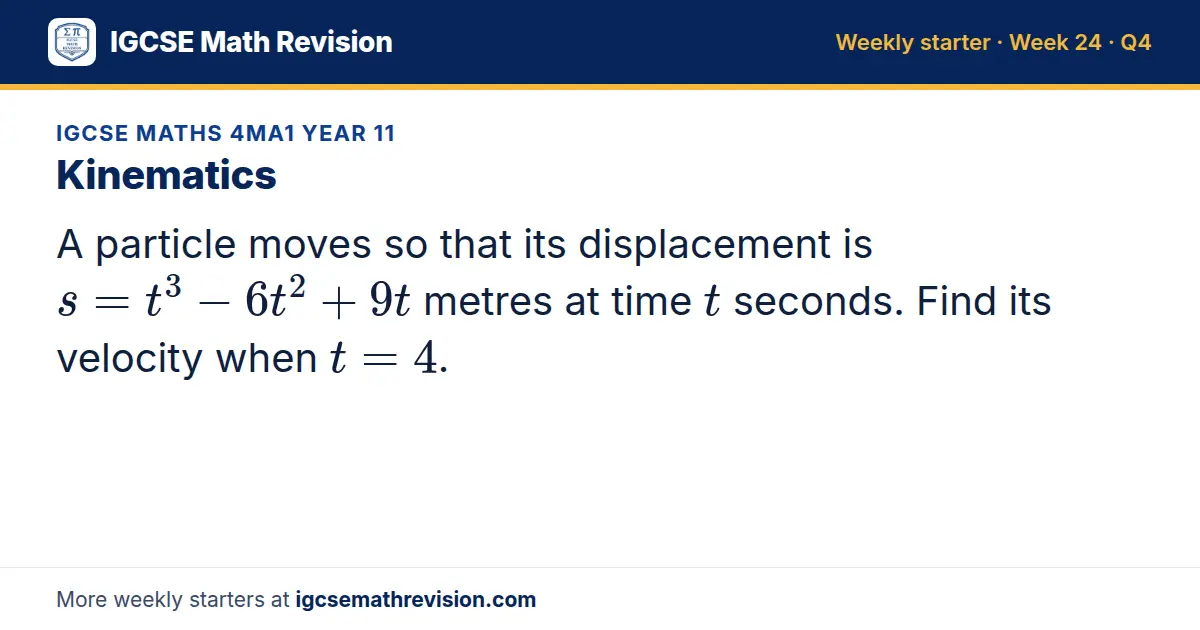
Question 4: Kinematics
A particle moves so that its displacement is s = t³ - 6t² + 9t metres at time t seconds. Find its velocity when t = 4.
More starter questions
Other weeks: Weeks 1–12 · Weeks 13–24. Answers and mark schemes are in the teacher tools.