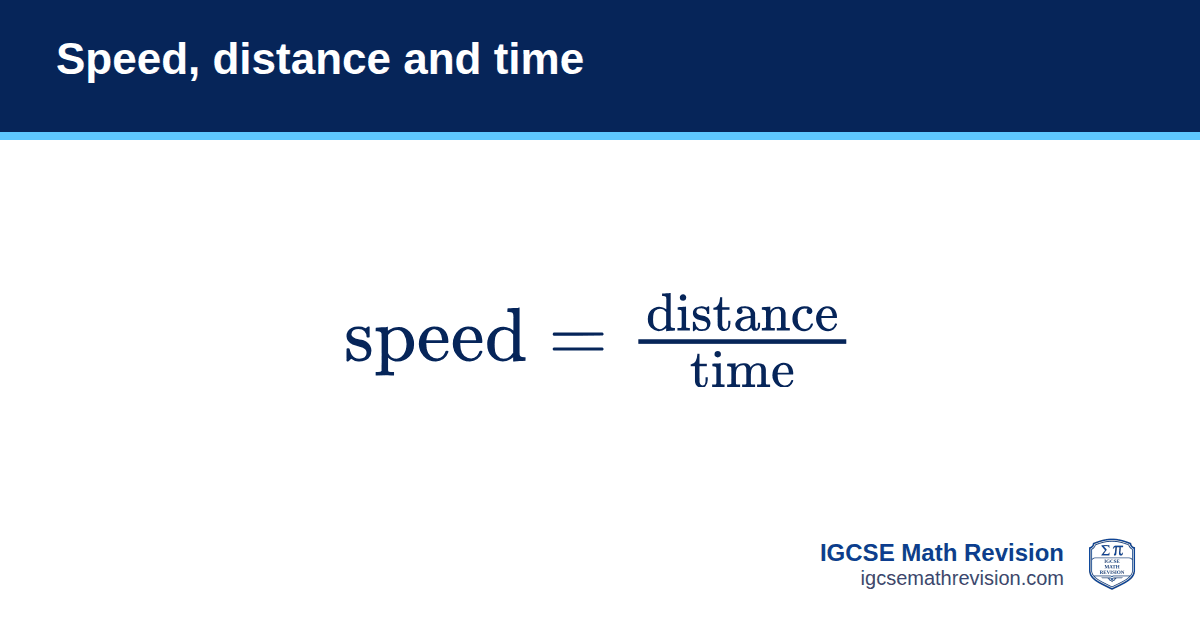
Speed distance time formula: speed = distance ÷ time
The speed distance time formula is speed = distance ÷ time.
What each letter means
- \(\text{distance}\) how far, e.g. in km or m
- \(\text{time}\) how long, in hours or seconds to match the speed unit
- \(\text{speed}\) the average speed, e.g. km/h or m/s
Speed, distance and time in Edexcel 4MA1 and Cambridge 0580
| Course | Where it is | Tier |
|---|---|---|
| Edexcel International GCSE Maths A (4MA1) | 4.4 Measures | Foundation and Higher Papers 1F and 2F and Papers 1H and 2H |
| Cambridge IGCSE Mathematics (0580) | C1.12 / E1.12 Rates | Core and Extended Paper 1 (no calculator) and Paper 3 (calculator) and Paper 2 (no calculator) and Paper 4 (calculator) |
Calculator: Edexcel 4MA1: A calculator may be used in all four papers. Cambridge 0580: No calculator on Papers 1 and 2; a scientific calculator is needed for Papers 3 and 4. Algebraic or graphic calculators are not allowed.
Without a calculator: The times are friendly: 1 hour 30 minutes is 1.5 hours, 20 minutes is ⅓ of an hour. Convert the time to hours before you divide. 0580 non-calculator papers: what to practise.
When to use it
For any journey at a steady (or average) speed. Rearranged: distance = speed × time and time = distance ÷ speed.
Worked example
A train travels 156 km in 2 hours 24 minutes. Find its average speed in km/h.
- \(2\text{ h }24\text{ min}=2+\tfrac{24}{60}=2.4\) hours
- \(\text{speed}=\dfrac{156}{2.4}\)
Answer: 65 km/h
Common mistake
Writing 2 hours 24 minutes as 2.24 hours. 24 minutes is 24/60 = 0.4 hours, so the time is 2.4 hours.
Try one yourself
One quick IGCSE Maths question on the speed, distance and time. No sign-in needed.
Get 5 more like this — freeGoogle, Microsoft or email. No card needed.
IGCSE exam-style questions, marked step by step
Our own questions in the style of the 4MA1 and 0580 papers. M1 is a method mark, A1 an accuracy mark that needs the method before it, and B1 a mark that stands on its own. The split is our illustration: how IGCSE mark schemes work.
A cyclist rides \(27\) km in \(1\) hour \(30\) minutes. Work out her average speed in km/h.
- \(1\) h \(30\) min \(=1.5\) h B1 · time in hours
- Speed \(=27\div1.5\) M1 · distance ÷ time
- \(=18\) A1 · answer
Answer: \(18\) km/h 3 marks in all
A car travels at a constant \(72\) km/h for \(25\) minutes. (a) How far does it travel? (b) Change \(72\) km/h into metres per second.
- (a) \(72\times\dfrac{25}{60}\) M1 · time as a fraction of an hour
- \(=30\) km A1 · distance
- (b) \(\dfrac{72\times1000}{3600}=20\) m/s B1 · units converted
Answer: (a) \(30\) km (b) \(20\) m/s 3 marks in all
Where IGCSE students lose marks
- Time conversions: 3 hours 36 minutes is not 3.36 hours. Fix: Divide minutes by 60. Check the units of the answer (km/h, m/s). (Edexcel 4MA1 examiner reports)
- Speed-time graphs: units and the sign of a deceleration. Fix: Read the axis units first and convert if needed. Gradient = acceleration; a deceleration is the size of a negative gradient, so it is given as a positive number. Distance = area under the graph. (Cambridge 0580 examiner reports)
From our summaries of the published examiner reports: Edexcel 4MA1 · Cambridge 0580.
Revise it for your IGCSE exam
- Notes 0580 notes: C1.12 / E1.12 Rates
- Notes 4MA1 Foundation: 4.4 Measures
- Practise Skill Builder (4MA1): Compound Measures 1 (free account)
- Practise Skill Builder (0580): Rates (free account)
- Papers Edexcel 4MA1 Higher past papers and mark schemes
- Papers Edexcel 4MA1 Foundation past papers
- Papers Cambridge 0580 past papers and mark schemes
- Checklist 4MA1 specification and 0580 syllabus checklists
- Dates IGCSE Maths exam dates (4MA1 and 0580)
On your IGCSE Maths course
| Course | In the exam |
|---|---|
| Edexcel 4MA1 (Higher) | Not given: learn it |
| Cambridge 0580 | Not given: learn it |
From our own IGCSE Maths formula sheets, in our words. Official: Pearson's 4MA1 specification (PDF, Appendix 5) · Cambridge's 0580 syllabus (PDF).
Practise and revise
IGCSE Maths FAQ
Is the speed, distance and time on the IGCSE formula sheet?
Edexcel 4MA1 (Higher): not given: learn it. Cambridge 0580: not given: learn it.
How do I find the average speed of a journey in two parts?
Divide the total distance by the total time. Do not average the two speeds.
Is the speed, distance and time formula Foundation or Higher, Core or Extended?
On Edexcel 4MA1 it is in section 4.4 (Measures) at Foundation, so it can come up on Papers 1F and 2F and Papers 1H and 2H. On Cambridge 0580 it is in sub-topic C1.12 / E1.12 (Rates) for Core and Extended.
Why is 3 hours 36 minutes not 3.36 hours?
There are 60 minutes in an hour, not 100: 36 minutes is 36 ÷ 60 = 0.6 hours, so 3 h 36 min = 3.6 h. Our summary of the 4MA1 examiner reports lists this as a common slip.
Can I use a calculator for speed, distance and time questions in IGCSE Maths?
Edexcel 4MA1: A calculator may be used in all four papers. Cambridge 0580: No calculator on Papers 1 and 2; a scientific calculator is needed for Papers 3 and 4. Algebraic or graphic calculators are not allowed. Without a calculator the times are friendly: 1 hour 30 minutes is 1.5 hours, 20 minutes is ⅓ of an hour. Convert the time to hours before you divide.
Our own wording, examples and card, checked by IGCSE Math Revision. Not produced or endorsed by Pearson Edexcel.