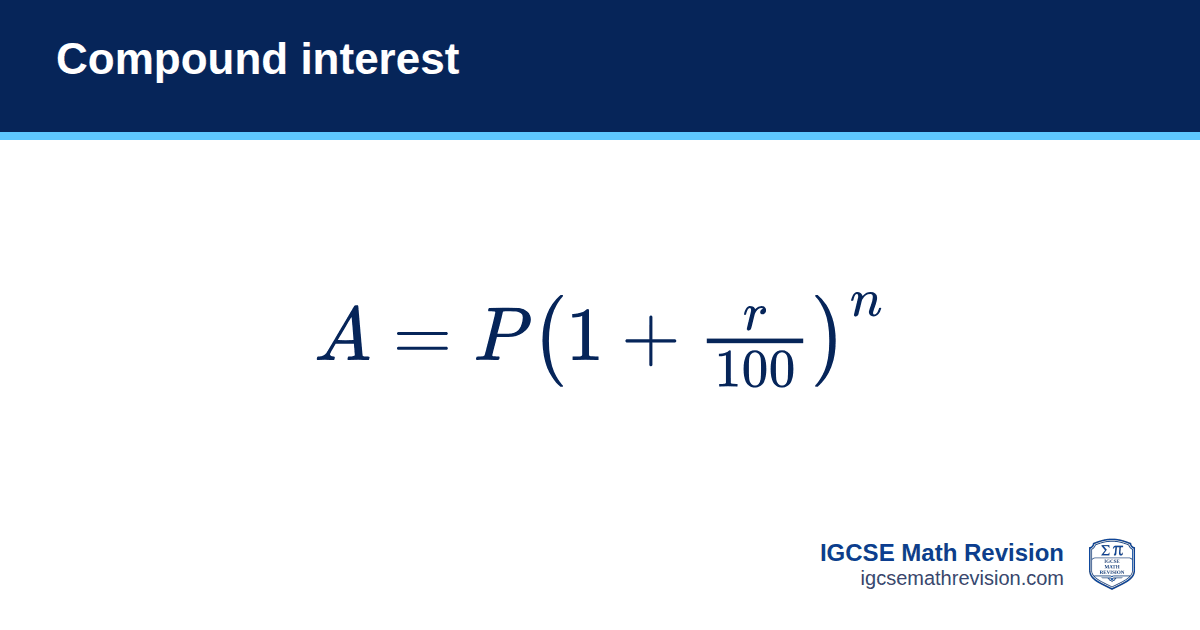
Compound interest formula: A = P(1 + r/100)ⁿ
The compound interest formula is A = P × (1 + r/100)ⁿ.
What each letter means
- \(P\) the amount at the start
- \(A\) the amount after n years
- \(r\) the percentage rate per year
- \(n\) the number of years
When to use it
When interest is added once a year and then earns interest itself. Use (1 − r/100)ⁿ for depreciation or decay.
Worked example
£4000 is invested at 2.5% per year compound interest. Find the value after 3 years.
- Multiplier \(=1+\dfrac{2.5}{100}=1.025\)
- \(A=4000\times1.025^3\)
Answer: £4307.56 (to the nearest penny)
Common mistake
Writing 1.25 as the multiplier for 2.5%. A 2.5% increase is a multiplier of 1.025.
On your course
| Course | In the exam |
|---|---|
| Edexcel 4MA1 (Higher) | Not given: learn it |
| Cambridge 0580 | Not given: learn it |
From our own IGCSE Maths formula sheets, in our words. Official: Pearson's 4MA1 specification (PDF, Appendix 5) · Cambridge's 0580 syllabus (PDF).
Practise and revise
- Practise 4MA1 percentages questions
- Practise 0580 percentages questions
- Revise Number notes
- Print Edexcel 4MA1 (Higher) one-page formula sheet
Questions
What is the compound interest formula?
The compound interest formula is A = P × (1 + r/100)ⁿ. P: the amount at the start; A: the amount after n years; r: the percentage rate per year; n: the number of years.
Is the compound interest given in the exam?
Edexcel 4MA1 (Higher): not given: learn it. Cambridge 0580: not given: learn it. This comes from our own IGCSE Maths formula sheets; your teacher has the official booklet.
What is the difference between simple and compound interest?
Simple interest is paid on the original amount only, so it is the same each year. Compound interest is also paid on earlier interest, so the balance grows faster each year.
Our own wording, examples and card, checked by IGCSE Math Revision. Not produced or endorsed by Pearson Edexcel.