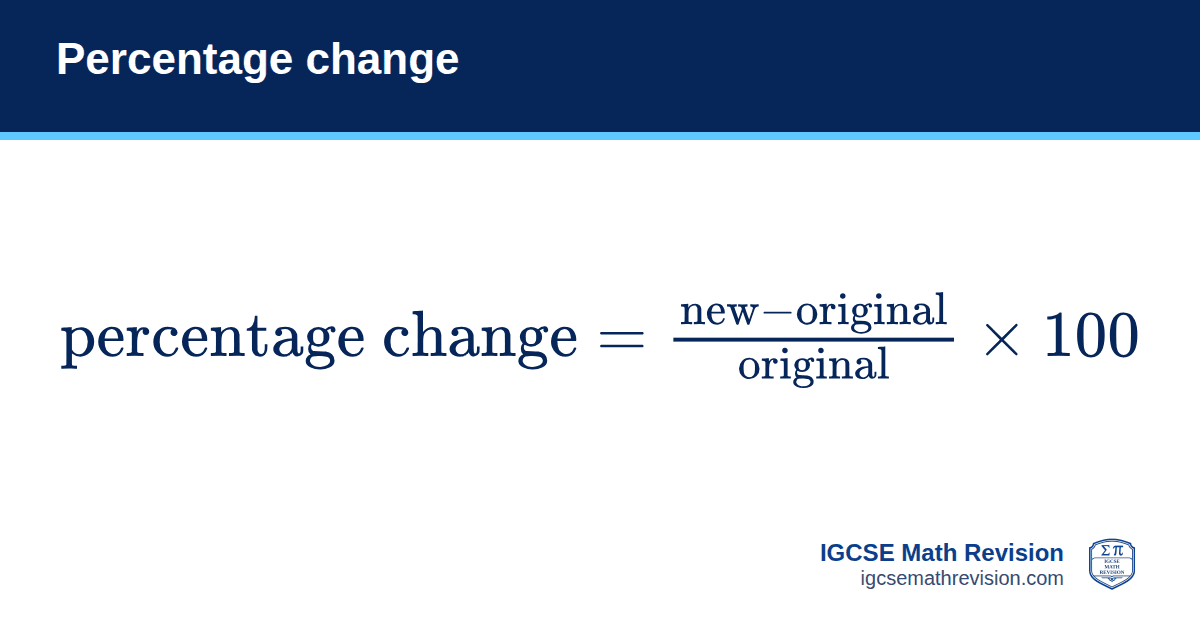
Percentage change formula: (new − original) / original × 100
The percentage change formula is percentage change = (new − original) / original × 100.
What each letter means
- \(\text{original}\) the value before the change
- \(\text{new}\) the value after the change
When to use it
To describe an increase or decrease as a percentage of where you started: price rises, profit and loss, population change.
Worked examples
1. The price of a book rises from £48 to £54. Find the percentage increase.
- Change \(=54-48=6\)
- \(\dfrac{6}{48}\times100\)
Answer: 12.5% increase
2. A town's population falls from 250 000 to 215 000. Find the percentage change.
- \(\dfrac{215\,000-250\,000}{250\,000}\times100\)
Answer: \(-14\%\), a 14% decrease
Common mistake
Dividing by the new value. Always divide by the original value.
On your course
| Course | In the exam |
|---|---|
| Edexcel 4MA1 (Higher) | Not given: learn it |
| Cambridge 0580 | Not given: learn it |
From our own IGCSE Maths formula sheets, in our words. Official: Pearson's 4MA1 specification (PDF, Appendix 5) · Cambridge's 0580 syllabus (PDF).
Practise and revise
- Practise 4MA1 percentages questions
- Practise 0580 percentages questions
- Revise Number notes
- Print Edexcel 4MA1 (Higher) one-page formula sheet
Questions
What is the percentage change formula?
The percentage change formula is percentage change = (new − original) / original × 100. original: the value before the change; new: the value after the change.
Is the percentage change given in the exam?
Edexcel 4MA1 (Higher): not given: learn it. Cambridge 0580: not given: learn it. This comes from our own IGCSE Maths formula sheets; your teacher has the official booklet.
How do I show a percentage decrease?
Use the same formula. The answer comes out negative: −14% means a 14% decrease.
Our own wording, examples and card, checked by IGCSE Math Revision. Not produced or endorsed by Pearson Edexcel.