IGCSE Math Revisionigcsemathrevision.com
Edexcel International GCSE Mathematics A (4MA1)Higher tier · one-page formula sheet · ★ = not given on the paper
★ Learn it: not on the 4MA1 Higher formulae sheet. Printed on the exam paper.
Number
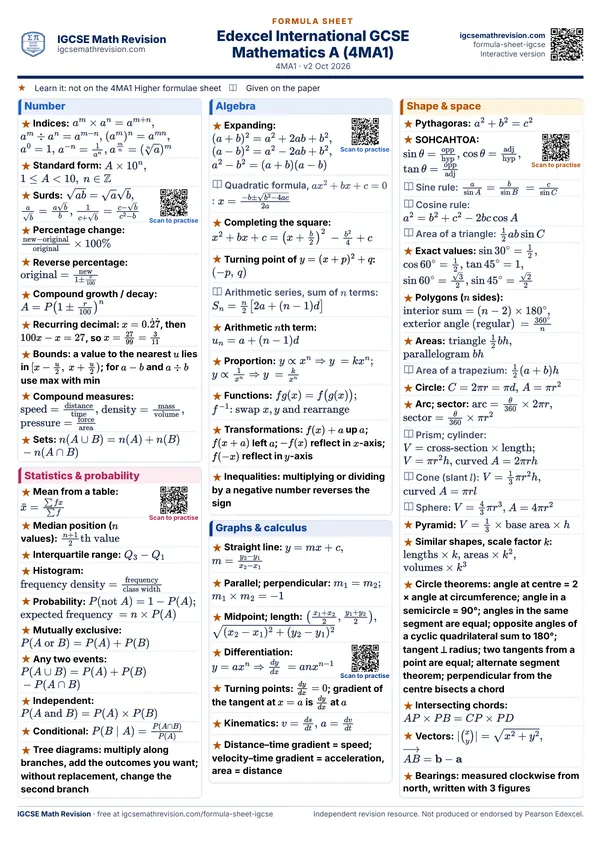
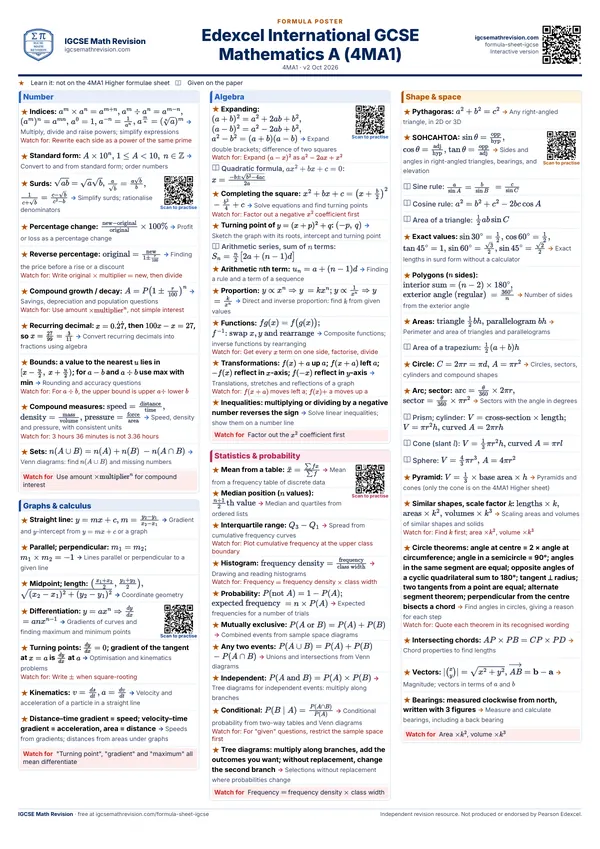
★Indices: \(a^m\times a^n=a^{m+n},\) \(a^m\div a^n=a^{m-n},\) \((a^m)^n=a^{mn},\) \(a^0=1,\) \(a^{-n}=\tfrac1{a^n},\) \(a^{\frac mn}=(\sqrt[n]a)^m\)Use: Multiply, divide and raise powers; simplify expressionsWatch for: Rewrite each side as a power of the same prime
★Standard form: \(A\times10^n,\) \(1\le A<10,\ n\in\mathbb Z\)Use: Convert to and from standard form; order numbers
★Surds: \(\sqrt{ab}=\sqrt a\sqrt b,\) \(\frac{a}{\sqrt b}=\frac{a\sqrt b}{b},\) \(\frac1{c+\sqrt b}=\frac{c-\sqrt b}{c^2-b}\)Use: Simplify surds; rationalise denominators
★Percentage change: \(\frac{\text{new}-\text{original}}{\text{original}}\times100\%\)Use: Profit or loss as a percentage change
★Reverse percentage: \(\text{original}=\frac{\text{new}}{1\pm\frac r{100}}\)Use: Finding the price before a rise or a discountWatch for: Write original \(\times\) multiplier \(=\) new, then divide
★Compound growth / decay: \(A=P\left(1\pm\tfrac r{100}\right)^n\)Use: Savings, depreciation and population questionsWatch for: Use amount \(\times \text{multiplier}^{n}\), not simple interest
★Recurring decimal: \(x=0.\dot2\dot7\), then \(100x-x=27\), so \(x=\tfrac{27}{99}=\tfrac3{11}\)Use: Convert recurring decimals into fractions using algebra
★Bounds: a value to the nearest \(u\) lies in \([x-\tfrac u2,\ x+\tfrac u2)\); for \(a-b\) and \(a\div b\) use max with minUse: Rounding and accuracy questionsWatch for: For \(a \div b\), the upper bound is upper \(a \div\) lower \(b\)
★Compound measures: \(\text{speed}=\frac{\text{distance}}{\text{time}},\) \(\text{density}=\frac{\text{mass}}{\text{volume}},\) \(\text{pressure}=\frac{\text{force}}{\text{area}}\)Use: Speed, density and pressure, with consistent unitsWatch for: 3 hours 36 minutes is not 3.36 hours
★Sets: \(n(A\cup B)=n(A)+n(B)\) \({}-n(A\cap B)\)Use: Venn diagrams: find \(n(A \cup B)\) and missing numbers
Watch for: Use amount \(\times \text{multiplier}^{n}\) for compound interest
Algebra
★Expanding: \((a+b)^2=a^2+2ab+b^2,\) \((a-b)^2=a^2-2ab+b^2,\) \(a^2-b^2=(a+b)(a-b)\)Use: Expand double brackets; difference of two squaresWatch for: Expand \((a - x)^{2}\) as \(a^{2} - 2ax + x^{2}\)
Quadratic formula, \(ax^2+bx+c=0\): \(x=\frac{-b\pm\sqrt{b^2-4ac}}{2a}\)Use: To a given accuracy or in surd form
★Completing the square: \(x^2+bx+c=\left(x+\tfrac b2\right)^2\) \({}-\tfrac{b^2}4+c\)Use: Solve equations and find turning pointsWatch for: Factor out a negative \(x^{2}\) coefficient first
★Turning point of \(y=(x+p)^2+q\): \((-p,\,q)\)Use: Sketch the graph with its roots, intercept and turning point
Arithmetic series, sum of \(n\) terms: \(S_n=\tfrac n2\big[2a+(n-1)d\big]\)Use: Find unknown terms from a given sum
★Arithmetic \(n\)th term: \(u_n=a+(n-1)d\)Use: Finding a rule and a term of a sequence
★Proportion: \(y\propto x^n\Rightarrow y\) \({}=kx^n;\) \(y\propto\tfrac1{x^n}\Rightarrow y\) \({}=\tfrac k{x^n}\)Use: Direct and inverse proportion: find \(k\) from given values
★Functions: \(fg(x)=f\big(g(x)\big);\) \(f^{-1}\text{: swap }x,y\text{ and rearrange}\)Use: Composite functions; inverse functions by rearrangingWatch for: Get every \(x\) term on one side, factorise, divide
★Transformations: \(f(x)+a\) up \(a\); \(f(x+a)\) left \(a\); \(-f(x)\) reflect in \(x\)-axis; \(f(-x)\) reflect in \(y\)-axisUse: Translations, stretches and reflections of a graphWatch for: \(f(x + a)\) moves left a; \(f(x) +\) a moves up a
★Inequalities: multiplying or dividing by a negative number reverses the signUse: Solve linear inequalities; show them on a number line
Watch for: Factor out the \(x^{2}\) coefficient first
Graphs & calculus
★Straight line: \(y=mx+c,\) \(m=\frac{y_2-y_1}{x_2-x_1}\)Use: Gradient and \(y\)-intercept from \(y = mx + c\) or a graphExplained: Equation of a straight line · Gradient formula
★Parallel; perpendicular: \(m_1=m_2;\) \(m_1\times m_2=-1\)Use: Lines parallel or perpendicular to a given line
★Differentiation: \(y=ax^n\Rightarrow\frac{dy}{dx}\) \({}=anx^{n-1}\)Use: Gradients of curves and finding maximum and minimum points
★Turning points: \(\frac{dy}{dx}=0\); gradient of the tangent at \(x=a\) is \(\frac{dy}{dx}\) at \(a\)Use: Optimisation and kinematics problemsWatch for: Write \(\pm\) when square-rooting
★Kinematics: \(v=\frac{ds}{dt},\) \(a=\frac{dv}{dt}\)Use: Velocity and acceleration of a particle in a straight line
★Distance–time gradient = speed; velocity–time gradient = acceleration, area = distanceUse: Speeds from gradients; distances from areas under graphs
Watch for: "Turning point", "gradient" and "maximum" all mean differentiate
Shape & space
★SOHCAHTOA: \(\sin\theta=\frac{\text{opp}}{\text{hyp}},\) \(\cos\theta=\frac{\text{adj}}{\text{hyp}},\) \(\tan\theta=\frac{\text{opp}}{\text{adj}}\)Use: Sides and angles in right-angled triangles, bearings, and elevation
Sine rule: \(\frac a{\sin A}=\frac b{\sin B}\) \({}=\frac c{\sin C}\)Use: Missing sides and angles in non-right-angled triangles
Cosine rule: \(a^2=b^2+c^2-2bc\cos A\)Use: A missing side, or an angle when all three sides are known
Area of a triangle: \(\tfrac12ab\sin C\)Use: Area of any triangle; a missing side or angle from the area
★Exact values: \(\sin30^\circ=\tfrac12,\) \(\cos60^\circ=\tfrac12,\) \(\tan45^\circ=1,\) \(\sin60^\circ=\tfrac{\sqrt3}2,\) \(\sin45^\circ=\tfrac{\sqrt2}2\)Use: Exact lengths in surd form without a calculator
★Polygons (\(n\) sides): \(\text{interior sum}=(n-2)\times180^\circ,\) \(\text{exterior angle (regular)}\) \({}=\tfrac{360^\circ}n\)Use: Number of sides from the exterior angle
★Areas: \(\text{triangle }\tfrac12bh,\) \(\text{parallelogram }bh\)Use: Perimeter and area of triangles and parallelograms
Area of a trapezium: \(\tfrac12(a+b)h\)Use: Compound shapes split into rectangles, triangles and trapezia
Prism; cylinder: \(V=\text{cross-section}\times\text{length};\) \(V=\pi r^2h,\) \(\text{curved }A=2\pi rh\)Use: Volumes of prisms and cylinders; convert volume units
Cone (slant \(l\)): \(V=\tfrac13\pi r^2h,\) \(\text{curved }A=\pi rl\)Use: Volumes and surface areas of cones, including in terms of \(\pi\)
Sphere: \(V=\tfrac43\pi r^3,\) \(A=4\pi r^2\)Use: Volumes and surface areas of spheres and composite solids
★Pyramid: \(V=\tfrac13\times\text{base area}\times h\)Use: Pyramids and cones (only the cone is on the 4MA1 Higher sheet)
★Similar shapes, scale factor \(k\): \(\text{lengths}\times k,\) \(\text{areas}\times k^2,\) \(\text{volumes}\times k^3\)Use: Scaling areas and volumes of similar shapes and solidsWatch for: Find \(k\) first; area \(\times k^{2}\), volume \(\times k^{3}\)
★Circle theorems: angle at centre = 2 × angle at circumference; angle in a semicircle = 90°; angles in the same segment are equal; opposite angles of a cyclic quadrilateral sum to 180°; tangent ⟂ radius; two tangents from a point are equal; alternate segment theorem; perpendicular from the centre bisects a chordUse: Find angles in circles, giving a reason for each stepWatch for: Quote each theorem in its recognised wording
★Intersecting chords: \(AP\times PB=CP\times PD\)Use: Chord properties to find lengths
★Vectors: \(|\binom xy|=\sqrt{x^2+y^2},\) \(\overrightarrow{AB}=\mathbf b-\mathbf a\)Use: Magnitude; vectors in terms of \(a\) and \(b\)
★Bearings: measured clockwise from north, written with 3 figuresUse: Measure and calculate bearings, including a back bearing
Watch for: Area \(\times k^{2}\), volume \(\times k^{3}\)
Statistics & probability
★Mean from a table: \(\bar x=\frac{\sum fx}{\sum f}\)Use: Mean from a frequency table of discrete data
★Median position (\(n\) values): \(\tfrac{n+1}2\text{th value}\)Use: Median and quartiles from ordered lists
★Interquartile range: \(Q_3-Q_1\)Use: Spread from cumulative frequency curvesWatch for: Plot cumulative frequency at the upper class boundary
★Histogram: \(\text{frequency density}=\frac{\text{frequency}}{\text{class width}}\)Use: Drawing and reading histogramsWatch for: Frequency \(=\) frequency density \(\times\) class width
★Probability: \(P(\text{not }A)=1-P(A);\) \(\text{expected frequency}\) \({}=n\times P(A)\)Use: Expected frequencies for a number of trials
★Any two events: \(P(A\cup B)=P(A)+P(B)\) \({}-P(A\cap B)\)Use: Unions and intersections from Venn diagrams
★Independent: \(P(A\text{ and }B)=P(A)\times P(B)\)Use: Tree diagrams for independent events: multiply along branches
★Conditional: \(P(B\mid A)=\frac{P(A\cap B)}{P(A)}\)Use: Conditional probability from two-way tables and Venn diagramsWatch for: For "given" questions, restrict the sample space first
★Tree diagrams: multiply along branches, add the outcomes you want; without replacement, change the second branchUse: Selections without replacement where probabilities change
Watch for: Frequency \(=\) frequency density \(\times\) class width