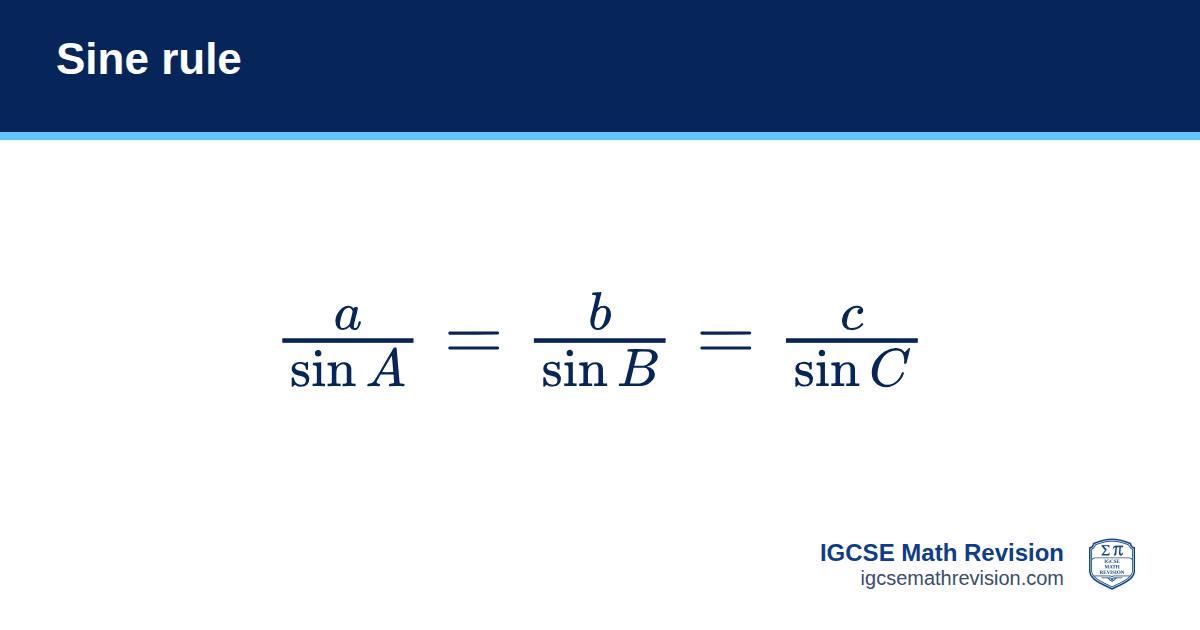
Sine rule formula: a/sin A = b/sin B
The sine rule formula is a/sin A = b/sin B = c/sin C.
Example: with P = 35°, Q = 110° and QR = 6 cm, PR = 6 × sin 110° ÷ sin 35° = 9.83 cm (3 s.f.).
What each letter means
- \(a,\ b,\ c\) the lengths of the sides
- \(A,\ B,\ C\) the angles opposite those sides (angle A is opposite side a)
Sine rule in Edexcel 4MA1 and Cambridge 0580
| Course | Where it is | Tier |
|---|---|---|
| Edexcel International GCSE Maths A (4MA1) | 4.8 Trigonometry and Pythagoras' theorem | Higher tier only Papers 1H and 2H |
| Cambridge IGCSE Mathematics (0580) | E6.5 Non-right-angled triangles | Extended only Paper 2 (no calculator) and Paper 4 (calculator) |
Calculator: Edexcel 4MA1: A calculator may be used in all four papers. Cambridge 0580: No calculator on Papers 1 and 2; a scientific calculator is needed for Papers 3 and 4. Algebraic or graphic calculators are not allowed.
Without a calculator: The angles must have exact sines, 30°, 45°, 60° or 90° (sub-topic E6.3): use sin 30° = ½ and sin 45° = √2/2 and leave the answer as a surd. 0580 non-calculator papers: what to practise.
When to use it
In a triangle without a right angle, when you know a side and the angle opposite it, plus one more side or angle. To find an angle, use it upside down: sin A / a = sin B / b.
Worked example
In triangle \(PQR\), angle \(P=35^\circ\), angle \(Q=110^\circ\) and \(QR=6\) cm. Find \(PR\).
- \(QR\) is opposite \(P\) and \(PR\) is opposite \(Q\)
- \(PR=\dfrac{6\sin110^\circ}{\sin35^\circ}\)
Answer: \(PR=9.83\) cm (3 s.f.)
Common mistake
Pairing a side with the wrong angle. Each side goes with the angle opposite it, not an angle next to it.
Try one yourself
One quick IGCSE Maths question on the sine rule. No sign-in needed.
Get 5 more like this — freeGoogle, Microsoft or email. No card needed.
IGCSE exam-style questions, marked step by step
Our own questions in the style of the 4MA1 and 0580 papers. M1 is a method mark, A1 an accuracy mark that needs the method before it, and B1 a mark that stands on its own. The split is our illustration: how IGCSE mark schemes work.
In triangle \(ABC\), angle \(A=30^\circ\), angle \(B=45^\circ\) and \(BC=6\) cm. Find \(AC\). Give your answer in the form \(k\sqrt2\).
- \(\dfrac{AC}{\sin45^\circ}=\dfrac{6}{\sin30^\circ}\) M1 · sine rule, matching pairs
- \(AC=\dfrac{6\times\frac{\sqrt2}{2}}{\frac12}\) M1 · exact values used
- \(AC=6\sqrt2\) A1 · answer
Answer: \(6\sqrt2\) cm 3 marks in all
In triangle \(PQR\), \(PQ=12\) cm, \(QR=9\) cm and angle \(QPR=40^\circ\). Angle \(PRQ\) is acute. Work out the size of angle \(PRQ\), correct to 1 decimal place.
- \(\dfrac{\sin R}{12}=\dfrac{\sin40^\circ}{9}\) M1 · sine rule for an angle
- \(\sin R=\dfrac{12\sin40^\circ}{9}=0.857\ldots\) M1 · rearranged
- \(R=59.0^\circ\) A1 · answer to 1 d.p.
Answer: \(59.0^\circ\) 3 marks in all
Where marks slip: The question asks for 1 decimal place, so write \(59.0^\circ\), not \(59^\circ\).
Where IGCSE students lose marks
- Ignoring the 3 s.f. (1 d.p. for angles) accuracy rule. Fix: Unless a question says otherwise, give non-exact answers to 3 significant figures and angles in degrees to 1 decimal place. Write the longer calculator value first, then the rounded answer. (Cambridge 0580 examiner reports)
From our summaries of the published examiner reports: Cambridge 0580.
Revise it for your IGCSE exam
- Notes 0580 notes: E6.5 Non-right-angled triangles
- Practise Skill Builder (0580): Non-right-angled triangles (free account)
- Papers Edexcel 4MA1 Higher past papers and mark schemes
- Papers Cambridge 0580 past papers and mark schemes
- Checklist 4MA1 specification and 0580 syllabus checklists
- Dates IGCSE Maths exam dates (4MA1 and 0580)
On your IGCSE Maths course
| Course | In the exam |
|---|---|
| Edexcel 4MA1 (Higher) | On the formulae page of the Higher papers |
| Cambridge 0580 | On the list of formulas in Extended papers (Extended only) |
From our own IGCSE Maths formula sheets, in our words. Official: Pearson's 4MA1 specification (PDF, Appendix 5) · Cambridge's 0580 syllabus (PDF).
Practise and revise
IGCSE Maths FAQ
Is the sine rule on the IGCSE formula sheet?
Edexcel 4MA1 (Higher): on the formulae page of the Higher papers. Cambridge 0580: on the list of formulas in Extended papers (Extended only).
What is the ambiguous case of the sine rule?
When you find an angle from two sides and an angle that is not between them, there can be two answers: θ and 180° − θ. Both are possible if the second still leaves room for the third angle.
Is the sine rule formula Foundation or Higher, Core or Extended?
On Edexcel 4MA1 it is Higher tier only (specification section 4.8, Trigonometry and Pythagoras' theorem), so it is tested on Papers 1H and 2H, not on the Foundation papers. On Cambridge 0580 it is Extended only (sub-topic E6.5, Non-right-angled triangles), so Core candidates do not need it.
Sine rule or SOH CAH TOA: how do I choose?
SOH CAH TOA works only in a right-angled triangle. With no right angle, use the sine rule when you know a side and the angle opposite it; with two sides and the angle between them, or three sides, use the cosine rule.
Can I use a calculator for sine rule questions in IGCSE Maths?
Edexcel 4MA1: A calculator may be used in all four papers. Cambridge 0580: No calculator on Papers 1 and 2; a scientific calculator is needed for Papers 3 and 4. Algebraic or graphic calculators are not allowed. Without a calculator, the angles must have exact sines, 30°, 45°, 60° or 90° (sub-topic E6.3): use sin 30° = ½ and sin 45° = √2/2 and leave the answer as a surd.
Our own wording, examples and card, checked by IGCSE Math Revision. Not produced or endorsed by Pearson Edexcel.