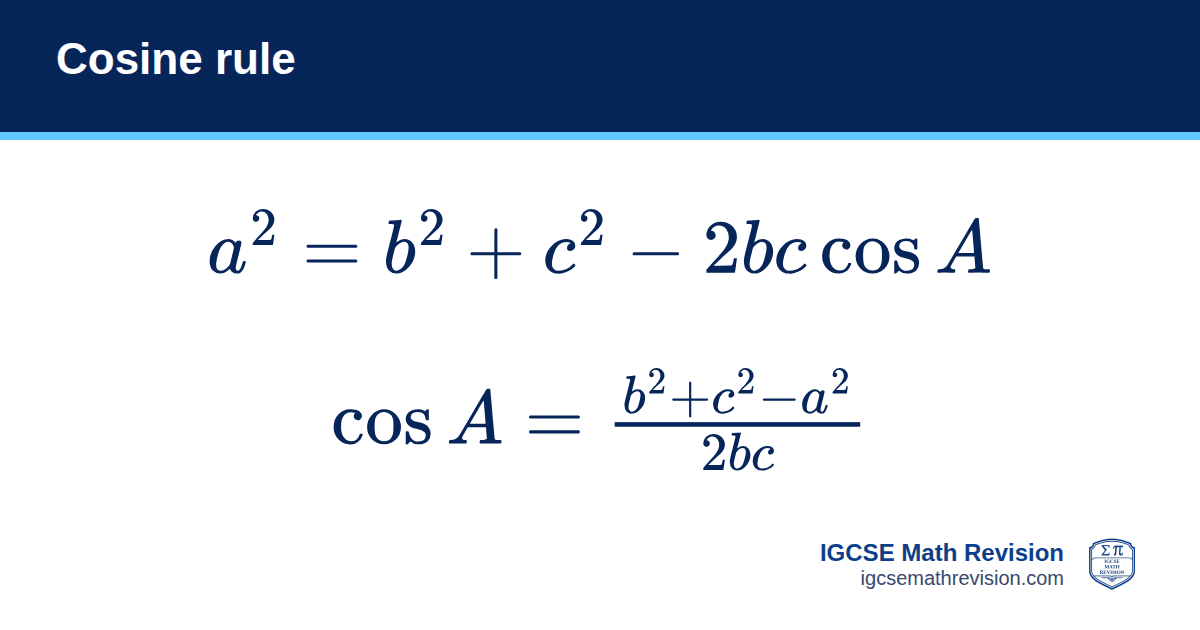
Cosine rule formula: a² = b² + c² − 2bc cos A
The cosine rule formula is a² = b² + c² − 2bc cos A, or cos A = (b² + c² − a²) / 2bc.
What each letter means
- \(a\) the side opposite angle A
- \(b,\ c\) the other two sides
- \(A\) the angle between sides b and c
When to use it
When you know two sides and the angle between them (to find the third side), or all three sides (to find an angle, using the cos A form).
Worked example
In triangle \(ABC\), \(AB=8\) cm, \(AC=11\) cm and angle \(A=47^\circ\). Find \(BC\).
- \(BC^2=8^2+11^2-2(8)(11)\cos47^\circ=185-176\cos47^\circ\)
Answer: \(BC=8.06\) cm (3 s.f.)
Common mistake
Working out b² + c² − 2bc first and then multiplying by cos A. Find 2bc cos A as one product, then subtract it.
On your course
| Course | In the exam |
|---|---|
| Edexcel 4MA1 (Higher) | On the formulae page of the Higher papers |
| Cambridge 0580 | On the list of formulas in Extended papers (Extended only) |
From our own IGCSE Maths formula sheets, in our words. Official: Pearson's 4MA1 specification (PDF, Appendix 5) · Cambridge's 0580 syllabus (PDF).
Practise and revise
Questions
What is the cosine rule formula?
The cosine rule formula is a² = b² + c² − 2bc cos A, or cos A = (b² + c² − a²) / 2bc. a: the side opposite angle A; b, c: the other two sides; A: the angle between sides b and c.
Is the cosine rule given in the exam?
Edexcel 4MA1 (Higher): on the formulae page of the Higher papers. Cambridge 0580: on the list of formulas in Extended papers (Extended only). This comes from our own IGCSE Maths formula sheets; your teacher has the official booklet.
Should I use the sine rule or the cosine rule?
Use the cosine rule when you know two sides and the angle between them, or all three sides. Use the sine rule when you know a side and the angle opposite it.
Our own wording, examples and card, checked by IGCSE Math Revision. Not produced or endorsed by Pearson Edexcel.