 IGCSE Math Revision
Worked example 1: Angle in a semicircle
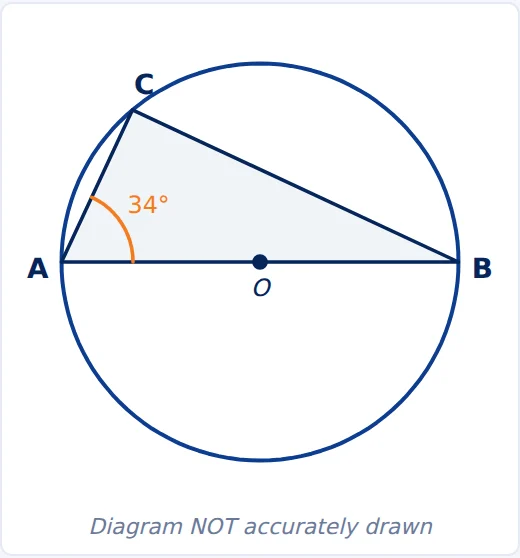
AB is a diameter and C is on the circle. Angle CAB =
Solution
- The angle in a semicircle is
- Angle ABC
Answer: 56°
3 steps · 1 to fill in
Tip: State the theorem as your reason.
Edexcel IGCSE Maths (4MA1) · Unit 5: Geometry
Updated October 2026 · By Pete Bromfield
The circle theorems link the angles made by chords, radii and tangents. The angle at the centre is twice the angle at the circumference; the angle in a semicircle is
1 of 6
Start with one question on circle theorems. Stuck? Take a hint. No sign-in needed.
5 more like this — free accountGoogle, Microsoft or email. No card needed.
The angle an arc makes at the centre is twice the angle it makes at the circumference. If the angle at the circumference is
Angles in the same segment, standing on the same chord, are equal. Opposite angles of a cyclic quadrilateral (all four corners on the circle) add to
A tangent is perpendicular to the radius at the point where it touches. Two tangents from the same outside point are equal in length. A tangent of length 15 cm from a point 17 cm from the centre touches a circle of radius
The angle between a tangent and a chord equals the angle in the alternate segment, on the other side of the chord. Look for it whenever a tangent and a triangle drawn in the circle meet at the same point.
The perpendicular from the centre to a chord bisects the chord. When two chords cross at
Learn it = not printed on the 4MA1 Higher formulae sheet, so learn it by heart. The whole 4MA1 formula sheet (free PDF) → · 4MA1 formulas to learn
AB is a diameter and C is on the circle. Angle CAB =
Answer: 56°
In a cyclic quadrilateral, one angle is
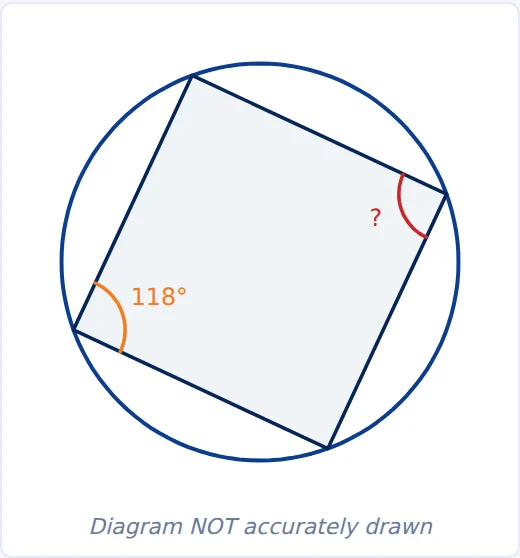
Answer: 62°
A tangent from P touches a circle of radius 5 cm at T. PT = 12 cm. Find the distance from P to the centre O.
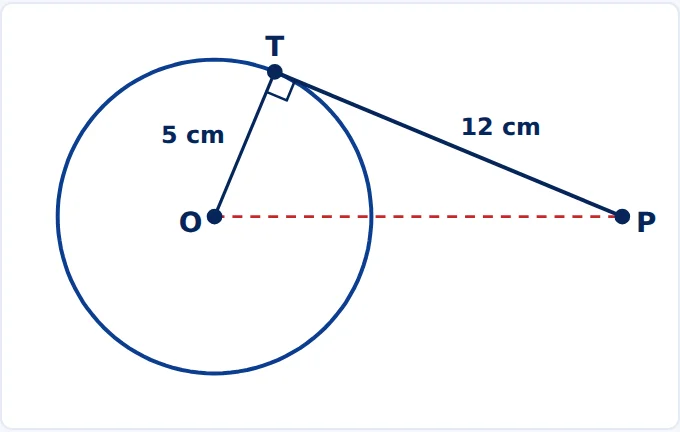
Answer: 13 cm
Free account: +5 practice questions on every topic, with instant feedback, and full worked answers on the free questions. Free, no card. Join free →
Try each question before you open the answer (one has its full worked solution open). The mark schemes use Edexcel-style marks: M for method, A for accuracy (after the method mark), B for an independent result.
A circle has centre O and radius 13 cm. AB is a chord of length 24 cm. Find the shortest distance from O to the chord AB.
Answer: 5 cm
A chord of a circle of radius 10 cm is 6 cm from the centre of the circle. Find the length of the chord.
Answer: 16 cm
Two chords AB and CD of a circle intersect at a point P inside the circle. AP = 4 cm, PB = 9 cm and CP = 6 cm. Find PD.
Answer: 6 cm
Every question here has a full worked solution. See them all →
Chords AB and CD of a circle intersect at P inside the circle. AP = 5 cm, PB = 8 cm and CD = 14 cm. CP is shorter than PD. Find CP.
Answer: 4 cm
P is a point outside a circle. A straight line through P meets the circle at A and then at B, so that A lies between P and B, where PA = 4 cm and AB = 12 cm. A second line through P meets the circle at C and D, where PC = 5 cm and C lies between P and D. Find the length of CD.
Answer: 7.8 cm
PT is a tangent to a circle at T. A line from P meets the circle at A and then at B. PA = 3 cm and AB = 9 cm. Find the length of PT.
Answer: 6 cm
A circle has radius 13 cm. Two parallel chords have lengths 10 cm and 24 cm. The chords are on opposite sides of the centre. Find the distance between the chords.
Answer: 17 cm
AB is a chord of length 16 cm in a circle with centre O. The perpendicular distance from O to AB is 4 cm. (a) Find the radius of the circle, correct to 3 significant figures. (2) (b) Find the size of angle AOB, correct to 3 significant figures. (2)
Answer: (a) 8.94 cm (b) 127°
Where students lose marks across 4MA1, from the examiner reports →
No. None of the circle theorems is printed on the 4MA1 Higher formulae sheet, so learn each one with the words to give as a reason.
Look at what meets where. A diameter means an angle in a semicircle; a tangent means a right angle with the radius or the alternate segment theorem; four points on the circle mean a cyclic quadrilateral; two angles on the same chord mean angles in the same segment.
Yes. A calculator may be used in all four 4MA1 papers, so both Higher papers (1H and 2H) allow one. Most marks are for the method you write down, so show your working.
Papers 1H and 2H are 2 hours each and 100 marks each, worth 50% each. Each tier has its own formulae sheet in the exam.
Circle Theorems revision notes · 4MA1 formula sheet · Taking Cambridge 0580 instead? Cambridge 0580 circle theorems questions
Every question and worked example here is original, written for IGCSE Math Revision rather than copied from Pearson papers, and every result was re-solved independently before publishing.
Save your answers and track your progressA free account remembers the questions you have done and brings you back to this page.
Join freeAlready have an account? Sign in