 IGCSE Math Revision
Worked example 1: Back bearing
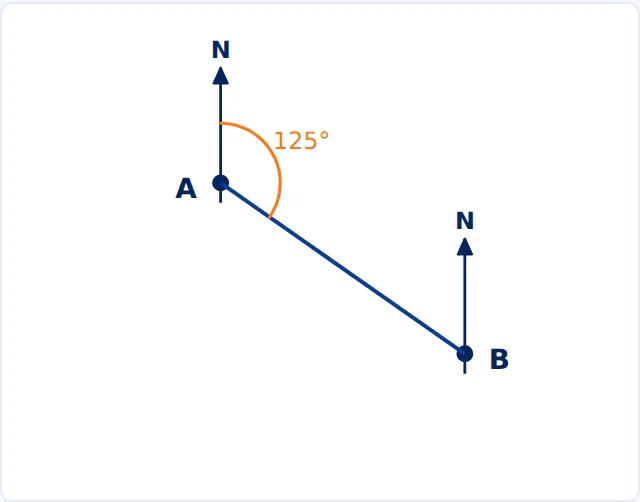
The bearing of B from A is
Solution
- The back bearing differs by
Answer: 305°
3 steps · 1 to fill in
Tip: Add 180 if the bearing is under 180, otherwise subtract.
Edexcel IGCSE Maths (4MA1) · Unit 5: Geometry
Updated October 2026 · By Pete Bromfield
A bearing is an angle measured clockwise from north, written with three figures, such as
1 of 8
Start with one question on bearings. Stuck? Take a hint. No sign-in needed.
5 more like this — free accountGoogle, Microsoft or email. No card needed.
Stand at the starting point, face north and turn clockwise to the line. "The bearing of B from A" is measured at A. Always use three figures:
The bearing of A from B is the bearing of B from A plus
Draw a north line at every point. A ship sails 8 km on a bearing of
On a map with scale 1 : 50 000, 1 cm on the map is 50 000 cm = 500 m in real life, so 7 cm on the map is 3.5 km. Work in the map's units and convert at the end.
Perpendicular bisector of AB: with the compasses set to more than half of AB, draw arcs from A and B above and below the line, and join the two crossing points. Angle bisector: an arc from the vertex cuts both arms; equal arcs from those two points cross on the bisector. Points the same distance from two points lie on the perpendicular bisector; points the same distance from two lines lie on the angle bisector; points within 3 m of a point form a circle of radius 3 m and its inside.
Learn it = not printed on the 4MA1 Higher formulae sheet, so learn it by heart. The whole 4MA1 formula sheet (free PDF) → · 4MA1 formulas to learn
The bearing of B from A is
Answer: 305°
A plan has scale 1 : 200. A wall is 3.5 cm long on the plan. Find its real length in metres.
Answer: 7 m
A goat is tied to a post by a 5 m rope in a large field. Describe the region it can reach and find its area.
Answer: Disc of radius 5 m; 78.5 m²
Free account: +5 practice questions on every topic, with instant feedback, and full worked answers on the free questions. Free, no card. Join free →
Where students lose marks across 4MA1, from the examiner reports →
Add 180° to the bearing if it is less than 180°, or subtract 180° if it is more. The bearing of A from B and the bearing of B from A always differ by 180°.
A ruler and a pair of compasses. A protractor is for measuring bearings and angles in scale drawings; the constructions themselves use only the ruler and compasses.
Yes. A calculator may be used in all four 4MA1 papers, so both Higher papers (1H and 2H) allow one. Most marks are for the method you write down, so show your working.
Papers 1H and 2H are 2 hours each and 100 marks each, worth 50% each. Each tier has its own formulae sheet in the exam.
Bearings and Constructions revision notes · 4MA1 formula sheet · Taking Cambridge 0580 instead? Cambridge 0580 scale drawings and bearings questions
Every question and worked example here is original, written for IGCSE Math Revision rather than copied from Pearson papers, and every result was re-solved independently before publishing.
Save your answers and track your progressA free account remembers the questions you have done and brings you back to this page.
Join freeAlready have an account? Sign in