The volume of any prism is the area of its cross-section times its length, so a cylinder has volume . A cone or pyramid is a third of the matching prism, and a sphere has volume . Surface area is the total area of every face: a closed cylinder has two circles plus the curved surface . The 4MA1 Higher formulae sheet gives the prism, cylinder, cone and sphere formulas, but not the pyramid.
Volume = area of cross-section × length. A triangular prism whose cross-section is a right-angled triangle with shorter sides 3 cm and 4 cm, and whose length is 10 cm, has volume cm³. A cylinder of radius 3 cm and height 10 cm has volume cm³.
Surface area
Add the areas of all the faces; a sketch of the net helps you count them. The curved surface of a cylinder unrolls to a rectangle by . A closed cylinder with and has surface area cm².
Cones and spheres
Cone: and curved surface area , where is the slant height. Sphere: and surface area . A cone with and has slant height , volume and curved surface area .
Pyramids and frustums
Pyramid: . A square-based pyramid with base 6 cm by 6 cm and height 5 cm has volume cm³. A frustum is a cone or pyramid with its top cut off: its volume is the large cone minus the small one.
Units and working backwards
Volumes are in cubic units and areas in square units, and 1 m³ = 1 000 000 cm³. To find a missing length, substitute and solve: a cylinder of volume 500 cm³ and radius 5 cm has height cm.
Key formulas
Prism; cylinder On the formula sheet
Cone (slant ) On the formula sheet
Sphere On the formula sheet
Pyramid Learn it
On the formula sheet = printed on the formulae sheet in the 4MA1 Higher papers, so know where to find it. Learn it = not printed on the 4MA1 Higher formulae sheet, so learn it by heart. The whole 4MA1 formula sheet (free PDF) → · 4MA1 formulas to learn
Volume and Surface Area worked examples
Worked example 1: Volume of a prism
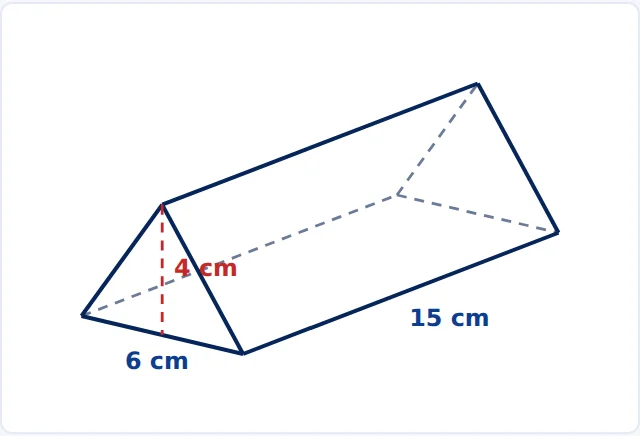
A triangular prism has a cross-section with base 6 cm and height 4 cm, and length 15 cm. Find its volume.
Solution
Cross-section area: .
Volume cm³.
Answer: 180 cm³
3 steps
Tip: Volume of a prism = area of cross-section × length.
Worked example 2: Surface area of a cylinder
Find the total surface area of a closed cylinder with radius 5 cm and height 8 cm.
Solution
Two circles: .
Curved surface: .
Total cm² (3 s.f.).
Answer: cm²
4 steps
Tip: The curved surface unrolls to a rectangle 2πr by h.
Worked example 3: Volume of a sphere
Find the volume of a sphere of radius 4.5 cm.
Solution
.
cm³ (3 s.f.).
Answer: 382 cm³
3 steps
Tip: Cube the radius before multiplying.
Free account: +5 practice questions on every topic, with instant feedback, and full worked answers on the free questions. Free, no card. Join free →
Volume and Surface Area exam-style questions
Try each question before you open the answer (one has its full worked solution open). The mark schemes use Edexcel-style marks: M for method, A for accuracy (after the method mark), B for an independent result.
Question 1 · easy · 2 marks
A cube has edges of length 4 cm. Work out its total surface area.
Show the answer and mark scheme
M1 6 × 4²
A1 96 cm²
Answer: 96 cm²
Question 2 · easy · 2 marks
A cuboid measures 5 cm by 3 cm by 2 cm. Work out its total surface area.
Show the answer and mark scheme
M1 2 × (5×3 + 5×2 + 3×2) or at least two different face areas doubled
A1 62 cm²
Answer: 62 cm²
Question 3 · easy · 3 marks
A closed cylinder has radius 4 cm and height 10 cm. Work out its total surface area. Give your answer in terms of π.
Show the answer and mark scheme
M1 2 × π × 4² (= 32π)
M1 2 × π × 4 × 10 (= 80π)
A1 112π
Answer: cm²
Question 4 · medium · 3 marks
A triangular prism has a cross-section that is a right-angled triangle with sides 6 cm, 8 cm and 10 cm. The prism is 15 cm long. Work out its total surface area.
Full worked solution Free, no sign-in
M1 2 × ½ × 6 × 8 (= 48)
M1 15 × (6 + 8 + 10) (= 360)
A1 408 cm²
Answer: 408 cm²
Every question here has a full worked solution.See them all →
Question 5 · medium · 3 marks
A cylinder with no lid has radius 5 cm and height 12 cm. Work out its total outside surface area. Give your answer to 3 significant figures.
Show the answer and mark scheme
M1 π × 5² (one end only)
M1 2 × π × 5 × 12
A1 456 (455.5…)
Answer: 456 cm²
Question 6 · medium · 2 marks
The curved surface area of a cylinder is cm². The radius is 5 cm. Find the height of the cylinder.
Show the answer and mark scheme
M1 2π × 5 × h = 150π
A1 15 cm
Answer: 15 cm
Question 7 · hard · 3 marks
A cuboid has a square base of side 6 cm and a volume of 360 cm³. Work out its total surface area.
Show the answer and mark scheme
M1 height 360 ÷ 36 = 10
M1 2 × 36 + 4 × 6 × their 10
A1 312 cm²
Answer: 312 cm²
Question 8 · hard · 4 marks
A prism is 20 cm long. Its cross-section is an isosceles trapezium with parallel sides 10 cm and 4 cm, perpendicular height 4 cm and sloping sides 5 cm. Work out the total surface area of the prism.
Show the answer and mark scheme
M1 trapezium area ½ × (10 + 4) × 4 (= 28)
M1 2 × their 28
M1 20 × (10 + 4 + 5 + 5) (= 480)
A1 536 cm²
Answer: 536 cm²
Common volume and surface area mistakes
Using the diameter as the radius. Halve the diameter first. Putting the diameter into makes the area four times too big.
Missing faces. A closed cylinder has two circular ends as well as the curved surface; an open one, like a cup, has one end.
Slant height or vertical height. A cone's volume uses the vertical height ; its curved surface uses the slant height . Pythagoras links them: .
Mixing units. Convert every length to the same unit before you calculate. Converting cm³ to m³ divides by 1 000 000, not by 100.
Which volume formulas are on the 4MA1 formula sheet?
The 4MA1 Higher formulae sheet gives the volume of a prism, the volume and curved surface area of a cylinder and of a cone, and the volume and surface area of a sphere. The pyramid formula, V = ⅓ × base area × height, is not given, so learn it.
How do I find the surface area of a cylinder?
Add the two circular ends, 2πr², to the curved surface, 2πrh. For an open cylinder, such as a tin with no lid, include only one end.
Can I use a calculator for volume and surface area in 4MA1?
Yes. A calculator may be used in all four 4MA1 papers, so both Higher papers (1H and 2H) allow one. Most marks are for the method you write down, so show your working.
How long are the 4MA1 Higher papers?
Papers 1H and 2H are 2 hours each and 100 marks each, worth 50% each. Each tier has its own formulae sheet in the exam.
Every question and worked example here is original, written for IGCSE Math Revision rather than copied from Pearson papers, and every result was re-solved independently before publishing.
Practise volume and surface area with your progress saved
Save your answers and track your progressA free account remembers the questions you have done and brings you back to this page.
 IGCSE Math Revision