Simultaneous equations are two equations that are true at the same time; the solution is the pair of values that fits both, which is where their graphs meet. For two linear equations, eliminate one unknown by adding or subtracting the equations (after scaling so a coefficient matches), or substitute. For one linear and one quadratic equation, rearrange the linear one and substitute it into the quadratic: you get up to two pairs of solutions.
Make the coefficients of one unknown the same size, then add the equations if the signs are different and subtract them if the signs are the same. For and , add: , so and . If no coefficient matches, multiply first: and become and ; subtracting gives , so and .
Substitution
If one equation already gives (or ) on its own, substitute it into the other. From and : , so , and .
Word problems
Choose a letter for each unknown and write one equation for each fact. Two adult tickets and three child tickets cost £31; one adult and two child tickets cost £18. So and , giving and : an adult ticket is £8 and a child ticket £5.
One linear and one quadratic equation
Rearrange the linear equation to or , substitute into the quadratic, rearrange to and solve. From and : , so , giving or . Find each from the linear equation and give the answers as pairs.
What the solutions mean on a graph
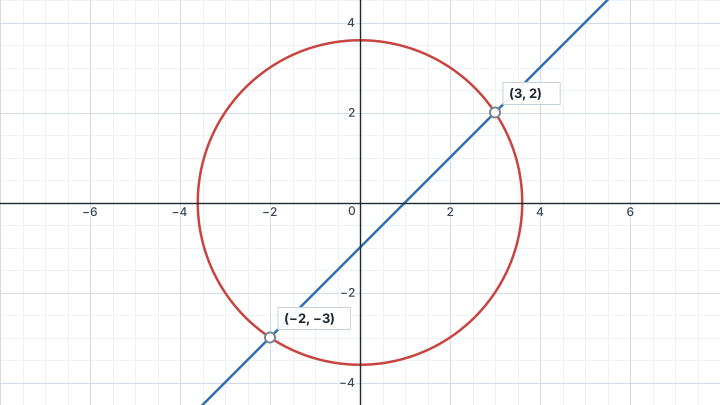
Each solution pair is a point where the two graphs cross. A line can cross a curve twice, touch it once or miss it altogether, so a linear and a quadratic equation have two, one or no pairs of real solutions. The graph shows worked example 2: the line crosses the circle at its two solutions.
Worked example 2 drawn with our Grapher: the line meets the circle at the two solution pairs.
Worked example 3: Forming and solving a pair of equations · 4 marks
At a climbing centre, 3 adult sessions and 5 junior sessions cost £65.75 in total. 4 adult sessions and 2 junior sessions cost £58.50 in total. Work out the cost of one adult session and the cost of one junior session.
Mark scheme
M1 3a + 5j = 65.75 and 4a + 2j = 58.50
M1 matches coefficients and eliminates, e.g. 12a + 20j = 263 and 12a + 6j = 175.50
A1 j = 6.25 or a = 11.50
A1 adult £11.50, junior £6.25
Answer: adult £11.50, junior £6.25
Free account: +5 practice questions on every topic, with instant feedback, and full worked answers on the free questions. Free, no card. Join free →
Simultaneous Equations exam-style questions
Try each question before you open the answer (one has its full worked solution open). The mark schemes use Edexcel-style marks: M for method, A for accuracy (after the method mark), B for an independent result.
Question 1 · easy · 3 marks
Solve the simultaneous equations and .
Show the answer and mark scheme
M1 adds to eliminate y: 6x = 18
M1 substitutes their x = 3 into either equation
A1 x = 3, y = −1
Answer:,
Question 2 · easy · 3 marks
Solve the simultaneous equations and .
Show the answer and mark scheme
M1 subtracts to eliminate x: 6y = −12
M1 substitutes their y = −2 into either equation
A1 x = 3, y = −2
Answer:,
Question 3 · medium · 3 marks
Solve the simultaneous equations and .
Full worked solution Free, no sign-in
M1 multiplies to match coefficients, e.g. 8x + 6y = 50 and 9x + 6y = 54
M1 eliminates a variable and substitutes back
A1 x = 4, y = 3
Answer:,
Every question here has a full worked solution.See them all →
Question 4 · medium · 3 marks
Solve the simultaneous equations and .
Show the answer and mark scheme
M1 e.g. 18x + 12y = 21 and 8x − 12y = 18
M1 26x = 39 and substitutes their x
A1 x = 1.5, y = −0.5
Answer:,
Question 5 · hard · 5 marks
The line passes through the points and . (a) Find the values of and . (b) The line meets the line at the point P. Find the coordinates of P.
Show the answer and mark scheme
M1 2a + 3b = 14 and −a + 9b = 14
M1 eliminates a, e.g. 2a + 3b = 14 and −2a + 18b = 28 so 21b = 42
A1 a = 4, b = 2
M1 4x + 2y = 14 and 3x − 2y = 5 added: 7x = 19
A1 (19/7, 11/7)
Answer: (a) , (b)
Question 6 · hard · 3 marks
Solve the simultaneous equations and .
Show the answer and mark scheme
M1 e.g. multiplies the first by 3: 1.2x + 4.5y = 10.2
M1 subtracts: 5y = 6, and substitutes their y
A1 x = 4, y = 1.2
Answer:,
Question 7 · hard · 5 marks
Solve the simultaneous equations and .
Show the answer and mark scheme
M1 x² + (2x − 1)² = 34
A1 5x² − 4x − 33 = 0
M1 (x − 3)(5x + 11) = 0 or correct use of the formula
A1 x = 3 and x = −2.2
A1 y = 5 and y = −5.4, correctly paired
Answer: or
Common simultaneous equations mistakes
Adding when you should subtract. If the matching terms have the same sign, such as and , subtract the equations; if the signs differ, add them.
Stopping after one unknown. Substitute your first value back into one of the original equations to find the other, and give both values.
Unpaired answers. In a linear and quadratic pair, each has its own . Write and , not and .
Finding y from the quadratic. Find from the linear equation. Putting into gives , but only is on the line .
Use elimination when both equations are in the form ax + by = c. Use substitution when one equation already gives x or y on its own, and always for one linear and one quadratic equation.
How many solutions can a linear and a quadratic equation have?
Up to two pairs. The line can cross the curve twice, touch it once (one repeated solution) or miss it (no real solutions). Each pair is a point where the graphs meet.
Can I use a calculator for simultaneous equations in 4MA1?
Yes. A calculator may be used in all four 4MA1 papers, so both Higher papers (1H and 2H) allow one. Most marks are for the method you write down, so show your working.
How long are the 4MA1 Higher papers?
Papers 1H and 2H are 2 hours each and 100 marks each, worth 50% each. Each tier has its own formulae sheet in the exam.
Every question and worked example here is original, written for IGCSE Math Revision rather than copied from Pearson papers, and every result was re-solved independently before publishing.
Practise simultaneous equations with your progress saved
Save your answers and track your progressA free account remembers the questions you have done and brings you back to this page.
 IGCSE Math Revision