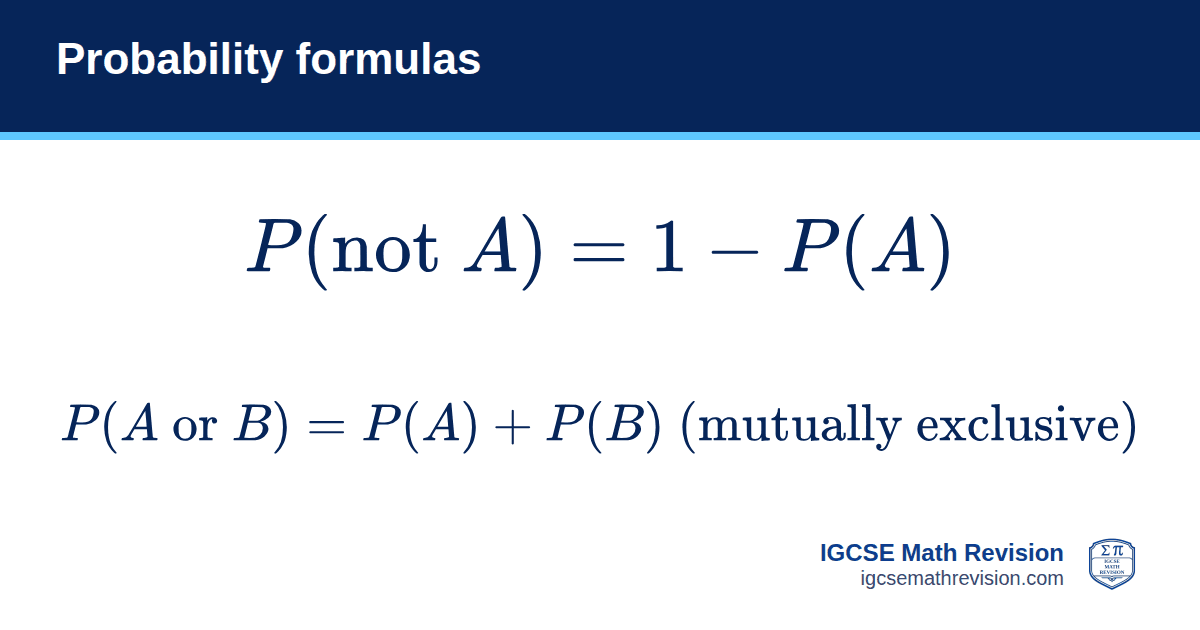
Probability formulas: P(not A) = 1 − P(A)
The probability formulas are P(not A) = 1 − P(A); P(A or B) = P(A) + P(B) when A and B cannot both happen.
What each letter means
- \(A,\ B\) two events
- \(P(A)\) the probability that A happens, between 0 and 1
When to use it
To combine probabilities of events: 'or' questions, 'at least one' questions, and Venn diagrams.
Worked example
A bag has 5 red, 3 blue and 2 green counters. One is taken at random. Find P(not blue) and P(blue or green).
- \(P(\text{blue})=\tfrac3{10}\), so \(P(\text{not blue})=1-\tfrac3{10}\)
- Blue and green cannot both happen: \(\tfrac3{10}+\tfrac2{10}\)
Answer: \(P(\text{not blue})=\tfrac7{10}\); \(P(\text{blue or green})=\tfrac12\)
Common mistake
Adding the probabilities of events that can happen together without subtracting the overlap P(A ∩ B).
On your course
| Course | In the exam |
|---|---|
| Edexcel 4MA1 (Higher) Mutually exclusive | Not given: learn it |
| Edexcel 4MA1 (Higher) Any two events | Not given: learn it |
| Cambridge 0580 Probability | Not given: learn it |
| Cambridge 0580 Mutually exclusive | Not given: learn it |
From our own IGCSE Maths formula sheets, in our words. Official: Pearson's 4MA1 specification (PDF, Appendix 5) · Cambridge's 0580 syllabus (PDF).
Practise and revise
- Practise 4MA1 probability questions
- Practise 0580 probability questions
- Revise Statistics and probability notes
- Print Edexcel 4MA1 (Higher) one-page formula sheet
Questions
What is the probability formula?
The probability formulas are P(not A) = 1 − P(A); P(A or B) = P(A) + P(B) when A and B cannot both happen. A, B: two events; P(A): the probability that A happens, between 0 and 1.
Is the probability formulas given in the exam?
Edexcel 4MA1 (Higher) (Mutually exclusive): not given: learn it. Cambridge 0580 (Probability): not given: learn it. This comes from our own IGCSE Maths formula sheets; your teacher has the official booklet.
When can I just add probabilities?
When the events are mutually exclusive (they cannot both happen). Then P(A ∩ B) = 0 and P(A ∪ B) = P(A) + P(B).
Our own wording, examples and card, checked by IGCSE Math Revision. Not produced or endorsed by Pearson Edexcel.