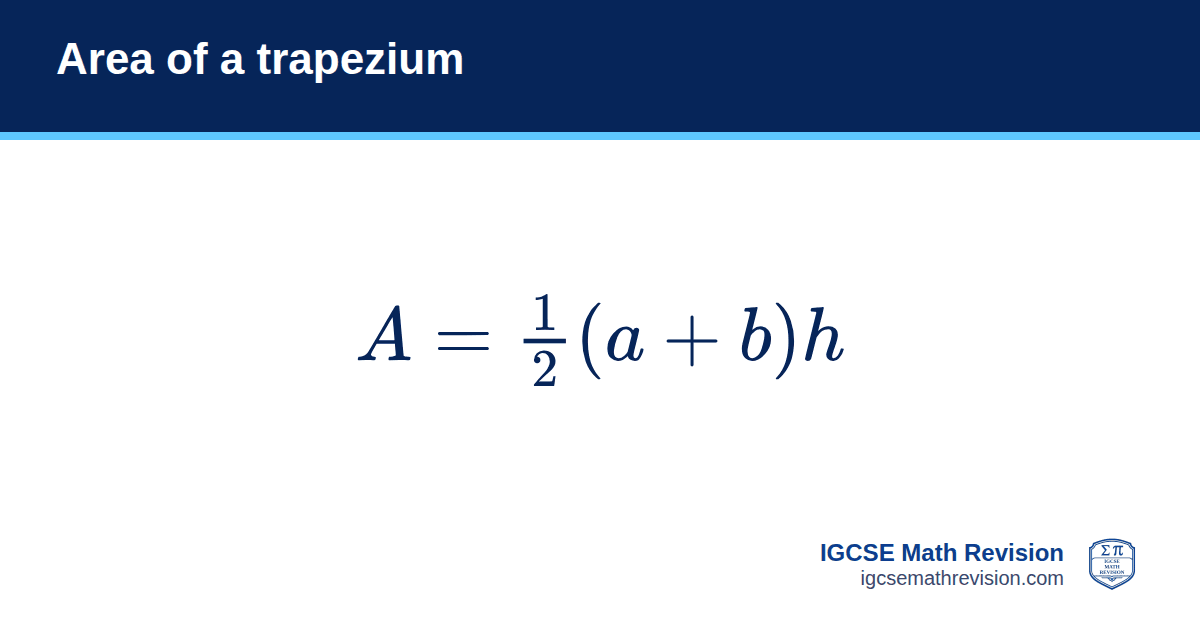
Area of a trapezium formula: A = ½(a + b)h
The area of a trapezium formula is A = ½(a + b)h.
What each letter means
- \(a,\ b\) the two parallel sides
- \(h\) the perpendicular distance between them
When to use it
For any four-sided shape with one pair of parallel sides, and for prisms with a trapezium cross-section.
Worked example
A trapezium has parallel sides 7 cm and 11 cm, 5 cm apart. Find its area.
- \(A=\tfrac12(7+11)\times5=9\times5\)
Answer: \(45\text{ cm}^2\)
Common mistake
Using the slanted side as the height. h is measured at right angles to the parallel sides.
On your course
| Course | In the exam |
|---|---|
| Edexcel 4MA1 (Higher) | On the formulae page of the Higher papers |
| Cambridge 0580 | Not given: learn it |
From our own IGCSE Maths formula sheets, in our words. Official: Pearson's 4MA1 specification (PDF, Appendix 5) · Cambridge's 0580 syllabus (PDF).
Practise and revise
Questions
What is the area of a trapezium formula?
The area of a trapezium formula is A = ½(a + b)h. a, b: the two parallel sides; h: the perpendicular distance between them.
Is the area of a trapezium given in the exam?
Edexcel 4MA1 (Higher): on the formulae page of the Higher papers. Cambridge 0580: not given: learn it. This comes from our own IGCSE Maths formula sheets; your teacher has the official booklet.
Which length is the height of a trapezium?
The perpendicular distance between the two parallel sides, not the length of a slanted side.
Our own wording, examples and card, checked by IGCSE Math Revision. Not produced or endorsed by Pearson Edexcel.