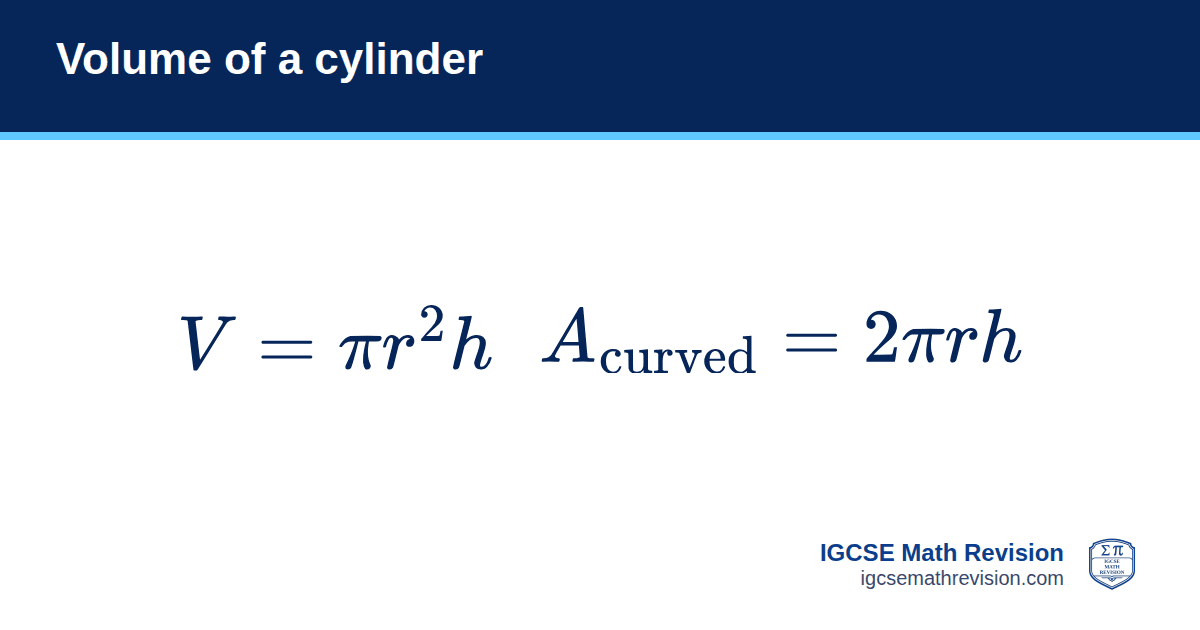
Volume of a cylinder formula: V = πr²h
The volume of a cylinder formula is V = πr²h (curved surface area = 2πrh).
What each letter means
- \(V\) the volume
- \(r\) the radius of the circular end
- \(h\) the height (the length between the two ends)
- \(2\pi rh\) the curved surface area: the label that wraps round a can
When to use it
For tins, pipes, tanks and any prism with a circular cross-section: the area of the circle πr² times the length h.
Worked example
A cylinder has volume \(500\text{ cm}^3\) and radius 5 cm. Find its height, to 3 significant figures.
- \(500=\pi(5)^2h=25\pi h\)
- \(h=\dfrac{500}{25\pi}=\dfrac{20}{\pi}\)
Answer: \(h=6.37\text{ cm}\)
Common mistake
Using the diameter as r. Halve the diameter first, and keep the units the same (convert m to cm before you multiply).
On your course
| Course | In the exam |
|---|---|
| Edexcel 4MA1 (Higher) | On the formulae page of the Higher papers |
| Cambridge 0580 | On the list of formulas printed in the paper |
From our own IGCSE Maths formula sheets, in our words. Official: Pearson's 4MA1 specification (PDF, Appendix 5) · Cambridge's 0580 syllabus (PDF).
Practise and revise
Questions
What is the volume of a cylinder formula?
The volume of a cylinder formula is V = πr²h (curved surface area = 2πrh). V: the volume; r: the radius of the circular end; h: the height (the length between the two ends); 2π rh: the curved surface area: the label that wraps round a can.
Is the volume of a cylinder given in the exam?
Edexcel 4MA1 (Higher): on the formulae page of the Higher papers. Cambridge 0580: on the list of formulas printed in the paper. This comes from our own IGCSE Maths formula sheets; your teacher has the official booklet.
What is the total surface area of a cylinder?
Total surface area = 2πrh + 2πr²: the curved surface plus the two circular ends. Leave out an end if the cylinder is open.
Our own wording, examples and card, checked by IGCSE Math Revision. Not produced or endorsed by Pearson Edexcel.