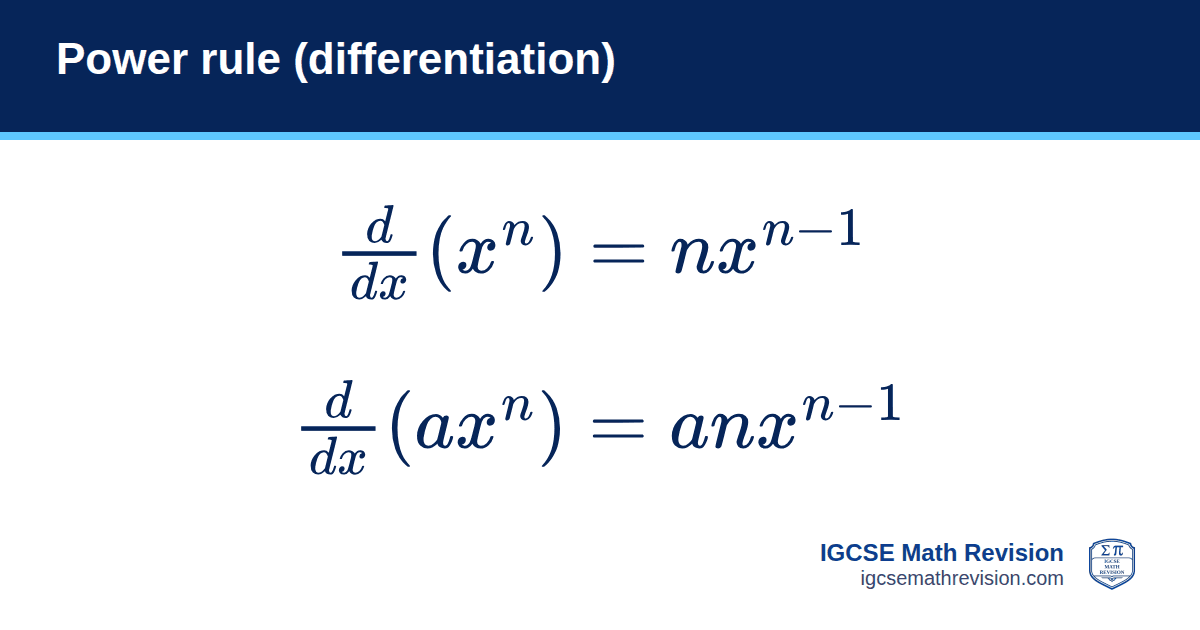
Power rule for differentiation: d/dx (xⁿ) = nxⁿ⁻¹
The power rule for differentiation is d/dx (xⁿ) = nxⁿ⁻¹, and d/dx (axⁿ) = anxⁿ⁻¹.
What each letter means
- \(n\) the power: any number, including fractions and negatives
- \(a\) a constant multiple
- \(\frac{d}{dx}\) differentiate with respect to x
When to use it
To differentiate any power of x, term by term: polynomials, roots (√x = x^½) and reciprocals (1/x² = x⁻²). Rewrite roots and fractions as powers first.
Worked example
\(y=x^3-6x^2+5\). Find \(\dfrac{dy}{dx}\) and the gradient of the curve when \(x=3\).
- \(\dfrac{dy}{dx}=3x^2-12x\)
- At \(x=3\): \(3(9)-12(3)=27-36\)
Answer: \(\dfrac{dy}{dx}=3x^2-12x\); gradient \(=-9\)
Common mistake
Differentiating 1/x² as 1/(2x). Write it as x⁻² first: the derivative is −2x⁻³. And the derivative of a constant is 0.
On your course
| Course | In the exam |
|---|---|
| Edexcel 4MA1 (Higher) | Not given: learn it |
| Cambridge 0580 | Not given: learn it (Extended only) |
From our own IGCSE Maths formula sheets, in our words. Official: Pearson's 4MA1 specification (PDF, Appendix 5) · Cambridge's 0580 syllabus (PDF).
Practise and revise
Questions
What is the power rule for differentiation formula?
The power rule for differentiation is d/dx (xⁿ) = nxⁿ⁻¹, and d/dx (axⁿ) = anxⁿ⁻¹. n: the power: any number, including fractions and negatives; a: a constant multiple; d/dx: differentiate with respect to x.
Is the power rule (differentiation) given in the exam?
Edexcel 4MA1 (Higher): not given: learn it. Cambridge 0580: not given: learn it (Extended only). This comes from our own IGCSE Maths formula sheets; your teacher has the official booklet.
How do I differentiate √x or 1/x?
Write them as powers: √x = x^½ gives ½x^(−½) = 1/(2√x), and 1/x = x⁻¹ gives −x⁻² = −1/x².
Our own wording, examples and card, checked by IGCSE Math Revision. Not produced or endorsed by Pearson Edexcel.