Equation of a straight line: y = mx + c
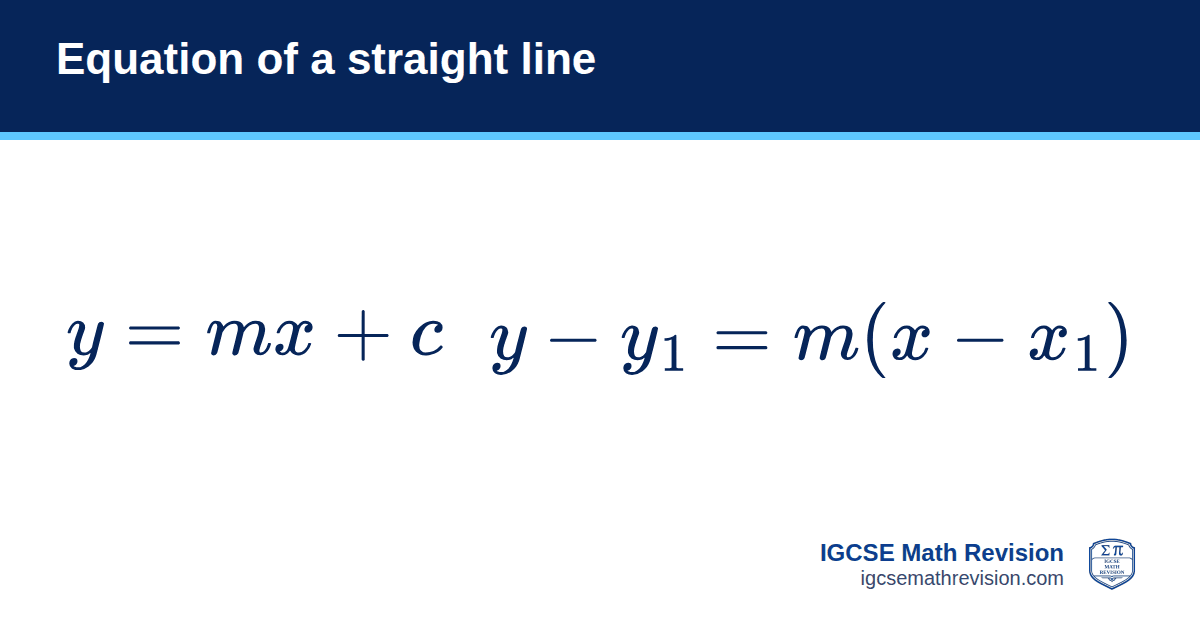
The equation of a straight line is y = mx + c, or y − y₁ = m(x − x₁) through the point (x₁, y₁).
What each letter means
- \(m\) the gradient (slope)
- \(c\) the y-intercept: where the line crosses the y-axis
- \((x_1,\ y_1)\) a point on the line
When to use it
To write the equation of a line from its gradient and one point, or from two points (find the gradient first). Use y − y₁ = m(x − x₁) when the point is not on the y-axis.
Worked example
A line has gradient 4 and passes through the point \((1,7)\). Find its equation.
- \(y=4x+c\); at \((1,7)\): \(7=4(1)+c\)
- \(c=3\)
Answer: \(y=4x+3\)
Common mistake
Sign slips with a negative coordinate: through (−3, 4) the equation is y − 4 = m(x + 3), not m(x − 3).
On your course
| Course | In the exam |
|---|---|
| Edexcel 4MA1 (Higher) | Not given: learn it |
From our own IGCSE Maths formula sheets, in our words. Official: Pearson's 4MA1 specification (PDF, Appendix 5).
Practise and revise
Questions
What is the equation of a straight line formula?
The equation of a straight line is y = mx + c, or y − y₁ = m(x − x₁) through the point (x₁, y₁). m: the gradient (slope); c: the y-intercept: where the line crosses the y-axis; (x₁, y₁): a point on the line.
Is the equation of a straight line given in the exam?
Edexcel 4MA1 (Higher): not given: learn it. This comes from our own IGCSE Maths formula sheets; your teacher has the official booklet.
How do I find the equation of a line through two points?
Find the gradient m = (y₂ − y₁) ÷ (x₂ − x₁), then put m and either point into y − y₁ = m(x − x₁) and rearrange.
Our own wording, examples and card, checked by IGCSE Math Revision. Not produced or endorsed by Pearson Edexcel.