Distance formula: d = √((x₁ − x₂)² + (y₁ − y₂)²)
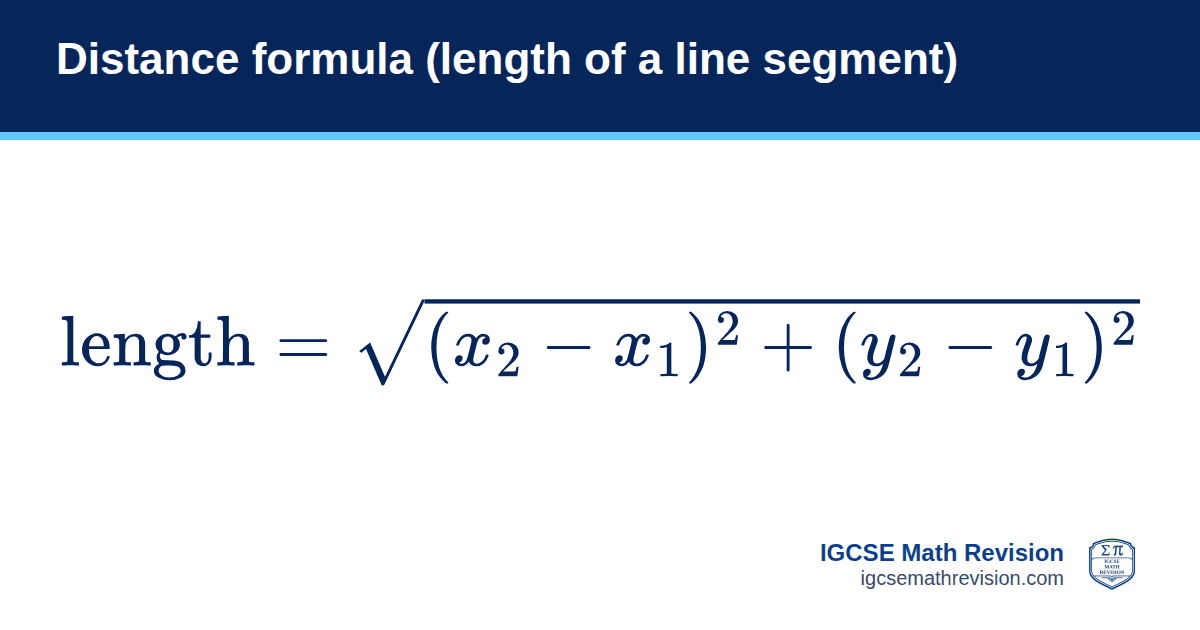
The distance formula is length = √((x₂ − x₁)² + (y₂ − y₁)²).
What each letter means
- \(d\) the distance between the two points
- \((x_1,\ y_1),\ (x_2,\ y_2)\) the two points
When to use it
To find the length of a line segment from the coordinates of its ends. It is Pythagoras on the horizontal and vertical gaps.
Worked example
Find the length of the line segment joining \((-3,5)\) and \((5,-1)\).
- \(\sqrt{(5-(-3))^2+(-1-5)^2}=\sqrt{64+36}\)
Answer: \(\sqrt{100}=10\)
Common mistake
Squaring a negative wrongly: (−6)² = 36, not −36. Put negative differences in brackets.
On your course
| Course | In the exam |
|---|---|
| Edexcel 4MA1 (Higher) | Not given: learn it |
| Cambridge 0580 | Not given: learn it (Extended only) |
From our own IGCSE Maths formula sheets, in our words. Official: Pearson's 4MA1 specification (PDF, Appendix 5) · Cambridge's 0580 syllabus (PDF).
Practise and revise
Questions
What is the distance formula?
The distance formula is length = √((x₂ − x₁)² + (y₂ − y₁)²). d: the distance between the two points; (x₁, y₁), (x₂, y₂): the two points.
Is the distance formula (length of a line segment) given in the exam?
Edexcel 4MA1 (Higher): not given: learn it. Cambridge 0580: not given: learn it (Extended only). This comes from our own IGCSE Maths formula sheets; your teacher has the official booklet.
How is the distance formula related to Pythagoras?
The horizontal and vertical gaps between the points are the two shorter sides of a right-angled triangle, so the distance is its hypotenuse.
Our own wording, examples and card, checked by IGCSE Math Revision. Not produced or endorsed by Pearson Edexcel.