Edexcel IGCSE Maths (4MA1) · Unit 7: Vectors & Proof
Edexcel IGCSE 4MA1 Vectors: Exam Questions and Answers
Vectors questions with full solutions for Pearson Edexcel International GCSE Mathematics A (4MA1), Higher tier. Read the 3 worked examples first, then try the 8 exam-style questions yourself and check your working against the mark scheme.
Vectors 2: Vector Arithmetic: Vector magnitude and vector routes on grids.
Vectors 3: Geometric Proofs: Using vector methods to prove points collinear/midpoints.
Vectors worked examples
Worked example 1: Column vectors
. Find and the magnitude of .
Solution
.
Magnitude .
Answer:; 13
Magnitude .
3 steps · 1 to fill in
Tip: Magnitude uses Pythagoras.
Worked example 2: Vector arithmetic
, . Find .
Solution
.
.
Answer:
3 steps
Tip: Subtracting a negative adds.
Worked example 3: Midpoint vector
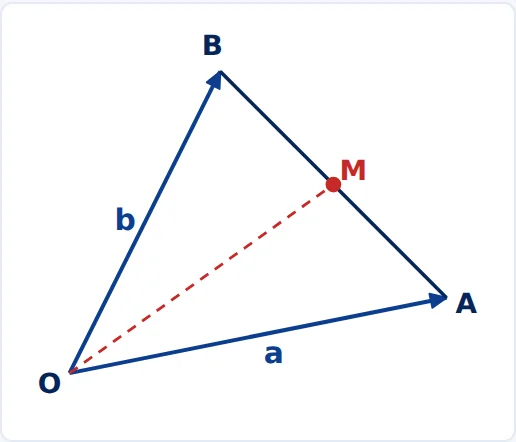
, and M is the midpoint of AB. Find .
Solution
.
.
Answer:
3 steps
Tip: Travel along known vectors from O to M.
Vectors exam-style questions
Try each question before you open the answer (one has its full worked solution open). The mark schemes use Edexcel-style marks: M for method, A for accuracy (after the method mark), B for an independent result.
Question 1 · easy · 2 marks
and . Write as a column vector.
Show the answer and mark scheme
M1 (6, −4) or (−3, 15) seen as column vectors
A1 (9, −19) as a column vector
Answer:
Question 2 · easy · 2 marks
and . Show that AB is parallel to CD.
Show the answer and mark scheme
B1 AB = −3(−a + 2b) = −3 CD
B1 one vector is a multiple of the other, so AB is parallel to CD
Answer:, so AB is parallel to CD (shown)
Question 3 · medium · 3 marks
(a) Find the magnitude of the vector . (b) The vector has magnitude 10, and is negative. Find the value of .
Show the answer and mark scheme
B1 13
M1 k² + 6² = 10²
A1 k = −8
Answer: (a) 13 (b)
Question 4 · medium · 3 marks
and . P lies on AB with . Find in terms of and . Give your answer in its simplest form.
Show the answer and mark scheme
M1 AB = b − a
M1 OP = a + ¼(b − a)
A1 ¾a + ¼b oe
Answer:
Question 5 · medium · 3 marks
, and . Prove that P, Q and R are collinear.
Full worked solution Free, no sign-in
M1 PQ = 3a + 2b or QR = 6a + 4b
M1 both PQ and QR (or PR = 9a + 6b)
A1 QR = 2PQ, parallel with the common point Q, so collinear
Answer:, with the common point Q (proved)
Every question here has a full worked solution.See them all →
Question 6 · hard · 4 marks
OABC is a parallelogram with and . M is the midpoint of AB, and N is the point on OC with . Find in terms of and . Give your answer in its simplest form.
Show the answer and mark scheme
B1 OM = a + ½c
B1 ON = ¼c
M1 NM = NO + OM = −¼c + a + ½c
A1 a + ¼c
Answer:
Question 7 · hard · 4 marks
and . P is the midpoint of OA. Q lies on AB with . R lies on OB extended so that . (a) Find in terms of and . (b) Prove that P, Q and R lie on a straight line.
Show the answer and mark scheme
M1 OQ = 4a + ¾(4b − 4a) = a + 3b
A1 PQ = −a + 3b
M1 PR = −2a + 6b
A1 PR = 2PQ, so PQ and PR are parallel and share the point P: P, Q, R are collinear
Answer: (a) (b) , parallel with the common point P, so collinear (proved)
Question 8 · very hard · 6 marks
OABC is a parallelogram with and . N is the midpoint of AB. Y is the point on CN with . (a) Find in terms of and . (b) Prove that Y lies on the diagonal OB, and find the ratio .
Show the answer and mark scheme
B1 ON = a + ½c (or AN = ½c)
M1 CN = −c + a + ½c
A1 CN = a − ½c
M1 OY = c + ⅔(a − ½c)
A1 OY = ⅔a + ⅔c
A1 OB = a + c, so OY = ⅔ OB: a multiple of OB with O common, so Y lies on OB; OY : YB = 2 : 1
Answer: (a) (b) , so Y lies on OB (proved);
Every question and worked example here is original, written for IGCSE Math Revision rather than copied from Pearson papers, and each answer was re-solved independently before publishing.
Either Higher tier paper, 1H or 2H, can test vectors: both cover the whole Pearson Edexcel International GCSE Mathematics A (4MA1) specification and both allow a calculator. Show your method, because most marks are for working.
Where can I practise more vectors questions?
In the IGCSE student hub: Unit 7 (Vectors & Proof) has more exam-style questions on this topic, each with a mark scheme. Practice starts with a 7-day free trial; the worked examples and questions on this page are free.
Practise vectors with your progress saved
Save your answers and track your progressA free account remembers the questions you have done and brings you back to this page.
 IGCSE Math Revision