The highest power of tells you the shape: gives a U-shaped (or upside-down) parabola, a cubic curve, and a reciprocal curve in two parts. Plot from a table of values and join the points with one smooth curve. To solve an equation with a graph you already have, rearrange it so one side is that graph, then read off where the line for the other side crosses it.
Work out for each , with brackets round negative values: for , gives . A quadratic's values are symmetrical about its line of symmetry, which is a quick check. Join the points with a smooth curve, not straight lines, and do not flatten the bottom.
Recognising the shapes
is a ∪ shape when and a ∩ shape when . passes through the origin and rises from left to right; falls. never meets the axes: the lines and are its asymptotes.
Roots, intercepts and turning points
The roots are where the curve crosses the -axis and the -intercept is the constant term. crosses the -axis at and , meets the -axis at and has its minimum point halfway between the roots, at . A cubic such as can have two turning points, here at and .
Solving equations with a graph
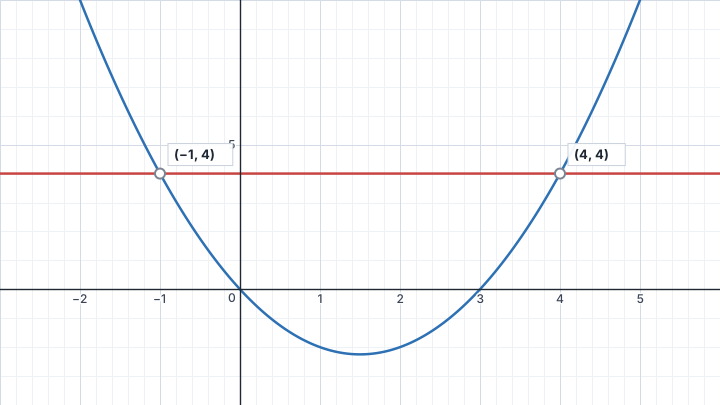
If the graph of is drawn, solve by rewriting it as and drawing the line . To solve , draw instead. Read the -values where the line crosses the curve; readings from a graph are estimates, so give them to the accuracy of the graph. The graph shows worked example 3.
Worked example 3 drawn with our Grapher: the line y = 4 crosses the curve at the two solutions.
Key formulas
Turning point of Learn it
Quadratic formula, On the formula sheet
On the formula sheet = printed on the formulae sheet in the 4MA1 Higher papers, so know where to find it. Learn it = not printed on the 4MA1 Higher formulae sheet, so learn it by heart. The whole 4MA1 formula sheet (free PDF) → · 4MA1 formulas to learn
Quadratic and Cubic Graphs worked examples
Worked example 1: Quadratic table of values
Complete a table of values for for to .
Solution
: .
: ; : ; : ; : .
The values are symmetrical about .
Answer: 0, −3, −4, −3, 0
The values are symmetrical about .
4 steps · 1 to fill in
Tip: Join the points with a smooth curve, not straight lines.
Worked example 2: Turning point of a quadratic
Find the turning point of .
Solution
Complete the square: .
Minimum at .
Answer:
3 steps
Tip: The x-coordinate changes sign from the bracket.
Worked example 3: Solving an equation with a graph
The graph of is drawn. Which line should be drawn to solve , and what are the solutions?
Solution
is , so draw .
It meets the curve where and .
Answer:;
It meets the curve where and .
3 steps · 1 to fill in
Tip: Rearrange so one side is the curve already drawn.
Play with itRoots and y-intercept: drag the sliders
Change a, p and q so that y = a(x − p)(x − q) crosses the x-axis at −1 and 3 and the y-axis at −6. Then expand your answer into the form y = ax² + bx + c.
How do I find the turning point of a quadratic graph?
Read it off the graph, or complete the square: y = (x + p)² + q has its turning point at (−p, q). It is also halfway between the roots.
What does a cubic graph look like?
y = x³ is an S-shaped curve through the origin. A cubic such as y = x³ − 3x has two turning points; with a negative x³ term the curve falls from left to right instead of rising.
Can I use a calculator for quadratic and cubic graphs in 4MA1?
Yes. A calculator may be used in all four 4MA1 papers, so both Higher papers (1H and 2H) allow one. Most marks are for the method you write down, so show your working.
How long are the 4MA1 Higher papers?
Papers 1H and 2H are 2 hours each and 100 marks each, worth 50% each. Each tier has its own formulae sheet in the exam.
Every question and worked example here is original, written for IGCSE Math Revision rather than copied from Pearson papers, and every result was re-solved independently before publishing.
Practise quadratic and cubic graphs with your progress saved
Save your answers and track your progressA free account remembers the questions you have done and brings you back to this page.
 IGCSE Math Revision