 IGCSE Math Revision
Christmas maths escape room for IGCSE and GCSE
The elves have locked the workshop, and the presents are stuck inside. Teams solve six locks in order; each code is needed for the next. Printable clue cards, a teacher answer key and a bonus lock for the fastest team.
- Level
- MYP / KS3 (ages 11 to 14)
- Time
- 41 minutes, plus a 10-minute extension
- Topics
- Number: the four operations and percentages; Perimeter; Fractions; Equations
- Equipment
- No calculator needed.
Suggested timings
| Part | Time | What |
|---|---|---|
| Starter | 5 min | Quick questions on the board |
| Main: lock 1 | 6 min | The toy shelves |
| Main: lock 2 | 6 min | The wrapping table |
| Main: lock 3 | 6 min | The reindeer pen |
| Main: lock 4 | 6 min | The cocoa machine |
| Main: lock 5 | 6 min | The sleigh bells |
| Main: lock 6 | 6 min | The workshop door |
| Extension | 10 min | Fast finishers or homework |
Starter (5 minutes)
Warm-up before the locks: quick questions on the board.
- Work out 9 × 6.
- Find half of 86.
- Work out 100 − 37.
Main activity (36 minutes)
Lock 1: The toy shelves (6 min)
The elves are counting toys.
- There are 8 shelves with 12 toys on each. How many toys are there? This is code 1.
Lock 2: The wrapping table (6 min)
Four elves share the wrapping.
- Code 1 presents are shared equally between 4 elves. How many does each elf wrap? This is code 2.
Lock 3: The reindeer pen (6 min)
The reindeer need a new fence.
- A rectangular pen is code 2 metres long and 10 metres wide. Find its perimeter in metres. This is code 3.
Lock 4: The cocoa machine (6 min)
The cocoa machine needs a number.
- Find 25% of code 3, then add 3. This is code 4.
Lock 5: The sleigh bells (6 min)
Some bells are gold.
- There are code 4 bells and 3/5 of them are gold. How many are gold? This is code 5.
Lock 6: The workshop door (6 min)
The last lock.
- Solve 3x + 6 = 4 × code 5. The value of x opens the door.
Extension (10 minutes)
Bonus lock for the fastest team.
- Find the mean of all six codes.
For teachers
Teacher notes and full worked answers
- Pitched at MYP and KS3 (ages 11 to 14). Every question works without a calculator; ask for a short method with each answer.
- How to run it: print the student sheet and cut out the six lock cards. Give each team lock 1. When a team brings you the right code, give them the next card (the answer key is in the answers PDF). The first team to open lock 6 escapes.
- Each code is used in the next lock, so check every code before the team moves on: one slip early on breaks the chain.
Starter
- 54
- 9 × 6 = 54
- 43
- 86 ÷ 2 = 43
- 63
- 100 − 37 = 63
Lock 1: The toy shelves
- 96
- 8 × 12 = 96
Lock 2: The wrapping table
- 24
- 96 ÷ 4 = 24
Lock 3: The reindeer pen
- 68
- 2 × (24 + 10) = 68
Lock 4: The cocoa machine
- 20
- 25% of 68 = 17
- 17 + 3 = 20
Lock 5: The sleigh bells
- 12
- 20 ÷ 5 = 4, and 3 × 4 = 12
Lock 6: The workshop door
- 14
- 4 × 12 = 48
- 3x + 6 = 48, so 3x = 42 and x = 14
Extension
- 39
- 96 + 24 + 68 + 20 + 12 + 14 = 234
- 234 ÷ 6 = 39
The same answers are in the answers PDF. Every answer was checked before publishing.
- Level
- IGCSE and GCSE (Higher and Extended)
- Time
- 41 minutes, plus a 10-minute extension
- Topics
- Number: speed, percentages and division; Algebra: sequences and equations; Shape and probability: volume and expected frequency
- Equipment
- No calculator needed.
Download student sheet (IGCSE / GCSE) (PDF)Answers (PDF)
Suggested timings
| Part | Time | What |
|---|---|---|
| Starter | 5 min | Quick questions on the board |
| Main: lock 1 | 6 min | The wrapping room |
| Main: lock 2 | 6 min | The list |
| Main: lock 3 | 6 min | The sleigh test |
| Main: lock 4 | 6 min | The gift box |
| Main: lock 5 | 6 min | The crackers |
| Main: lock 6 | 6 min | The workshop door |
| Extension | 10 min | Fast finishers or homework |
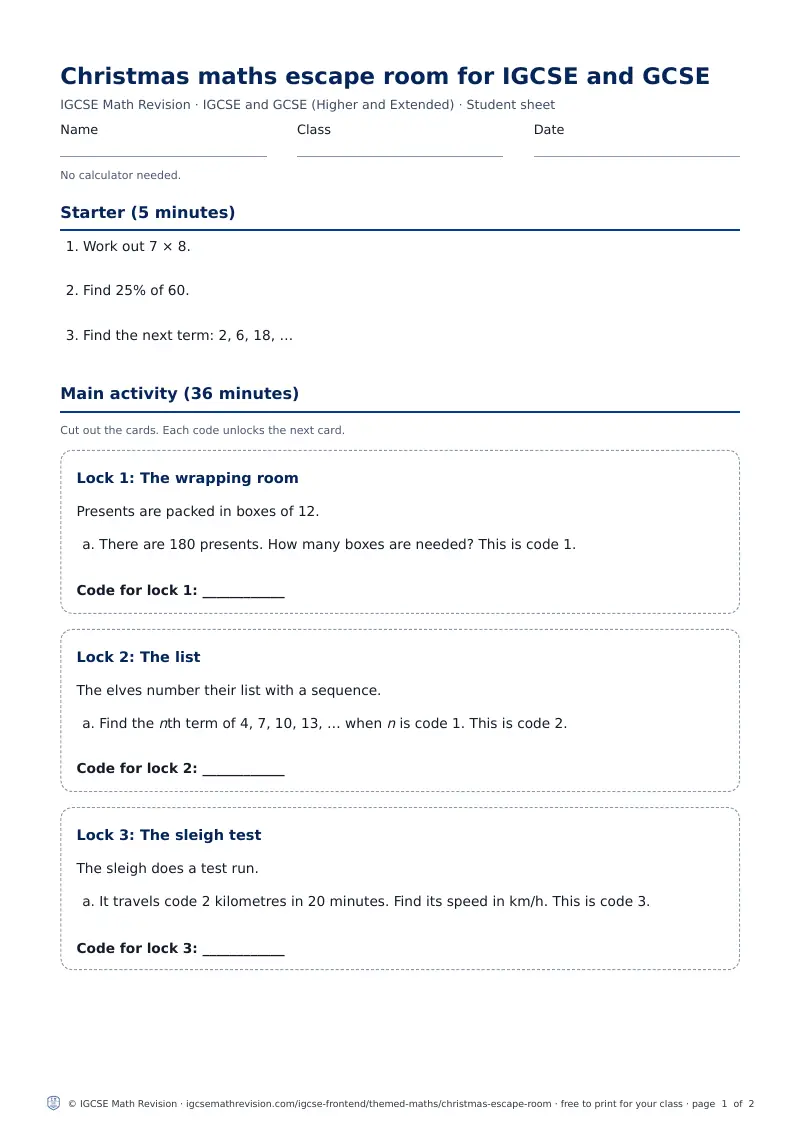
Starter (5 minutes)
Warm-up before the locks: quick questions on the board.
- Work out 7 × 8.
- Find 25% of 60.
- Find the next term: 2, 6, 18, …
Main activity (36 minutes)
Lock 1: The wrapping room (6 min)
Presents are packed in boxes of 12.
- There are 180 presents. How many boxes are needed? This is code 1.
Lock 2: The list (6 min)
The elves number their list with a sequence.
- Find the nth term of 4, 7, 10, 13, … when n is code 1. This is code 2.
Lock 3: The sleigh test (6 min)
The sleigh does a test run.
- It travels code 2 kilometres in 20 minutes. Find its speed in km/h. This is code 3.
Lock 4: The gift box (6 min)
A cuboid gift box measures 3 cm by 2 cm by h cm.
- h = code 3 ÷ 23. Find the volume of the box in cm3. This is code 4.
Lock 5: The crackers (6 min)
The probability that a cracker contains a paper hat is 5/6.
- Out of code 4 crackers, how many would you expect to contain a hat? This is code 5.
Lock 6: The workshop door (6 min)
The last lock.
- Solve 2x − 4 = code 5. The value of x opens the door.
Extension (10 minutes)
Bonus lock for the fastest team.
- Find the mean of all six codes.
For teachers
Teacher notes and full worked answers
- How to run it: print the student sheet and cut out the six lock cards. Give each team lock 1. When a team brings you the right code, give them the next card (the answer key is in the answers PDF). The first team to open lock 6 escapes. Teams can also have every card at once and race through them in order.
- Each code is used in the next lock, so check every code before the team moves on: one slip early on breaks the chain.
Starter
- 56
- 7 × 8 = 56
- 15
- 60 ÷ 4 = 15
- 54
- Each term is 3 times the last.
Lock 1: The wrapping room
- 15
- 180 ÷ 12 = 15
Lock 2: The list
- 46
- nth term = 3n + 1
- 3 × 15 + 1 = 46
Lock 3: The sleigh test
- 138
- 20 minutes is 1/3 of an hour.
- 46 × 3 = 138 km/h
Lock 4: The gift box
- 36
- h = 138 ÷ 23 = 6
- 3 × 2 × 6 = 36
Lock 5: The crackers
- 30
- 5/6 × 36 = 30
Lock 6: The workshop door
- 17
- 2x = 34
- x = 17
Extension
- 47
- 15 + 46 + 138 + 36 + 30 + 17 = 282
- 282 ÷ 6 = 47
The same answers are in the answers PDF. Every answer was checked before publishing.
- Level
- IB Maths SL and HL (AA and AI)
- Time
- 41 minutes, plus a 10-minute extension
- Topics
- Exponents and logarithms; Sequences and series; The binomial theorem; Differentiation
- Equipment
- No GDC needed.
Suggested timings
| Part | Time | What |
|---|---|---|
| Starter | 5 min | Quick questions on the board |
| Main: lock 1 | 6 min | The wrapping room |
| Main: lock 2 | 6 min | The list |
| Main: lock 3 | 6 min | The lights |
| Main: lock 4 | 6 min | The power lock |
| Main: lock 5 | 6 min | The cracker |
| Main: lock 6 | 6 min | The workshop door |
| Extension | 10 min | Fast finishers or homework |
Starter (5 minutes)
Warm-up before the locks: quick questions on the board.
- Evaluate 210.
- Evaluate log10 1000.
- Differentiate 5x2.
Main activity (36 minutes)
Lock 1: The wrapping room (6 min)
The first lock shows a logarithm.
- Solve log2 x = 5. This is code 1.
Lock 2: The list (6 min)
An arithmetic sequence has u1 = 3 and d = 4.
- Find un when n = code 1 ÷ 4. This is code 2.
Lock 3: The lights (6 min)
A string of lights doubles: 1, 2, 4, 8, …
- Find the sum of the first n terms, where n = (code 2 + 9) ÷ 4. This is code 3.
Lock 4: The power lock (6 min)
The lock asks for a power of 2.
- Code 3 + 1 = 2k. Find k. This is code 4.
Lock 5: The cracker (6 min)
Inside the cracker is a binomial expansion.
- Find the coefficient of x2 in (1 + x)n, where n = code 4. This is code 5.
Lock 6: The workshop door (6 min)
The last lock.
- f(x) = x3. Find f′(a), where a > 0 and a2 = code 5 − 9. It opens the door.
Extension (10 minutes)
Bonus lock for the fastest team.
- Three presents are opened. Each one, independently, is a book with probability 1/4. Find the probability that at least one is a book.
For teachers
Teacher notes and full worked answers
- How to run it: print the student sheet and cut out the six lock cards. Give each team lock 1. When a team brings you the right code, give them the next card (the answer key is in the answers PDF). The first team to open lock 6 escapes. Teams can also have every card at once and race through them in order.
- Each code is used in the next lock, so check every code before the team moves on: one slip early on breaks the chain.
Starter
- 1024
- 210 = 1024
- 3
- 103 = 1000
- 10x
- Multiply by the power and reduce it by 1.
Lock 1: The wrapping room
- 32
- x = 25 = 32
Lock 2: The list
- 31
- n = 8
- u8 = 3 + 7 × 4 = 31
Lock 3: The lights
- 1023
- n = 10
- S10 = (210 − 1)/(2 − 1) = 1023
Lock 4: The power lock
- 10
- 1024 = 210
Lock 5: The cracker
- 45
- 10C2 = 45
Lock 6: The workshop door
- 108
- a2 = 36, so a = 6
- f′(x) = 3x2, so f′(6) = 108
Extension
- 37/64
- 1 − (3/4)3 = 1 − 27/64 = 37/64
The same answers are in the answers PDF. Every answer was checked before publishing.
- Level
- IB HL and A Level Further Maths (no calculator)
- Time
- 41 minutes, plus a 10-minute extension
- Topics
- Series and the binomial theorem; Complex numbers; Integration; Binomial distribution
- Equipment
- No calculator needed: every code is a whole number.
Suggested timings
| Part | Time | What |
|---|---|---|
| Starter | 5 min | Quick questions on the board |
| Main: lock 1 | 6 min | The sorting machine |
| Main: lock 2 | 6 min | The complex cracker |
| Main: lock 3 | 6 min | The endless tinsel |
| Main: lock 4 | 6 min | The elf integral |
| Main: lock 5 | 6 min | The sack of crackers |
| Main: lock 6 | 6 min | The workshop door |
| Extension | 10 min | Fast finishers or homework |
Starter (5 minutes)
Warm-up before the locks: quick questions on the board.
- Find |4 + 3i|.
- Find 6C2.
- Find the gradient of y = x3 at x = 2.
Main activity (36 minutes)
Lock 1: The sorting machine (6 min)
Presents go through the machine in numbered batches.
- Find the sum of the whole numbers from 1 to 15. This is code 1.
Lock 2: The complex cracker (6 min)
Inside the cracker is a complex number.
- z = a + 5i, where a = code 1 ÷ 10. Find |z|. This is code 2.
Lock 3: The endless tinsel (6 min)
Each strand of tinsel is 3/4 as long as the one before.
- The first strand is code 2 metres long. Find the total length of all the strands, going on for ever. This is code 3.
Lock 4: The elf integral (6 min)
The elves set an integral.
- Let k = √(code 3 − 3). Find ∫0k 2x dx. This is code 4.
Lock 5: The sack of crackers (6 min)
Each cracker has a joke inside with probability 1/7.
- X ~ B(n, 1/7) where n = code 4. Find Var(X). This is code 5.
Lock 6: The workshop door (6 min)
The last lock.
- The door opens with the coefficient of x2 in the expansion of (1 + x)n, where n = code 5.
Extension (10 minutes)
Bonus lock for the fastest team.
- Add up all six codes and write the total in binary. What do you notice?
For teachers
Teacher notes and full worked answers
- For IB HL and A Level Further Maths classes. Every answer is exact and the whole set works without a calculator.
- How to run it: print the student sheet and cut out the six lock cards. Give each team lock 1. When a team brings you the right code, give them the next card (the answer key is in the answers PDF). The first team to open lock 6 escapes.
- Each code is used in the next lock, so check every code before the team moves on: one slip early on breaks the chain.
Starter
- 5
- √(16 + 9) = 5
- 15
- 6 × 5 ÷ 2 = 15
- 12
- dy/dx = 3x2 = 12
Lock 1: The sorting machine
- 120
- 15 × 16 ÷ 2 = 120
Lock 2: The complex cracker
- 13
- a = 12, so |z| = √(144 + 25) = 13
Lock 3: The endless tinsel
- 52
- Sum to infinity = 13 ÷ (1 − 3/4) = 13 × 4 = 52
Lock 4: The elf integral
- 49
- k = √49 = 7
- [x2] from 0 to 7 = 49
Lock 5: The sack of crackers
- 6
- Var(X) = np(1 − p) = 49 × 1/7 × 6/7 = 6
Lock 6: The workshop door
- 15
- 6C2 = 15
Extension
- 255 = 11111111 in binary
- 120 + 13 + 52 + 49 + 6 + 15 = 255
- 255 = 28 − 1 = 11111111 in binary: eight 1s.
The same answers are in the answers PDF. Every answer was checked before publishing.
- Level
- Beyond school: for adults and maths fans
- Time
- 41 minutes, plus a 10-minute extension
- Topics
- Number theory; Counting; Sequences
- Equipment
- No calculator needed: every code is a whole number.
Suggested timings
| Part | Time | What |
|---|---|---|
| Starter | 5 min | Quick questions on the board |
| Main: lock 1 | 6 min | The stocking count |
| Main: lock 2 | 6 min | The elf handshakes |
| Main: lock 3 | 6 min | The base-5 lock |
| Main: lock 4 | 6 min | The snowflake |
| Main: lock 5 | 6 min | The remainder |
| Main: lock 6 | 6 min | The workshop door |
| Extension | 10 min | Fast finishers or homework |
Starter (5 minutes)
Warm-up before the locks: quick questions on the board.
- What is 210?
- How many prime numbers are there below 30?
- What is 112?
Main activity (36 minutes)
Lock 1: The stocking count (6 min)
Stockings hang in a rectangle.
- How many positive divisors does 360 have? This is code 1.
Lock 2: The elf handshakes (6 min)
The elves greet each other.
- Code 1 elves each shake hands once with every other elf. How many handshakes are there? This is code 2.
Lock 3: The base-5 lock (6 min)
The lock only reads base 5.
- Write code 2 in base 5 and add up its digits. This is code 3.
Lock 4: The snowflake (6 min)
A snowflake curve starts as an equilateral triangle with perimeter 3. Each step replaces every edge with 4 edges a third as long.
- After code 3 steps the perimeter is p/q in lowest terms. Code 4 is p − q.
Lock 5: The remainder (6 min)
One more step.
- Find the remainder when code 4 is divided by 24. This is code 5.
Lock 6: The workshop door (6 min)
The last lock.
- The door opens with the number of ways to write code 5 as an ordered sum of 1s and 2s.
Extension (10 minutes)
Bonus lock for the fastest team.
- Find the smallest whole number bigger than 1 that leaves remainder 1 when divided by each of 2, 3, 4, 5 and 6.
For teachers
Teacher notes and full worked answers
- A stretch set for anyone past school maths: adults, maths clubs and keen sixth-formers. Competition style, no calculator, every answer exact.
- How to run it: print the student sheet and cut out the six lock cards. Give each team lock 1. When a team brings you the right code, give them the next card (the answer key is in the answers PDF). The first team to open lock 6 escapes.
- Each code is used in the next lock, so check every code before the team moves on: one slip early on breaks the chain.
Starter
- 1024
- 210 = 1024
- 10
- 2, 3, 5, 7, 11, 13, 17, 19, 23, 29
- 121
- 11 × 11 = 121
Lock 1: The stocking count
- 24
- 360 = 23 × 32 × 5
- (3 + 1)(2 + 1)(1 + 1) = 24
Lock 2: The elf handshakes
- 276
- 24C2 = 24 × 23 ÷ 2 = 276
Lock 3: The base-5 lock
- 4
- 276 = 2 × 125 + 1 × 25 + 0 × 5 + 1, so it is 2101 in base 5.
- 2 + 1 + 0 + 1 = 4
Lock 4: The snowflake
- 229
- Each step multiplies the perimeter by 4/3: 3 × (4/3)4 = 256/27.
- 256 − 27 = 229
Lock 5: The remainder
- 13
- 229 = 9 × 24 + 13
Lock 6: The workshop door
- 377
- The number of ways for n is the (n + 1)th Fibonacci number.
- For 13: 1, 2, 3, 5, 8, 13, 21, 34, 55, 89, 144, 233, 377
Extension
- 61
- It is 1 more than a multiple of LCM(2, 3, 4, 5, 6) = 60.
The same answers are in the answers PDF. Every answer was checked before publishing.
Practise the topics
Ada Lovelace Day maths · e Day maths · Valentine’s Day maths · All themed maths
More for lessons: Weekly starters · Skill Builders · Worksheet builder · Competition maths