 IGCSE Math Revision
Bonfire Night maths activities for IGCSE and GCSE
A ready-to-teach lesson for the week of 5 November: a 5-minute starter, a 35-minute main activity, an extension and full worked answers. It practises quadratics, sequences and cones.
- Level
- MYP / KS3 (ages 11 to 14)
- Time
- 35 minutes, plus a 10-minute extension
- Topics
- Substitution into formulae; Sequences; Speed, distance and time; Angles and circles
- Equipment
- No calculator needed. Use π = 22/7 where a question says so.
Suggested timings
| Part | Time | What |
|---|---|---|
| Starter | 5 min | Quick questions on the board |
| Main: task A | 15 min | Flash and bang |
| Main: task B | 15 min | Bonfire geometry |
| Extension | 10 min | Fast finishers or homework |
Starter (5 minutes)
Quick-fire, no calculator. Show one at a time or all four on the board.
- How many days are there from 5 November to 25 December?
- A rocket’s height is h = 20t − 5t2 metres after t seconds. Find h when t = 2.
- Write down the next two terms: 5, 11, 17, 23, …
- Sparklers come in packs of 12. How many packs are needed for 100 sparklers?
Main activity (30 minutes)
Task A: Flash and bang (15 min)
You see a firework burst, then hear the bang a moment later. Take the speed of sound to be 340 m/s.
- The bang arrives 3 seconds after the flash. How far away is the firework?
- Another firework is 1.7 km away. How long does its bang take to reach you?
- A rocket climbs 150 m in 5 seconds. Find its average speed.
Task B: Bonfire geometry (15 min)
The bonfire is built in a field with a circular safety zone around it.
- From the side, the bonfire is an isosceles triangle with a 40° angle at the top. Find each base angle.
- Another triangle has angles of 35° and 85°. Find the third angle.
- The safety zone is a circle of radius 14 m. Taking π = 22/7, find its area.
- Spectators stand round the edge of the safety zone, 2 m apart. Taking π = 22/7, how many can stand round it?
Extension (10 minutes)
For fast finishers, or as homework.
- Rockets cost £4 and Roman candles cost £6. Sam spends exactly £50 and buys at least one of each. In how many different ways can Sam do this?
For teachers
Teacher notes and full worked answers
- Pitched at MYP and KS3 (ages 11 to 14). Every question works without a calculator; ask for a short method with each answer.
- Task A is a good moment to talk about why light arrives almost at once while sound takes seconds.
Starter
- 50 days
- 5 November to 30 November is 25 days.
- Then 25 more days to 25 December: 25 + 25 = 50
- 20 m
- 20 × 2 − 5 × 4 = 40 − 20 = 20
- 29 and 35
- The terms go up by 6.
- 9 packs
- 8 packs give only 96, so 9 packs are needed.
Task A: Flash and bang
- 1020 m
- 340 × 3 = 1020
- 5 seconds
- 1.7 km = 1700 m
- 1700 ÷ 340 = 5
- 30 m/s
- 150 ÷ 5 = 30
Task B: Bonfire geometry
- 70°
- (180 − 40) ÷ 2 = 70
- 60°
- 180 − 35 − 85 = 60
- 616 m2
- 22/7 × 14 × 14 = 616
- 44 people
- Circumference = 2 × 22/7 × 14 = 88 m
- 88 ÷ 2 = 44
Extension
- 4 ways
- 4r + 6c = 50, so 2r + 3c = 25 and c must be odd.
- c = 1, 3, 5, 7 with r = 11, 8, 5, 2
The same answers are in the answers PDF. Every answer was checked before publishing.
- Level
- IGCSE and GCSE (Higher and Extended)
- Time
- 40 minutes, plus a 10-minute extension
- Topics
- Quadratic graphs and completing the square; Linear and quadratic sequences; Exponential patterns; Volume and surface area of a cone
- Equipment
- The starter is non-calculator. A calculator helps with the cone task.
Download student sheet (IGCSE / GCSE) (PDF)Answers (PDF)
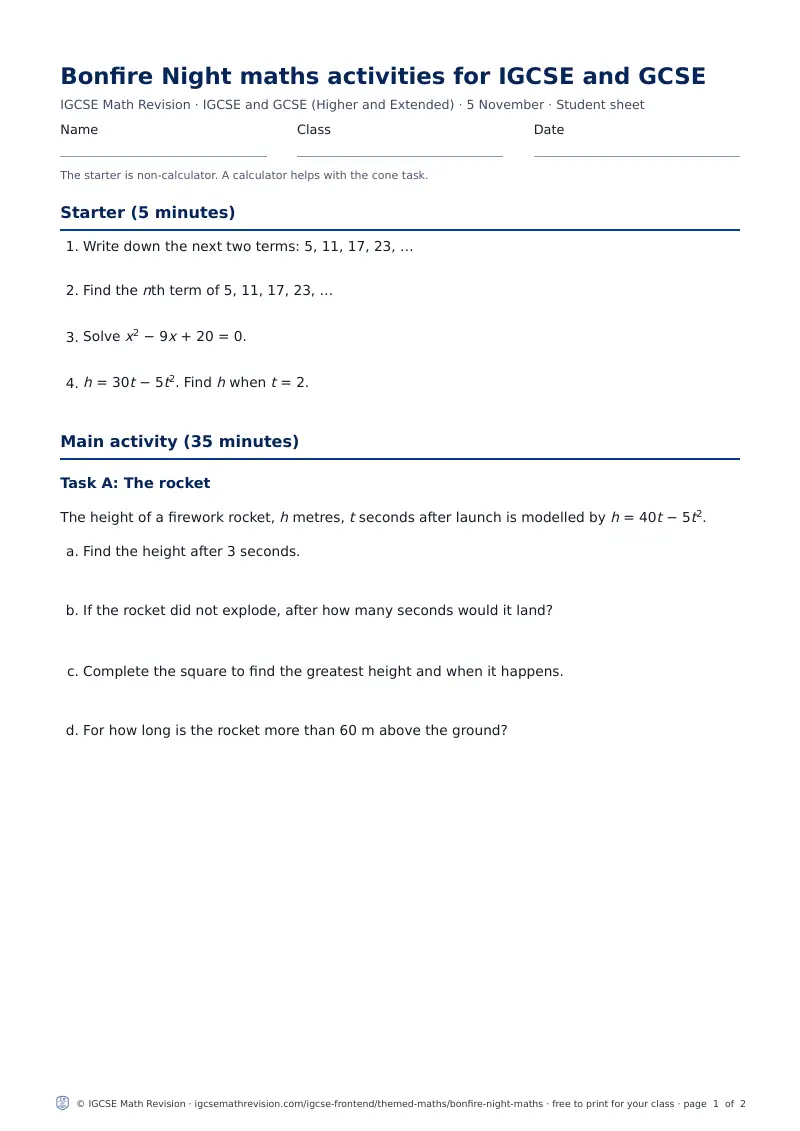
Suggested timings
| Part | Time | What |
|---|---|---|
| Starter | 5 min | Quick questions on the board |
| Main: task A | 12 min | The rocket |
| Main: task B | 12 min | Remember, remember: sparkler patterns |
| Main: task C | 11 min | The bonfire |
| Extension | 10 min | Fast finishers or homework |
Starter (5 minutes)
No calculator.
- Write down the next two terms: 5, 11, 17, 23, …
- Find the nth term of 5, 11, 17, 23, …
- Solve x2 − 9x + 20 = 0.
- h = 30t − 5t2. Find h when t = 2.
Main activity (35 minutes)
Task A: The rocket (12 min)
The height of a firework rocket, h metres, t seconds after launch is modelled by h = 40t − 5t2.
- Find the height after 3 seconds.
- If the rocket did not explode, after how many seconds would it land?
- Complete the square to find the greatest height and when it happens.
- For how long is the rocket more than 60 m above the ground?
Task B: Remember, remember: sparkler patterns (12 min)
Pattern 1 uses 5 sparklers, pattern 2 uses 9 and pattern 3 uses 13.
- Find the nth term for the number of sparklers.
- How many sparklers are in pattern 50?
- Can a pattern use exactly 100 sparklers? Explain.
- In a firework display, the numbers of stars in each burst are 3, 8, 15, 24, 35, … Find the next term and the nth term.
- Which burst has 168 stars?
Task C: The bonfire (11 min)
A bonfire is built as a cone with base radius 1.5 m and height 2 m. Volume of a cone = 1⁄3πr2h; curved surface area = πrl.
- Find the volume of the bonfire, to 3 significant figures.
- Find the slant height and the curved surface area, to 3 significant figures.
Extension (10 minutes)
Two rockets.
- A second rocket is launched 1 second after the first. Its height is h = 50(t − 1) − 5(t − 1)2, where t is the time since the first launch. When are the two rockets at the same height, and how high are they? Give the height to 3 significant figures.
For teachers
Teacher notes and full worked answers
- Enjoy fireworks at an organised display; this pack is about the maths only.
- In the rocket task, ask why t = 0 is also a solution of h = 0 and what it means.
- For the quadratic sequence, students often halve the first difference instead of the second difference.
Starter
- 29, 35
- The terms go up by 6 each time.
- 6n − 1
- The difference is 6, so start with 6n. The first term is 5 = 6 − 1, so 6n − 1.
- x = 4 or 5
- (x − 4)(x − 5) = 0
- 40
- 60 − 20 = 40
Task A: The rocket
- 75 m
- 40 × 3 − 5 × 9 = 120 − 45 = 75
- 8 seconds
- 40t − 5t2 = 0 gives 5t(8 − t) = 0, so t = 0 or 8.
- 80 m after 4 seconds
- −5(t2 − 8t) = −5[(t − 4)2 − 16] = 80 − 5(t − 4)2.
- The greatest value is 80, when t = 4.
- 4 seconds
- 40t − 5t2 = 60 gives t2 − 8t + 12 = 0, so (t − 2)(t − 6) = 0.
- It is above 60 m from t = 2 to t = 6: 4 seconds.
Task B: Remember, remember: sparkler patterns
- 4n + 1
- The difference is 4 and 5 = 4 + 1.
- 201
- 4 × 50 + 1 = 201
- No
- 4n + 1 = 100 gives n = 24.75, which is not a whole number.
- 48; n2 + 2n
- First differences 5, 7, 9, 11; second difference 2, so start with n2.
- Subtract n2: 2, 4, 6, 8, 10, which is 2n. So n2 + 2n.
- Next term: 62 + 12 = 48.
- The 12th
- n2 + 2n = 168 gives (n + 14)(n − 12) = 0, so n = 12.
Task C: The bonfire
- 4.71 m3
- 1⁄3 × π × 1.52 × 2 = 1.5π = 4.712…
- 2.5 m; 11.8 m2
- l = √(1.52 + 22) = √6.25 = 2.5
- π × 1.5 × 2.5 = 3.75π = 11.78…
Extension
- t = 2.75 s, at 72.2 m
- Expand: 50t − 50 − 5t2 + 10t − 5 = 60t − 55 − 5t2.
- Set equal to 40t − 5t2: the t2 terms cancel, so 20t = 55 and t = 2.75.
- Height = 40 × 2.75 − 5 × 2.752 = 72.1875, so 72.2 m.
The same answers are in the answers PDF. Every answer was checked before publishing.
- Level
- A Level Maths (Year 12 and Year 13)
- Time
- 40 minutes, plus a 10-minute extension
- Topics
- Projectiles (Year 13 mechanics); Constant and variable acceleration; Arithmetic and geometric series
- Equipment
- The starter is non-calculator. A calculator is needed for the main activity. Take g = 9.8 m s−2.
Suggested timings
| Part | Time | What |
|---|---|---|
| Starter | 5 min | Quick questions on the board |
| Main: task A | 14 min | The firework projectile |
| Main: task B | 8 min | The rocket motor (Year 13) |
| Main: task C | 13 min | Remember, remember: series |
| Extension | 10 min | Fast finishers or homework |
Starter (5 minutes)
No calculator.
- Find the sum of the first 10 terms of 3, 7, 11, …
- Find the sum to infinity of 8 + 4 + 2 + …
- A spark is thrown straight up at 14 m s−1. How long does it take to reach its highest point? (g = 9.8 m s−2)
- Solve 4.9t2 − 19.6t = 0.
Main activity (35 minutes)
Task A: The firework projectile (14 min)
A firework is launched from ground level at 35 m s−1 at 60° above the horizontal. Model it as a particle moving freely under gravity.
- Find the time to reach the highest point and the greatest height, each to 3 significant figures.
- The firework explodes at its highest point. How far has it travelled horizontally? Give 3 significant figures.
- If it did not explode, how far from the launch point would it land? Give 3 significant figures.
- For how long is the firework at least 30 m above the ground? Give 3 significant figures.
Task B: The rocket motor (Year 13) (8 min)
A rocket rises vertically from the ground. Its velocity is v = 24t − 3t2 m s−1 for 0 ≤ t ≤ 8.
- Find when the acceleration is zero, and the greatest velocity.
- Find the height of the rocket when t = 8.
Task C: Remember, remember: series (13 min)
A display fires 5 fireworks in the first minute, 8 in the second, 11 in the third, and so on.
- How many fireworks are fired in the 20th minute, and in the first 20 minutes altogether?
- The display has 1000 fireworks. After how many whole minutes have they all been fired?
- On 5 November one person shares a photo with 5 friends. The next day each of them shares it with 5 new people, and so on. How many people (not counting the first) have received it after 5 rounds?
- After how many rounds have more than one million people received it?
Extension (10 minutes)
Projectiles from a height.
- Show that the path of the firework in task A is y = √3x − (2/125)x2.
- The same firework is launched from the top of a 20 m high hill, at the same speed and angle. How long is it in the air, and how far away horizontally does it land? Give 3 significant figures.
For teachers
Teacher notes and full worked answers
- Enjoy fireworks at an organised display; this pack is about the maths only.
- Keep exact values (35 sin 60° = 35√3/2) until the last line: early rounding changes the third significant figure in A (d).
- Ask the class what the model ignores (air resistance, the rocket’s own thrust) and how each would change the answers.
Starter
- 210
- S10 = 10/2 × (2 × 3 + 9 × 4) = 5 × 42 = 210
- 16
- a = 8, r = ½: 8 ÷ (1 − ½) = 16
- 10/7 s ≈ 1.43 s
- v = u − gt = 0 gives t = 14 ÷ 9.8 = 10/7.
- t = 0 or 4
- 4.9t(t − 4) = 0
Task A: The firework projectile
- 3.09 s; 46.9 m
- Vertical: u = 35 sin 60° = 30.31… m s−1.
- Time to the top: 30.31 ÷ 9.8 = 3.09 s.
- Height: (35 sin 60°)2 ÷ (2 × 9.8) = 918.75 ÷ 19.6 = 46.875, so 46.9 m.
- 54.1 m
- Horizontal speed: 35 cos 60° = 17.5 m s−1.
- 17.5 × 3.0929… = 54.13 m
- 108 m
- Flight time is twice the time to the top: 6.186 s.
- 17.5 × 6.186 = 108.25…, so 108 m.
- 3.71 s
- 30.311t − 4.9t2 = 30 gives 4.9t2 − 30.311t + 30 = 0.
- t = 1.237 or 4.949.
- Time above 30 m = 4.949 − 1.237 = 3.71 s
Task B: The rocket motor (Year 13)
- t = 4; 48 m s−1
- a = dv/dt = 24 − 6t = 0 when t = 4.
- v(4) = 96 − 48 = 48
- 256 m
- ∫08 (24t − 3t2) dt = [12t2 − t3]08 = 768 − 512 = 256
Task C: Remember, remember: series
- 62; 670
- u20 = 5 + 19 × 3 = 62
- S20 = 20/2 × (5 + 62) = 670
- 25 minutes
- n/2 × (10 + 3(n − 1)) ≥ 1000 gives 3n2 + 7n − 2000 ≥ 0.
- n ≥ (−7 + √24 049) ÷ 6 = 24.68…
- So 25 minutes (S24 = 948 is not enough).
- 3905
- Σr=15 5r = 5(55 − 1) ÷ 4 = 5 × 3124 ÷ 4 = 3905
- 9 rounds
- 5(5n − 1) ÷ 4 > 1 000 000 gives 5n > 800 001.
- n > log 800 001 ÷ log 5 = 8.45…, so 9 rounds.
Extension
- y = √3x − (2/125)x2
- x = 17.5t, so t = x ÷ 17.5.
- y = 30.31t − 4.9t2 = (35 sin 60° ÷ 17.5)x − 4.9x2 ÷ 306.25.
- 35 sin 60° ÷ 17.5 = √3 and 4.9 ÷ 306.25 = 0.016 = 2/125.
- 6.79 s; 119 m
- −20 = 30.311t − 4.9t2 gives 4.9t2 − 30.311t − 20 = 0.
- t = (30.311 + √(918.75 + 392)) ÷ 9.8 = 6.787…
- 17.5 × 6.787 = 118.8, so 119 m.
The same answers are in the answers PDF. Every answer was checked before publishing.
- Level
- IB HL and A Level Further Maths (no calculator)
- Time
- 35 minutes, plus a 10-minute extension
- Topics
- Differential equations: first order, linear; Kinematics with vectors; Proof by induction and series
- Equipment
- No calculator needed: every answer is exact.
Suggested timings
| Part | Time | What |
|---|---|---|
| Starter | 5 min | Quick questions on the board |
| Main: task A | 15 min | Rocket with drag |
| Main: task B | 15 min | Catherine wheel |
| Extension | 10 min | Fast finishers or homework |
Starter (5 minutes)
Quick-fire, no calculator. Show one at a time or all four on the board.
- A rocket’s velocity is 3i + 4j m/s. Find its speed.
- Solve dy/dt = −2y with y = 5 at t = 0, and find y when t = ln 2.
- Find the sum to infinity of 1 + 1/3 + 1/9 + …
- Find the coefficient of x2 in the expansion of (1 + x)−1.
Main activity (30 minutes)
Task A: Rocket with drag (15 min)
After its fuel runs out, a rocket’s upward velocity v m/s satisfies dv/dt = −10 − v/5, with v = 50 when t = 0.
- Solve the equation to show that v = 100e−t/5 − 50. Find v when t = 5 ln(5/4).
- Find the exact time at which the rocket stops rising.
- Find the height it gains from the moment the fuel runs out until it stops rising, in the form a − b ln 2.
Task B: Catherine wheel (15 min)
A spark on the rim of a Catherine wheel has position r = 3 cos t i + 3 sin t j metres at time t seconds.
- Find the speed of the spark.
- Find the magnitude of its acceleration.
- At t = π/2 a spark flies off and moves in a straight line with the velocity it had at that moment. Where is it 1 second later?
Extension (10 minutes)
For fast finishers, or as homework.
- Prove by induction that 1 × 2 + 2 × 3 + … + n(n + 1) = n(n + 1)(n + 2)/3. Use it to find 1 × 2 + 2 × 3 + … + 10 × 11.
For teachers
Teacher notes and full worked answers
- For IB HL and A Level Further Maths classes. Every answer is exact and the whole set works without a calculator.
- In task A, compare with no air resistance (dv/dt = −10): the rocket would rise for 5 s and gain 125 m.
Starter
- 5 m/s
- √(9 + 16) = 5
- 5/4
- y = 5e−2t
- At t = ln 2: 5e−2 ln 2 = 5/4
- 3/2
- 1/(1 − 1/3) = 3/2
- 1
- (1 + x)−1 = 1 − x + x2 − …
Task A: Rocket with drag
- 30 m/s
- Integrating factor et/5: d(vet/5)/dt = −10et/5, so vet/5 = −50et/5 + C, and C = 100.
- At t = 5 ln(5/4), e−t/5 = 4/5: v = 80 − 50 = 30
- t = 5 ln 2 s
- v = 0 when e−t/5 = 1/2
- t = 5 ln 2
- 250 − 250 ln 2 m
- ∫05 ln 2 (100e−t/5 − 50) dt = [−500e−t/5 − 50t]
- = (−250 − 250 ln 2) − (−500) = 250 − 250 ln 2
Task B: Catherine wheel
- 3 m/s
- v = −3 sin t i + 3 cos t j, with |v| = 3
- 3 m/s2
- a = −3 cos t i − 3 sin t j, with |a| = 3
- (−3, 3)
- At t = π/2 it is at (0, 3) with velocity (−3, 0).
- One second later it is at (0 − 3, 3) = (−3, 3)
Extension
- 440
- Inductive step: k(k + 1)(k + 2)/3 + (k + 1)(k + 2) = (k + 1)(k + 2)(k + 3)/3.
- n = 10: 10 × 11 × 12 ÷ 3 = 440
The same answers are in the answers PDF. Every answer was checked before publishing.
- Level
- Beyond school: for adults and maths fans
- Time
- 35 minutes, plus a 10-minute extension
- Topics
- Optimisation; Probability; Combinatorics and geometry
- Equipment
- No calculator needed. Every answer works out exactly. Take g = 10 m/s2.
Suggested timings
| Part | Time | What |
|---|---|---|
| Starter | 5 min | Quick questions on the board |
| Main: task A | 15 min | The best launch angle |
| Main: task B | 15 min | Sparkler probability |
| Extension | 10 min | Fast finishers or homework |
Starter (5 minutes)
Quick-fire, no calculator. Show one at a time or all four on the board.
- In how many orders can 3 identical rockets and 2 identical Roman candles be launched?
- A firework bursts into a sphere of sparks of radius 30 m. Find the ratio of its surface area to its volume.
- What is the 12th term of 1, 1, 2, 3, 5, …?
- What is the remainder when 511 is divided by 7?
Main activity (30 minutes)
Task A: The best launch angle (15 min)
A firework is launched from the ground at speed u at angle θ above the horizontal. With no air resistance its range is R = u2 sin 2θ / g.
- Which angle θ between 0° and 90° gives the greatest range?
- With u = 20 m/s, find the greatest range.
- Find the two launch angles that give a range of 20 m.
Task B: Sparkler probability (15 min)
A box holds 10 sparklers, and 2 of them are duds.
- Three sparklers are taken at random. What is the probability that none is a dud?
- All 10 are lit one at a time in a random order. What is the probability that the two duds are lit one straight after the other?
- On average, how many good sparklers are lit before the first dud?
Extension (10 minutes)
For fast finishers, or as homework.
- Fireworks stand at the 8 corners of a cube with edges of 1 m. How many different distances are there between pairs of fireworks, and what is the sum of the squares of all 28 distances?
For teachers
Teacher notes and full worked answers
- A stretch set for anyone past school maths: adults, maths clubs and keen sixth-formers. Competition style, no calculator, every answer exact.
- Task B’s last part has a neat symmetry argument; ask solvers to explain it before checking with a sum.
Starter
- 10
- Choose the 2 places for the Roman candles out of 5: 5C2 = 10
- 1/10 (per metre)
- 4πr2 ÷ (4πr3/3) = 3/r = 3/30 = 1/10
- 144
- 1, 1, 2, 3, 5, 8, 13, 21, 34, 55, 89, 144
- 3
- 56 leaves remainder 1, so 511 leaves the same as 55.
- 52 → 4, 54 → 2, 55 → 10 → 3
Task A: The best launch angle
- 45°
- sin 2θ is greatest (1) when 2θ = 90°.
- 40 m
- 400 × 1 ÷ 10 = 40
- 15° and 75°
- sin 2θ = 20 × 10 ÷ 400 = 1/2
- 2θ = 30° or 150°, so θ = 15° or 75°
Task B: Sparkler probability
- 7/15
- 8C3 ÷ 10C3 = 56/120 = 7/15
- 1/5
- The duds take 2 of the 10 places: 10C2 = 45 choices, 9 of them next to each other.
- 9/45 = 1/5
- 8/3
- Each good sparkler comes before both duds with probability 1/3 (it is equally likely to be first, second or third of the three).
- 8 × 1/3 = 8/3
Extension
- 3 different distances; the squares add to 48
- Distances: 1 (12 edges), √2 (12 face diagonals), √3 (4 space diagonals).
- 12 × 1 + 12 × 2 + 4 × 3 = 48
The same answers are in the answers PDF. Every answer was checked before publishing.
Practise the topics
e Day maths · Valentine’s Day maths · Pi Day maths · All themed maths
More for lessons: Weekly starters · Skill Builders · Worksheet builder · Competition maths